




Abstract
This Scientometric study aimed to provide state-of-the-art information on research growth and trends, areas of potential growth and development in genomics in India, and identify the key players (organizations or institutions, and funding agencies). It was found that the number of publications and citations related to genomics research has been steadily increasing over the years, indicating a growing interest and investment in the field as the Indian Council of Agricultural Research was the leading contributor to the field. Among the 159 contributing countries from 2012 to 2021, India contributed 4.46% of publications. The Department of Biotechnology (Ministry of Science and Technology, India) provided the most funds for genomics research. In the last decade, research was primarily focused on “Genetic Diversity,” “Polymorphism,” “Comparative Genomics,” “Phylogeny,” “ Random amplification of polymorphic DNA (RAPD),” “Single nucleotide polymorphism (SNP),” “Polymerase chain reaction (PCR),” “Gene Expression,” etc. The study's findings may shed light on the strengths and weaknesses of the country's research infrastructure, as well as the effectiveness of government policies and funding mechanisms.
Introduction
Over the years, Genomics science has emerged as a strategic research area within the biological sciences. It is a branch of biology that combines genetics, molecular biology, and bioinformatics to understand the structure and function of genomes and their interactions. Genomics science has applications in many areas, including disease diagnosis, drug development, and agricultural research. It has also been used to understand the evolution of species and the genetic basis of adaptation. Genomics science is an essential field of scientific research that has the potential to revolutionize health care and medicine. It involves the study of the structure, function, and interactions of an organism's genetic material. It can be used to identify and characterize disease-causing genes and develop new treatment strategies and personalized medicine. Genomics science has already been used to develop treatments for cancer, heart disease, and other serious illnesses, and its potential applications are only beginning to be explored. 1,2 In addition, genomics science can be used to gain a better understanding of how the environment affects health and how to improve public health. 3,4
In India, genomics science plays a significant role in health care, agriculture, and biodiversity conservation. This is also important for global health, as that can reduce global health inequalities by providing developing countries with efficient, cost-effective, and robust means of preventing, diagnosing, and treating major diseases. 5,6 To increase diversity in genomic studies, it is essential to ensure that research is conducted in a variety of populations, including countries like India, which have large populations. This will allow for more personalized and targeted treatments and a better understanding of the underlying mechanisms of diseases.
Theoretical background and previous research
The field of genomics has proliferated in the past two decades, although there needs to be more focus on examining its growth trends and impact through scientometric tools. It allows researchers to measure and evaluate various aspects of scientific research, such as the number of publications, citations, collaborations, and impact. Since the last five decades, it is a primary tool for researchers and policy makers for evaluation of research impacts and performances.
Several scientometric studies of the trends and evolution of different research fields have been carried out time to time. To evaluate the research growth trends and performances, several studies have investigated different aspects of scientific performance, including the number of publications, citations, keywords occurrences, collaborations, trending research themes, research funding, etc. 7 –17 Studies were carried out in the field of drugs and epigenetic molecular functions, 18 human microbiome, evolutionary robotics and astrobiology, 19 evolution of experimental physics, 20 translational medicine research, 10 emergence of synthetic biology, 21 Sensor Research, 22 quantum computing, 23 and applied sciences. 20
These study findings suggest the empirical properties of the evolution of the research fields. Many researchers argued that Citations are increasingly used as performance indicators within the research system, and scientists with high reputations and many citations will attract more scientific opportunities (e.g., grants, international collaborations, etc.), leading to better scientific performance and further recognition. 16,24 Moreover, the cocitation analysis aids in the exploration of the intellectual linkages between the influential articles in a discipline and the mapping of the intellectual structure of the discipline. 17,25 –29 Analysis of keywords is an indivisible part of scientometric studies. By analyzing the appearance of keywords assigned by the authors in research articles, we can determine the trending research themes in a particular domain. 17,29 Similarly, the authorship collaboration analysis is not new for scientometric researchers. By analyzing the coauthorship among authors, a researcher can find out the social structure of the research in a particular field. It helps other researchers identify collaborators for future research in a similar field.
To extend the research stream, the research growth trends and performance evaluation of the scientific actors are crucial. Scientometric study on genomics is essential because it provides vital information about the impact of genomics research on the scientific community and society. It helps to identify the most important genomics research topics, assess the impact of research in terms of citations and publication, and track the development of the field over time. By providing an objective measure of the impact of genomics research, scientometric studies can inform policymakers and funders to make decisions about how to allocate resources to support genomics research.
Several research evaluations have been carried out to assess the research publications in the various domains of biological sciences in India in a few decades. Scientometric evaluations were found in the Biochemistry, Genetics, and Molecular Biology research in India based on the Scopus database, 30,31 where significant research growth and collaboration in the field were highlighted. A study assessed the Biotechnology research profile of India by extracting data from Derwent Biotechnology Abstracts, NCBI, PubMed, and ISI Web of Science database. Results highlighted the stabilization of research and development efforts given by India in Biotechnology research, where India was in the sixth position in the research field worldwide as the Council of Scientific and Industrial Research (CSIR) produced the most research. 32 At the same time, the United States was in the first position. India's research productivity has been increasing since the last decade, and India reached into the third position in biotechnology research worldwide as the Indian Institute of Technology, Delhi, contributed the most number of researches in the field. 33
On the global level, the research evaluation was carried out in the field of biotechnology research, 34 genetics, 35,36 Human gene therapy, 37 Autism Genetic Research, 38 molecular cell biology, 39 and CRISPR Gene Editing. 40
However, a few studies deal with systematic literature reviews using scientometric tools on genomics. As a result, a study was conducted a thematic analysis of distributed ledger technology in genomics based on the 60 relevant articles taken from Scopus, Web of Science, PubMed, ACM Digital Library, IEEE Xplore, arXiv, and BiorXiv databases. 41 However, the study was focused on the technology perspective, that is, distributed ledger, block chain, data management, data protection etc.
A scientometric analysis on algal genomics highlighted the exponential growth in the field. 42 Another study was conducted based on the data collected from ISI science citation index and found that the United States was in the lead, followed by Japan. Europe was strong in terms of scientific production, is weak in terms of patent applications, 43 However, this scientometric study was to examine the impact of investment in the field of genomics based on the three kinds of actors, that is, founding authors (a scientist who is cited with the highest frequency), academic stars (a scientist who has the most significant number of publications), and patent owners (firm or laboratory).
The researcher did not focus on other parameters like scientific mapping analysis, collaboration analysis, and network visualization to determine the precise growth of research in the field. Network visualization is a powerful approach for analyzing many scientometric networks, including citation relationships between publications, coauthorship relationships between researchers, and co-occurrence relationships between keywords. 44 Moreover, most of these studies used data from the WoS, PubMed, and other data sources, which are not as exhaustive as the Scopus database, which offers broader coverage, both publications and citations, across all major fields and document types, as well as a better representation of non-English and regional literature. 45 –47
For genomics research, AI models based on deep learning are now state of the art for making functional predictions. However, the underlying basis on which predictive models make such predictions is often yet to be discovered. For genomics researchers, this missing explanatory information would frequently be of greater value than the predictions themselves, as it can enable new insights into genetic processes. 48
A study empirically investigated the emergence of search regimes in biotechnology, genomics, and nanotechnology. The study highlighted the growth of publications, most contributed countries, and the development of title words in these three domains. Finally, the study also highlighted the interactions between the local research practices, scientific fields, and socioeconomical contexts. It revealed that the existing models of science insufficiently address these different levels of analysis of knowledge dynamics. The regimes are systemic, largely beyond (government) control; further developments are based on the self-organization of the interactions among the contexts of discovery, justification, and application. 49
From the above literature review, it is observed that the research evaluation in the field is in its infancy. Most of the previous studies were conducted at the microlevels. Hence, more comprehensive information concerning the research progress in genomics is needed. Thus, the present study aimed to provide state-of-the-art information regarding the research progression, collaboration, intellectual structure, and trending research themes in the field, which can be useful for the related key stakeholders for policy making, funding, and future research agendas.
Objectives of the study
To assess the chronological growth trends and forecast growth of genomics research in India
To identify the most prolific organizations or institutions, and funding agencies of genomics research in India
To analyze the social and intellectual structure of genomics research in India
To analyze the trending research themes and identify the most influential publications in genomics research in India
Materials and Methods
A systematic review of published literature in a particular domain is essential to determine research growth and trends. The metric study can help speed up the review process by quantitatively analyzing bibliographical data. Thus, this study used scientometric methods to analyze the published literature on genomics in India to determine the research growth trends; performance of researchers, organizations, and journals; as well as the intellectual and social structure of the research. Scientometric study is concerned with the quantitative aspects of science, technology, and innovation. 50 It evaluates the research publications through two main approaches, that is, performance analysis and science mapping. 17,51 A performance analysis evaluates the activities of scientists (researchers, countries, organizations, departments) and the impact of those activities. It includes publication-related metrics (total publications, number of contributing authors, coauthored publications etc.), citation-related metrics (total citations, average citations, citations per article etc.), and citation and publication-related metrics (h-index, g-index etc.).
At the same time, Science mapping analysis monitors a scientific field to determine its cognitive structure, its evolution, and the main actors within it. 52 It includes citation analysis, cocitation analysis, bibliographic coupling, coword analysis, and coauthorship network analysis. 17,53 This study employed both performance analysis and science mapping approaches to analyze the published literature in genomics. Additionally, the altmetric tools have been used to collect the social attention to the most influential research publications.
Sample and data
For the present study, 9423 bibliographic records were exported from the Scopus database. This study considered only the scholarly articles published in English language as indexed by Scopus between 2012 and 2021. Data were searched in the “Article titles, Abstract, and Keywords” section of the Scopus database using the search term “genomic*” on 28.7.22. In the search term, the truncation symbol (*) was used to create searches with unknown characters, multiple spellings, or various endings of the same keywords. The search results were limited to the publication year (2012–2021), documents type (articles), affiliated country (India), and language (English). As a result, a number of 9423 records were found and exported in the .csv format for further analysis.
The Altmetric data and Mendeley readership metrics were collected from the
Measures
Number of publications: To measure the amount of Indian research conducted in genomics over time.
Citations: To measure the impact of individual articles, authors, or journals and identify the most influential articles in the field.
Cocitation analysis: To identify related articles or authors that are cited together in other publications. It can help identify key topics and research clusters within genomics.
Collaboration: To determine the social structure of the research and provide insights into the level of cooperation and knowledge sharing within the field.
Funding: To track funding sources and levels available for research in the field.
Keyword analysis: To identify the emerging trends and topics within the field.
Altmetrics: To track the online attention received by individual articles or authors, providing additional insight into the impact of research beyond traditional citation metrics.
h-index: To measure both productivity and impact of authors.
Models and data analysis procedure
Based on the two analysis approaches, that is, performance measurement and scientific mapping, the study employed MS Excel and Tableau to analyze the chronological publication and citation growth trends. Moreover, the most influential article publications were identified based on the citation counts, Altmetric Attention Score (AAS), and Mendeley reading metrics. The most prolific organizations and funding agencies were identified based on the number of publications and citation impacts. The publications of each of the organization/institutions were arranged in decreasing order, and 10 organizations/institutions were selected based on the number of publications and citations.
The visualization of authorship collaboration networks and co-occurrence networks of keywords was prepared using the bibliometric network visualization tool VOSviewer. Biblioshiny (Bibliometrix R Package) was used to count the number of publications of the scientific actors and their citation impacts. Analyses were conducted based on the different scientometric indicators, that is, number of scientific publications, citation, coauthorship, affiliations, and prominent author keywords. The results are presented in tables and figures.
Results and Discussion
Chronological growth trends and forecast growth of genomics research
Genomics research publications have steadily increased during 2012–2021 (Fig. 1). The publication grew exponentially globally with a 73.23% average annual growth rate (AGR) during the study period. There was a significant increase in research on genomics in India, and shared 4.46% of global publications. Compared with global research growth, India's research was growing faster, with a 93.92% of average AGR in the last decade. The highest number of research was growth in the year 2020, with 18.18% AGR. However, the publication was negative (−4.93%) growth in 2016 in India. The growth of publication was again accelerated from 2017 without any curb. As seen in the Table 1, AGR was calculated using the formula propounded by Arora and Trivedi. 54
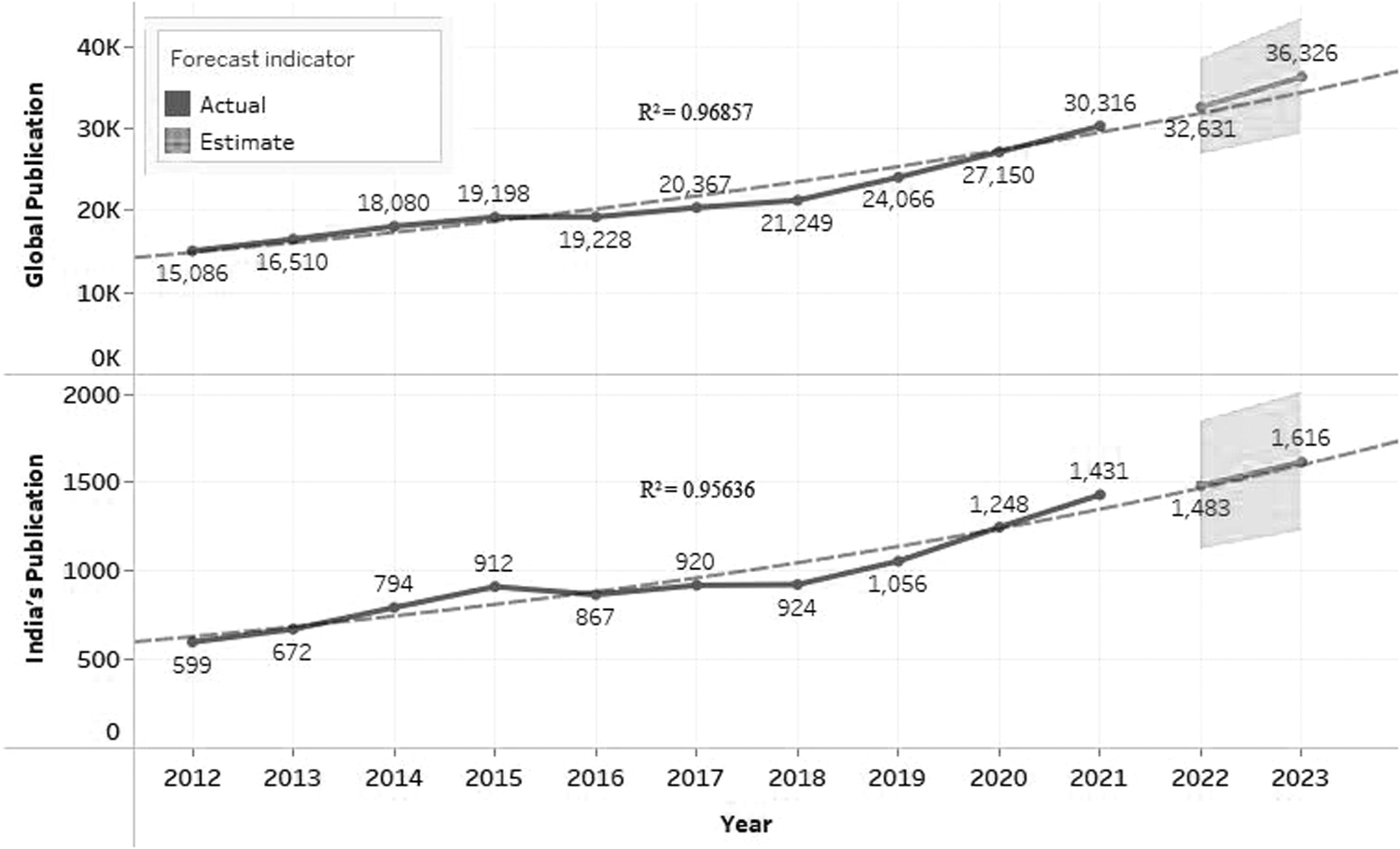
Year-wise publication growth trends. The figure also presents the publication growth forecast for the next 2 years.
Annual Growth Rate of Publications of Genomics Research in India Between 2012 and 2021
AGP, annual growth of publication; PGR, publication growth rate.
Here,
r = Publication growth in percentage
P 0 = Number of publications in the base year
P 1 = Number of publications in the present year
The research publication growth is presented through a line chart. A regression exponential trend line is added to present the R-squared (r 2 ) value, while r 2 = 0.96857 (≈1) at the global level and r 2 = 0.95636 (≈1) in India, which implies the consistent growth of publications. Moreover, the estimate of future growth trends of the research is also forecast through the statistical analysis and interactive data visualization software tool Tableau. The number of publications is expected to grow in the coming years. This growth can be attributed to technological advances and increased funding for genomics research. Research growth forecasting is essential. It can help us plan for the future and make more rational decisions. For example, information professionals can plan subscriptions to forecasting journals. 17,55
Most prolific organizations/institutions
The top 10 prolific organizations/institutions that contributed tremendously to genomics research have been ranked based on the number of publications, total citations, and h-index. By analyzing the most prolific organizations, we can better understand which organizations are doing the most research and scholarship, as well as which organizations have the most impact on their fields. This can help inform funding and policy decisions and provide insight into the progress of the field or the development of new research areas. This study found that most researchers were affiliated with the Indian Council of Agricultural Research (ICAR), which carried out a series of studies on diverse topics concerning genomics sciences. It was followed by the CSIR and the University of Delhi (Table 2).
Top 10 Most Prolific Organizations/Institutions That Conducted Research on Genomics in India During 2012–2021
Authors are ranked based on the number of publications, total citations, and h-index of the authors.
NP, no. of publication; TC, total citation.
Top funding agencies
By analyzing the top funding agencies, we can gain a deeper understanding of the types of research projects being funded and their impact. 56 This information can help inform policy decisions, improve funding strategies, and identify areas for further research. Additionally, analyzing the top funding agencies can help identify research trends and highlight areas where further investment is needed. The study found that the Department of Biotechnology (DBT) of the Ministry of Science and Technology, India, was the top funding agency that provided the most financial grants for genomic research in the last decade. The DBT has been instrumental in promoting genomics research in India by providing resources and support for setting up research institutes, providing access to advanced technologies, and setting up genomics databases. In addition, the DBT has established several research projects, such as the Human Genetics & Genome Analysis, which aims to identify the genetic basis of human diseases and conditions, capacity building in human genetics, and genomics. 57
The DBT is also actively supporting the development of innovative products and services based on genomics research, followed by the Department of Science and Technology (DST) and CSIR, etc., as seen in (Table 3). In addition, the genomics researchers received funds from international agencies too. The National Institutes of Health (USA) and the University Grants Committee (Hong Kong) were among the top funders among the international funding agencies. 58
Top Funding Agencies During 2012–2021
The top 10 funding agencies are ranked based on the number of publications, total citations, and h-index of the funding agency.
Funding plays a significant role in increasing the citations research publications. Genomics research is a data-intensive and technology-driven field that requires substantial resources to generate and analyze large datasets. Researchers require funding to access cutting-edge equipment and technologies, hire skilled personnel, and publish their findings in high-impact journals. A well-funded research project can yield high-quality data and impactful publications, increasing the likelihood of citation by other researchers in the field. Additionally, funding agencies often require researchers to disseminate their findings broadly, leading to increased visibility and citations.
Social structure of the genomics research
Scientists are motivated to collaborate due to the opportunity to discover new knowledge and the increasing specialization within a particular subject. The collaboration among scientists in research activities signifies the social structure of the research activities. 17,59,60 Coauthorship analysis helps to identify the collaboration and communication among the authors of the articles. Coauthorship occurs when two authors copublish a study. 61,62
Authorship collaboration
Authorship collaboration analysis is an integral part of research evaluation and can be used to inform strategic decisions about research funding and collaboration. Authorship collaboration was analyzed in bibliometric network visualization tool, VOSviewer. VOSviewer coauthorship analysis allows us to determine the three essential components, that is, number of publications, citations, and collaboration total link strengths (TLS). The number of publications gives valuable information to evaluate the authors' performance according to their performances and roles in the network; citation gives information about the influence of publications, and the TLS signify the collaboration relationship between other authors.
To visualize the network of authorship collaboration, the minimum number of documents of an author has been set as 10 in VOSviewer. Out of 36,226 authors, 641 have been meeting the VOSviewer threshold. Authors are grouped into 17 colored clusters, as seen in (Fig. 2). The size of an author's circle nodes and font size are proportional to the number of publications. The connection and thickness between nodes represent the cooperation relationship and frequency between the two authors, where Kumar S. from Cluster 12 had the most number of collaborative publications (n = 307, TC = 2772, TLS = 599), followed by Kumar A. from Cluster 3 (n = 306, TC = 3561, TLS = 652), and Kumar R. from Cluster 3 (n = 198, TC = 2195, TLS = 454). In terms of citation burst, Varshney RK was the most influential author, who received the most number of citations (TC = 4536), followed by Kumar A and Kumar S.
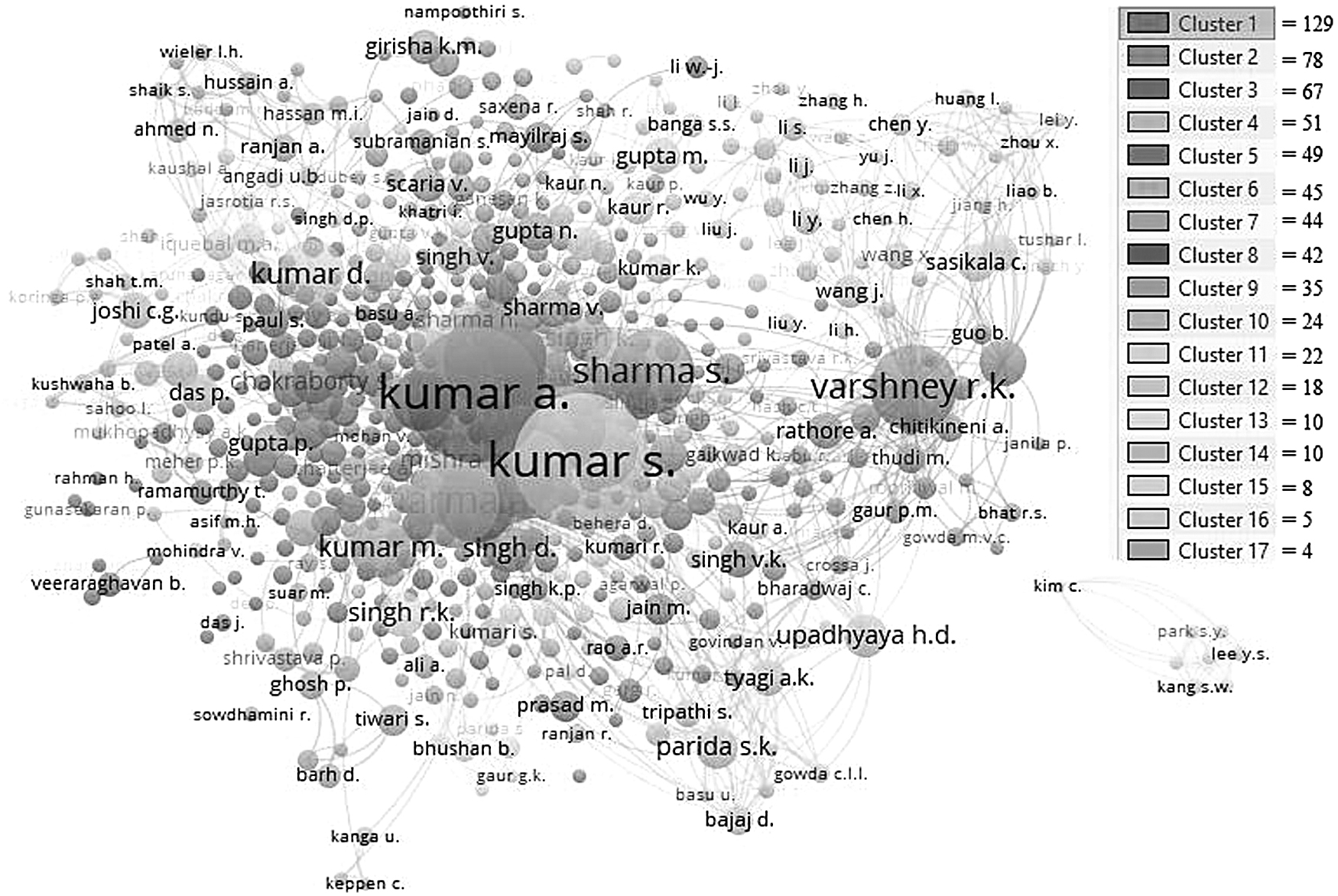
Network visualization of authorship collaboration. (Fig. 2 depicts the networks of co-authorship of authors prepared in the VOSviewer visualization tool. A line connecting circle nodes indicates the relationship between authors. The size of the circle nodes represents the weight of the collaboration).
Coauthorship of organization
To explore core institutions and relationships of cooperation in the research on genomics sciences, we generated a network of coauthors' institutions. A total of 30,346 organizations are found. Out of 30,346 organizations, 382 organizations found that they were strongly connected. These are visualized in the VOSviewer (Fig. 3).

Network visualization of co-authorship of organization. (Fig. 3 depicts the collaboration networks between organizations prepared in the VOSviewer visualization tool. A line connecting circle nodes indicates the relationship between organizations. The size of the circle nodes represents the weight of the collaboration).
In terms of publication frequencies of various institutions, the International Crops Research Institute for the Semi-Arid Tropics (ICRISAT), Hyderabad, conducted the most collaborative research (n = 27, TC = 1230, TLS = 25), followed by the National Institute of Plant Genome Research (NIPGR), New Delhi (n = 26, TC = 654, TLS = 39), and Academy of Scientific and Innovative Research (ACSIR), Ghaziabad (n = 24, TC = 47, TLS = 6). The size of circle nodes and font size of organization names can identify it. Bigger size represents more number of publications. In addition, the citation burst of institutions can be an indicator reflecting institutions that publish many articles during a short period. ICRISAT received the most citations (TC = 1230), followed by the NIPGR (TC = 654). The NIPGR, New Delhi, India, had the highest TLS with other organizations (TLS = 39), followed by the Division of Genetics, Indian Agricultural Research Institute (TLS = 31). The TLS attribute indicates the total strength of the coauthorship links of a given researcher with other researchers. 63
Still, it is found that most of the research collaboration occurred among the Indian organizations/institutions during the study period. Whereas, some Indian authors collaborated with researchers affiliated to the foreign organizations/institutions.
Some of the organizations/institutions that Indian authors frequently collaborated were, Kansas State University, United States (n = 14, TC = 393); Robert Koch Institute, Berlin, Germany (n = 10, TC = 188); International Maize and Wheat Improvement Center (CIMMYT), Mexico (n = 9, TC = 165); London School of Hygiene and Tropical Medicine, United Kingdom (n = 7, TC = 198).
The University of Western Australia, Australia (n = 6, TC = 247); Western Kentucky University, United States (n = 5, TC = 282); Ross University School of Veterinary Medicine, Saint Kitts and Nevis (n = 5, TC = 40); Albaha University, Saudi Arabia (n = 5, TC = 11); University of Cambridge, United Kingdom (n = 5, TC = 14); University of California, United States (n = 5, TC = 64); Cornell University, United States (n = 5, TC = 692); Chinese Academy of Agricultural Sciences, China (n = 5, TC = 74); International Crops Research Institute for the Semi-Arid Tropics (ICRISAT), Kenya (n = 5, TC = 201); Johns Hopkins University School of Medicine, United States (n = 5, TC = 208); State Agricultural Biotechnology Center, Center for Crop and Food Innovation, Food Futures Institute, Murdoch University, Australia (n = 5, TC = 12); Bgi-Shenzhen, Shenzhen, China (n = 5, TC = 230), etc.
Indian researchers collaborated most number of research with the researchers of the United States. There could be several reasons for Indian authors collaborating with researchers in the United States in genomic research such as access to resources, expertise, international recognition, and funding.
Intellectual structure of research publications
The intellectual structure of scholarly publications can be identified, traced, and visualized by counting the frequency with which an author's work is cocited with another author in the references of citing documents. 60,64 The cocitation analysis aids in the exploration of the intellectual linkages between the influential articles in a discipline and the mapping of the intellectual structure of the discipline. 25 –28 A cocitation is a frequency with which two units are cited together. 65 Cocitation analysis can help map the intellectual structure of a research field and identify the most active research areas, discover front-line research, and bring out high-impact transformative discoveries. 17
The minimum number of citations of an author has been set as 20, and out of 506,263 cited authors, 9634 meet the threshold of the visualization tool VOSviewer. Among 9634 authors, 1000 with a robust set of relationships were selected for the network graph visualization. The cited authors have been grouped into four colored clusters according to their appearance times in the documents.
As a result, Cluster 1 consists of 412 cited authors, whereas Wang Y. (TC = 1769, TLS = 93,784) is the most cited author. Cluster 2 consists of 216 authors, whereas Kumar A. (TC = 1910, TLS = 101,709) appeared most times. Cluster 3 consists of 211 authors, whereas Kumar S. (TC = 2766, TLS = 105,515) is the most cited author. Cluster 4 consists of 161 authors, whereas Varshney RK. (TC = 1872, TLS = 192,774) was the leading cocited author. This has also been mentioned under (Fig. 4).

Network visualization of the cocitation of cited authors. (Fig. 4 depicts the cocitation networks of cited authors prepared in the VOSviewer visualization tool. A line connecting circle nodes indicates the relationship between cited authors. The size of the circle nodes represents the weight of the item.
Trending research themes on genomics research
Trending research themes in a particular subject can be identified by analyzing the keywords assigned by the authors in particular research articles. Using keyword analysis in scientometric studies is an essential tool for researchers to gain insight into the current state of scientific discourse. Keyword analysis can identify topics of interest in a given field, providing researchers with a snapshot of the current literature. Additionally, keyword analysis can identify potential gaps in the literature, allowing researchers to focus their research efforts on areas that still need to be adequately explored. It helps identify emerging trends in a field, allowing researchers to stay ahead of the curve in a rapidly changing environment.
A total number of 21,822 keywords were found in the network. However, the 168 most prominent keywords, which have at least 20 appearances in the research, have been selected for visualization. It was found that the keyword “Genetic Diversity” appeared 200 times in various research articles. Similarly, “Polymorphism” (197 times), “Genomics” (190 times), “Comparative Genomics” (126 times), “Phylogeny” (110 times), “RAPD” (110 times), “SNP” (110 times), “PCR” (107 times), and “Gene Expression” (102 times) as seen in Figure 5. The keywords that appeared under bigger circle nodes were the most frequently appeared keywords in different research articles. It signifies that the research was primarily focused on these topics. Genetic diversity has become a hot research topic due to its importance in the health of species and ecosystems. 66

Co-occurrence network visualization of the prominent keywords. (Fig. 5 illustrates the co-occurrence networks of author keywords. The cluster of the same color represents the group of similar keywords. The size of the circle nodes indicates the number of times each keyword appears in the network, while the connecting lines represent the relationships between the keywords).
Similarly, gene polymorphism is an essential topic in research because it significantly contributes to phenotypic variation among individuals. It affects the expression of genes and can lead to various diseases, including cancer. Additionally, it is becoming an increasingly important field of study as researchers can better identify the genetic variants associated with the disease. In general, genomics research has become increasingly popular in recent years due to advances in technology and the potential of genomics to revolutionize health care, agriculture, and other industries. 58
The VOSviewer overlay visualization revealed that, at the beginning of the last decade, the research was primarily conducted on the topics like “genetic diversity,” “RAPD,” “molecular markers,” “DNA extraction,” “DNA isolation,” etc. Later, the research evolved to the topics like “polymorphism,” “phylogeny,” “population structure,” “phylogenetic analysis,” etc. The topics related to “comparative genomics,” “SNPS,” “metagenomics,” “next-generation sequencing,” “DNA methylation,” “breast cancer,” “lung cancer,” etc., were the trending research topics in recent years. Most recently, researchers have identified new research themes related to “sars-cov-2,” “Covid-19,” “whole genome sequencing,” “GWAS,” “biofilm,” “drug resistance,” “antibiotic resistance,” “DNA repair,” etc. The evolution of the research signifies that the domain is in a state of continuous development.
Most influential publications on genomics sciences
Identifying the most influential publication is essential for several reasons. It allows researchers to understand what research has had the most impact in a particular field. This can inform future research and development or help identify areas of research that may have been overlooked or undervalued. Additionally, the most influential articles may be used to inform policymakers and other stakeholders about the state of research in a particular area. By understanding the most influential articles, researchers can better understand how various disciplines are interconnected and how they may influence each other. This study identified the 10 most influential articles in the field of genomics sciences that received the most citations and public attention on social media platforms.
The AAS and Mendeley reading metrics of influential articles have been added to observe the attention sparked on social media platforms and reading on Mendeley. AAS is the supplement metric of the citations and other citation-related impact values. 17 It measures the attention and engagement a scholarly publication receives from various sources, such as news outlets, blogs, social media, policy documents, and other scholarly sources.
In contrast, Mendeley readers' metrics can be used as the unit of research impact evaluation because Mendeley reading is an early indicator of the research's popularity and impact. 67 –69 AASs are typically calculated from the number of mentions a research article receives, how influential the sources are, and how often the mentions are shared. The article “The tomato genome sequence provides insights into fleshy fruit evolution” 70 published in “Nature” was the most influential article that received the most number of citations (TC = 2061), followed by the article “Analysis of the human tissue-specific expression by genome-wide integration of transcriptomics and antibody-based proteomics” 71 published in “Molecular and Cellular Proteomics” that received the significant number of citations (TC = 1748), etc. (Table 4). In terms of AAS, the article “Inborn errors of type I IFN immunity in patients with life-threatening COVID-19,” 72 published in “Science” received the most number of AAS (AAS = 3213).
Most Influential Publications on Genomics Sciences During 2012–2021 Ranked Based on Citation Impacts
AAS, Altmetric Attention Score; DOI, digital object identifier.
While the article “Pan-cancer analysis of whole genomes” 73 published in “Nature” was read the most number of times (2847 counts). It was found that the most influential articles were published in the journal, “Nature.”
Conclusion
The results of this scientometric study on genomics present a comprehensive overview of the research growth and trends within the field. Additionally, the study reveals the most prolific organizations and funding agencies in the field, which can be used to further analyze the impact of research in genomics and identify potential collaborators for future research.
The ICAR has been at the forefront of genomics technology development in India, and invested heavily in research, training, and capacity building in genomics. In addition, the ICAR has also worked to establish links and collaborations with international genomics research organizations to enable the transfer of technology and knowledge. As a result, the ICAR has become an important research hub for the genomics research community in India. Its research output is recognized and cited in national and international scientific journals. DBT (Ministry of Science and Technology, India) has been a primary source of funding for genomic research in India, as it is keen to promote the development of innovative technologies in the field. DBT also provides special grants and incentives to scientists, universities, and research institutes for genomic research.
This encourages the development of new technologies and ideas, helping to create a strong knowledge base. DBT has also set up a National Genomics Grid, providing access to high-throughput genomic data and analysis tools to scientists nationwide. This helps promote collaboration between institutions and scientists and encourages sharing knowledge and resources. Scholars argued that funding mainly affects citations, and funded articles can attract more usage, although a variation exists between research fields. 16,74,75 Similarly, the research collaboration in the domain is crucial, and increasing diversity in clinical trial participation is necessary to improve health outcomes and requires addressing existing social, structural, and geographic barriers. 76
However, the present study did have some limitations. For example, the data search terms may have excluded some relevant research topics or authors. Additionally, the results are limited to research publications indexed in the Scopus database for 10 years (2012–21), which may exclude publications of different years and some that were not indexed. There is ample scope for further studies using other databases, that is, Web of Science, PubMed, Dimensions, Google Scholar, etc. using a more comprehensive search and a more extensive dataset to obtain a more comprehensive view of the field. To determine the precise information of the progression and trends of the research in the field, time-to-time systematic review and scientometric mapping are required that helps the stakeholders in the future initiatives.
Overall, this study of the genomics field provides insight into the current landscape and the potential for future growth. It demonstrates the importance of the interdisciplinary nature of the field and the need for continued collaboration between researchers from different disciplines, organizations, and countries. Additionally, the analysis of the research output reveals the potential for future developments in the field, particularly in less focused areas inclusively. To support the continued growth and development of genomics, research policies should be designed to promote innovation, collaboration, and ethical considerations. India has made significant progress in genomics research in recent years, but there is still much room for growth and development in this field.
Footnotes
Acknowledgments
The authors duly acknowledge Dr. K.C. Garg, Former Chief Scientist, CSIR-National Institute of Science Communication and Policy Research (CSIR-NIScPR), New Delhi, India for his valuable insights and guidance in the data analysis and methodology of this research.
Authors' Contributions
B.B.: his contributions to the current study are literature search; literature review; data collection, data analysis, tabulation, and graphical presentation of data; and article draft preparation. P.K.M.: his contributions to the study are introduction, article editing, and referencing. M.K.V.: his contributions to the study are conceptualization of the ideas, research design, article review, revision, and overall supervision.
Author Disclosure Statement
No competing financial interests exist.
Funding Information
No funding was received for this article.