




Abstract
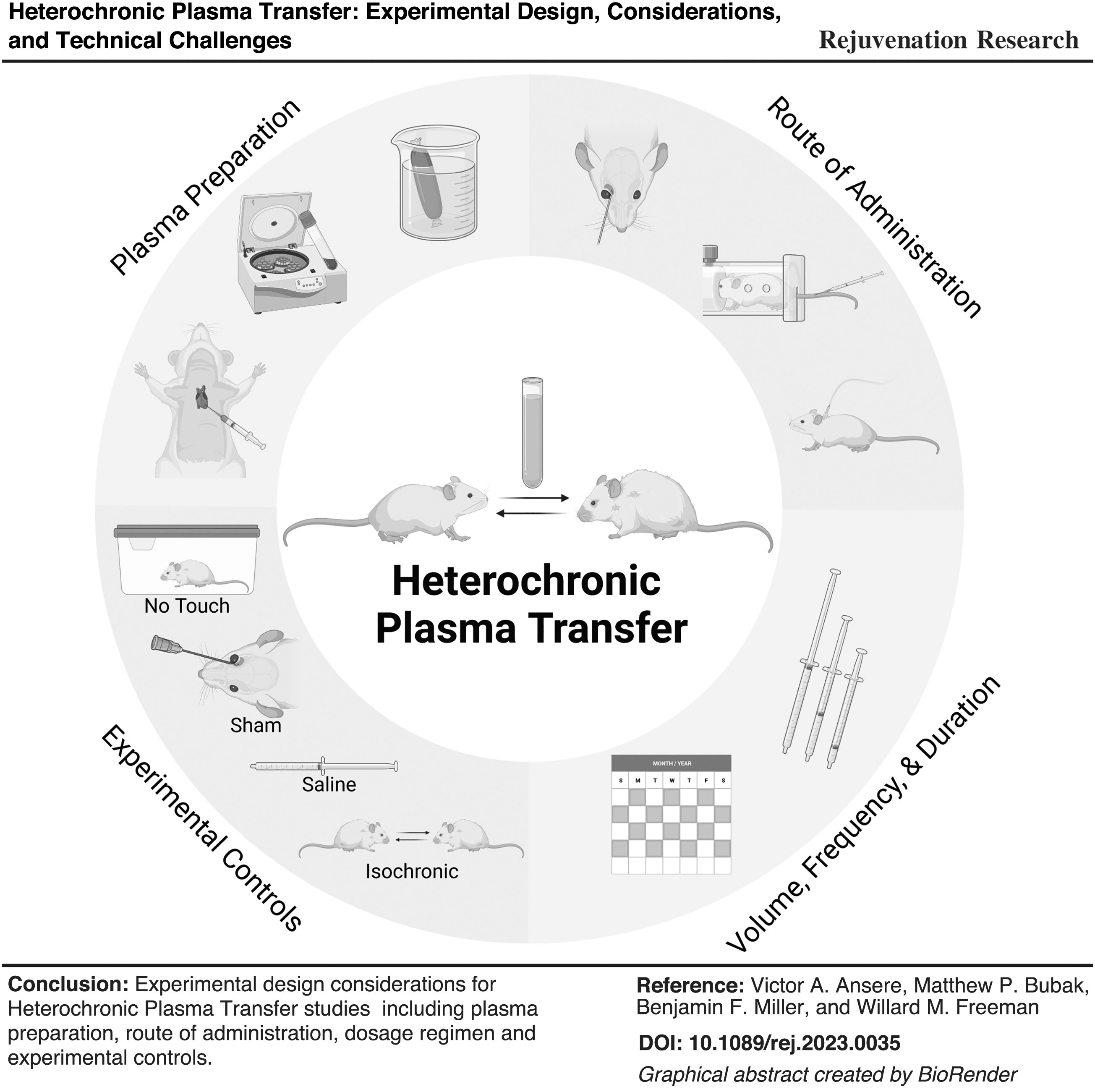
Experimental approaches such as Heterochronic Plasma Transfer (HPT) provide insights into the aging process and help identify the factors that impact aging, with the aim of developing anti-aging therapies. HPT involves the transfer of plasma from an animal of one age to an animal of a different age and highlights the effects of the systemic environment on aging. Despite its importance as an aging research tool, HPT is not without limitations and HPT experiments across various studies differ in key experimental designs considerations, presenting a challenge in obtaining comparable outcomes. In this review, we examine the caveats and experimental design considerations of HPT as a research tool. We provide insights into plasma preparation procedures, route of administration, dosing regimen, and appropriate controls to assist investigators in achieving their experimental goals.
Introduction
Advancements in medicine and public health have increased lifespan while not necessarily extending healthy years free of significant disability. As echoed by the Italian philosopher Giacomo Leopardi, as we strive to live longer, old age robs us of all pleasures and brings miseries. 1 Aging has effects across organ systems and is a key risk factor for many chronic diseases, contributing to physical deterioration, cognitive decline, and poor quality of life. 2 –6
A current aim of aging research is to examine aging as a treatable condition to lessen age-related chronic disease burden. To successfully delay the onset and progression of age-related diseases, a better understanding of the underlying mechanisms of aging is needed. It is imperative to develop innovative and integrative research methods while optimizing existing ones to gain insights into the biology of aging.
Aging involves complex interactions among genetic, environmental, and lifestyle factors. There is considerable evidence that cell non-autonomous 7 –11 and systemic factors 12 –15 influence the aging process. Experimental models, including blood and plasma exchanges, have been developed to study the impact of the systemic environment on aging. 16 –20 Studies involving these techniques show that the systemic milieus of old and young animals contribute to age acceleration or delay, respectively. 16,21 –25
One of the earliest documented experiments involving blood exchange is parabiosis, a surgical procedure that connects the circulatory systems of two living organisms. 16,21 –25 To study the contribution of the systemic environment to aging, pairs of old and young animals are formed through heterochronic (hetero: different, chrono: time) parabiosis. 16,21 –26
The integration of heterochronic parabiosis with transcriptomic and proteomic approaches has resulted in the identification of protective and deleterious circulating factors, such as growth differentiation factor 11, 27 –29 β2-microglobulin, 30 and C–C motif chemokine ligand 11. 13
There is a growing trend of using heterochronic plasma transfer (HPT) or exchange as an alternative to study the contribution of systemic factors on aging. 14,20,31 –34 HPT involves transferring plasma from an animal of one age to an animal of another age without the need for surgical joining. Like heterochronic parabiosis, HPT transfers youthful phenotypes to older animals and has been shown to improve spatial memory and cognition, 13,20,33 mitigate hepatic senescence, and improve regeneration of liver cells 35 in old rodents.
However, the design of HPT studies varies among experiments, with differences in the route of administration, dosage regimen, and treatment duration, which affects outcomes. 13,14,17,20,32,33,35 –46 Further, blood collection procedures, as well as the potential removal of some factors during plasma preparation can introduce uncontrolled variables. This review examines these experimental design, concerns, and technical challenges of HPT as an aging research tool to guide investigators in best achieving their experimental goals.
Heterochronic Parabiosis
Parabiosis is a valuable research tool for studying the physiological or pathological implications of the systemic environment on multiple organ systems. 16,21 –24 Heterochronic parabiosis has been used since the 1950s 47 to understand aging and associated diseases. 16,23,24 Through heterochronic parabiosis studies, it is apparent that the old systemic environment contributes to aging phenotypes. 20,23,24 Young blood in old animals attenuates aspects of biological age 26 while improving aging hallmarks such as mitochondrial dysfunction, 48 senescence, 23 inflammation, 24,45 and stem cell exhaustion. 25
Studies show that the negative effect of the old systemic environment in young or adult animals is more pronounced than the anti-aging effects of the young milieu in old animals. 17,24 The effects of parabiosis are not permanent as Poganik et al. 26 showed that separating parabionts results in the reversal of pro-aging effects after 2 months. Aside from the global effects of parabiosis, recent single-cell transcriptomic analyses suggest cell and tissue-specific effects as well. 24
Since its initial description by Paul Bert in 1864, 49 the surgical technique for establishing parabiosis has undergone refinements to decrease perioperative and postoperative mortality. 16,50 –52 In addition to connecting the skin flaps of the animals, investigators suture the scapulae and femur to provide additional support, which helps to maintain parabiotic pairs for longer periods. 16,50,52,53
Improvements in surgical techniques and postoperative care have effectively deterred the removal of sutures by animals and reduced the risk of infections. 50,52,53 Despite these refinements, the procedure still poses considerable challenges, particularly when establishing heterochronic pairs. Frailty of older animals and parabiotic disease, 16,53,54 a condition in which the young parabionts become anemic and sickly, complicate the procedure and increase the risk of mortality.
Disparities in the weight, aggressiveness, and mobility between young and old animals are complications that need to be addressed to minimize post-surgery injuries and death. 54 Moreover, the trauma and stress associated with the surgery and subsequent separation impact animal behavior. 54 These challenges limit the widespread adoption of heterochronic parabiosis as an aging research model.
Although sham and isochronic (iso: same, chrono: time) controls are useful to disentangle some of the effects of the parabiosis surgery, approaches such as HPT provide viable options to study the systemic effects of aging without the need for surgical joining. These methods are also well suited for experiments that involve behavioral studies.
Plasma Transfer and Blood Exchanges
Heterochronic plasma transfer
HPT offers the advantage of minimizing the physiological stress associated with surgical procedures to physically connect animals. HPT involves the injection of plasma or plasma fractions from animals of one age to animals of another age 14,20,31,55 and recapitulates the pro- and anti-aging effects of heterochronic parabiosis. 32,35,41,56 In mice, the transfer or exchange of young plasma to the old improves hippocampal synaptic plasticity, neurogenesis, and cognitive function. 14,20,33,57
Conversely, young mice receiving old plasma have impaired neurogenesis, cognitive function, and spatial memory. 13,17 HPT facilitates the study of specific plasma factors and the transfer of the beneficial systemic effects of other lifestyle interventions such as exercise from one animal to another. Examples of specific factors identified include Vascular Cell Adhesion Molecule 1 (VCAM1) is elevated in aged plasma and inhibiting VCAM1 decreases microglial activation and improves hippocampal neurogenesis and cognition. 32
In another study, the administration of plasma from young mice or young exercised mice to aged triple-transgenic mouse model of AD (3 × Tg-AD) mice improves Alzheimer's Disease (AD) pathology by increasing Brain-Derived Neurotrophic factor and synaptophsin, thus decreasing amyloid beta plaques and tau fibrils. 57 These studies highlight that HPT not only mimics the pro- and anti-aging effects of parabiosis, but it also allows for the probing of specific factors that modulate these effects.
Although HPT is a valuable experimental approach for aging research, there is currently no consensus on experimental considerations such as methods of plasma collection, dosing, frequency, and duration of plasma treatment. Here, we examine critical experimental considerations that have significant impact on HPT studies and our understanding of the effects of systemic factors on aging.
Plasma preparation
The procedure for collecting plasma is often underappreciated as a variable in HPT studies and should be carefully considered with experimental design and goals in mind. Ideally, donor mice should not have existing health conditions and be of the same age, as even a slight difference in age impacts plasma composition. 12 Maintaining a consistent time of day for blood collection is essential due to the effects of the circadian rhythm on the systemic milieu. 58 –60
Unless the objectives of the study specifically require the transfer of plasma between sexes, donor animals should be the same sex as recipients. Blood from donor animals (mice or rats) can be obtained by survival blood collection techniques, including tail clip or tail vein nick, saphenous vein puncture, and submandibular or retro-orbital (RO) bleeding. 13,61 –64
These survival blood collection methods often yield small amounts of blood and are suitable for serial blood collections. Tail clips or vein nicks are relatively simple procedures that come with the risks of scarring and contamination of collected blood samples by tissues surrounding nicked tail area. 62,65 –67 RO bleeding involves inserting a hematocrit tube or pipette into the RO sinus in mice or plexus in rats. 61,62,65,68
RO blood sampling thus poses some risk of complications, such as periorbital infection, injury to the eye or surrounding tissues, and vision loss. 61,62,68 Survival techniques for blood collection require either anesthesia or manual restraint of the animal, both of which cause distress and elevate stress hormone levels in the blood. 62,65 –67
For HPT studies, the preferred method of blood collection is intracardiac bleeding (or cardiac puncture), due to its ability to yield larger quantities of good quality blood. 13,14,20,32,65,69 Cardiac puncture is a terminal procedure and requires carbon dioxide (CO2) narcosis or deep anesthesia. 62 Inhalation anesthesia, such as isoflurane, is the preferred method for achieving anesthesia as it induces minimal stress, unlike CO2 narcosis. 62,70,71
Excessive CO2 levels can lead to alterations in the blood metabolite levels, causing acidosis that affects plasma parameters. 71,72 Injectable anesthesia, such as ketamine hydrochloride combined with xylazine, causes a reduction in heart rate, unlike inhalant anesthesia. 62,73 The decrease in heart rate limits the volume of blood that is collected when injectable anesthesia is used.
An alternative to cardiac puncture is exsanguination through the caudal vena cava or the abdominal aorta, which requires deep anesthesia, as well. 62,64,74 The abdominal cavity of the animal is opened and blood is withdrawn from the vessels while the animal is still breathing, which typically results in large blood quantities. 62,64
Proper needle and syringe sizes help to maintain appropriate back pressure and ensure smooth blood withdrawal to prevent the heart or vessels from collapsing. A 23- to 25-gauge needle with a 1–3 cc syringe is recommended for mice, whereas an 18-gauge needle with a 10–12 cc syringe is preferred for rats. 62,64 Using smaller gauge needles restricts blood flow, leading to clotting and cell damage. It is important to avoid using longer needles that can inadvertently pass through the heart or shorter needles that fail to reach it. 62,64
When collecting blood, it is recommended to pre-fill or coat the syringes and collection tubes with suitable anticoagulants such as ethylenediamine tetraacetic acid, heparin, or sodium citrate to slow down clot formation. 33,62,64 Silicone-coated tubes can be used for blood collection, as they offer the additional benefit of delaying clot formation and preventing red blood cells from sticking to tube walls. 75,76
Collected blood should be maintained at 2°C–8°C and centrifuged within 30 minutes of collection to isolate plasma. A single or double centrifugation method is used to collect plasma from the blood. In the single centrifugation method, the blood is spun down once at 1000–2000 g for 10 minutes at 4°C. 20,32,77,78
This single-spin process results in the formation of three distinct layers: a bottom layer that is rich in red blood cells, a middle layer known as the buffy coat, containing high amounts of white blood cells (WBCs) and platelets, and a top layer consisting of the plasma. In the double centrifugation method, after the initial spin of the collected blood, the resulting upper layer containing plasma is subjected to a second spin (>1000 g for 10 minutes).
This second spin removes any residual WBCs and platelets, resulting in a refined and purer plasma sample. 77 –80 In studies requiring platelet-rich plasma, the upper layer of plasma and buffy coat resulting from the initial spin are subjected to the second spin to concentrate platelets, which are then resuspended in a smaller volume of plasma. 77–78
It is critical to dialyze plasma in phosphate-buffered saline to remove lethal amounts of anticoagulant to safely administer plasma to animals. 14,20 The dialysis process removes smaller metabolites or factors from the plasma depending on the molecular weight cut-offs of the dialysis tubes, which range from 3.5 to 14 kDa.
To ensure a uniform distribution of plasma factors, plasma needs to be pooled both before and after the dialysis process. It is recommended to create aliquots of the dialyzed plasma and store them at −80°C to avoid repeated pipetting and freeze-thaw cycles that compromise the integrity of the plasma.
Route of administration
The methods of administering plasma in HPT studies are through the lateral tail vein, jugular vein, and RO sinus or plexus. Although the tail vein is a commonly used route for plasma injections, it is a technically challenging procedure. Successful tail vein injections demand extensive practice and experience, alongside the use of suitable restraining devices to avoid injury to animal and handler.
Animal movements or tail jerking have the potential to dislodge the needle, leading to subcutaneous injections. An appropriate restraint should limit movement, ensure normal respiration, and be clear enough to allow constant observation of restrained animals. 67,81 –83 Restraining animals is stressful, and a recent study has shown that restraint and subsequent tail vein injection affects hippocampal neuronal proliferation. 34
Even with appropriate restraint, locating or visualizing the lateral tail vein is difficult, particularly in dark-pigmented animals such as C57BL/6 mice. Warming the tail by immersion into warm water or by exposure to infra-red light dilates veins for easy visibility. 83 However, methods for vasodilation carry the risk of overheating or burn-related issues. 83
To ensure proper needle placement, veins are initially flushed with a small volume of plasma that necessitates the addition of extra plasma to the syringe beyond the intended injection amount. Alternatively, injections can be performed using needles attached to microtubing, which helps visualize the backflow of blood, indicating that the needle is inside the vein. 81
The risk of scarring and vein collapses 67,81 due to repeated injections, or attempts to locate the vein make it challenging to administer multiple plasma injections accurately and consistently. Investigators should consider using tail vein catheters, which provide easy insertion into the tail vein without the need for surgery. Catheters enable repeated dosing or continuous infusions, providing a more reliable method for plasma administration.
Jugular vein catheterization provides a viable alternative for repeated plasma injections. It involves a surgical procedure where a tube is inserted into the right jugular vein and tunneled subcutaneously to the dorsal side of the neck for ease of access for infusions. 84 –87 Catheterization offers the advantage of requiring only light restraint during injections, eliminating the need for anesthesia or heavy restraint.
Although the surgery induces stress in animals, minimizing tissue damage during surgery and allowing animals ample time to recover after catheterization reduce the impact of stress on study outcomes. 85,87 Capping the external catheter tubing and changing caps after each injection prevents clogging of tubes with dirt or debris and lowers the chances of infection. It is vital to ensure that the external tubing is short enough to discourage catheterized animals from accessing the cap or tubing. In addition, single-housing animals after surgery is necessary to prevent other animals from interfering with catheters.
Catheters inserted into the jugular vein remain patent for >30 days, ensuring longer periods of functionality. 87,88 Flushing catheters between injections regularly with a suitable flush or lock solution, such as normal saline, heparinized glycerol, or glucose, clears catheters and prolongs the patency of catheters. 85
An alternative method of plasma administration involves using the RO sinus in mice or the plexus in rats. 24,32,34 Various vessels drain the RO sinus, including the supraorbital, inferior palpebral, dorsal nasal, and superficial temporal veins. 67 RO sinus veins provide a rapid route for plasma to enter the bloodstream. RO injections are performed with the animals under anesthesia, which as discussed earlier causes stress. 89
The use of isoflurane as an anesthetic helps minimize stress levels and facilitates a quick recovery. 70 It is crucial to use a low-flow anesthesia delivery system that allows for precise control of anesthetic depth and respiratory rate. Plasma injections through the RO sinus in mice typically involve volumes up to 200 μL. 24,32,34 It is recommended to administer one injection per day and alternate between the left and right sinuses to reduce irritation. 67
Inserting the needle too deeply causes bleeding and damage to tissues surrounding the RO sinus. Also, minimizing movement once the needle is in place in the sinus or plexus is critical to reduce injuries. With RO injections, the risk of the veins collapsing is decreased as injections occur in the RO sinus cavity rather than directly into a vein. 67
Topical ophthalmic ointments to minimize irritation and inflammation should be applied when multiple injections are required. RO injections can cause vision damage or blindness, which limits its use in studies involving behavioral experiments dependent on the ability of animals to see. 67
Some studies use intraperitoneal (IP) injections to administer plasma into the circulatory system. 19,32 The advantage of IP injections is that they are relatively easy to perform with minimal preparation required. Substances injected into the peritoneum are drained into the systemic circulation either directly through peritoneal blood capillaries or indirectly via lymphatics and portal circulation. 90
The disadvantage of IP injections is that the absorption or diffusion rate of plasma components into the circulation depends on factors such as molecular size and concentration gradient. 90 Therefore, IP injections result in inconsistent absorption, which affects the volume of plasma or the bioavailability of plasma components in circulation. Therefore, it is not advisable to use IP injections for plasma administration.
Administered plasma volume, treatment duration, and frequency
There are currently no comparative reports on optimizing the volume, frequency, and duration of treatment to achieve maximum effects following plasma transfer. The usual plasma volume administered varies from 100 to 200 μL for mice 13,14,20,30,33,34 and up to 1 mL for rats per single injection, which represents <10% of the average blood volume of mice (0.077–0.08 mL/g) and rats (55–70 mL/kg), respectively. 74
Although the administered plasma is not sufficient to produce fluid overload in recipient animals, plasma should be injected slowly to avoid rapid changes in the blood volume, particularly when administering intravenously. Recipient animals typically receive multiple injections over a time course. There are studies that give plasma treatments for as short as 3 days 69 or for as long as 8 weeks. 33
To our knowledge, two studies have conducted short-term HPT, which we define as one injection or multiple injections over a period of <7 days. Brett et al. found that tail vein injections of aged-exercise serum into aged mice every 24 hours for 3 days had greater activation of muscle resident stem cells (i.e., satellite cells) compared with sham controls. 69
Yousef et al. showed that aged plasma injected via RO twice a day for 4 days increased microglial activation in young mice. 32 In contrast to short-term HPT, most studies use long-term transfers involving 2–3 injections per week over a 4- to 5-week period, with a minimum of 8 injections in total. 13,14,20,41,42,44 One study, conducted by Zhao et al., deviates from the typical 4- to 5-week time range for plasma transfers and extends the duration to 8 weeks. 33
The specific rationale behind the duration and frequency of treatment was not clearly defined in most studies. However, it is reasonable to suggest that repeated injections have a cumulative impact that can be beneficial compared with single or short-term injections.
Experimental control
Appropriate controls for HPT studies should serve to rule out confounding factors such as stress from animal handling, restraint, anesthesia, damage from single or repeat needle insertion, and/or plasma volume expansion from plasma effects. Controls are expected to include one or more of the following groups: (1) a sham group that does not get plasma but must undergo surgery, needle insertion, anesthetic induction, or restraint; (2) an isochronic group; (3) a group that gets physiological or albumenized saline as a dilution control; and/or (4) a no-contact group that does not experience any experimental procedure.
Heterochronic and neutral blood exchanges
Although we are focused on HPT in the current review, it is worth noting that there are alternative systemic approaches such as heterochronic blood exchange (HBE) and neutral blood exchange (NBE). 17,55,91,92 HBE uses automated exchange devices or syringes to serially extract and swap blood between younger and older animals through jugular vein cannulation. 17,55,92
The exchange device enables animals to be readily connected and disconnected, allowing for both acute and chronic administration. Typically, HBE results in ∼50% homogenization of blood between the two animals. Similar to heterochronic parabiosis and HPT, a study involving HBE revealed that old blood negatively impacts young animals.
Young (3 months) mice that received a single bout of blood exchange from aged (22–24 months) mice had elevated levels of senescence and inflammatory markers in several organs, 14 days after the blood exchange. 92 In a different study, HBE improved regeneration and function of the tibiallis anterior hind leg muscles after injury. 17 One disadvantage of HBE in rodent models is that it does not account for individual variations among animals, which is avoided if a recipient receives exchanges from multiple pooled donors.
NBE, in which blood from an animal is serially exchanged for albumenized saline, resulting in ∼50% blood plasma replenishment 46,91 has also gained popularity. NBE removes and dilutes aging components from the systemic environment, which is different from saline injections that just dilute old blood. 46 NBE addresses the question of whether the addition of youthful factors or the simple dilution of aged factors is responsible for the improvements in aging phenotypes.
The evidence from HPT, 20,42 HBE, 17,55 and NBE 46,91 studies suggests that both systemic factors and the dilution of old systemic milieus contribute to the effects of the systemic environment on aging phenotypes.
Clinical and translational applications
Transcriptomic and proteomic approaches have identified and characterized plasma factors that may be responsible for the anti-aging properties of young blood as a potential therapeutic. The high level of interest in “youthful” plasma factors has led to the initiation of several clinical trials to assess the efficacy, safety, and tolerance of whole plasma and plasma fractions as anti-aging therapies.
The Plasma for Alzheimer's Symptom Amelioration study assessed the safety and feasibility of young frozen plasma infusions in AD patients. 43 In the initial phase, nine patients diagnosed with mild to moderate AD were randomly assigned to receive weekly infusions (250 mL) of plasma or saline for a period of 4 weeks, using a double-blinded approach.
After a 6-week washout period, the subjects crossed over to receive 4 once-weekly infusions of the alternate treatment. Later, as part of modifications to allow for unblinded treatments, nine new patients were enrolled in a plasma-only group and were treated once a week for 4 weeks. The researchers did not provide the rationale behind selecting a dose of 250 mL.
It is noteworthy that the donor plasma used in the study was collected from males below the age of 30, whereas the recipient group were predominantly females. The study identified only mild cases of adverse events including headache and dizziness that were only reported in the treatment group, confirming the general tolerance of plasma infusions.
A similar trial in 2016 examined the effects of whole plasma infusions from young donors (≤35 years) on aging- and disease-related biomarkers in older individuals (NCT02803554), although the results have not yet been published.
The tolerability of intravenous infusions of plasma-derived products has been assessed in older people for the age-associated diseases AD and Parkinson's disease (NCT03765762, NCT03520998, NCT04527328, and NCT03713957). In a Phase 2 study involving patients with mild to moderate AD, a total of 47 participants were randomly assigned to two doses of GRF6019, a plasma fraction depleted of blood coagulation factors and immunoglobulins. 93
The study assessed the safety and tolerability of daily infusions of either 100 or 250 mL of GRF6019 over a span of 5 days, during two separate dosing periods. The two doses were selected based on allometric scaling of doses that showed beneficial effects in pre-clinical studies.
The study's findings showed that the daily dosing of GRF6019 was safe and well tolerated by patients, as there were minimal reports of serious adverse events during the study. Further, evaluation of cognitive and functional status of the patients showed no significant impairment in cognition and only minor functional deterioration over the treatment period. 93
Finally, therapeutic plasma exchange (TPE) or plasmapheresis is already used as a disease-modifying treatment in diseases such as thrombotic microangiopathies, Guillain–Barré syndrome, and multiple sclerosis. 94 –96 In TPE, the harmful plasma components such as damage-associated molecular patterns, and auto-antibodies are removed from the blood.
Patient plasma is replaced with protective factors and albumin or fresh frozen plasma, to maintain normal plasma volume and osmotic balance. These studies show the therapeutic potential of TPE to impact physiological and pathophysiological functions by altering the composition of the systemic environment.
Conclusion
This review examined the experimental design, concerns, and technical challenges of HPT as an aging research tool. HPT serves as an effective tool for the investigation and identification of systemic factors that affect aging and age-related disease. However, careful consideration needs to be given to methodological factors to ensure consistent and repeatable results.
Clear reporting of methods such as plasma collection and administration are required, as these can significantly affect the interpretation of experimental outcomes. At minimum, studies should include a justification of the route of administration, plasma volume, duration, and frequency of HPT. HPT may be a feasible and cost-effective therapy to treat age-related diseases with low implementation barriers as plasma is currently used to treat trauma, burn, shock, and COVID-19 patients.
Data from clinical trials show that the administration of plasma and plasma fractions is feasible and safe. However, results from early phase clinical trials remain inconclusive with regards to the efficacy of treatment. Therefore, at this point, HPT remains a useful aging research tool with encouraging therapeutic potential.
Footnotes
Authors' Contributions
V.A.A. and M.P.B.: Writing–original draft, writing–review and editing, and conceptualization. B.F.M. and W.M.F.: Supervision, writing–review and editing, and conceptualization.
Disclaimers
The content is solely the responsibility of the authors and does not necessarily represent the official views of the National Institutes of Health. The views expressed in this article are those of the authors and do not necessarily reflect the position or policy of the Department of Veterans Affairs or the United States government.
Data Availability
No data were used in this article.
Author Disclosure Statement
The authors report no conflict of interest.
Funding Information
This work was supported by grants from the National Institutes of Health R01AG059430 (W.M.F.) and F99AG079813 (V.A.A.). This work was also supported in part by awards IK6BX006033 (W.M.F.) and I01BX005592 (B.F.M.) from the U.S. Department of Veterans Affairs, Biomedical Laboratory Research and Development Service; Oklahoma City Veterans Affairs Medical Center (M.P.B.) and from the American Federation for Aging Research (V.A.A. and M.P.B.).