




Abstract
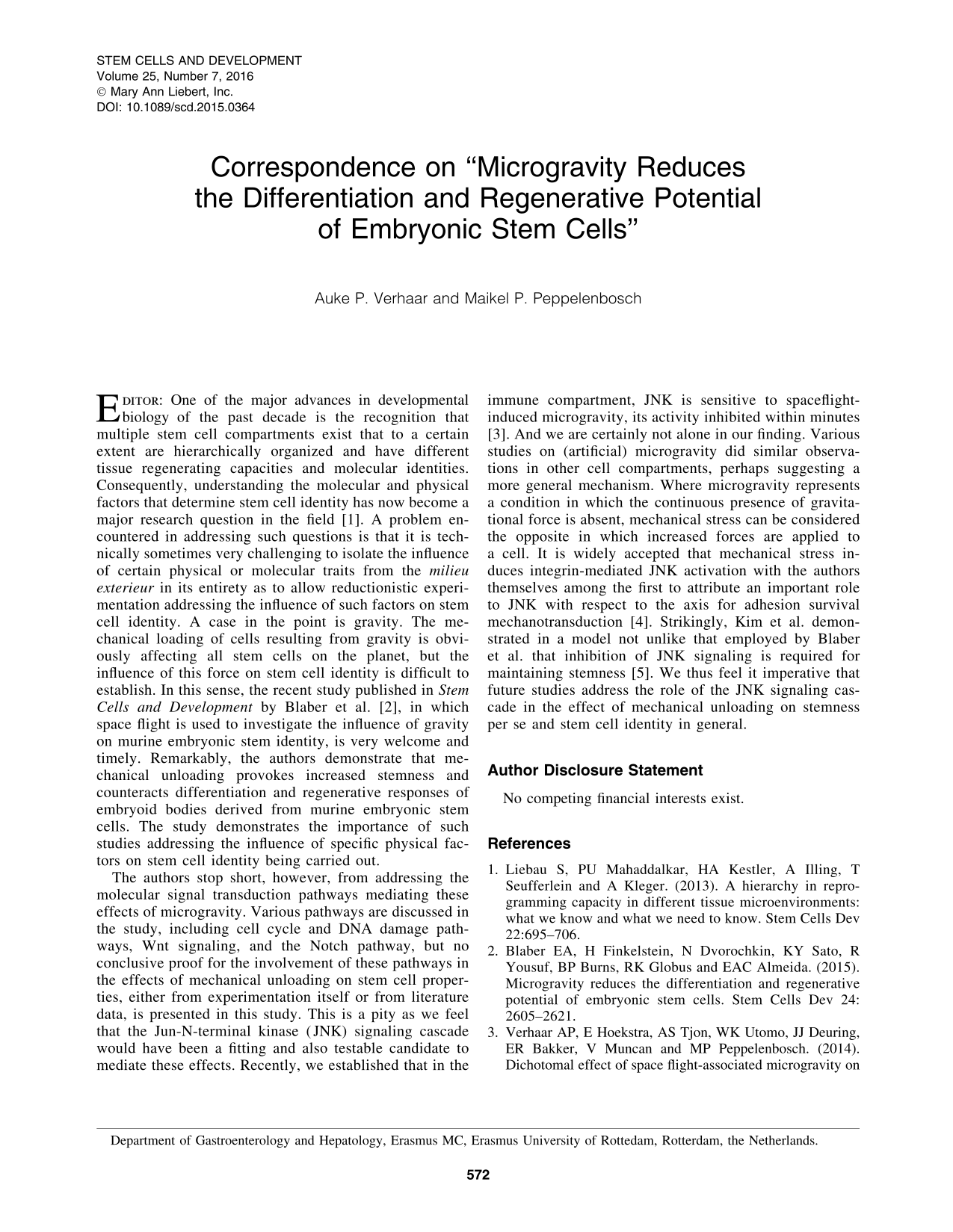
E
The authors stop short, however, from addressing the molecular signal transduction pathways mediating these effects of microgravity. Various pathways are discussed in the study, including cell cycle and DNA damage pathways, Wnt signaling, and the Notch pathway, but no conclusive proof for the involvement of these pathways in the effects of mechanical unloading on stem cell properties, either from experimentation itself or from literature data, is presented in this study. This is a pity as we feel that the Jun-N-terminal kinase (JNK) signaling cascade would have been a fitting and also testable candidate to mediate these effects. Recently, we established that in the immune compartment, JNK is sensitive to spaceflight-induced microgravity, its activity inhibited within minutes [3]. And we are certainly not alone in our finding. Various studies on (artificial) microgravity did similar observations in other cell compartments, perhaps suggesting a more general mechanism. Where microgravity represents a condition in which the continuous presence of gravitational force is absent, mechanical stress can be considered the opposite in which increased forces are applied to a cell. It is widely accepted that mechanical stress induces integrin-mediated JNK activation with the authors themselves among the first to attribute an important role to JNK with respect to the axis for adhesion survival mechanotransduction [4]. Strikingly, Kim et al. demonstrated in a model not unlike that employed by Blaber et al. that inhibition of JNK signaling is required for maintaining stemness [5]. We thus feel it imperative that future studies address the role of the JNK signaling cascade in the effect of mechanical unloading on stemness per se and stem cell identity in general.
Footnotes
Author Disclosure Statement
No competing financial interests exist.