




Abstract
Abstract
Commercial spaceport activities have been under study for more than a dozen years by governments and industry. For clarity in this article, the terms spaceport and launch site are interchangeable. Although the Federal Aviation Administration (FAA) issues a license for a launch site that covers safety of the launch operation, other safety activities such as 14 CFR Section 420.53 Control of public access, Section 420.59 Part c, Launch site accident investigation response plan, Section 420.55 Scheduling of launch site operations, and International Traffic in Arms Regulations Requirements and International Coordination Among Spaceports are left to the spaceport to manage. This study culminated a collection of publicly available policies, regulations, and procedures pertaining to commercial launch operations (which may be conducted at a joint air and spaceport). It is also a collection of other publicly published information from nongovernment sources. Principle Investigator Hynes and the author assembled a working group of colleagues and New Mexico State University (NMSU) graduate students who developed a listing of commercial spaceport activities and a taxonomy to structure that information. The PI interviewed all spaceport executives and the Range Commanders executives before developing the final taxonomy. A draft of this taxonomy was provided to all current spaceport managers and the Range Commanders Council, which consists of Army, Navy, Air Force, and NASA representatives, for review and comment to refine and improve the categorization. Once the taxonomy was finalized and named the Framework for Spaceport Operations, the working group began the collection of documents that could be used by commercial spaceports to establish their own procedures, standards and regulations. When there were limited number of documents available, appropriate aviation documents and standards were included as an aid. In order for the thousands of pages of documents to be searchable online by users, and to enable constant additions to the framework, and to assure the collection of websites remains active, the NMSU Library was selected to create a searchable digital collection. The working group collaborated with the digital librarians at NMSU Library to organize the documents within a content management system. The body of knowledge (BoK) for spaceport practices, accessible on the web through the NMSU Library Digital Collections (http://contentdm.nmsu.edu) by the public, is a tool to increase spaceport safety and reduce the duplication of implementing spaceport operational activities. The BoK is organized according to the framework, which has 12 categories (major areas) and >125 subcategories to enable a better understanding of the activities and responsibilities of a commercial spaceport. The working group has supplemented this list with appropriate procedures, standards, and regulations for many commercial spaceport activities. In 2015, definitions were created for all subcategories and included in the document management system. In 2016, two additional categories were included based on FAA Accident Threat Categories and Accident Groupings.
Introduction of the Research Problem
Objective of the Research
To develop an accepted, searchable, publicly available framework to capture a body of knowledge (BoK) for commercial spaceport operations and best practices; integrate into applicable documents and materials; enable documents to be found by title, subject, or keyword; and assure copyright protections.
Methodology
Public meetings were held to discuss framework variables. The early listing of categories was presented at the Commercial Space Transportation Advisory Committee (COMSTAC) meetings and briefings were given to additional industry groups.
The working group surveyed Federal Aviation Administration (FAA)-licensed spaceport executive directors and five federal range operators with the Range Commanders Council to obtain their input into the categories and subcategories.
As a result of this outreach, and research into previously prepared reports, the working group initially developed 10 commercial spaceport categories. The survey found that it would be beneficial to develop a collection that would allow a spaceport developer or operator to find and view examples of procedures and standards used by others in the aerospace industry. This would serve to reduce the cost and time needed to adapt standards, policies, and procedures to an individual commercial spaceport. It can also serve as a tool for educating new entrants into the field.
As commercial space transportation procedures and standardized documents are not currently available for each category and subcategory, the working group decided to accept some documents used by Federal Ranges (NASA and Air Force). In addition, (1) certain specific FAA standards (signage and runway markings, security procedures, etc.), (2) commercial industry association standards (e.g., National Fire Protection Association), and (3) European Space Agency documents were included as examples that could be adapted at commercial spaceports.
Description of the Current Spaceport Environments
Today's commercial space access systems do not employ standard systems that allow different commercial spaceports, ranges, and launch providers to interoperate in the seamless manner needed to stimulate a vibrant commercial space launch industry. This poses challenges for the long-term overall vision of interoperable commercial spaceport services, both from the perspective of the commercial spaceports and the commercial launch providers. Today's pattern of individual launch sites tailored uniquely to each commercial vehicle's design and operational infrastructure (similar to the way vertical launch systems are developed) will, at some time, give way to a new generation of interoperable commercial space launch products and services to fulfill the demand of the emerging commercial space industry. Ground operations standards and procedures will also evolve to support the long-term vision of interoperable spaceports.
With 10 FAA-licensed launch sites and three nonlicensed sites, the significant and growing technical, business, and professional communities involved in the development and operation of commercial spaceports have many common interests and needs. This includes common needs and interests between one another and with related professional communities, such as airports. Key near-term needs include the development of operational procedures, including fuel handling, safety risk management, and interface practices. Longer term needs include training and certification of personnel, promotion of policymaker awareness of policies, and regulations needed for fiscally viable, safe commercial spaceport operations.
Framework for Spaceport Operations
The working group developed a taxonomy that defined groups on the basis of shared characteristics and gave names to those groups.
The major categories were labeled as follows:
1.0 Airfield and Launch Operations
2.0 Site Security
3.0 Emergency Response
4.0 Visitor Management
5.0 Ground and Flight Safety
6.0 Environmental Management
7.0 Mission Readiness
8.0 International Traffic in Arms Regulations Requirements
9.0 International Coordination Among Spaceports
10.0 Self-Inspection
11.0 Accident Threat Categories
12.0 Accident Groupings
1.0 Airfield and Launch Operations
Airfield and Launch Operations consists of the standards, policies, and procedures for facilities during launch vehicle activities. The facilities include operational infrastructure (runways, terminal facilities, hangars, spaceflight preparation facilities, and launch and mission control facilities); ground operations services (fueling and propellant operations, deicing activities, and meteorology); and flight operations services (communication, navigation, and surveillance; spaceflight passenger preparation; launch vehicle and passenger departure, flight, and return; payload preparation; and air and space traffic management).
There were limited commercial documents publicly available for this area; however, there were useful NASA documents that were available that demonstrated the specific types of activities that were needed and that could be modified for commercial spaceport and launch operations. In addition, pertinent FAA documents were included in the database as a spaceport may decide to use these documents or they may be required at a combined air and spaceport. Commercial space launch vehicle activities were included in the framework only to the extent that there was a need for coordination with the spaceport as required by federal regulations.
2.0 Site Security
This category consists of policies for physical and electronic systems that may be used to ensure the security of the commercial spaceport. The subcategories included fencing and barriers, spaceport access (vehicles, deliveries, visitors, media, and private aircraft), restricted area access (on-site spaceport personnel, launch operator personnel, passengers, VIP visitors, general public, and media and international visitors), and security systems (badging procedures, video monitoring, aural and visual alarms, security patrols, and agreements with police and fire authorities). As several commercial spaceports are currently located remote from population centers, the FAA security requirements for small remote airports were included in this section as a low cost example for satisfying security requirements. It should be recognized that some documentation concerning site security may not be available, including security procedures and strategies.
3.0 Emergency Response
Any emergency incident at a commercial spaceport will result in a call to the spaceport's emergency officer/coordinator and require the spaceport to provide a response. Therefore, the categories within this include maintaining information and developing a relationship with local police and fire departments, developing support agreements with those departments, and developing a rescue and firefighting program that is consistent with the types of aircraft and space launch vehicles (and their propellants) that may operate from the commercial spaceport. The rescue and firefighting elements include vehicle accident response plans, spill response plans, and determining the type of rescue vehicles, medical personnel, and facilities required. There are also categories pertaining to training of first responders, establishing communications systems, and preparing an accident investigation and follow-on report.
4.0 Visitor Management
Commercial spaceports hope to encourage a state and regional visitor program. Therefore, subcategories were developed to describe visitor management activities, including visitor center management, accommodations, tours, concessions, medical care, air and ground transportation, and procedures for public and private events.
5.0 Ground and Flight Safety
Many ground and flight safety activities are required as a result of the FAA licenses for commercial launch operators and for commercial launch sites. However, there are some activities and procedures that are not highlighted in the FAA license application (e.g., safety during construction activities) or are left to the operator to develop. As the industry evolves, the framework could become a repository of these policies and procedures as they would track the development of commercial spaceports. These documents would be consistent with framework subcategories including commercial spaceport safety policy, the safety management system, ground safety (including motor vehicle safety, explosive material safety, evaluation of new commercial space launch vehicles, and encroachment by neighboring property owners), and flight safety (including mission planning and flight analysis, coordination of the mission plans, air traffic coordination, and certification/training of personnel), and system software safety.
6.0 Environmental Management
An environmental review is required for every major federal action, including the licensing of a commercial launch site within a spaceport. It must also be renewed periodically, with a review that will include new local, state, or federal laws and regulations that were established since the last review. These reviews often contain continuing environmental management requirements, including the need to study the habitats of endangered species that live near the spaceport or the need to continue coordination of planned spaceport activities with both governmental and nongovernmental authorities that own land nearby or operate nearby the spaceport. As a result of these continuous requirements, the maintenance of environmental information established during the first license application is necessary. The Environmental Management section contains subcategories for most of the possible environmental review areas, including hazardous materials, waste and substance activities, wildlife management, air quality, noise management, and environmental permitting.
7.0 Mission Readiness
The purpose of developing a category for mission readiness is to understand commercial spaceport responsibilities during commercial space launch operations. The subcategories include coordination outside U.S. airspace, communications with the space launch operator and licensing authorities, agreement on safety-related activities with the commercial space launch operator and local safety authorities, development of liability insurance and cross waivers, and, finally, weather planning.
8.0 International Traffic in Arms Regulations Requirements
International Traffic in Arms Regulations (ITAR) impacts commercial rocket launches, including the vehicle itself and the exchange of information between the vehicle and the ground. This impacts the commercial spaceport operator because of the storage of the vehicle and payload, and the launch operation of the vehicle at the spaceport. However, other spaceport activities that support the operation of the commercial launch vehicle, which may be similar to aircraft operations, (e.g., fueling and runway operation), are not covered by ITAR. Therefore, the category of ITAR includes the impact of ITAR on specific commercial spaceport operations and compliance requirements.
9.0 International Coordination Among Spaceports
This category includes information on international communication and coordination among commercial spaceports that may be useful in the development of the industry.
10.0 Self-Inspection
This category was included to identify the internal inspection program that would be needed at each commercial spaceport. The subcategories included the areas of operations, security, safety, and compliance. References included NASA, Air Force, and FAA self-inspection programs.
11.0 Accident Threat Categories
This category includes accidents caused by fuel tank ignition, launch/reentry/landing excursion, structural failure, flight deck layout/instrument confusion, and other areas that have been (or could be) the cause of accidents or incidents.
12.0 Accident Groupings
Four groupings represent significant opportunities for additional safety improvements. They are (1) loss of control, (2) controlled flight into an object, launch, (3) reentry operations, and (d) the human–automation interface.
Development of the Bok for Spaceport Operations
By partnering with the New Mexico State University (NMSU) Library for document management and description, the working group was able to house the BoK in a content management system. The library provides easy access to the online collection, document storage, linking to documents and websites, full-text keyword search capabilities, and rich description of each item, including the use of authorized subject heading from the NASA thesaurus. The items could be organized according to their placement in the framework, and users would have the option to filter their results at various levels of the framework.
Configuration of the BoK
The first step the NMSU Library takes with any new digital collection is a meeting with the project stakeholders to determine the needs and goals of the collection. This includes determining specifications for digitizing physical objects (when necessary), any special copyright or access issues surrounding the items in the collection, the metadata elements needed to best describe the collections for both the users' and administrative purposes, and workflows for the various tasks involved in creating the collection. To this end, the Library's Associate Dean and Metadata Librarian began attending the working group's teleconferences in early 2012.
Item Storage and Access
One of the first determinations to be made was regarding the presence of actual documents within the collection. Because the value of the project was not in the creation of new material but in the consolidation of material under the umbrella of the framework, it was a given that the material selected would already exist on the Internet or in some physical form. It was entirely feasible that the BoK could be a mere collection of links, classified according to the framework categories.
However, there were also continuity and historical considerations. First, it is not uncommon for websites to be reorganized in such a way that information that lived in one area moves to a very different area, sometimes with no redirection or easily followed historical path. It is also not uncommon for information on the Internet to disappear entirely. Having the BoK be a mere collection of links left the working group at risk of possibly presenting users with URLs that were valid and relevant when initially submitted to the collection, only to become utterly meaningless down the line. From a historical perspective, many scientific and technical documents are subject to revision and replacement during their lifespans, and documents that do not undergo revision and replacement may be found of interest long after their initial usefulness. Historical interest in the documents that were being consolidated in the BoK could mean an increase in the value of the BoK over the long term.
Not all of the items submitted to the BoK were documents, a great many were websites. If copyright restrictions prevented inclusion in the BoK, the item was included in the collection as a metadata-only record containing a link to the relevant resource. When a document was in the public domain or permission had been received from the copyright holder, a copy of the document was saved to the library's dedicated digital collections server and an access copy stored with the appropriate metadata in the BoK.
Metadata
The next step in the process was determining the metadata needs of the collection. The working group provided the library with sample documents over the course of the Spring 2012 semester, which allowed the library to familiarize themselves with the types of documents they would be working with and formulate ideas on description needed for effective user access to the materials. The library developed a set of metadata elements, based on the Dublin Core Metadata Scheme, which was taken to the working group for consultation and approval. See Appendix Table A1 for information on the metadata elements used in the BoK.
Item Organization in CONTENTdm
Metadata provided the solution for the major challenge that the library faced in the creation of the BoK. The BoK needed to be organized according to the levels of the framework, which was a challenge due to the nature of the CONTENTdm software. CONTENTdm only allows for grouping items at a “collection” level, which would allow for grouping resources according to the top categories of the framework with no option for grouping according to subcategories. Because neither the library nor the working group had the resources to invest in the acquisition and configuration of new software, it was incumbent upon the library to find a means for organizing the BoK properly.
A partial solution came in the form of locally created metadata fields. The library created five fields to contain information related to the framework levels (Fig. 1). The Framework Category field is visible to the user and indicates the lowest framework level into which the item is parsed. The Top Category, First Subcategory, Second Subcategory, and Third Subcategory fields are not visible to the user and indicate all the levels of the framework into which the item is parsed. Therefore, the metadata for an item whose final parsing is into Category 5.5.1 would also include indications that the item fits into the Top Category 5.0 and the First Subcategory 5.5.
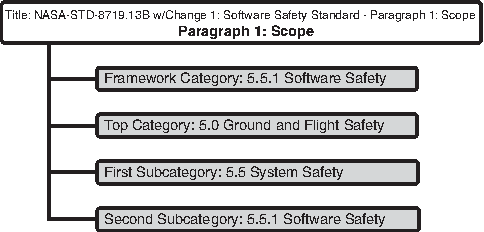
Metadata fields showing framework parsing.
The Top Category, First Subcategory, Second Subcategory, and Third Subcategory fields are what make navigating the collection according to the framework levels possible. Although users always have the option of browsing the entire collection, having these fields in the metadata made it possible for the library to set up custom queries that allow users to browse the collection according to the top categories of the framework and filter their browsing according to the lower level categories.
Workflow
Once the needs and configuration of the collection had been established, it was necessary to develop a workflow for submitting items to the library for inclusion in the collection. Working group members had volunteered to find items for different sections of the framework and needed a procedure for transmitting the relevant information to the library.
The library developed a workflow by which working group members could submit to the library the basic information that the library would need to find the items, retain copies where permissible, and begin the metadata creation and item submission process. This information included the title of the item, the URL where the item could be found, the organization or agency where the item originated, and the framework category into which it parsed. Because some of the items contained highly specialized content, the library also asked the working group's assistance in determining the content through brief descriptions of the items. These descriptions were helpful to the Metadata Librarian in determining subject headings, and were subsequently entered into the metadata to help users determine the relevance of the item to their needs. The library also asked the working group to make note of any special circumstances surrounding the item, such as its supersession of, or relation to, another document. The library felt that these pieces of information would be either easily apparent to the working group members during item selection or may have even played a role in item selection, and wished to avoid the duplication of effort that would have resulted from the working group members submitting a mere title and URL. As working group members had been made aware of all the metadata fields that were to be used in the collection, they were welcome to submit information for any of the other fields that they wished.
Once the Metadata Librarian had received the necessary information from working group members, she went about the tasks that would ultimately conclude with the inclusion of items in the BoK. The first step was to view each item and determine the form that the item would take within CONTENTdm. As already noted, there would be cases wherein it would be permissible to store copies of the documents in the BoK with their corresponding metadata. In the cases wherein it was not permissible to have a copy of the document in the BoK, or if the item submitted to the library was a website, the item would appear to BoK users as a metadata-only record, containing only the metadata and a link to the website or document location. As these cases had slightly different processing requirements, it was necessary to know which case an item fits in to put it in the appropriate queue.
For items wherein a copy of the document would reside in the BoK, it was necessary for the Metadata Librarian to find and save copies of the items to the library's dedicated digital collection server. As the working group proceeded with item selection, they found that in some cases, only a specific chapter or section of a document was relevant to a certain framework category, with the rest of the document being more appropriate for other categories or wholly unnecessary. Having an unnecessary or unnecessarily duplicated document in the system would be burdensome both to the user (in terms of possibly having to move through irrelevant information to reach the relevant) and to the system (in terms of the amount of storage space that would be wasted on unnecessary information). It was agreed that in these cases, it was acceptable to isolate the relevant sections from their larger documents. When necessary, this isolation took place as part of the process of saving documents to the library's server.
Once the items submitted to the library by the working group had been sorted appropriately, the librarian used Excel spreadsheets to complete the metadata begun by the working group for each item. This included the assignment of subject headings; determining entities involved in the creation of and contribution to the item; determining and recording rights information; ensuring that all of the fields pertaining to the framework categories were completed; and recording administrative metadata related to file formats, the source of the material, and the project personnel (both from the working group and the library) who worked on submitting the item to the BoK. The working group had responsibility for final approval of items to be included in the BoK.
The work that took place in the library during the Spring 2012 semester was that of configuration and preparation in advance of full-swing submission of items to the BoK. That work began in earnest during Summer 2012 and the Metadata Librarian was able to focus exclusively on the BoK for a period of 10 weeks. This period served as a sort of pilot project phase of BoK construction. The working group focused on Framework Category 5.0 Ground and Flight Safety, for their selection and submission activities, and the library focused on processing those submissions and configuring the user interface for the collection.
Applicability of Copyright Laws to the Research Project
As part of the review process, the working group, in conjunction with the NMSU Library, reviewed copyright requirements for the resources being considered for inclusion in the BoK and found that there would be copyright limitation on the use of some of the resources. For these items, the working group (1) identified the individual who would be authorized to extend permission and (2) sent a written request for a nonexclusive, irrevocable, and royalty-free permission, not intended to interfere with other uses of the same work by the copyright holder. As part of the permission requests, the working group explained the project's educational purpose and offered to include a full citation to the work and other acknowledgments as the copyright holder requested.
Of the 221 resources in the BoK, 38 were determined to require permission from the copyright holder. Sixteen initial permission request letters were sent to 16 entities and several follow-up letters have been sent. The letters, permissions received, and conditions attached have been tracked in an Excel spreadsheet. The working group has not yet received responses to some of their requests. In these cases, the resource is currently included in the BoK, with a notation that the working group is awaiting communication from the rights holder regarding copyright permissions.
For more information about copyright law in the United States, please visit the United States Copyright Office (www.copyright.gov)
Limitations of the Study
As work progressed on this study, several limitations were noted. These include the difficulty of organizing the resources in CONTENTdm according to the framework and copyright restrictions on some of the resources that the working group wished to include in the BoK, both previously discussed. Another limitation that the working group encountered was the reluctance of currently licensed commercial spaceports or launch operators to allow the inclusion of their operational documents in the BoK. This occurred as a result of the competition between spaceports for the opportunity to launch new commercial space launch and reentry vehicles. The procedures that each commercial spaceport develops may affect their costs and may increase or limit commercial launch operations. Therefore, currently licensed spaceports consider their policies as part of their competitive advantage and were reluctant to provide data for this study. Finally, it has also become apparent that more work is needed to check for broken website links. Having “broken” links frustrates users and decreases the value of the BoK.
Future Considerations for the Study
It is the working group's hypothesis that in a complex system, the existence of the BoK will be a major tool to reduce cost and maintain safety when implementing multiple commercial space missions from a single commercial spaceport. Therefore, 24/7/365 access to the BoK will enable faster work flow for commercial vehicles operating from multiple commercial spaceports, increase commercial spaceport interoperability, and enhance collaboration, innovation, and creativity.
Spaceport developers and operators who work with each other and with launch providers to develop a robust system capable of handling a variety of vehicles will be the leaders of the emerging commercial space transportation industry. Commercial spaceports and commercial space launch operators will need to respond to each other as the commercial market and current technology will drive design considerations. As new spaceports are developed and perhaps point-to-point operations become a reality, substantially more cooperation will be needed between commercial spaceports and launch operators. A reasonable assumption of the commercial space transportation industry is that there will be new facilities developed that support these commercial activities. As more commercial facilities come online, key components of spaceports systems, related interfaces, and operations should be identified to help establish future requirements.
As this work moves forward, spaceport developers will likely benefit from an examination of lessons learned within the aviation industry, including the National Airspace System that standardizes air traffic operations throughout the United States.
A new survey and analysis should be conducted to compare the Commercial Spaceport Framework with the activities accomplished at commercial spaceports. This could result in an updated set of categories, subcategories, and supporting documents that would keep the framework current. Based on experience during development of the framework, it will be necessary to motivate the commercial spaceports to share their processes under some form of controlled disclosure to be successful.
In the future, the working group would like to see surveys conducted to determine the adequacy of the framework from the point of view of commercial spaceports, and the framework revised accordingly. In addition, an effort should be undertaken to increase the number of documents included in the BoK that are used by the U.S. government, commercial associations, or international organizations.
Footnotes
Acknowledgments
This work was conducted under a grant from the FAA Center of Excellence for Commercial Space Transportation administered by the New Mexico Space Grant Consortium. The development of a framework for commercial spaceport practices was accomplished by a workgroup consisting of the author and coauthor of this article. The work was further supported by the American Institute of Aeronautics and Astronautics (AIAA) and the Boeing Company during their contract with Kennedy Space Center. We very much appreciate their participation and support. This article is adapted from two articles that were presented to the International Astronautical Congress (IAC) in 2014 and 2016. All errors and omissions are the responsibility of the author.
Author Disclosure Statement
No competing financial interests exist.
Metadata Elements Used in the Body of Knowledge
| Metadata element | Dublin core or locally created | Purpose |
|---|---|---|
| Title | Dublin core | The title of the item |
| URL | Locally created | The URL where the item can be found, regardless of whether there is a copy of the item in the system |
| Framework category | Locally created | The lowest level of the framework into which the item parses |
| Special note | Locally created | Any special information surrounding the item |
| See also | Locally created | Information on other resources relevant to the item |
| Is part of | Dublin core | The title of the whole document when an item is an isolated chapter or section |
| Subject | Dublin core | Subject headings assigned to the item |
| Description | Dublin core | A brief description of the content of the item |
| Creator | Dublin core | The entity primarily responsible for the intellectual content of the item |
| Contributor | Dublin core | The entity(ies) responsible for making contributions to the content of the item |
| Originating institution | Locally created | The institution in whose collection team members found the item |
| Date original | Dublin core | The original publication date |
| Date effective | Dublin core | The date effective (if applicable) |
| Date modified | Dublin core | The date modified (if applicable) |
| Expiration date | Locally created | The expiration date (if applicable) |
| Audience | Dublin core | The intended audience for the item |
| Identifier | Dublin core | The alphanumeric string by which the item is identified (either locally or on the Internet) |
| Type | Dublin core | The item's content type (text, still image, etc.) |
| Format | Dublin core | The file format of the original item (not any access copies) |
| Source | Dublin core | The source of the item |
| Language | Dublin core | Any languages that item content appears in |
| Rights | Dublin core | Rights information for the item |
| Top category | Locally created | The top-level framework category into which the item parses |
| First subcategory | Locally created | The first framework subcategory into which the item parses |
| Second subcategory | Locally created | The second framework subcategory into which the item parses (if applicable) |
| Third subcategory | Locally created | The third framework subcategory into which the item parses (if applicable) |
| NMSGC personnel | Locally created | Team personnel who worked on the item |
| Library personnel | Locally created | Library personnel who worked on the item |
| Digitization specifications | Locally created | Information on how the item came to be on the library's server (either through digitization or saving) (if applicable) |
In addition to the elements already listed, CONTENTdm has a number of administrative fields pertaining to activity dates and system identification numbers that are automatically populated and modified.
NMSGC, New Mexico Space Grant Consortium.