




Abstract
Abstract
Debates over U.S. space policies often focus on the potential economic outcomes of funding a civilian space agency. NASA has consequently become an outlier in a political climate that has generally eschewed active industrial policy and this makes space policy a rich research context in which to weigh a more assertive national industrial policy. A historical analysis of the case of NASA's Commercial Orbital Transportation Services (COTS) program through the lens of industrial policy concludes that it offers a valuable model for national industrial policy. While governmental regulation, ambiguity, and opposition are found to have stymied several efforts, these firms are found to have significantly contributed to the eventual success of follow-on firms. The analysis concludes that the COTS model should be adopted as the default approach for NASA missions where proven technology is sufficient and commercial markets are identifiable, but where specific domestic capabilities do not yet exist to meet the agency's needs. Traditional, cost-plus contracting models should be reserved for missions where the technical risk is significant and markets are unidentified. More importantly, the COTS model should be applied beyond the space agency to leverage necessary taxpayer investments in many areas into further economic development.
Introduction
As U.S. politicians revisit the advantages of an active national industrial policy, space policy serves as a valuable case for analysis. Debates in the U.S. space policy realm frequently focus on the economic externalities generated by work at our national space agency. Specifically, do taxpayers get concrete returns from their investment in NASA's missions of exploration and science and, if so, how significant are those returns? Politicians seeking justification for these investments, often to belie their obvious regional interests, usually focus their arguments on the direct employment of workers in these programs and the fruits of technology “spin-offs.”
The direct labor argument is compelling primarily to politicians and their local constituents. The wages generated in developing or building spacecraft are primarily valuable to the states where the NASA centers or contractor facilities are located. Opponents of these expenditures find fertile ground in arguments of opportunity cost. It is always difficult to argue for funding government workers over leaving those funds in the hands of efficient private sector actors; all the more so when the fruits of their labor are going to literally be blasted into space.
The development of products such as memory foam, critical support for emerging industries such as solar photovoltaic power, and contributions to major infrastructure systems such as GPS and the Internet better illustrate national and even global economic returns from space investments. However, the value of these spin-offs has been notoriously hard to quantify.
Active Industrial Policy: the American System
The debate over the benefits and risks of an active national industrial policy has a long history. Alexander Hamilton, James Madison, and Thomas Jefferson sparred over these concepts over 200 years ago. Hamilton's Report on the Subject of Manufactures 1 presented to Congress in 1791 presumed that the nascent United States had a strategic, national, economic, and defense interest in moving from an agrarian colonial economy toward a modern manufacturing-based one. Hamilton and others at the time felt that a resource-based economy would be subject to continual predation and manipulation by the European powers.
Hamilton's plan for accelerating United States' development of a manufacturing economy called for protecting developing U.S. manufacturers via tariffs, building and maintaining physical infrastructure conducive to industrialization, and establishing a financial system to support commerce. While Madison's opposition kept Congress from officially adopting Hamilton's policies, they were widely acknowledged as prudent and were enacted in practice. Hamilton's recommendations established the foundation for the “American (Economic) System.”
The American System dominated the U.S. economy during the rapid industrialization of the 19th and early 20th century. The system featured internal free markets and focused on the power of capitalism and competition to create efficiencies but maintained a nationalistic approach to strategic industries and trade. The United States maintained high tariffs, subsidized railroad and telecommunications construction, and developed a system of managed central banking via the Federal Reserve. The U.S. government openly favored domestic suppliers over foreign ones.
Despite the British advocacy of Free Trade theory, the American System was judged successful by pragmatic observers. The American System was adopted by Japan during the Meiji Restoration and from there it spread to the post-war “Asian Tigers” (Taiwan, Korea, etc.) and eventually to China. The historical record suggests that this system was very effective in these countries, creating new wealth, propelling agricultural-based economies into technology powerhouses, and lifting millions out of poverty. At the same time, the United States moved toward the British Free Trade System with arguably less robust results. Declining U.S. economic growth and living standards have compelled a shift in U.S. politics with leading presidential candidates Bernie Sanders and Donald Trump echoing Hamiltonian themes in their campaigns.
Today'S Space Market
The recent history of space policy and its outcomes offers an informative historical perspective on public policy geared toward private returns. Space launch and satellite operations generate over $300 billion a year in global economic activity. 2 The space business is experiencing increased growth, investment, and competition as Silicon Valley entrepreneurs and investors pile into space launch, communications, Earth imaging (remote sensing), and tourism. According to a 2016 report from the Space Foundation, commercial (nongovernmental) space activities accounted for $126 billion in 2015. The biggest sector in the commercial space market is communications, with satellite TV being the single largest business. Lately, Internet and remote sensing/Earth imaging constellations have been major areas of growth, along with big data analysis of the multispectrum data from these systems.
While at first glance, today's space market may seem like a capitalist's dream, there is no other major field of commercial endeavor that has been more tightly controlled by government than the business of spaceflight. New industries are defined not just by their technologies and possible applications but also by the nature of their founding entrepreneurs and investors. Robert Goddard's initial experiments in liquid fueled rockets were supported by grants from the Smithsonian. If he had been able to secure major private investment to pursue the commercial applications of rocketry in the 1930s, the history of space would be very different. Sadly, the development of rocketry moved to Germany where Von Braun secured support from the Nazi regime. The conversion of Von Braun's A4 rocket into Hitler's Vengeance Weapon 2 (V2) and its success in causing death and destruction hundreds of miles away ensured that the development of rockets would be tightly controlled. The fact that the V2 was arguably the first (suborbital) spacecraft was lost in the panic over “death from above.” When Russia orbited the benign Sputnik probe in 1957, it was immediately viewed as a threat and created a panic in the West that its political backers in Moscow had intended. The “space race” was officially launched and the upside to this was massive government investment in rocket and satellite technologies.
Enter “New Space”
The modern dream of private, commercial access to space and spaceflight accessible to the general population is commonly referred to as “New Space.” The New Space movement can be traced back to the activities of aerospace engineer Robert Truax in the 1960s. 3 Truax and his “Project Private Enterprise” received the first New Space equity investment from motorcycle stuntman Evel Knievel in 1975. * The early 1980s saw several serious attempts to deploy privately funded launch systems, including Space Services, Incorporated's (SSI's) Percheron, which blew up on launch in 1981 and the sea-based Dolphin rocket, which made three failed launch attempts off the coast of California. These efforts culminated in the successful suborbital flight of SSI's Conestoga rocket in 1982.
The Conestoga was funded with $6 million in Venture Capital, a New Space first, but one that was hardly free of governmental involvement. Government policy was both crucial to the success of the Conestoga and its downfall. Conestoga's engine was a surplus government-designed and government-procured Minuteman ICBM motor purchased from NASA under a creative lease agreement. 4
The participants recall that the approval process for the vehicle was extremely difficult. Despite the success of the first flight, additional funding was not forthcoming as further flights of Conestoga vehicles were delayed by “the regulatory environment and government policy” (Butrica, 1998). 5 In 1985, SSI managed to procure the first license from the U.S. government to fly commercial payloads on private rockets, but by 1990, the firm was forced to abandon the launch services market. SSI was purchased by EER systems.
EER entered an agreement with NASA for launching orbital experiments under the Commercial Experiment Transporter (COMET) program. The original Conestoga's ICBM motor design could not support a sustainable commercial business model. The design for the new orbital Conestoga 1620 shifted to commercially procured Castor engines. The first 1620 attempted to launch from NASA's Wallops Flight Facility in October of 1995. Control was lost due to a hydraulic failure and the rocket was remotely destroyed by range safety. 6 NASA abandoned the partnership and the COMET program after this single failure. 7
State-Owned Enterprise: the Promise and Reality of the Shuttle
Meanwhile, the government, confident with its success in the Apollo program, was envisioning a nationalized space launch solution, the Space Transportation System, also known as Space Shuttle. STS was originally conceived as an “all things to all clients” solution, providing both crewed flights to undetermined locations in Low Earth Orbit (LEO) and a platform for delivering military, commercial, and scientific satellites to orbit and beyond. The shuttle's partially reusable design promised to save money and provide for a rapid launch cadence from both Florida's Kennedy Space Center and California's Vandenberg AFB.
Transitioning success from Apollo's bold goal-oriented program (beat the Russians to the moon) to a business services model turned out to be a bridge too far for NASA. The resulting government service was more reminiscent of Amtrak. The shuttle was supposed to carry up to 27,500 kg to LEO and do it regularly, at historically low prices. Forty flights a year were proposed with payloads delivered for prices as low as $118 per pound. 8 Throughout the 1970s and early 1980s, NASA and their contractors promoted the shuttle as a super-cheap, reliable service. The prospect of subsidized competition from an immensely credible source repressed private investment in the United States and international commercial launch systems. NASA was frequently accused of intentionally subverting potential private sector competition.
The complexity of the shuttle system resulted in logistical nightmares and reliability problems producing an actual launch cadence of a bit more than four times a year. This order of magnitude drop in flight volume and an accompanying increase in capital costs drove the cost per shuttle launch into the stratosphere. Critics now suggest that the average fully capitalized shuttle flight, priced out at around $1.5 billion, 9 making the cost per pound well over $20,000. Even the supporters placed the price at about $10,000 per pound, still far from competitive with low-cost international competitors, such as Russia's Proton or China's Long March rockets. While as Jeff Greason commented, “Apollo proved that America could do communism better than the Soviet Union,” the shuttle apparently proved we could not do state capitalism as well as the Russians or the Chinese.
Attempting to Re-Embrace Capitalism
A few years of shuttle operations made it clear to the U.S. government that this government run system could not meet the United States' growing need for commercial launch services. Meanwhile, space entrepreneurs such as SSI were frustrated with the process of obtaining approval from an ill-defined bureaucracy. Nobody knew who in the Federal government could authorize a launch, but there seemed to be a number of folks who felt they were authorized to stop one from Federal Aviation Administration to the Department of Alcohol Tobacco and Firearms.
Reacting to this, Congress with the support of the Reagan White House produced a bipartisan solution in the form of the 1984 Commercial Space Launch Act. Part of the original genesis for the act was a proposal by Rockwell for them to fund the construction of an additional sixth shuttle that would provide the additional launch capacity to allow for commercial flights, including flights of paying commercial spaceflight participants or astronauts (author's discussion with former Science and Technology Committee Chairman, Robert Walker, September 5, 2017). The Act acknowledged the reality of the emerging commercial sector by directing the Secretary of Transportation to establish a single point-of-contact solution for the licensing of commercial space launches. Clearly recognizing the potential importance of entrepreneurship in developing U.S. space capabilities, the Act also directed the Secretary to “promote economic growth and entrepreneurial activity through utilization of the space environment for peaceful purposes” and even “encourage, facilitate, and promote commercial space launches by the private sector.” 10 An amendment to the Act added in 1988 provided for liability sharing in keeping with international treaty obligations.
On January 28, 1986, the Space Shuttle Challenger (OV-99) was launched on STS-51L. A leak in one of its solid rocket boosters triggered the explosive release of cryogenic fuel and destruction of the orbiter about 70 s into the flight. The loss of this vehicle and its crew changed everything. The shuttle program was grounded for nearly 3 years, dramatically increasing the backlog of satellite launches. This loss of launch capacity left no doubt that plans to use the shuttle as a national, all-purpose space vehicle had been terribly misguided.
Circumstances looked ripe for the development of a commercial market. The United States had several viable private rockets in development, strong market demand, and an attractive regulatory environment. However, none of this could overcome the rift the shuttle model had created with the private sector and the investment community remained shy. Institutional investors and venture capitalists avoided space and eagerly pursued booms in other technologies, notably personal computer software and eventually Internet start-ups. Ironically, the new tech boom had its roots in technologies developed by or for the space program. 11
While no new firm received adequate funding to replace the shuttle's role in commercial satellite launch, the United States' legacy stable of Delta IIs, Atlas IIs, and Titan IVs was aging and too expensive to operate. The launch business for commercial satellites that the United States had pioneered moved overseas during this period. The DOT's new Office of Commercial Space Transportation (AST) had very little to actually license during its first decade.
Chinese Spying Leads to a Shotgun Wedding
The U.S. commercial, scientific, and even national security payloads were forced to find foreign launch providers and China's state-owned launch company, Great Wall Industries, was extremely willing to accommodate. A series of failures of Long March rocket failures in the 1990s culminated with the 1996 loss of a Loral Space and Communications satellite. The Long March 3B carrying Intelsat 708 plowed into a village shortly after launch. Not only was the satellite a loss but the Washington Post reported the rocket as, “obliterating the hotel where Western observers had dropped off their luggage only hours before,” and that “U.S. defense intelligence officials estimate the deaths at about 200” (locals on the ground). 12
Later Congressional investigations revealed that technology from the Intelsat 708 launch had been compromised before and possibly after the event (the encoder board was never found). Further in an attempt to correct the problem, the U.S. firms had subsequently transferred rocket control technologies to the Chinese rocket builders, potentially enabling China to improve both their space launch vehicles and related ICBMs. 13 Dependence on foreign rockets was clearly not going to be a viable national policy from a national security perspective.
In the 1990s, the Air Force launched an effort to resolve this situation for DOD and other secure government payloads. The plan was to move from an “oversight-based” to an “insight-based” model with at least two competitive U.S. launch vehicles vying for government business. It was presumed that modern designs and market competition would drive down costs 25%–50%, and provide system redundancy and reliable launch cadence. The technical result was the development of the Boeing Delta IV and the Lockheed Martin Atlas V rockets. 14 Both of these vehicles, particularly the Atlas V, have served as reliable workhorses for U.S. governmental launch needs.
The business result was an ugly spat between the prime contractors that devolved into a lawsuit filed by Lockheed against Boeing in 2003, alleging their rival had obtained its bid documents via industrial espionage. 15 Worried that the United States' access to space might be determined by a court, the White House moved to prevent a disaster. At the end of 2004, the Bush administration issued National Security Presidential Directive 40 on the subject of “U.S. Space Transportation Policy” restating that “assured access to space” was a requirement for national and homeland security and provided to:
fund the annual fixed costs for both launch services providers unless or until such time as the Secretary of Defense, following coordination with the Director of Central Intelligence and the Administrator of the National Aeronautics and Space Administration, certifies to the President that a capability that reliably provides assured access to space can be maintained without two Evolved Expendable Launch Vehicle providers.
Under pressure from the government, Boeing and Lockheed Martin announced plans to transfer their launch systems into a new 50–50 joint venture, United Launch Alliance (ULA), on May 2, 2005. The business officially launched in December of 2006 16 with the firms promising to lower launch costs via economies of scale and removal of duplicate administrative functions. The reality was that this monopoly business resulted in continual increases in launch costs, with the Atlas V going from just over $100 m per launch to an apparent $400 m per launch by 2017. 17 This monopoly solution has faced political and legal challenges from new players.
Using an RD-180 engine from Russian engine-maker NPO Energomash lowered ULA costs and increased operational efficiency for the Atlas. 18 As the U.S.—Russian relationship soured in the 2010s, the engine dependency became a lightning rod of national security concerns. This resulted in several attempts by Congress to ban the import of the engines and compel ULA to replace them with a U.S. built alternative. 19 The firm currently appears to be on track to adopt Blue Origin's BE-4 motor for its upcoming Vulcan rocket. 20
The Clipper, the Gambler, and the Tourist
The 90s saw some notable side stories that pushed commercial possibilities forward, including the development of the McDonnell Douglas Delta Clipper rocket (DC-X) and the Lockheed-Martin X-33 suborbital spaceplane. The DC-X rocket notably took off vertically, transitioned horizontally, and returned to its pad to land on its tail and be reused. DC-X had its origins in the general pursuit of the elusive goal of a reusable single-stage-to-orbit (SSTO) vehicle, a practical rocket such as those in science fiction films that could take off, land, and launch again with little more than refueling. The push for DC-X involved significant influence from outside advocates, notably science fiction author Jerry Pournelle and a group called the Citizens' Advisory Council on National Space Policy. Pournelle and a handful of others were able to get the ear of Vice President Dan Quayle who headed up the National Space Council. With Quayle's support, the DC-X program was fast tracked as part of the heavily funded Strategic Defense Initiative (SDI/“Star Wars”) missile defense system. 21 Like much of SDI, DC-X never fulfilled its goal of reaching orbit but made major technical contributions and demonstrated surprising capabilities that inspired the modern commercial reusable boosters from SpaceX and Blue Origin.
A significant commercial space effort was launched in 1997 by Texas banker, amateur mathematician, and poker player Andrew Beal. Beal's team aimed to mass produce simple orbital rockets using noncryogenic fuels and oxidizers. Beal's effort quickly collapsed. Beal's program was criticized by many for design choices, such as the selection of hydrogen peroxide as an oxidizer, as well as for management failures and difficulties in procuring launch sites.22,23 Beal himself blamed competitive pressure from traditional firms subsidized under the DOD's EELV program and NASA's SLI plan as the cause when he shut down operations in 2000. He remarked:
While Beal Aerospace recognizes the need for NASA to develop a human rated launch capability for space station and other human missions, we find it inexcusable and intolerable that NASA intends for these subsidized systems to additionally compete for non-human rated missions including cargo for the space station and commercial satellite missions. We wonder where the computer industry would be today if the U.S. government had selected and subsidized one or two personal computer systems when Microsoft, Inc. or Compaq, Inc. were in their infancy.
Beal's firm left rocket motor test stands and other infrastructure in McGregor, Texas. This facility was later purchased by SpaceX and became the primary engine testing facility for Elon Musk's firm. 24 Similarly, SpaceX's primary facility in Hawthorne, CA, was an abandoned aircraft assembly plant and most of the workforce were left behind when Boeing and others abandoned the once legendary Southern California aerospace manufacturing hub.
An important lesson for industrial policy makers is that failures of new and incumbent firms are a natural and required part of the entrepreneurial process. All firms operate in a competitive ecosystem, where very little goes to waste. While all firms eventually die and some may go quickly, they invariably contribute at the environmental level to the success of future organizations by providing valuable infrastructure, technical and market knowledge, and trained workers. The act of their failure contains important information for current and future competitors.
The X-Prize provided credibility for the supply-side possibilities of commercial spaceflight. The demand side of the market was demonstrated with the advent of a paid space tourism business in the early 2000s. In the late 1990s, U.S.-based Mir Corp worked with the cash strapped Russian Space agency on arrangements to send a U.S. citizen, Dennis Tito, to the former Soviet Space Station, Mir. The U.S. government and NASA pressured the Russians to concentrate their efforts on their contributions to the new International Space Station and to keep their Soyuz flights limited to that effort as well. Despite signing an agreement with Mir Corp and having the station refitted for commercial use, the Russians deorbited the old station in March 2001.
Undeterred, Tito began working with another U.S. firm, Space Adventures, on a tourist flight to the International Space Station. His effort faced significant opposition from the United States and other ISS partners. NASA's opposition was particularly noteworthy, highlighting a lack of agency support for commercial ventures at the time. While the agency publicly stated that their concerns were centered around the professional training and capabilities of the space tourists to assist in emergencies, a Space Adventures executive remarked that “They put up everything that they could throw in the way to make it not happen.” 25 Robert Cabana, Chief of the Astronaut Office, notably refused to train the entire Russian cohort for the Soyuz TM-32 mission and stated, “We will not be able to begin training, because we are not willing to train with Dennis Tito.” 26 Nonetheless, Tito trained at Russian facilities and flew to the ISS in April 2001.
NASA's opposition to space tourism softened following Tito's successful mission and changes in leadership at the agency. Space Adventures flights to the station continued, primarily constrained by space on Soyuz flights. The Soyuz seats became an insurmountable problem following the end of the Space Shuttle program with NASA buying up all available Russian capacity to ferry U.S. astronauts to the station.
In 2001, Elon Musk founded Space Explorations Technologies (SpaceX), another commercial space launch start-up. Musk began work on a small orbital payload launcher, the Falcon 1. The firm's ambitions were originally accommodated by the United States Air Force, which promised to provide facilities and a launch pad at Vandenberg AFB on California's central coast. After the firm contracted and paid for the space, the DOD ousted the start-up, citing national security launch requirements for prioritizing launches of Lockheed-Martin's Atlas V rocket at the site.
SpaceX was forced to relocate to the much less convenient Pacific atoll of Kwajalein. 27 The additional cost of logistics and launch failures associated with corrosion in the hot and salt sprayed environment on that remote island nearly bankrupted the nascent space launch firm. Still, the fundamental willingness of the Air Force to host launches from an unproven start-up (even at a suboptimal location) and to actually provide a small payload from the Air Force Academy gave the project a rare opportunity and the association bestowed legitimacy on SpaceX's efforts.
Columbia, Griffin, and the Miracle of Commercial Orbital Transportation Services
While the commercial launch market had moved on, NASA had remained very dependent on the Space Shuttle for material resupply of the International Space Station and for transportation of crew to and from the station. Following the loss of the shuttle Columbia in 2003, the STS program was again suspended for over 2 years. The station was suddenly dependent on Russian Progress vehicles for any large-volume resupply and entirely dependent on Soyuz for crew transportation.
Meanwhile, the newly appointed NASA administrator, Michael Griffin, searched for a solution to the ISS resupply while the agency worked on its new Ares launch system, designed for deep space exploration. 28 While Ares and the Orion capsule could do the job, using deep space hardware on routine missions to LEO was an expensive proposition and could distract from bolder exploration plans.
Some at NASA advocated using the technology behind the X-37 (an Air Force uncrewed space plane) or the X-38 (a “lifeboat” crew vehicle conceived for ISS) as a cargo ferry system (discussion with Chris Shank September 8, 2017). These programs were fairly far along in design and compatible with existing launch systems, such as the Atlas V. These solutions looked like they could have been deployed faster than a commercial one. Furthermore, getting a government or military supported solution approved would surely have been quicker than launching a new commercial endeavor.
However, in 2004, Scaled Composites succeeded in launching a privately funded crewed spacecraft, SpaceShipOne, after only 3 years and at an incredibly low cost (est. $24 m). The suborbital SpaceShipOne system had been developed by Scaled Composites at the Mojave Air and Space Port specifically to win the $10 million Ansari X-Prize. The X-Prize Foundation also achieved its goal of advancing access to space for all when Virgin founder Sir Richard Branson stood on a Mojave taxiway immediately after a SpaceShipOne flight and announced the formation of his space tourism venture, Virgin Galactic.
In addition, the success of the X-Prize as a motivator to engage outside private investment and accomplishment inspired some Congressional staffers who then convinced NASA leadership to consider prizes as a tool to rapidly advance a commercial solution.
Griffin appreciated the prize motivation concept, but his business education led him to be wary of a “one off” approach and envisioned a more reliable solution: establishing a milestone-driven reward system that could move vendors toward the goal, keep them solvent, and help them to secure private funding. In fact, one of the first milestones would be a requirement for such outside funding, leveraging NASA credibility to reduce the agency's actual investment in the required launch systems (discussion with Chris Shank September 8, 2017).
Furthermore, Griffin understood that the Commercial Orbital Transportation Services (COTS) solution went beyond simply solving NASA's immediate needs. In 2004, he summarized the concept of using NASA's station resupply requirement as an “anchor customer” for giving new commercial enterprises their first step:
With the advent of the ISS, there will exist for the first time a strong, identifiable market for “routine” transportation service to and from LEO, and that this will be only the first step in what will be a huge opportunity for truly commercial space enterprise. We believe that when we engage the engine of competition, these services will be provided in a more cost-effective fashion than when the government has to do it. 29
The Bush administration embraced the COTS ideals in its 2004 Vision for Space Exploration which stated:
For cargo transport to the Space Station after 2010, NASA will rely on existing or new commercial cargo transport systems, as well as international partner cargo transport systems. NASA does not plan to develop new launch vehicle capabilities except where critical NASA needs—such as heavy lift—are not met by commercial or military systems. 30
The Space Portal team at NASA's Ames Research Center developed the conceptual foundation for what became the COTS program in 2005 and presented their recommendations to the Non-Traditional Approach Projects Office (NAPO) at NASA HQ. The Space Portal team even invented the COTS acronym (conversations with Space Portal Team NASA Ames, November 13, 2017 and subsequent follow-up with Bruce Pittman through January 2018). The Space Portal had been organized in 2005 to “promote the commercial development of space for NASA and public benefit.” Consequently, many observers expected the COTS program to be administered out of Ames and the Center's director, Scott Hubbard, advocated for that opportunity. However, the dominance of human spaceflight interests, both in the COTS vehicles interfacing to the Space Station and in an anticipated crewed follow on to COTS, resulted in Houston's Johnson Space Center being given the lead.
Griffin also wanted significant control over COTS from NASA HQ. William Gerstenmaier, the head of the Space Operations Mission Directorate at the time, ran ISS and was the “customer.” Gerstenmaier was allowed to select Alan Lindenmoyer to run the COTS program out of JSC. Lindenmoyer acknowledged the significance of the Ames contribution.
We also had a member of the team, Dan [Daniel J.] Rasky, from the [NASA] Ames Research Center [Moffett Field, California]. I really wanted this to be a NASA-wide effort, not just JSC, so we had good support from across the Agency. Ames was known to be a leader in partnerships with industry. They're in Silicon Valley [high-technology region around San Francisco, California], and they were the leader for non-traditional business with NASA. They had a portal set up for partnerships with NASA. They're a really strong leader for that.
I was made aware of that and had Dan join our team. Dan knew of this particular consultant who was helping him out there with some of these aspects, and that's when I knew that's what we needed. We did a procurement, an open competition, and the guy we were working with ended up being awarded the job. Then you know from there how much we learned. That was a really good outcome. 31
In January 2006, NASA publicly announced the “Commercial Crew and Cargo” program with a commitment to help fund the development of demonstration vehicles able to provide such services and the promise of a recurring supply business to follow. 32 Originally, $500 million were allocated to the COTS demonstrations, a very small amount by orbital spacecraft standards.
The agency moved quickly and decisively with this small program and within a few months had selected six proposals from a pool of 24 submissions. 33 On August 18, 2006, NASA announced that Rocketplane Kistler (Rpk) and SpaceX were winners of Phase I development contracts for the COTS demonstrations.
True to the mandate of Griffin's vision for COTS, RpK was swiftly eliminated in September 2007, for failing to reach the milestone requiring matching private investments. 34 RpK had received only $32 million and the agency wisely moved on, avoiding the lure of the sunk cost fallacy.
Requiring private investment was the crucial differentiator of the COTS program. This condition ensured that several outside private parties would conduct due diligence on the technical and economic viability of the proposed systems—at no cost to NASA, marking a radical innovation in government procurement. Proper enforcement of the requirement was also critical and resulted in savings of hundreds of millions that were transferred to a new and ultimately successful competitor, Orbital ATK.
Chris Shank worked with Griffin on the program notes that envisioning creative policies supporting commercial development was not enough; those charged with implementation had to make the tough choices and then defend them. Shank remarked to me, “It's hard to do this, it requires tactical work on the Hill.” In this case, the agency had to resist political pressure from friends of RpK in Congress and politely push back noting that they would be forced to reveal how bad the situation actually was, rather than just quietly dropping the firm for failing to meet a nontechnical milestone (author's discussion with Chris Shank, September 8, 2017).
Maintaining at least two participants in the COTS program was also important and proved to be critical to the success of the Commercial Resupply Services program (CRS), the regular resupply contracting program that followed COTS. Not only would there be the ability to pit the vendors against each other in bidding for future services but the agency also received technical redundancy with two systems supporting CRS. When an Antares rocket exploded during a CRS launch in 2014, SpaceX was able to continue operations while Orbital ATK redesigned their booster. The following year, SpaceX lost an upper stage and capsule and Orbital was able to immediately strike a deal with ULA to meet their obligation by putting the Cygnus capsule atop an Atlas V. This level of versatility would have been absent from a traditional single vendor government program.
The mechanisms for the COTS awards were Space Act Agreements (SAAs), a unique legal agreement defined by the 1958 National Aeronautics and Space Act. 35 SAAs were established under the frenzy of Sputnik to empower NASA to work with any entity that it required to fulfill its mission and importantly allowed the agency to eschew the burdensome requirements of the traditional Federal Acquisition Requirements (FAR) process.
The unique contracting process of COTS, the requirement for matching private funds, and a general distrust that NASA would stay on this course dissuaded some traditional players from participating. Shank suggests that it was hard to imagine a big aerospace firm's corporate board allocating funds for this sort of adventure. They would have seen NASA go off on odd goose chases before and either not follow through or have their direction changed for them under the next administration.
As the program matured, NASA's commitment solidified and the hybrid New-Traditional firm, Orbital ATK, came on-board in the second COTS round in early 2008. Boeing pursued and won a spot on the Commercial Crew program (CCDev) in early 2010. 36 CCDev built upon the COTS model to transport astronauts to and from ISS and was supported by the Obama administration with funds from the American Reinvestment and Recovery Act (ARRA). Despite encountering funding battles in Congress, COTS and CCDev secured the support of three, very different administrations (Bush, Obama, and Trump).
While the Bush–Obama presidential transition significantly disrupted national space policy, including the cancellation of Bush's marque Constellation program, support for commercial programs continued. In 2009, the Obama administration's Office of Space Technology (OSTP) announced the formation of a Policy Review of United States Human Spaceflight Plans Committee. The committee's report remapped NASA's exploration program and broadly suggested utilizing commercial firms to support NASA activities in LEO several times with statements such as, “there is now a burgeoning commercial space industry. If we craft a space architecture to provide opportunities to this industry, there is the potential—not without risk—that the costs to the government would be reduced.” 37 The report also made specific suggestions for commercial partnerships including, “A potential government-guaranteed market to provide fuel in low-Earth orbit would create a strong stimulus to the commercial launch industry.”
The report also explicitly recognized the national industrial policy implications of investment in space exploration stating, “This should carry important benefits to society, including: driving technological innovation; developing commercial industries and important national capabilities.”
The Obama administration continued to support commercial launch and service efforts. On April 15, 2010, at the Kennedy Space Center, the President stated:
And in order to reach the space station, we will work with a growing array of private companies competing to make getting to space easier and more affordable. Now, I recognize that some have said it is unfeasible or unwise to work with the private sector in this way. I disagree. The truth is, NASA has always relied on private industry to help design and build the vehicles that carry astronauts to space, from the Mercury capsule that carried John Glenn into orbit nearly 50 years ago, to the space shuttle Discovery currently orbiting overhead. By buying the services of space transportation—rather than the vehicles themselves—we can continue to ensure rigorous safety standards are met. But we will also accelerate the pace of innovations as companies—from young startups to established leaders—compete to design and build and launch new means of carrying people and materials out of our atmosphere. 38
The Space Policies of the Trump administration also disrupted the Obama exploration plan, including a swift move to cancel NASA's Asteroid Redirect Mission (ARM). However, once again, support for commercial efforts remained consistent with the Trump team endorsing public–private partnerships. In a speech at the Kennedy Space Center on July 6, 2017, Vice President Pence remarked “In conjunction with our commercial partners, we'll continue to make space travel safer, cheaper, and more accessible than ever before.” 39
COTS solved NASA's ISS resupply problem in a timely and cost-effective manner. According to a 2011 NASA report, 40 the space agency utilized the NASA-Air Force Cost Model (NAFCOM) to estimate that the cost of development of the SpaceX Falcon 9 would have run under traditional governmental contracting mechanisms. The report concluded this cost was $4 billion and that using a “more commercial” approach could have reduced costs to $1.7 billion. SpaceX reports spending $300 million on the vehicle and NASA paid the firm $396 million to complete the COTS milestones over a 6-year period. The NASA report does not offer insight into the time for developing such a launch vehicle using traditional methods, but the progress of recent NASA launch vehicles and capsules, although much more complex, would suggest that such a project would have seen significant delays, a potentially expensive and risky situation.
More importantly, the economic impact of the program extended beyond the space agency. COTS allowed SpaceX to both survive and develop the Falcon 9. The start-up was able to leverage its success with COTS and NASA's position as an anchor customer under CRS to bestow legitimacy on itself and thereby capture commercial satellite launch customers and to secure significant outside financing. By 2017, the SpaceX Falcon 9 had captured over 40% of the global commercial launch market and was on track to have a full majority share the following year (Fig. 1). This is a market the United States had lost to low-cost foreign competitors. Payments from international customers such as BulgariaSat, Thaicom, and the National Space Organization of Taiwan contributed hundreds of millions of dollars to our national trade flow in services annually.
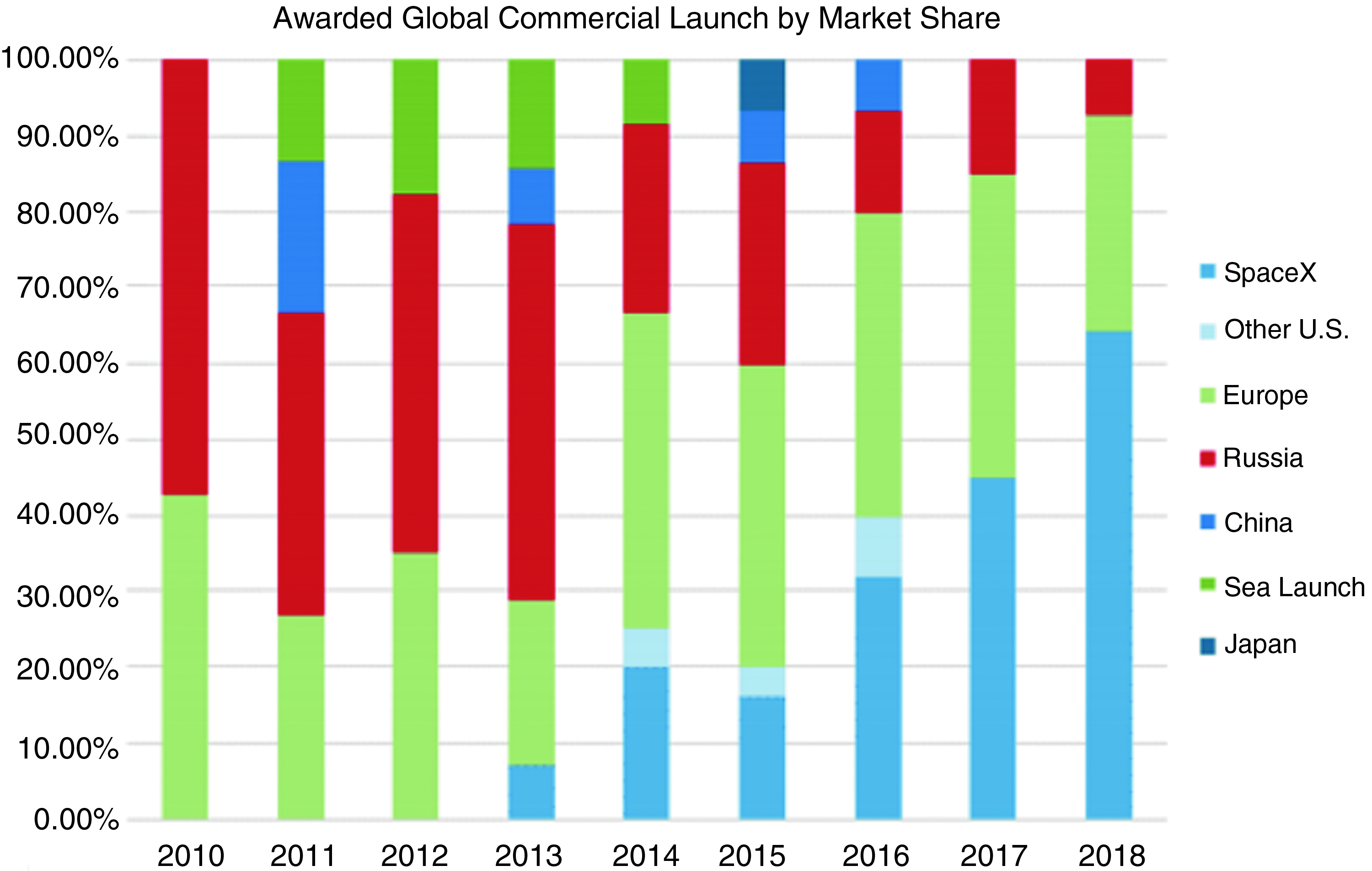
The 2017 Senate Testimony by Tim Hughes, SpaceX. 41
By 2017, SpaceX also had over six thousand U.S. citizens employed in California, Texas, and Florida. SpaceX's founder Elon Musk has publicly recognized NASA's anchor customer status and the COTS program in contributing to this success. 42
My analysis concludes that the COTS program successfully blended planning with competition. A specific governmental requirement was satisfied, the program was more efficient than traditional approaches and most importantly positive economic externalities were generated that exceeded the public investment. The results suggest that after decades of attempts, the government had finally demonstrated successful space industrial policy. All those involved at NASA and the other governmental actors in two administrations who supported this program should be commended. The COTS model should be adopted as the default approach for NASA missions where proven technology is sufficient and commercial markets are identifiable, but where specific domestic capabilities do not yet exist to meet the agency's needs. Traditional, cost-plus contracting models should be reserved for missions where the technical risk is significant and markets are unidentified. More importantly, the COTS model should be applied beyond the space agency to leverage necessary taxpayer investments in many areas into further economic development.
Footnotes
Acknowledgments
Thanks to Chris Shank, Alan Lindenmoyer, Bruce Pittman, Allison Zuniga, Dan Rasky, Edgar Zapata, and many others for their advice and background on this piece and to Helena Yli-Renko for her patience.
Author Disclosure Statement
No competing financial interests exist.