




Abstract
Abstract
There are currently no direct regulations and few guidelines regarding restraint design for commercial spaceflight vehicles. Operators designing vehicles intended solely for private commercial use, particularly short-duration suborbital flights, have questioned the need for 5-point restraints, instead considering the options of fewer restraints and less stringent application requirements. We sought to identify risks and benefits of alternative restraint designs for the commercial spaceflight industry, particularly for the diverse population of commercial spaceflight participants (SFPs). A systematic review was conducted on currently available information and published literature of human and animal studies as well as industry standards regarding restraint design, common injuries, and patterns of injuries in vehicular trauma, including automobile, aircraft, and spacecraft. Although data are lacking regarding commercial spacecraft or potential mishap forces, extensive studies are available in analogue environments, including motor vehicle crashes and aviation mishaps, which demonstrate variations of restraint design and relative risks and benefits of these systems. These studies demonstrate superiority of harnesses that include shoulder restraint and a negative-G (crotch) belt to limit torso movement. Injury patterns in anthropometrically varied populations, with factors including gender, obesity, and advanced age, demonstrate increased vulnerability to morbidity and mortality in obese and elderly populations and improved outcomes with more rigorous restraint designs. Given the varied population anticipated for commercial SFPs and significant reduction in morbidity and mortality associated with 5-point restraint designs, evidence suggests that the use of a 5-point restraint is most appropriate for commercial spacecraft.
Introduction
The United States has recently expanded the focus of the spaceflight to include the commercial sector, encouraging the development of private enterprises that aim to make spaceflight available to a greater population. The design of commercial vehicles varies significantly between such private companies, ranging from capsule-style rocketry to winged vehicles capable of landing on a runway. At present, there are few limitations or regulations on vehicular design, with expectations of crew safety left to be interpreted and implemented by commercial operators rather than forcing compliance with specific standards. This is particularly evident in restraint design—although there is an industry expectation of effective restraints that will accommodate the range of individuals who intend to fly in a commercial vehicle, there are as of yet no direct regulations regarding restraint design, load capacity, anthropometric accommodation, or similar factors.
Some operators have chosen to meet, or at least approximate, NASA or military standards, particularly when such operators are recipients of contracts related to NASA-sponsored flight. To better delineate NASA standards for commercial operators, reports have recently been published summarizing the history of restraint design and biodynamics of occupant protection in spaceflight.1,2 These reports provide an excellent outline of restraint guidance for commercial vehicles intended to carry NASA crewmembers and provide an understanding of the Brinkley Dynamic Response Criteria (BDRC), a dynamic model utilized to evaluate the risk of injury during flight given a known restraint and seat design.1,2 However, the commercial spaceflight industry has questioned the applicability of such seat and restraint design guidance to vehicles that are not intended primarily for use by NASA or its international partners. Operators designing vehicles intended solely for private commercial use (particularly short-duration suborbital “tourism” flights) have questioned the need for 5-point restraints, instead considering the options of fewer belts, less stringent application requirements, and selection of universal designs more familiar to vehicle occupants.
NASA recommendations include accommodation for astronauts who have been deconditioned by long-duration flight2–4 ; however, deconditioning will not occur during short suborbital flights. Commercial spaceflight participants (SFPs) are likely to fly for very short periods of time, with spaceflights lasting only a matter of hours instead of days or weeks. Operators have identified the need for simple and limited restraints designed for fastening by layperson SFPs, even during a microgravity phase. Although the desire to protect occupants from injury is universal, multiple factors, including length of flight, ease of application, and accommodation of anthropometric extremes, have led operators to consider the relative benefits of simpler and less cumbersome restraint design. As some operators intend for SFPs to be free to release their own restraints during microgravity then reapply the straps before reentry, there is a desire for simplified systems (or systems that approximate common and familiar design, such as automobile-style lap-and-shoulder harnesses) that are easily applied even in the unfamiliar conditions of microgravity.
Clear precedents indicate that the SFP population will include extremes of age, height, weight, stature, fitness level, and medical histories.5–7 As operators seek to accommodate a broader population than career astronauts, the implementation of a 5-point restraint design may limit the anthropometric boundaries for SFPs, whereas a simple 2-point lap belt restraint, or 3-point lap-and-shoulder restraint system, could potentially fit the more extreme body types.
This review was developed to address these concerns and better evaluate the need for a specific harness design, or common design elements, for commercial spaceflight vehicles. For the purposes of this review, it was assumed that commercial spaceflight vehicles would not include custom molded seats, ejection seat technology, or airbag protection devices for SFPs. Furthermore, our review was designed to address ideal protection practices for SFPs, rather than for pilots of commercial spaceflight vehicles. We assumed that vehicle occupants would be adults. In this review, we sought to address the anthropometric and population differences anticipated in SFPs when compared with career astronaut and military populations upon which the Brinkley model and NASA recommendations have been based. We further sought to provide some guidance to commercial industry providers, particularly in identifying injury patterns seen after impact with various restraint systems during spaceflight and analogue conditions, and how such injury patterns will be affected by alterations in the spaceflight population brought about by the advent of the commercial spaceflight industry.
Of note, this article is not intended to identify best practices regarding seat design, seat and restraint attachment interfaces or angles of attachment, or specifics regarding materials or design of harnesses. We did not include a review of materials interactions, head and neck restraint devices, or crush technologies that improve upon survivability in an impact environment. Our intent was simply to identify the risks and benefits regarding 2-, 3-, 4-, and 5-point (or more) harnesses for the anticipated SFP population. This comparative impact protection evaluation may provide some insight regarding most effective restraint design and configuration for commercial spaceflight as well as identifying common safety themes that should be universal to the industry.
Methods
A systematic review was conducted on currently available information and published literature of human and animal studies as well as industry standards regarding restraint design, common injuries, and patterns of injuries in vehicular trauma, including automobile, aircraft, and spacecraft. The search terms used included “restraint,” “seat design,” “spacecraft,” “anti-G strap,” “negative-G strap,” “crotch strap,” “five-point harness,” “four-point harness,” “three-point harness,” “chance fracture,” “human impact protection,” “traffic collision injury,” “obesity,” “elderly,” “seatbelt,” “belt restraint,” “belt loading,” “lap belt,” “shoulder harness,” “fatality risk,” “injury risk,” “harness configuration,” “restraint slack,” “restraint failure,” and similar search terms regarding restraints and restraint design, body morphology, and risk of injury or fatality during vehicular trauma. In addition, a search for the literature on expected SFP body morphology and age range was performed, particularly regarding the interaction of these factors with risk of injury and restraint design. Databases included Pubmed, Medline, Web of Science, Google Scholar, and the Defense Technical Information Center. NASA and military archives were searched for the same criteria mentioned previously. Aviation and aerospace industry standards and recommendations provided by the Federal Aviation Administration (FAA) and Department of Transportation were queried and reviewed for pertinent information.
All titles obtained from these search criteria were reviewed. Studies published in a language other than English without available translation were discarded. Articles regarding impact protection that did not address human concerns, the spaceflight industry or appropriate analogues, or occupant protection from anticipated acceleration forces from flight or impact trauma were discarded. Specific restraint design, particularly regarding differing number of restraints and the addition or absence of a negative-G (or “crotch”) strap, was considered especially relevant, as well as studies regarding the relative risk of varied body morphology, age, and body frailty. Studies that addressed these issues and similar considerations of occupant impact protection were reviewed in their entirety. The references of these articles were also searched to identify additional applicable studies. Animal, human, and anthropometric dummy studies were considered for inclusion. Documents describing practices specific to various governing bodies and federal agencies, including the FAA and National Transportation Safety Board (NTSB), were also included for reference and context, although these are not peer reviewed. Using these methods, 76 documents were identified that met the search criteria and were considered potentially applicable to this review. Eighteen articles addressed issues of occupant protection in circumstances not related to commercial spaceflight, such as military limb restraint during ejection, and similarly focused and nonrelevant issues, and were thus excluded. Four studies were published in languages other than English, without available translations, and were also discarded. The remaining 54 documents were included in the review.
Results
Number of Restraints
The majority of data relating different restraint configurations and comparing the performance of 2-, 3-, 4-, and 5-point harnesses arise from aggregated automobile impact data and injury patterns. When restraints were first introduced to automobiles, early restraint systems employed a single lap belt, a 2-point restraint system, tethering the body at either hip (Fig. 1a). Such systems were rapidly deemed ineffective for impact protection. At the time of impact, the body pivots over the single belt, with significant force transmitted to the low spine and abdominal viscera and no protection offered to prevent head or torso impact against forward consoles.8,9

Harnesses for impact attenuation.
In the 1960s, a single shoulder restraint was added to the automobile restraint system, creating the 3-point harness with a single attachment point at one of the occupant's hips (Fig. 1b). 8 Although the 3-point harness effectively reduced torso and head impacts during frontal impact (−Gx) collisions, this restraint system offers little protection from multidirectional force. Rear impact (+Gx) can still cause significant hyperextension of the head and cervical fractures, and side impacts can cause pelvic compression injuries, head and neck injuries, solid organ damage, and torso rotational injuries ranging from muscular strain (whiplash) to significant spinal or large vessel disruption.8,10,11 In particular, the 3-point harness offers little protection during rollover 8 or similar negative-G dynamic impact environments, limiting its effectiveness in the multiaxis aerospace environment.
Aerospace restraint design has similarly evolved over time, with earlier studies rapidly demonstrating poor protection offered by a single lap belt compared with lap-and-shoulder 4-point restraint systems (Fig. 1c).12,13 Even so, the single lap belt configuration continues to be utilized in commercial aviation applications where, while pilots are provided a 5-point harness system, passengers are required only to attach a single 2-point restraint before flight. Although many airline accidents are nonsurvivable, there are numerous reports of injuries after survivable impact, and such injuries follow the same patterns seen in automobiles with only 2-point restraints.14–16 Harness-related concerns and similar injury patterns have been seen in the aerospace environment. After the Columbia Space Shuttle mishap, the Columbia Crew Survival Investigation report detailed injuries that were sustained by crewmembers (as evidenced by autopsy findings) secondary to restraint failure, particularly failure of shoulder harnesses, 17 with patterns of injury mimicking those of a 2-point restraint given the lack of upper torso control. The report recommended improvement upon restraint design in future vehicles to include appropriate crew restraint during “vehicle loss of control” and “off-nominal situations.” 17
The NTSB has attempted to estimate the role of shoulder restraints in aviation mishaps. In 1985, the NTSB published a safety report that suggested that a mere 16% of occupants in general aviation aircraft wore shoulder harnesses, but that 20% of occupants who died in a general aviation mishap might have survived their injuries with the use of bilateral shoulder harnesses. 18 Furthermore, the report estimated that 79% of serious injuries would have been reduced in severity if occupants had utilized bilateral shoulder harnesses rather than lap belts alone, and that 82% of all occupants in survivable impacts would have received significant benefit from shoulder restraint. 18 Multiple reports from the 1980s and 1990s highlighted inadequate restraint by lap belts alone as a significant contributor to fatal injury in glider and small aircraft mishaps involving survivable forces.19,20 In a further study in 2011, the NTSB suggested that the risk of fatal or severe injury from an aircraft mishap with the occupant wearing a 2-point harness was 50% higher than for occupants wearing a 4-point harness. 21 As a result of these studies, the NTSB recommended retrofitting of all general aviation aircraft with more effective restraints, including the use of shoulder harnesses. 21
Utility of the Negative-G Strap
One of the most notable differences between aerospace restraint design utilized in high-performance flight and restraints utilized in other vehicles, such as automobiles and commercial aviation, is the inclusion of the negative-G strap (or “crotch” strap). This strap is designed to anchor the lap belt and buckle and tether these structures low over the pelvic bones, preventing lap belt slippage over the abdomen, a phenomenon known as “submarining.” 22 Submarining and related injuries are seen frequently in automobile impacts, particularly from frontal impact (−Gx) events.23,24 Injuries include spinal injuries,25,26 transection of abdominal muscles,22–24 hepatic lacerations,23,27 hollow organ laceration or perforation,22,23 and mesenteric injuries.22–24 Furthermore, these injuries can be particularly dangerous because of delayed symptoms, difficult visualization by standard imaging, and delayed complications secondary to blood loss, intra-abdominal contamination from bowel perforation, and similar.23,28,29 Inclusion of the negative-G strap converts a 4-point harness system to the common 5-point harness system (Fig. 2a).
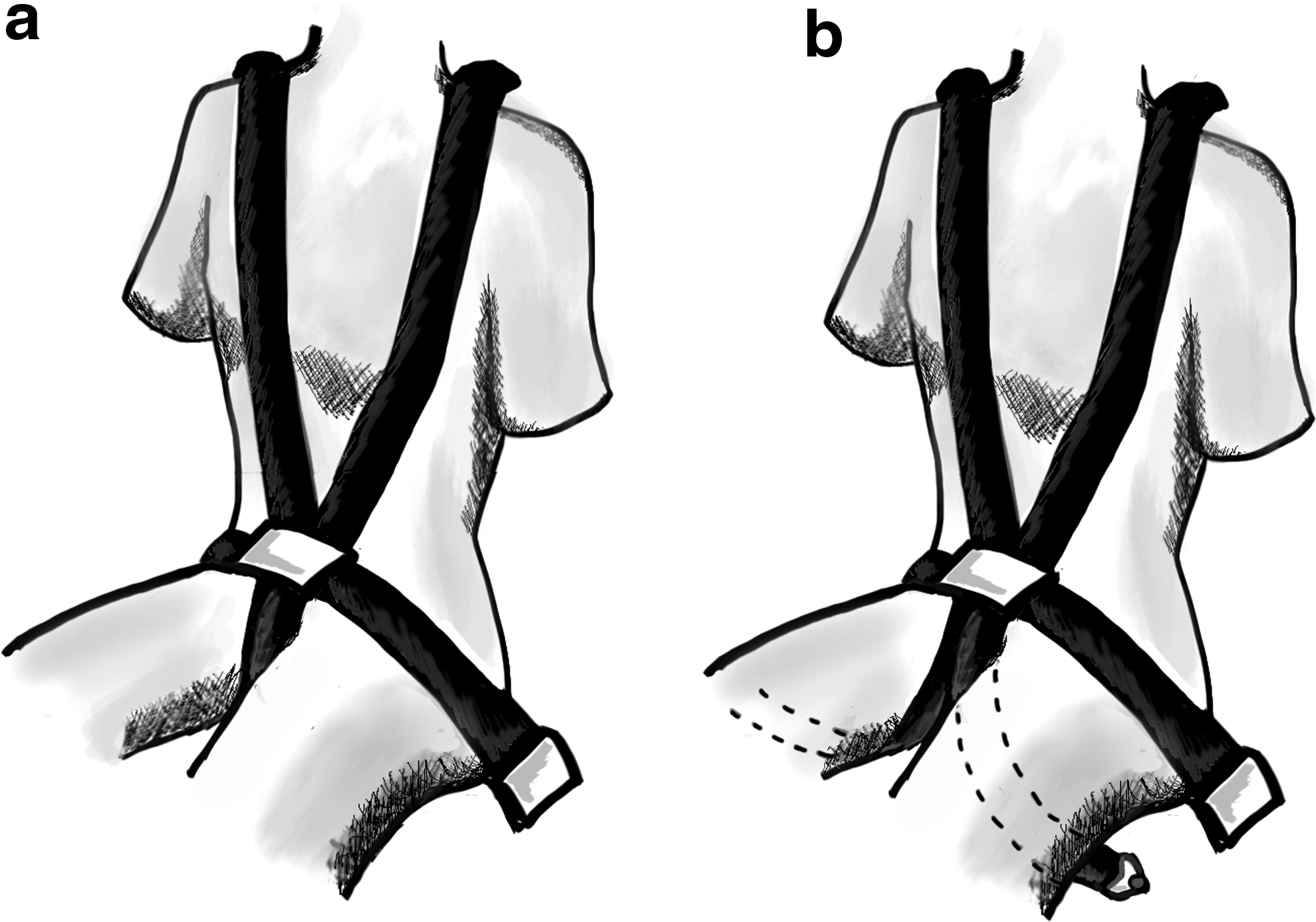
Harness with negative-G restraint.
Hearon and Brinkley evaluated the relative benefit of the negative-G strap in aerospace environments, reviewing data from the Air Force Aerospace Medical Research Laboratory. 22 Findings indicated that the negative-G strap significantly reduced torso submarining during −Gx impacts, but also provided significant occupant protection, through occupant–seat coupling, during both free-fall and vertical (+Gz) impact.22,30,31 In addition, they found that the negative-G strap transmits shoulder strap loads linearly to the seat in the case of inversion, offering safety improvements in severely off-nominal flight. 22 Studies have demonstrated that these findings are applicable to a wide variety of anthropometric variants, including 5th and 95th percentile ranges of males, indicating that the addition of a negative-G strap provides significant benefits for most body types. 32 Risks associated with the inclusion of a negative-G strap are largely theoretical and few actual injury reports exist, consisting of thigh or scrotal soft tissue injuries such as minor lacerations and contusions. Such injuries are rare and generally limited to ejection at extreme altitudes and velocities.22,31
Alternative designs to a single negative-G strap are common in stock car racing, where classic restraint design is that of a 6-point harness that includes a double strap between the legs (Fig. 2b). 33 This design is particularly effective for frontal impacts (−Gx) and provides improved restriction of forward pelvic motion, forcing shoulder harnesses to engage earlier and reducing overall chest movement, thereby limiting intrathoracic injury. 33 This configuration is not often utilized outside of the stock car racing industry; however, there are few studies addressing its utility in other populations, particularly in elderly or obese individuals.
Harness Configurations and Application
There are numerous military aviation studies of 5-point harness configurations, ranging from the classic double shoulder strap and lap belt restraint system, where all five harness straps meet at a buckle located centrally below the umbilicus (Fig. 3a), to multiple harnesses approximating the distribution of straps similar to the arrangement seen in parachuting harnesses. One alternative restraint system, modeled after a parachuting harness, is the PCU-15/P, where shoulder straps extended vertically from the high shoulder attachment point to parallel attachment points on either side of the lap belt, and the remaining lap belts and negative-G strap attach centrally below the umbilicus (Fig. 3b). 22 Hearon and Brinkley studied comparative performance of these two systems, demonstrating that the PCU-15/P configuration offered poor impact protection, poor distribution of load forces, and increased risk of injury to the occupant compared with the single attachment point configuration. 22 In particular, the PCU-15/P allows slippage of the trunk in side-to-side (±Gy) forces and during −Gz rollover environments, and still permits significant submarining during −Gx impacts. 34 Other restraint configurations have been considered in the past for both the automobile and the aviation environment; for example, Snyder et al. described the inverted-Y configuration with a single point of attachment for shoulder harnesses behind the neck and wide hip attachments (Fig. 3c). 10 However, this configuration has been associated with a number of failures, most notably including torso slippage through the harness attachments and resultant torso and head impact into console components.10,35 As a result, this harness configuration is not often utilized, and literature related to injury rates attributable to an inverted-Y style belt is lacking.10,36
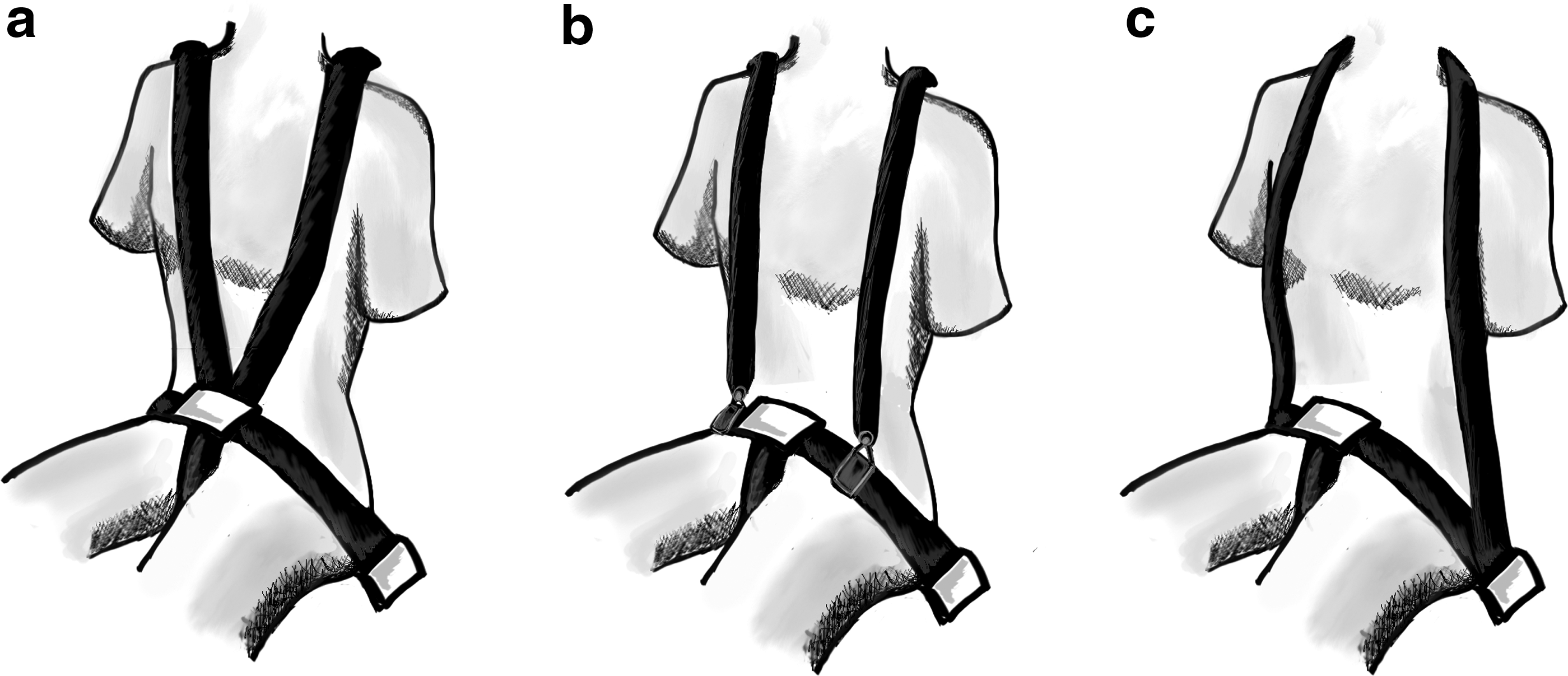
Varied configurations of the 5-point harness.
It is worth noting that correct application of restraints is necessary to ensure that a harness system confers the occupant protection parameters already described (distribution of load forces, prevention of submarining, multiaxis torso stabilization, protection from head impact, etc). In the case of inappropriate attachment of any one of the belts, the entire harness will be rendered significantly less effective. Studies regarding failures of even single belts in a multibelt restraint system demonstrate negation of the effects of the entire system, with severe morbidity and mortality as a result. 37 Kirkham et al. reported severe injuries with the singular failure of shoulder restraints or negative-G straps. 37 Impacts from harness failure resulted in nonsurvivable injuries including severe hyperextension of the cervical spine, head and torso impact into console components, severe flail injuries, submarining and resultant intra-abdominal organ injuries, and the like. 37 Similarly, excessive slack in the system is highly associated with injury and even fatality. 35 These studies suggest that ensuring that all belts are buckled correctly, with straps appropriately placed and tightened, is as important as the selection of the most effective restraint design and configuration.
SFP Demographics
In addition to the type and configuration of restraints, there are a number of factors related to SFP demographics that will affect the type and severity of injury in the case of commercial spaceflight mishap. It is worth noting that NASA recommendations, often based upon the BDRC, have been heavily dependent upon impact data of mostly male military participants under 30 years old. 1 This source of data introduces significant limitations and population restrictions into the model particularly as it may translate to the SFP population. As health and fitness levels in the SFP cohort will be more variable, prior studies that utilize the BDRC may have underestimated injury patterns and expectations. 1
The effects of anthropometric features such as smaller stature can also affect injury patterns. 1 NASA and its industry partners have tried to mitigate many of the limitations of the BDRC by incorporating injury assessment reference values (IARVs) based on Hybrid III anthropometric test devices (ATDs) to design vehicles and minimize the risk of injury. 2 This method uses tolerances developed from the 5th percentile female to the 95th percentile male anthropometric extremes, providing a more specific and appropriate standard for a broader population of career astronauts. 2 However, commercial SFPs will present even more of a variation than has been studied in military and NASA literature, with extremes of age and body type that may exceed even the broadened IARV and ATD data. 38 These factors may weigh heavily on the risk of injury in a spacecraft mishap; for example, in motor vehicle collisions, increased body weight is associated with an increased risk in mortality and injury severity. 39 To fully appreciate the risk of injury to the SFP population and the factors of obesity, age, frailty, and gender, further impact data should be considered.
The Crash Injury Research and Engineering Network (CIREN), a collaborative effort to conduct comprehensive research on injuries from vehicular collisions, is often referenced in study of impact response and injury patterns in motor vehicle crashes (MVCs) involving subjects with differing body types. 25 In 2014, Rao et al. used CIREN data to demonstrate that more injuries occur in MVCs where occupants are either elderly or have a body mass index (BMI) of >36 kg/m 2 , placing them in the body morphology category of severe to morbid obesity. 26 Further articles from the same authors have demonstrated more severe vertebral fractures in MVCs to be linearly related to BMI. 40 Pal et al. found that abdominal injury was more common in the higher BMI cohorts in side impact MVCs. 41 In a review of data from the National Trauma Data Bank from 2007 to 2010, Joseph et al. demonstrated that individuals with a BMI ≥40 kg/m 2 had a higher likelihood of in-hospital mortality after MVC. 42 Multiple studies have demonstrated similar findings of higher morbidity and mortality associated with elevated BMI when matching obese to nonobese patients with similar injuries from MVCs.43–45
Restraint-related mechanisms of injury can vary in persons with high BMI. Specifically, obese persons have higher body excursions, head, torso, and lower extremity flail, and higher submarining tendencies than individuals of normal BMI.46,47 Modeling techniques have further demonstrated that belt fit failures secondary to body shape and high BMI are highly associated with restraint failure and worsened injury during impact. 48 One mechanism for injury may be the improper placement of restraints, particularly the placement of the lap belt across the abdomen as opposed to low across the iliac crest (Fig. 4). 49 As already discussed, this placement results in submarining-type injuries of the abdominal organs as well as mesenteric and spinal injuries.
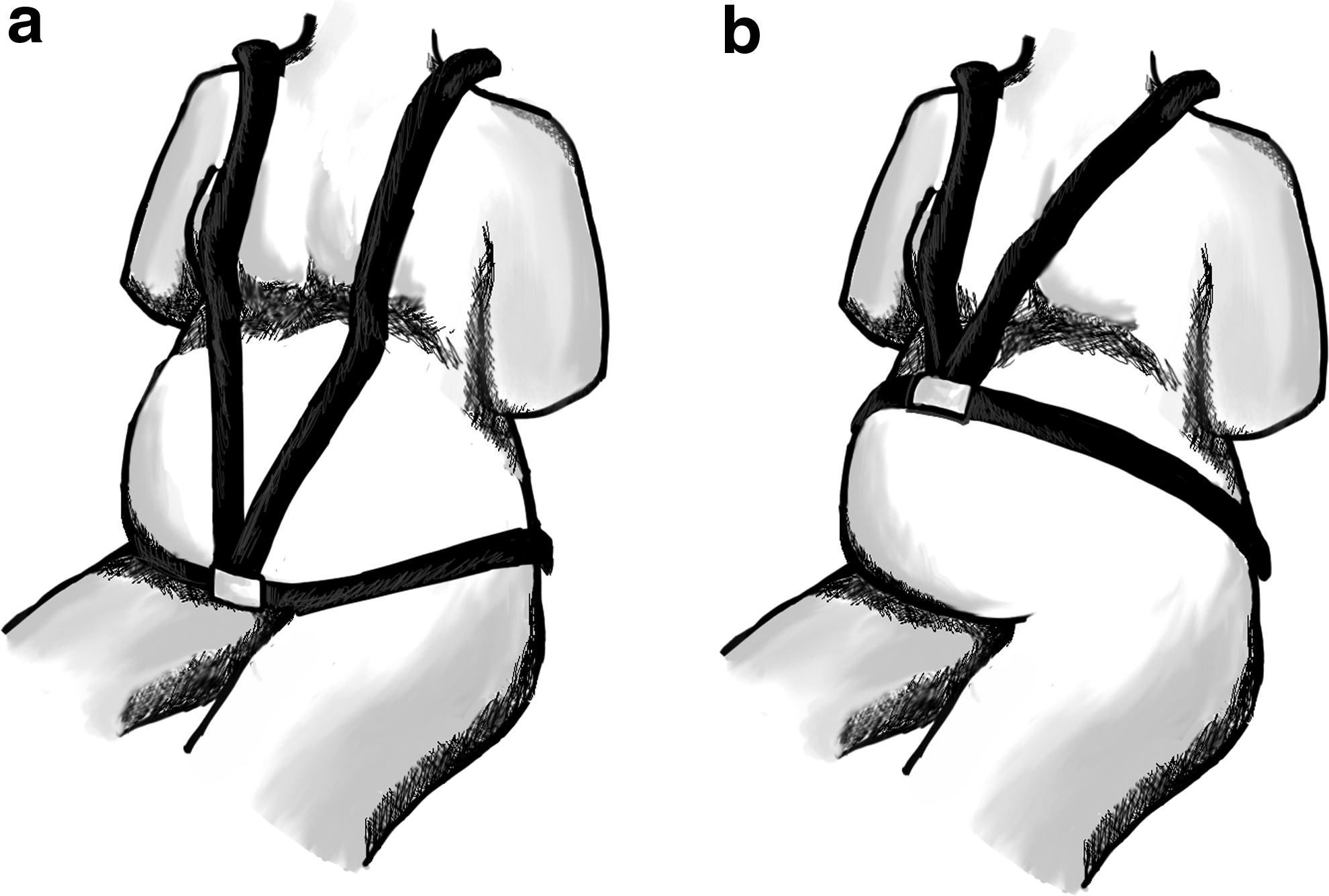
Lap belt placement for increased abdominal girth.
As with obesity, there are specific risks associated with extremes of age; however, the effect of age on predisposition to traumatic injury has been linked more to individual characteristics, such as a “decrease in bone strength, disk degeneration, ligament strength, and muscle strength and reaction,” than to specific injury patterns expected at certain age ranges. 1 Similarly, Oskutis et al. associated sacropenia and osteopenia with the severity of injury as opposed to age alone in a 2016 study. 25 However, as age can be associated with each of the conditions mentioned, there are patterns of increasing injury in elderly patients after significant impact forces. 26 Data have demonstrated that older individuals account for an increased proportion of fatalities and injuries in MVCs.40,50 In particular, elderly individuals seem to have a higher likelihood of thoracolumbar spinal injuries, likely related to increased stiffening and calcification of the spine associated with aging.51,52
Carter et al. utilized data from the National Automotive Sampling System-Crashworthiness Data System to compare the effects of age, BMI, and gender in severe MVCs, demonstrating that age was the single greatest contributory factor to injury, particularly injuries of the thorax and head. 53 He argued that a restraint system tailored to the injury risks associated with age and body morphology could significantly reduce morbidity and mortality after impact. 53 Further study has demonstrated that, by age 70 years, the risk of fatality for both genders in a vehicular collision has tripled in comparison with that in age 20 years. 54 For passengers over the age of 65 years, use of a 3-point restraint system, while an improvement over 2-point lap belt design, is still highly associated with thoracolumbar injury during MVC. 51 This suggests that restraint of the hips and thorax using a classic lap-and-single-shoulder belt (3-point harness) is not sufficient to prevent significant injury during impact for the elderly population.
Using the fatal accident reporting system and scenarios where men and women were involved in the same MVC, Evans found that from ages 15–45 years, women have a 25% higher chance of fatality than men, although men have higher fatality rates if they were younger than 15 years or older than 45 years. 54 Although injury rates in moderate severity crashes were similar for drivers of either gender, Pal et al. found that women had higher rates of lower extremity injuries in side impact MVCs, which seems to be additionally correlated with low BMI. 41 In severe crashes, Carter et al. found that men had lower rates of thorax and extremity injuries in frontal impacts and head injury in far-side impacts than women. 53 Stature may also be related to rates of head injury: in side impact crashes, skull injuries were higher for those of taller stature (height >175 cm) with an incidence of 27% compared with shorter individuals (<175 cm), where incidence was 12%. 41 Pal et al. noted that taller people may have more contact with the roof side rail during a side impact, which could increase the risk of skull injuries. 41
Discussion
Available literature demonstrates significant safety benefits for human occupants in both spaceflight vehicles and analogue environments, including automobiles and aircraft, with appropriate restraint design. However, the demographics, anthropometry, and pre-existing medical conditions of SFPs represent new challenges in the design of restraints in the space environment. Analogues in civil aviation and MVCs demonstrate increased risk associated with age, frailty, and obesity.
The literature reviewed demonstrates vast superiority of a 5-point restraint when compared with 2- and 3-point harnesses, particularly in the protection of occupants from off-nominal scenarios and mishap forces. Inclusion of shoulder harnesses significantly reduces morbidity and mortality in aircraft mishaps; spacecraft mishap data suggest that human occupant protection is similarly amplified by the inclusion of bilateral shoulder harnesses. Ideal harness configuration includes a single point of attachment of all harnesses just above the pubic symphysis. The application of a negative-G restraint further conveys significant protection at very little occupant risk, particularly in multiaxial dynamic environments. The potential for dynamic rotational loads and multiaxis forces in an aerospace mishap lends credence to the argument for a 5-point restraint design for use in the spaceflight environment, regardless of vehicle type. In addition, the anthropometric and demographic range of SFPs, to include anthropometric extremes and potentially older frailer individuals, further provides argument in favor of improved restraint design and the choice of a 5-point harness over alternative restraint systems.
Proper application of the harness and ensuring that all components are appropriately attached and secured will prevent injury; failure of any single component of the harness design is likely to render the entire restraint system ineffective. This is particularly important for industry providers who intend to allow vehicle occupants to remove harnesses during microgravity and replace their own restraints before reentry. Effective training of occupants for appropriate restraint application and securing of all belts and locking mechanisms is essential to ensure the safety of the system. In particular, positioning of lap restraints low over hips, regardless of body morphology, should be a focus of training, particularly if SFPs are allowed to apply their own restraints before or during any phase of flight.
There are many limitations to this review. There are few studies providing data truly applicable to the commercial spaceflight environment. We have chosen to focus on analogues including aviation and MVCs, but the true risk of injury or fatality in a commercial spaceflight vehicle will largely depend upon many aspects of vehicle design (including but not limited to restraint configuration), impact forces, and other mishap-related factors. Regarding restraint design, we have chosen not to evaluate certain factors, including inertial reels or other restraint locking alternatives, tension minimums in restraint application, attachment angles, types of buckles, restraint materials, materials used for deformation or energy attenuation, seat design, and similar factors. Our focused intent in this discussion has been to provide some understanding of the risks and benefits of various harness designs, number of restraints, and limitations to their protection of various populations that may be seen in commercial spaceflight.
There will undoubtedly be questions regarding whether the recommendations presented here are applicable to all commercial spaceflight designs, including both capsule- and glider-style vehicles. Although there will be significant vehicular variations in the magnitude and direction of forces involved in any off-nominal scenario, the data presented here have demonstrated superior protection for increasingly vulnerable populations in dynamic multiaxis impact forces with the use of a 5-point (or more) restraint system. However, the paucity of data available in the literature leads us to such conclusions based on presumed best-protection practices in nominal and off-nominal scenarios. Undoubtedly, further study with dedicated data collection regarding vehicle design, forces experienced, anticipated or experienced forces in future flights (nominal and off-nominal), layperson use of restraints in the aerospace environment (including hypergravity and microgravity), and the like would greatly aid decision-making in future restraint design.
Conclusions
Use of appropriate restraints can indeed be life saving in the case of mishap as restraint systems greatly influence human tolerance to impact forces. Data suggest that use of whole-body restriction by a 5-point harness and good restraint positioning help to reduce injury in all demographics and body morphological variations. Although there have been arguments in favor of simple or familiar designs in commercial vehicles, available data clearly support the use of a full 5-point harness, with a negative-G strap and single point attachment below the umbilicus, to improve survivability and reduce injury in a mishap or off-nominal situation.
Footnotes
Acknowledgments
The work presented here was performed, in part, under a Federal Aviation Administration Center of Excellence for Commercial Space Transportation grant dedicated to the investigation of future concerns for commercial spaceflight. The authors acknowledge additional support from the National Space Biomedical Research Institute (NSBRI) through NASA NCC 9-58. Although the FAA and NSBRI have sponsored this project, neither endorsed or rejected the findings of this research. The presentation of this information is in the interest of invoking aerospace community comments on the results and conclusions presented.
Author Disclosure Statement
No competing financial interests exist.