




Abstract
Solar-geomagnetic superstorms like the 1859 Carrington Event pose significant risks to electrical power utilities and satellite infrastructure. Damage to this critical infrastructure could have significant legal and ethical ramifications, ranging from worldwide economic crises to international disaster response needs of unseen magnitude. Despite these potential consequences, the legal and ethical frameworks for space weather risk management are only just beginning to be developed by regulatory agencies. Furthermore, existing international regulations and ethical standards are designed for typical natural disasters (i.e., floods, droughts, earthquakes, and hurricanes) and may not account for the additional complexity and cascading effects associated with a future Carrington Event, such as combined and large-scale loss of electrical grid and satellite capabilities in countries that typically provide, rather than receive, disaster relief. To address this insufficiency, this article outlines the legal and ethical issues associated with solar-geomagnetic superstorms and provides recommendations for incorporating specific action plans into existing international agreements, national policies, commercial space best practices, and international disaster response law guidelines.
Introduction
The Carrington Event of 1859 is considered to be the largest solar-geomagnetic superstorm on record. It involved a bright solar flare [visually observed by Richard Carrington (1826–1875) while sketching sun spots] followed by a coronal mass ejection that reached the Earth 17 h later. The event caused violent distortions in the Earth's magnetosphere (i.e., a geomagnetic storm), which resulted in aurora as far south as the tropics and powerful electrical currents that destroyed telegraph infrastructure worldwide.1,2 Available studies indicate that a current day Carrington Event would first cause high-frequency radio blackout on the daylight side of the Earth, followed by satellite transmission noise jamming, due to X-ray and ultraviolet radiation. Less than 20 min later, satellites would be bombarded with high-energy protons, electrons, and other particles causing extreme solar panel degradation and operational anomalies. These effects would adversely impact navigation satellite networks, remote sensing satellite capabilities, and telecommunications, including satellite-to-home television and radio, national and international business communications, financial and governmental activities, and remote information access.3,4
Two potential scenarios have emerged as likely occurrences in the case of a modern Carrington Event. In the first scenario, it is believed that potential damage would not be significant and that society is relatively well prepared to deal with such an occurrence because satellites are resilient and outages would be brief. 5 In contrast, the second scenario could lead to extensive damage to equipment and to disruptions and blackouts lasting for months. 6 Work is, as of yet, required to comprehensively assess potential levels of direct and indirect losses. Differences in preparedness levels across economic sectors and regions also affect the ability to predict impact. An example of this can be seen in the impact of the 2003 Halloween solar storms, where North American countries reported that no major failures occurred. This was attributed, in part, to post-1989 solar storm planning. 1
The 1989 solar storm event was the most recent and has shown what kind of effect a solar-geomagnetic superstorm could have on modern society. The total cost to rectify damage to one individual power company was estimated to be >$20 million USD. 1 Odenwald and Green estimated that if at least 20 satellites are lost in such a storm, the associated costs could be $30 billion USD. 7 As this estimate was given in 2007 and the number of satellites in orbit has increased significantly, the current estimates for an event larger than the 1989 event have been estimated by Metatech Corporation to be $1–2 trillion USD in the first year with an estimated full rebuild time of 4–10 years, depending on the severity of the storm. 8 A worst case scenario for an individual country, such as the United States, could have wide reaching global effects. Lack of access to telecommunications and electronics would undoubtedly trigger a humanitarian crisis with unmet medical needs alone requiring significant international support. Considering the post-9/11 U.S. market losses and the 2007 Global Recession as analogous economic events, the aforementioned economic loses and their associated market impacts could theoretically trigger a recession, further deepening the need for international intervention (both regulatory and physical).
The legal and ethical issues associated with a worldwide economic recession caused by a future Carrington Event have prompted regulatory, commercial, and humanitarian bodies to develop deterministic approaches to manage these risks. Discussed herein are the existing legal and ethical frameworks of the United Nations (UN), the European Union (EU), the United States, and the International Federation of the Red Cross (IFRC), their shortcomings, implications for new space, and future recommendations for improvement.
Existing Legal and Ethical Frameworks for Space Weather
Since 2010, the UN Committee on the Peaceful Uses of Outer Space (COPUOS) has developed, via consensus, 21 guidelines to maintain long-term sustainability of space operations. In 2019, at the 56th session in Vienna, two guidelines specific to space weather, B.6 and B.7, were accepted.
Guideline B.6, to “share operational space weather data and forecasts,” emphasizes that states and intergovernmental organizations should promote proactive monitoring and collection of data on space weather anomalies with international cooperation, standardization, and free and unlimited access to real-time forecast outputs and models. 9
Guideline B.7 emphasizes the need to “develop space weather models and tools and collect established practices on the mitigation of space weather effects.” Of specific interest are Guidelines B.7.2(f), which includes “participation of countries with emerging space capabilities,” B.7.5(a), which includes “capability to recover from a debilitating space weather effect,” and B.7.5(b), which includes “space weather effects into satellite designs and mission planning for end-of-life disposal.” Altogether, these guidelines have significant legal and ethical consequences, described in Table 1, if left unresolved. 9
Legal and Ethical Consequences of Unresolved Space Weather Mitigation Guidelines
COPUOS, Committee on the Peaceful Uses of Outer Space; ITU, International Telecommunication Union.
While the above two guidelines are not legally binding to individual nation states or international organizations, the objective is for them to be adopted in local governance pertaining to outer space activities.
The EU currently has several programs and policies in place that are of relevance to space weather risks. The European Program on Critical Infrastructure Protection and the EU Disaster Risk Management Policy are tasked with preventing, preparing, and responding to infrastructure damage. This includes identifying and protecting infrastructure critical to two or more EU member states and creating a Critical Infrastructure Warning Information Network for exchanging rapid alerts.10,11 Additionally, all EU member states are required to create a national risk assessment and, thus far, six states (Finland, Hungary, the Netherlands, Sweden, United Kingdom, and Norway) have specifically listed space weather in their assessment. Finally, Article 188 R of the Common Security and Defence Policy within the Treaty of Lisbon outlines the solidarity clause for a joint EU response to natural or man-made disasters affecting member states. When a member state faces a disaster, all EU nations are bound to assist according to national capabilities, in the spirit of solidarity. 12
In 2019, the U.S. National Science and Technology Council within the Office of the President created a National Space Weather Strategy and Action Plan to address space weather risks. This plan contained three broad objectives, which were subdivided into specific action plans with deliverables and timelines for the coordinated effort of governments, agencies, disaster managers, industry, and other experts. These plans are shown in Table 2 with corresponding COPUOS guidelines. Objectives within the 2017 iteration of this action plan was assigned to the Department of Homeland Security (DHS), which was tasked with publishing its own strategy in 2018, pursuant to Section 1913 of the National Defense Authorization Act for Fiscal Year 2017, to protect the United States against geomagnetic disturbances. 13
U.S. Goals for Space Weather Disturbances and Corresponding Committee on the Peaceful Uses of Outer Space Guidelines
Shortcomings of Existing Frameworks
The UN, EU, and United States are establishing legal and ethical frameworks to manage the risks associated with space weather (as mentioned above). There has also been a recent regional warning center created in South Africa in addition to a joint Russian–Chinese center. 14 Despite these efforts, many developing countries have yet to take these risk management steps. For example, although the African Union has established a space policy that recognizes the risk of space weather to electrical power and satellite systems and is developing tools for space weather monitoring, no action plan for regulatory bodies has been developed to manage the legal and ethical impacts of space weather. 15 Similarly, India has an established civilian space policy that also recognizes the risk of space weather on electrical power and space-based operations but is lacking the regulatory structure and legal architecture to implement space security policy. 16 These shortcomings, if left unaddressed, could increase the vulnerability these countries have to a future Carrington Event.
States without space weather frameworks that also lack well-designed national disaster relief regulations can suffer from bureaucratic bottlenecks, which restrict relief operations, goods, personnel, and projects (e.g., visas, work permits, customs paperwork) during times when they are most needed. This reduces the quality and efficacy of relief coordination efforts. To help states avoid these problems, a set of international disaster response law guidelines was created by the IFRC and adopted by the parties to the Geneva Conventions in 2007 to reduce restrictions on entry of relief personnel, goods, and equipment into affected countries and to create minimum accountability standards for relief coordination and quality. 17 Despite these guidelines, however, some countries (e.g., Myanmar, Democratic Republic of the Congo, Venezuela) may not accept the principle of humanitarian custom under international law to reduce the human vulnerability and suffering that may result from a Carrington Event.18–20
Economic instability in markets could manifest during a Carrington Event, and financial institutions' responses to such instability represent an ethical shortcoming to relief and recovery efforts. 8 For example, the actions of global and national financial institutions throughout the 2007 economic crisis were widely questioned by ethicists. While technically correct in their postcrisis response, the actions that ratings agencies took to downgrade affected sectors were directly linked to further losses, which cyclically supported the recession's triggers, reinforced protectionism, and hindered sector recovery.21,22 There appears to be no definitive framework in place to prevent a repeat of such response-specific actions in the commercial sector, which can be detrimental to human well-being.
Using existing legal and ethical disaster management frameworks following a future Carrington Event may be inappropriate. Many large-scale disasters are natural in origin: hurricanes, blizzards, excessive drought, earthquakes, and so on. With these more common disasters comes relief, which relies on space and ground-based infrastructure built upon electronic hardware. To help facilitate relief and recovery efforts in such an event, communication is needed. However, during a future Carrington Event, many of the communications systems on Earth and in orbit may cease to function. In discussion with members of the commercial satellite industry, although there are currently contingency plans for services and safe mode operations for satellites, there is little risk mitigation preparedness of commercial or governmental infrastructure if such an event were to occur. 23 Thus, Carrington Events are considered rare occurrences of enormous global consequence, unlike typical regionally focused disasters.
Implications for New Space
As new space companies become more numerous, and have more invested interests in space, the lack of a cohesive legal and ethical framework for a Carrington Event could cause crippling economic losses. These losses may stem from the private sector's unwillingness to pay for collection of scientific data about space weather. Instead, firms have seen these data as a service provided from the public sector. 24 This attitude may place legal and ethical risk on commercial space, unless they are willing to play a greater role in space weather data collection.
Satellite Business
Although satellites are built to withstand some space weather, large space weather events remain a great risk to satellites. In October 2003 alone, >30 satellites suffered anomalies, and 1 satellite was completely lost during space weather events. 24
Intelsat's Galaxy-15 provides one example of the challenges that satellites face. After a space weather event in April 2010, communication to the Galaxy-15 satellite was lost. The satellite is still operating autonomously. However, since the satellite cannot be controlled and could be accepting and rebroadcasting signals sent to other satellites, it poses a major collision and interference risk. This has led Intelsat to develop procedures with other satellite operators to shut down or maneuver satellites passing Galaxy-15 to prevent any accidents. 24
As a Carrington Event could cause large-scale damage similar to what has transpired with Galaxy-15, the situation could become complex in nature. The current international legal framework lacks an adequate response to defunct or dying satellites, including those disabled by space weather, which could help commercial satellite companies avoid collision liability. 25 Commercial revenue loss due to damaged satellites could be significant, as was the case with Galaxy-15. 24 And ethical questions remain, such as whether or not to risk crowding Earth's orbital slots with debris. Kessler syndrome—a theoretical disaster, where a small number of spacecraft collisions cascade into a major chain reaction, causing space debris to increase exponentially—could make accessing space impossible due to the heavy concentration of debris orbiting Earth. 26 Kessler syndrome could also have catastrophic long-term effects due to a Carrington Event, as it would make space extremely difficult to access and would impair many satellite-based technologies.
Due to the lack of clear legal framework for space usage, some scholars have proposed an international tax for space companies who leave debris in orbit. 26 This idea has been mostly left unexplored but could serve to fund space weather research and preparation to mitigate space weather-associated risks.
Commercial Aviation, Suborbital, and Orbital Flights
Commercial aviation could be significantly impacted by space weather events, as these events may have impacts on communications satellites, navigation satellites, and produce radiation hazards for aircrew. Aircrew are among the occupational groups most at risk from increased radiation exposure from space weather. Measures to reduce exposure include increasing radiation shielding, route changes, and lower altitude flights and add additional costs to airlines. Although cumulative radiation dose is monitored as a legal requirement in the EU, no commercial or legal framework currently exists for monitoring and managing cumulative dose outside the EU and among frequently flying passengers. 24 These radiation dose concerns are also of relevance to suborbital space tourism, particularly those flying over polar regions.
Solar flares have been identified as a risk for high-flying planes, their passengers, and crew. This risk can range from malfunctions in electronics to higher radiation exposure for crew and passengers. While the radiation might not cause a large concern for individual passengers, constantly flying crew are at higher risk. 27 This risk for high flying flights raises important legal and ethical questions for new space companies exploring suborbital flights: (1) What are the legal requirements protecting crew during suborbital and orbital flights? (2) What are the legal requirements protecting passengers during suborbital and orbital flights? (3) What legal and ethical issues exist for pregnant crew and/or passengers on suborbital or orbital flights, and how could these be resolved?
The current radiation limits for aviation crew set by the U.S. Federal Aviation Administration are 50 millisieverts per year. This limit is lowered to 1 millisievert throughout pregnancy, and pregnant crew members are encouraged to consult their physicians for individual risk assessment. 28 Ultimately, commercial space tourism companies may need to ground suborbital and orbital flights, with advance notice of 17 h to <20 min,1–4 to prevent any radiation-related issues during Carrington Events, particularly for passengers with lower radiation limits, and may need to develop transparent and ethical policies for passengers with lower radiation limits to reduce radiation risk.29,30 These issues further support the legal and ethical need for advanced space weather warning programs.
Insurance for Space and Terrestrial Markets
While it is possible that the damage caused by a solar storm could be considered a natural event and might be covered under basic homeowners insurance, lack of legal definition and precedent, and wide variability between insurance carriers and policies, leaves the question of coverage unanswered. In many cases, damage from a lack of electricity (like food spoilage) caused by widespread power outages originating from off the property or uninhabitable conditions from disabled heating or air conditioning would not be covered. But, in the case of a Carrington Event, the bigger question would be if insurance companies could even respond to claims made. 31 As there is no cohesive insurance definition for solar storms, it places new space companies and their terrestrial units at a risk of losses. This also applies to insurance companies themselves, who might face overwhelming claims after a Carrington Event.
One study found that insurance claims for industrial electrical and electronic equipment, following the 5% most geomagnetically active days, increased by 40%, and relative to quiet days, increased by 30%. 32 Another study found that ∼4% of the U.S. high-voltage power grid is attributed to strong geomagnetic actvity. 32 This potential for large numbers of insurance claims may necessitate the need for a sovereign fund or catastrophe risk pool that can address Carrington Event risks and encourage more funding toward a less costly proactive approach, perhaps through cofinancing of insurance premiums and capitalization and operating costs of risk pools, rather than an expensive reactive approach. 33
Recommendations and Conclusions
Given the existing legal and ethical frameworks and their shortcomings for managing a future Carrington Event, the following recommendations have been made for regulatory and humanitarian agencies:
Representatives of 73 UN member states, in 2019, agreed upon COPUOS Guidelines B.6 and B.7 on mitigating space weather risks for long-term sustainability of space operations. Not all of them have implemented these guidelines. The UN should encourage support for countries in forming space weather regulatory structures within their existing governmental bodies and suggest specific action plans with deliverables and timelines. Continued regulatory planning would serve to reduce the vulnerabilities these countries could face during a future Carrington Event and reduce their need for postdisaster aid and recovery.
34
Furthermore, COPUOS should support the creation of a UN advisory group for space weather, similar to or within the existing Space Mission Planning Advisory Group that was established in 2014 to deal with threats posed by near-Earth objects.
35
As a point of reference, this advisory group could incorporate input and the existing space safety standards developed by the International Association for the Advancement of Space Safety.
36
i) At present, only six EU countries have considered space weather as a threat to infrastructure. Also, there appears to be no specific ethical framework in place to prevent a repeat of response-specific actions to an economic collapse that could occur following a future Carrington Event. Thus, EU countries should (1) improve coordination between space weather actors, (2) establish pan-European decision-making capability to better coordinate intra-EU space weather risk mitigation and response, (3) further harden infrastructure for Carrington Events to prevent ethical implications of humanitarian disasters, and (4) create specific ethical frameworks for economic collapses. ii) The United States, in accordance with its National Space Weather Action Plan, has begun the process of tasking its regulatory agencies with targets and timelines for improved space weather policy, preparedness, and response. However, further engagement with public and private sector infrastructure partners is needed because the majority of vulnerable U.S. infrastructure is privately owned, and the DHS does not have regulatory authority over these infrastructure sectors. Therefore, partnerships should be formed with Federal, State, Local, Tribal, and Territorial entities to address legal and ethical issues related to infrastructure risk. v) At present, several countries, which have previously refused humanitarian relief despite vulnerability and suffering of their citizens (e.g., Myanmar, Democratic Republic of Congo, Venezuela), may not accept the principle of humanitarian custom under international law to reduce the human vulnerability and suffering that may result from a space weather disaster.18–20
Additionally, existing legal and ethical disaster management frameworks that could be invoked may be inappropriate due to the global nature of a Carrington Event. Thus, the IFRC should (1) form an international advisory committee composed of experts in space weather risk, human rights law, international environmental law, refugee law, international humanitarian law, global health law, and international development law (Fig. 1), as a coordination forum involving UN and non-UN humanitarian partners, to (2) establish coordination procedures for civil defense and military assistance of aid workers in protecting vulnerable groups, and (3) adopt solar-geomagnetic superstorm-specific guidelines to assist in disaster situations that could be caused by a future Carrington Event. This advisory committee should be aligned with the global road map for 2015–2025, commissioned by the Committee on Space Research and the International Living with a Star Steering Committee, on understanding space weather to shield society, which included recommendations to create a coordinated, collaborative, information sharing environment that brings together international scientific and operational communities and impacted societal groups. This approach has been successfully implemented for non-Carrington Event disasters through the International Charter Space and Major Disasters.32,37 A Carrington Event currently poses a major radiation risk for astronauts. In the future, this risk could extend to pilots, flight crews, and passengers aboard commercial suborbital and orbital flights, particularly those more vulnerable to radiation (e.g., pregnant women). Adapting current aviation policies to higher altitudes will require more rigorous radiation risk management. Therefore, human spaceflight should incorporate mandatory space weather monitoring, and flight plan adjustments according to prevalent weather patterns to avoid unsafe radiation exposure. The insurance market is currently exposed to the possibility of mass claims resulting from a Carrington Event. To mitigate this, there are several actions governmental and intergovernmental bodies can take. First, the better prepared the new space sector is for space weather of this magnitude, the fewer potential claims insurers face. Public bodies can assist the private sector by providing knowledge and advice and by making readiness for severe space weather a standard condition in public private partnership contracts. This would help to ensure that preparation and mitigation were the norm in the new space sector. Second, a public fund could be established, cofinanced by industry and governments, allowing for disaster relief funds to be released after a Carrington event. This would be designed to mitigate the effect of the event, on both the insurance industry and the end consumer. The precise design and administration of this fund is beyond the scope of this article, but the aim of preserving economic stability, rather than being a replacement for insurance, and a focus on transparency would be crucial.
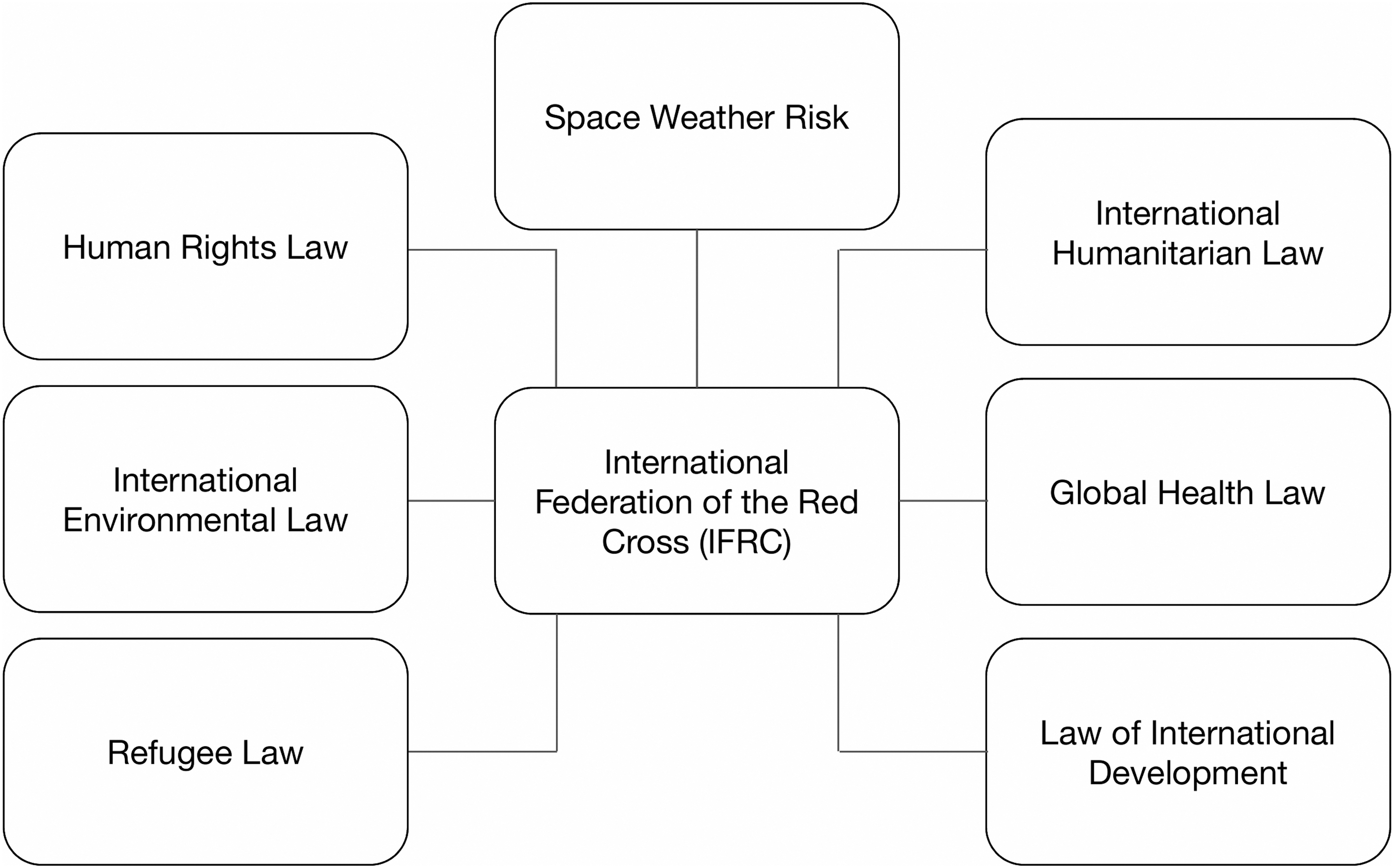
Recommended International Federation of the Red Cross Advisory Committee structure to develop solar weather-specific International Disaster Response Law guidelines.
In conclusion, the EU and the United States are developing regulatory frameworks to mitigate against a future Carrington Event. The EU has an extensive cooperation framework, and the Treaty of Lisbon provides a basis for major disaster responses. In case of a Carrington Event, the Treaty of Lisbon in the EU and federal agencies in the United States could be activated to assist affected areas with managing the disaster response and recovery efforts. However, improved coordination between EU countries, and between the U.S. regulatory agencies and privately owned infrastructure, could be made. Countries outside the EU and the United States could be heavily affected by lack of coordinated assistance. With these countries, existing UN and IFRC guidelines and agreements may be the current best frameworks to mitigate Carrington Event effects and minimize the need for aid. This could be reinforced with space weather-specific disaster response plans, bilateral and international cooperation agreements, and hardening of infra- and social structures. Additionally, several new policies and regulations should be explored for commercial space. This includes considerations for commercial satellites, suborbital and orbital flights, and insurance.
Footnotes
Author Disclosure Statement
No competing financial interests exist.
Funding Information
This work was supported by the International Space University, inspired by Dr. Helmut Kessler and supervised by Dr. Hugh Hill.