




Abstract
One of the biggest challenges faced by emerging spacefaring nations is developing a sustainable financial environment to fund their space activities. In this article, we describe the favorable Brazilian space sector momentum, discuss the main roadblocks to creating a thriving space ecosystem, delve deeper into the current funding landscape, and provide recommendations for overcoming financial constraints. By examining challenges and identifying opportunities, we hope to lay a roadmap to nurture space initiatives in Brazil that can benefit other countries pursuing similar endeavors.
INTRODUCTION
Developing a sustainable financial environment to fund space activities is one of the biggest challenges emerging spacefaring nations face. Even among traditional actors like the United States, China, and Europe, where the space sector primarily relies on public resources, there is a growing interest in lowering the reliance on taxpayer money. For countries aiming to capitalize on the latest space interest surge, relying on existing sources while exploring new avenues may help bridge the existing gap.
Despite producing world-class agriculture, oil and gas, and aviation expertise, Brazil has struggled to foster a burgeoning space sector. The largest Latin American economy was one of the first nations in the developing world to launch a space program in 1961. Brazil has highly skilled technical personnel and a sophisticated aerospace industrial base thanks to a solid aeronautical tradition. And yet, the country has seen others surpass its accomplishments. 1
Without the favorable conditions encountered elsewhere, stakeholders must explore untapped opportunities to promote its space endeavors. As it turns out, the timing to reverse the current scenario seems favorable, building upon the geographic redistribution of space activities trend. 2 Three main factors could play a role in Brazil: the change in the global geopolitical landscape, the exponential nature of technology, and the fast growth of entrepreneurial space.
First, space activities worldwide have gained momentum because of the growing importance of the topic in the international sphere. Reflecting the dispute between the United States and China, space has become a strategic domain tied to commercial and security priorities. Prestige, technology demonstration, and natural resources are fueling a new space race in the form of scientific and commercial missions, both in Earth orbit and deep space.
Technological development is democratizing access to space. Some examples are the fast acceleration of computing power, miniaturization, and new materials. Companies like SpaceX are reducing launch costs, improving scheduling predictability, and lowering startup entry barriers.
Commercial space, notably New Space, is driving the fast growth among private activities. 3 Following the footsteps of Elon Musk, Jeff Bezos, and other successful New Space founders, a new generation of entrepreneurs is joining the sector. Those companies have also nurtured talent, fueling a new wave of space companies. 4
Despite lagging, the space sector has the potential to grow sustainably in Brazil. Although direct and indirect public funding is expected to remain a significant source of financing, thinking beyond the current framework is crucial to broaden the options to foster space activities. Otherwise, like previous industrial policy initiatives, Brazil risks perpetuating a dependency on public resources with the government as the sole customer, stifling growth and innovation in the sector. 5
In this article, we describe the favorable Brazilian space sector momentum, discuss the main roadblocks to creating a thriving space ecosystem, delve deeper into the current domestic and international funding landscapes, and provide recommendations for overcoming financial constraints. New challenges and opportunities emerge as the interface between space and nonspace sectors becomes less defined. By examining them, we can lay a roadmap to nurture space initiatives in Brazil that can benefit other countries pursuing similar endeavors. 6
BUILDING MOMENTUM
Space activities have gained momentum on several fronts recently in Brazil. A renewed interest in space has led local authorities to engage in high-profile activities, including signing international cooperation agreements and granting licenses for private space companies to operate in the country, among other developments.
After almost two decades of negotiations, Brazil and the United States signed a Technology Safeguards Agreement in 2019, creating conditions for commercial space exchange between the two nations on Brazilian soil. 7 The agreement allows U.S. companies to launch from the Alcantara Space Center (CLA), which offers favorable conditions for equatorial and polar orbits. Several companies, including Virgin Orbit, have received an operator’s license from the Brazilian government.
Brazil signed the Artemis Accords in 2021, becoming the first Latin American nation to join the initiative that will bring humanity back to the moon while fostering commercial opportunities. In June 2022, the Sao Paulo Research Foundation (FAPESP), one of Brazil’s principal science funding agencies, issued a call for interest in proposing projects for a collaboration under Artemis. 8
With a sophisticated industrial base, Brazil counts on several companies equipped to seize the growing space sector trend. Established in 1993, the Aerospace Industries Association of Brazil (AIAB) represents 38 aeronautics, space, and defense companies primarily based in Sao Jose dos Campos, Brazil’s most traditional space hub. The city also houses the TechPark, building upon the large aerospace industrial base in the area, with incubation opportunities such as TechPark UNIVAP and Incubaero.
Plenty of companies in Sao Jose dos Campos have decades of experience working with the government in space initiatives. Chief among those is the China–Brazil Earth Resources Satellite program (CBERS) 9 signed in 1988. In March 2023, Brazil and China announced the signature of the CBERS-6 agreement for developing the Synthetic Aperture Radar (SAR) satellites for monitoring the Amazon. 10
In parallel, a New Space ecosystem starts to take shape. Brazilian entrepreneurs are starting to see opportunities in the sector with the lowering of entry barriers. The country has seen the creation of different space businesses in recent years, ranging from startups developing hardware technologies to companies creating domestic space launch systems and related software.
Formed in 2020, the Alliance of Brazilian Space Startups (ASB) aims to promote New Space in Brazil. With 12 companies enlisted, the ASB is gaining momentum as a result of the space accomplishments of its members. That is the case of Airvantis, which has taken scientific experiments and other educational payloads to the International Space Station (ISS) since 2018. Airvantis has worked with commercial customers to fly payload to space and entered into agreements with European and Japanese space entities to access the space economy.
Although Sao Paulo state concentrates most space activities, new startup programs are being created countrywide. Two notable cases are the northeastern state of Maranhao, where the Alcantara Launching Center is located, and the southern state of Santa Catarina and its Catarina Constellation Program.
Research and academic initiatives have been primary drivers for space activities in Brazil. CubeSats for educational purposes is one of the most promising areas, with seven missions conducted between 2014 and 2020. 11 In January 2022, PION-BR1 became the first satellite developed by a Brazilian company primarily funded with private resources to launch into space. 12 We see the aforementioned examples as evidence that a potentially robust and sustainable space ecosystem, albeit one that faces many challenges, is beginning to form.
CHALLENGES
“All happy families resemble each other.” The line from Tolstoy’s Anna Karenina masterpiece describes successful space programs that count on solid government support, resource allocation, and coordination. For everyone else lagging, unmet aspirations might have various root causes. In Brazil, the lack of a long-term strategy, industrial policy, and underprioritization have created barriers to space sector development over the years. 1
Brazil’s space program was on par with those of China and India in the 1970s. The following decades saw a series of decisions that led to an increasing gap between aspiration and execution. The goal of creating indigenous launching capabilities led to several initiatives. In the early 2000s, different initiatives such as the Alcantara Cyclone Space, Satellite Launch Vehicle, Microsatellite Launch Vehicle, and Sounding Booster Vehicle were running in parallel, competing for interests and resources, and none of them yielded the expected results. 1 In 2003, a tragedy that killed 21 people, the second-largest space accident in space history, further derailed the Brazilian space launch program. After joining the ISS in 1998, Brazil withdrew the agreement after not honoring its commitments a decade later.
As mentioned, CBERS helped spur companies that provided services to the program. However, most of those companies have struggled as the continuity of the cooperation between Brazil and China became unclear, echoing previous industrial policy priorities where import substitution did not help launch competitive export-led businesses. Similarly, motivated by the idea of creating a national space champion, Brazil partnered with Ukraine to form Alcantara Cyclone Space, a launch company, in 2003. The aim was to provide services to the global satellite market, ending in 2015 without concrete results.
From a comparative perspective, Brazil invests significantly less in space than other countries. 13
According to the Organization for Economic Cooperation and Development (OECD), only five other nations among the G20 countries spend less on their space initiatives (Fig. 1). As a percentage of the GDP, the United States spends 33 times more than Brazil does on space activities. According to the same metrics, Argentina’s space budget is 50% higher than its larger neighbor. 11 Brazilian authorities acknowledge the gap in human, financial, and logistical investments. 13
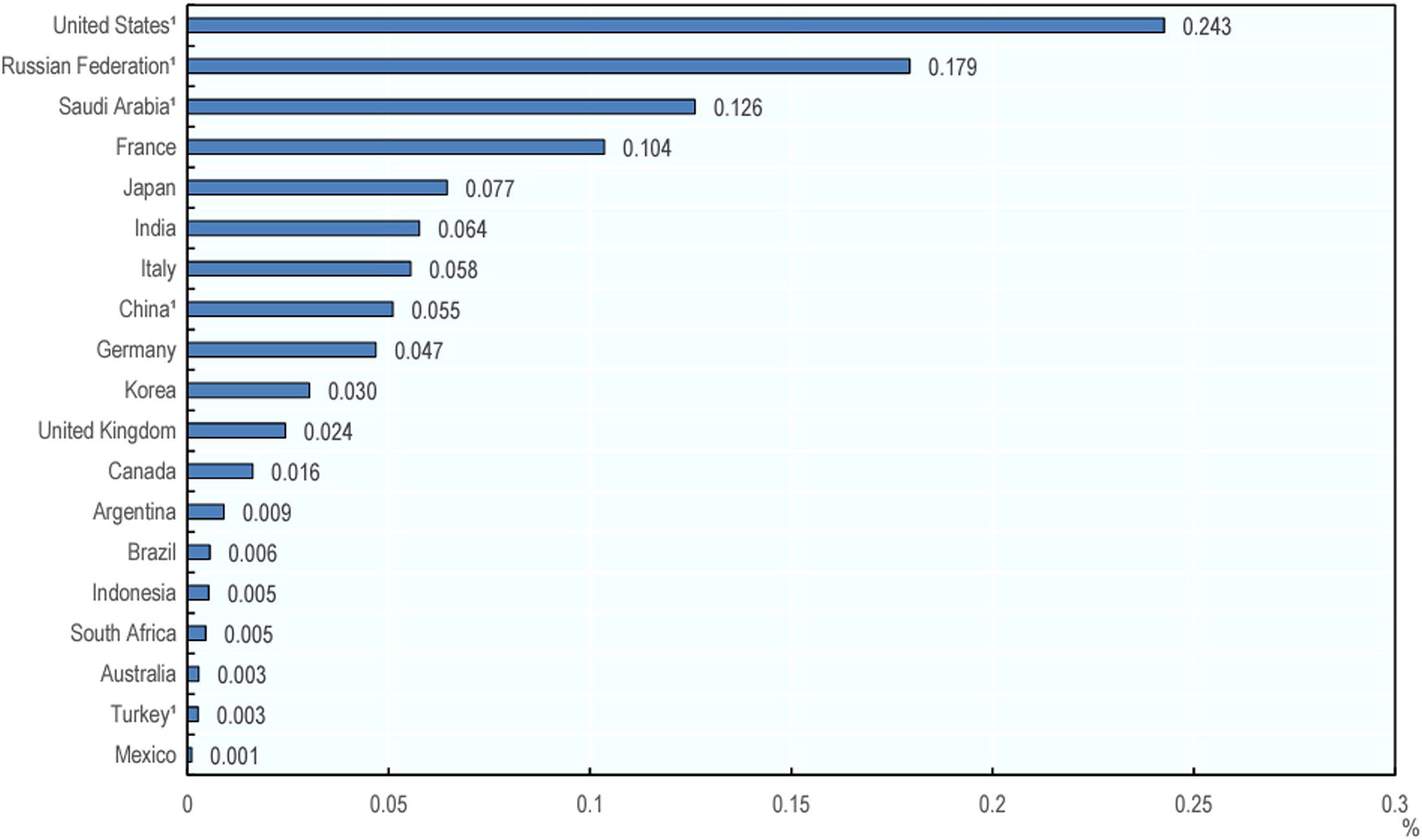
Government space budget estimates for G20 countries as a share of the GDP in 2019 (%). Source: OECD.
After experiencing a brief boon in the first years of the 21st century, Brazil has encountered challenges to resume growth, with direct consequences for the space sector. Figure 2 reveals the recent fall in the executed budget of the Brazilian Space Agency (AEB) in absolute terms and relative to Brazil’s GDP. In other words, even with the dismal performance of the Brazilian economy over the past decade, AEB’s budget has been disproportionally affected since 2006.

AEB executed budget and Brazil’s GDP. AEB, Brazilian Space Agency. Source: Authors’ calculations with inputs from Portal Brasileiro de Dados Abertos, Ipeadata, and World Bank.

The Brazilian Space Program. Source: Authors.

Space program governance. Source: Authors.
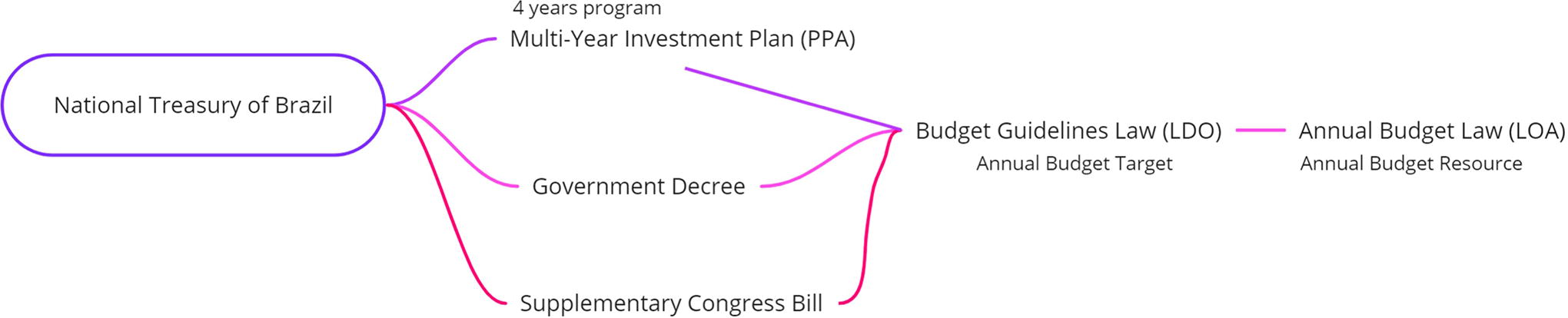
Public budget flowchart. Source: Authors.
FUNDING LANDSCAPE
Thanks to a solid scientific tradition, diverse economy, and sophisticated industrial base, Brazil counts on an institutional framework with the potential to support space initiatives beyond traditional means. Space initiatives could also explore international resources that remain vastly underutilized. Next, we delve deeper into the current funding landscape, including public and private sources, and elaborate on untapped opportunities.
Public Sector
Like other spacefaring nations, the public sector has been Brazil's primary funding source for space activities. Resources are funneled through several organizations, including the Brazilian National Treasury, primarily through the Ministry of Science, Technology, and Innovation (MCTI)—which houses the AEB—and the Ministry of Defense. Congress, development financial institutions, including the Brazilian Development Bank (BNDES), and special initiatives such as sectoral funds have also provided resources to the space sector.
Brazilian National Treasury and direct budget
Most Brazilian Space Program funding comes from the government’s direct budget. Introducing the division between the executing entities and the established public policies that guide the Brazilian program helps to illustrate the financial flow. The AEB develops the civil program's core. 14 The National Policy for Space Activities Development (PNDAE) is the primary document that guides the space civil program. A National Program for Space Activities (PNAE) is renewed every 10 years with an execution and financial plan to meet the PNDAE guidelines. A Superior Council assists the Brazilian Space Program, conveying the demands of public entities and economic sectors. The Space Systems Implementation and Coordination Commission organizes the military program and follows the guidelines proposed in the Strategic Program for Space Systems (PESE). 15
Several entities execute the programs managed by AEB and the Space Systems Implementation and Coordination Commission (CCISE). Brazil has tried to separate civil and military activities. However, there are often overlaps of activities between different entities. Focusing on the PNAE and PNDAE, the structure encompasses launchers and launching centers under military supervision and satellites under civil supervision. For the PESE, all the activities sit under the Ministry of Defense.
Recently, other commissions and groups started to support space activities in Brazil. A Brazilian Space Program Development Committee (CDPEB) was installed with the president's office to discuss the space program with actors from different sectors (public and private). A National Space Council assists the CDPEB with high-level authorities from the government.
The CDPEB has implemented working groups to discuss a wide variety of topics about space, and one of the groups has consolidated a new General Law of Space Activities in Brazil, to be published soon. Also, the MCTI has launched the “space network,” a multisector group that convenes discussions about civilian space activities.
Civil and military activities share the total direct budget allocated for the space program under the Annual Budget Law (LOA). The Brazilian Space Program (PEB) received BRL 173.6 million for the LOA in 2022. The MCTI received most of the funds, BRL 151.2 million, to implement the PNAE. In contrast, the Ministry of Defense was granted BRL 22.4 million to execute the PESE.
Brazilian Development Bank
The Brazilian Development Bank (BNDES) is a federal public company founded in 1952 under the Brazilian Ministry of Finance. Its primary objective is to be the main instrument of the federal government for providing long-term financing to projects fostering economic growth and social development in Brazil. The bank focuses on strengthening the capital structure of private companies, supporting the development of capital markets, facilitating the trade of machinery and equipment, and providing financing for exports. 16
The BNDES provides financing through different funds and programs that space startups could use. It is one of the world’s largest development banks, with approximately BRL 700 billion in assets and a portfolio of projects totaling more than BRL 400 billion. 17 The bank supports entrepreneurs and companies of all sizes by providing financing, underwriting securities, providing guarantees, and granting nonrefundable funds. 18
Aerospace is one of the sectors in which the BNDES has shown interest in the past decade. For instance, it assisted the Aero Defense Innovation Plan in 2013 to leverage different companies within space, defense, security, and the special materials fields. 19 The initiative, joined by other agencies and financing partners, injected BRL 2.9 billion into the sector.
Although it finances large projects, the BNDES also has programs specifically targeting the support of Brazilian startups at the seed level and beyond. The bank provides loans, as well as direct and indirect equity investments. For instance, the BNDES Garagem initiative has recently financed multiple startups. The program offers two funding levels, BRL 20,000 or BRL 30,000, for selected startups and other types of nondilutive assistance. In 2021 and 2022 alone, the program has funded and accelerated 100 startups. 20 One of these startups, Um Grau e Meio, uses satellite imagery and other technologies to monitor fires in Brazil to reduce CO2 emissions. 21
The BNDES also indirectly funds startups by providing capital to fund managers in specific programs targeting startups. In 2021, the BNDES launched public calls to select investment firms focused on impact investment to help BNDES deploy approximately BRL 450 million to startups. 22 For instance, BNDES has participated in a public funding system, the FIP Aeroespacial, 23 where it has joined forces with the Brazilian Innovation Agency (FINEP), Sao Paulo Development Agency (DESENVOLVE SP), and Embraer to establish an equity investment fund to invest in a wide range of companies in Brazil that operate in the aerospace segment.
Another avenue to obtain BNDES financing is through its Technological and Scientific Development Fund (FUNTEC). 24 FUNTEC offers financial support to research, development, and innovation projects in science and technology. Through this fund, BNDES provides nonreimbursable resources to projects led by public or private institutions, including companies working with universities or research institutions. FUNTEC allocates resources to strategic areas for Brazil's development, such as agriculture, biotechnology, energy, health, information and communication technology, environment, and others.
FINEP and sectoral funds
FINEP is a public enterprise under the MCTI, established to support and promote research, development, and innovation in the country. Created in 1967, FINEP offers a range of financing options, including grants, repayable loans, and investments in innovative projects, companies, and institutions.
FINEP focuses on fostering the competitiveness and growth of the Brazilian economy by advancing science, technology, and innovation. The organization plays a crucial role in fostering strategic sectors, such as biotechnology, renewable energy, and aerospace, and supporting small and medium-sized enterprises in their innovation efforts. It nurtures Brazil’s innovation ecosystem by financing research and development projects in the country, mainly through loans, grants, and equity investments.
Several initiatives focus on supporting nascent businesses. One example is FINEP Startup, designed to bridge the gap between early-stage startups with high growth potential and the resources they need to scale and succeed in the market. The program provides up to BRL 2.2 million in seed capital to startups that meet the program criteria, such as having revenue of at least BRL 360,000 and at most BRL 4.8 million in revenue in the year preceding the application. 25 Another example is the FINEP Centelha program, which provides idea-stage financing to entrepreneurs to assist them in turning ideas into innovative companies. More than 490 startups came about through this program. Each company receives approximately BRL 50,000 in funding and other types of support. 26
Besides its programs, FINEP participates in initiatives with the BNDES and other entities to leverage the aerospace sector in Brazil. More recently, the organization launched a series of public bids targeting technology demonstration projects within the aerospace segment. Three public calls were conducted as of March 2023, one for suborbital launchers, one for small launchers, and one for an observation satellite.
FINEP is also the executing agency for the National Fund for Scientific and Technological Development (FNDCT). The Brazilian government created the FNDCT in 1969 to finance scientific and technological development programs. The FNDCT grew throughout the past several decades and now includes 16 “Sectoral Funds” to provide funding assistance to areas the country determines a priority for national development. 27
One of these Sectoral Funds is the Space Sector Scientific and Technological Development Program (the “Space Sectoral Fund”), which has the stated purpose of stimulating scientific research and technological development related to the application of space technology in the generation of products and services in the areas of communication, remote sensing, meteorology, agriculture, oceanography, and navigation. 28 The Space Sectoral Fund and other specific sectoral funds could assist space companies or businesses offering solutions that leverage space technology in other areas, such as agriculture, biotechnology, and mining.
FNDCT financing falls into two categories—reimbursable and nonreimbursable instruments, as shown in (Table 1). 29 Reimbursable instruments are those through which the funds invested by FNDCT carry some expectation that FNDCT will be repaid. As with any financing by FNDCT, reimbursable financing applies toward technological innovation and research activities. 30 They include loans, equity contributions, and liquidity guarantees.
FNDCT Financing
Note: Items marked with an asterisk (*) refer specifically to Space Sectoral Funds.
FNDCT, National Fund for Scientific and Technological Development.
Nonreimbursable financing instruments carry no such expectations of repayment, and some have grant-like characteristics. In 2022, the Space Sectoral Fund had a federally allocated budget of BRL 12 million for financing activities through nonreimbursable instruments, with no expectation that FNDTC funds would be repaid by receiving entities. 31 Scholarships, direct financing of strategic projects, studies, and events are examples of nonreimbursable activities eligible for nonreimbursable financial support.
Subnational agencies
Research Foundations (FAPs) are state-level public foundations in Brazil responsible for supporting and promoting scientific research and technological development in different states in Brazil. Each FAP funds research projects, scholarships, and fellowships in several fields, including natural sciences, engineering, humanities, and social sciences.
The mission of the FAPs is to advance knowledge, promote scientific and technological innovation, and contribute to specific states and Brazil's economic and social development. FAPs also play a crucial role in fostering international collaborations and partnerships, encouraging the exchange of researchers and ideas between Brazilian states and other countries. The most active FAP comes = São Paulo state (FAPESP), with specific programs like the Small Business Innovative Research Program (PIPE), which helps to start companies develop their business model. 1
Desenvolve São Paulo, created by the São Paulo state government, supports and promotes the development of micro, small, and medium-sized companies in the state. The program offers various services such as financing, consultancy, training, and networking opportunities to help entrepreneurs and businesses grow and prosper in the local economy.
Multilateral Institutions
Brazil has long been a member of international organizations such as the World Bank, the United Nations (UN), and several development banks such as the Inter-American Development Bank (IADB). Although these organizations may not have specific funds and programs to fund space startups in Brazil, they support innovation and the global startup ecosystem in alternative ways. The Brazilian space technology ecosystem may leverage some of such assistance. Brazilian space technology startups may be able to access funding and other types of assistance by applying their technologies, products, and services to specific Brazilian development needs.
The UN system
The United Nations (UN) has highlighted, in many instances, that the use of space technology applications is in line with its agency’s missions. A recent 2021 report stressed that space technologies could be a valuable tool and, directly and indirectly, contribute to achieving the UN’s Sustainable Development Goals. Space technologies have provided food security and agriculture solutions, health, access to telecommunications, disaster risk reduction, natural resource management, environmental conservation and monitoring, and poverty reduction. 32
The UN also has programs that space technology startups can use to receive technical support and funding. 33 For instance, the United Nations Children’s Fund (UNICEF) has an initiative called the Innovation Fund (also known as the UNICEF Venture Fund), whose mission is to “quickly assess, fund, and grow open-source digital public goods that have been developed in new and emerging markets.” 34 The Innovation Fund has funded hundreds of startups since 2016. In the 2021–2022 fiscal year, it funded 69 early-stage and 12 growth-stage startups with check sizes of approximately USD 100,000 each. The Innovation fund has funded companies that work with satellite data to monitor economic drivers and map schools and hospitals in developing countries. Further, the Innovation Fund has highlighted that space technologies have the potential to assist UNICEF in achieving some of its goals. For instance, the Innovation Fund 2021–2022 annual report stated, “Data from low-earth orbiting satellites and high-altitude pseudo-satellites have the potential to play a critical role in providing last-mile-connectivity and ensuring access to information, opportunity, and choice for every child.” 35
Another funding initiative is the Investment and Technology Promotion Office (ITPO) within the United Nations Industrial Development Organization (UNIDO). ITPO aims to facilitate investment flows and technology transfers to recipient countries, and ITPO does that through capacity-building activities, advisory services, and investment, among other supportive activities. Although no Brazilian space startup has obtained funding from UNIDO, the agency, through ITPO, supported at least one company, CLOQ, with a USD 500,000 investment. 36
Multilateral banks
Multilateral development banks (MDBs) have both global and regional reach. These organizations formed by different countries provide financing and technical support to member countries. 37 In the case of Brazil, Brazil is a member of the World Bank, the IADB, the New Development Bank, and others. 38
These MDBs all have, as part of their missions, invested in programs to support entrepreneurship. Some have specific departments focused on providing technical, and sometimes financial, support to startups from their member countries. For instance, the IADB has an initiative called the IDB Lab, an innovation laboratory that provides financial and technical support to assist in testing early-stage ideas by startups. 39 IDB Lab has allocated over USD 2 billion to more than 2700 projects across Latin America and the Caribbean. Brazilian startups—including space technology startups—are eligible to apply for and receive assistance. 41 The IADB has supported space initiatives in Latin America. For example, the IADB invested in Satellogic, a satellite constellation company from Argentina, in 2019. 42 Also, in 2019, the IADB supported Argentina’s satellite project SAOCOM with a USD 60 million loan. 43
The World Bank’s private arm, the International Finance Corporation (IFC), provides financial support to startups through its Venture Capital (VC) program. The IFC VC program invests in startups and other high-growth companies in various industries, including technology, health care, and renewable energy. The program invests in firms addressing social and environmental issues, such as expanding access to healthcare or lowering carbon emissions. IFC’s VC program has the following requirements:
44
“Project must be located in a developing country that is a member of IFC; and Be in the private sector; Be technically sound; Have good prospects of being profitable; Benefit the local economy; and Be environmentally and socially sound, satisfying our environmental and social standards and those of the host country.”
44
Thus, Brazilian space technology startups whose products or services align with these requirements could be eligible for financing and other assistance the IFC VC Program provides. Although not in Brazil, the IFC has, in the past, financed companies working with space technologies. One notorious example is Planet Labs, and the IFC VC arm led the company’s round C of financing with an investment of USD 20 million. 45 Another example is the satellite constellation company OB3 Networks, which received USD 74.2 million in two loan operations. 46
Other Opportunities
Space is a global industry at its core. With the growing importance of commercial space and the perceived impact of space in other sectors, private investors, social enterprises, nonprofit organizations, and others are amplifying funding access in Brazil and worldwide.
Private investment
Space startups around the globe have benefited from angel and venture capital investment in recent years. According to Brycetech, a consulting firm, 241 startup space ventures received USD 15.4 billion in investments in 2021 worldwide.
E2MC, Seldor Capital, Seraphim Capital, Space Capital, the Space Fund, and Stellar Ventures are some firms that invest in early-stage space companies worldwide. At the later stage, traditional firms such as Andreesen Horowitz, Founders Fund, and Lux Capital are active space investors. In Brazil, venture funds like GRIDS Capital and Pitanga have shown an appetite for Deep Tech, with the latter investing in Argentinian-based Satellogic. VC dry powder reached USD 300 billion in the United States alone in 2022. 47 In other words, there is capital unallocated that will eventually be deployed to the companies ready to take advantage of it.
Nonprofit organizations
Among nonprofit organizations, the Brazilian Company for Industrial Research and Innovation (Embrapii) is notable for promoting research, development, and innovation in collaboration with companies, universities, and research institutions. Embrapii's main objective is to increase the competitiveness of the Brazilian industry by providing funding and technical support to companies that want to develop innovative products, processes, and services. Embrapii works on a partnership model, with companies contributing to the funding of projects and Embrapii providing access to specialized research teams and infrastructure. This model encourages private investment in research and development in areas like space, thereby boosting innovation and economic growth in Brazil.
Similarly, Instituto Serrapilheira seeks to promote scientific and technological development in Brazil by supporting researchers and projects that address critical scientific questions and challenges. It offers funding and resources to scientists, researchers, and entrepreneurs working on cutting-edge projects across various fields, including neuroscience, physics, biotechnology, and space science. Although not exclusively focused on space research, Serrapilheira has provided funding for several projects within the space community in Brazil.
Another nonprofit organization, Instituto Garatéa, focuses on promoting space activities. With its flagship program, the Brazilian Lunar Mission, Garatéa aims to leverage science, entrepreneurship, and education in Brazil through space missions. Instituto Garatéa has experimented with different funding options such as sponsorship, philanthropy, and selling collectible digital assets. 2 Since 2018, Garatéa has sent several educational experiments to the ISS. 48
Other traditional entities in Brazil, such as SENAI and SEBRAE, have shown interest in developing space programs, especially with universities. Part of the Brazilian “S” system, both entities have been involved in space activities.
Other opportunities
At the idea stage, the Founder Institute is an incubator present in several tech hubs worldwide. The program is free, and top performers often have access to investment from a network of mentors. The space accelerators organized by AWS, Seraphim, and Techstars offer virtual and residence programs for early-stage startups.
The gold standard among the accelerators, since 2016, Silicon Valley-based Y Combinator (YC) has helped scale 18 space companies such as Relativity Space, Momentus, Turion, and Wyvern. 49 The organization invests USD 500,000 in return for 7% of the company. They have founders from all over the world but expect companies to establish legal entities in specific jurisdictions. 50 An essential value added is the stamp of validation: most startups receive seed money upon graduation from investors from the YC extended network.
Other global initiatives for more mature space startups, such as the Creative Destruction Labs and Endless Frontier Labs, with their ties to world-class universities, leading experts, industry, and investors, are ideal for companies ready to scale. SpaceWERX, the innovation arm of the U.S. Space Force, and its parent organization AFWERX have created several opportunities for startups worldwide to compete for contracts with a particular interest in dual-use technologies.
Despite the volatility of cryptocurrencies and pushback on nonfungible tokens (NFTs), blockchain-based technologies will continue to evolve, opening doors for using digital assets to support space projects. The first NFT artwork flew to space in July 2021, and several similar initiatives have occurred since then. 51 Project Brazil 200, which aims to pioneer new business models to fund space activities, has launched a pilot campaign involving NFTs. 52
RECOMMENDATIONS
Creating a nurturing environment will allow startups to seize opportunities resulting from the fast development of the space sector. The prioritization of entrepreneurial activities, connection with other sectors, and development of a mindset focused on global markets would pave the way for Brazil's long-term growth of space activities.
Figure 6 introduces a preliminary map showing the potential funding sources. Funding sources encompass categories by type of endeavor contemplated. Several options are available in Brazil, from basic science to fully developed commercial initiatives. Below we set forth specific recommendations based on existing alternatives and untapped opportunities.

Funding map for space ventures.
Support initiatives aimed at fostering space startups: Creating a pool of opportunities comprising startups with skilled entrepreneurs empowered with sensible business models will help attract investors. In 2021, ONOVOLAB, based in the Sao Carlos municipality in Sao Paulo state and one of Brazil’s tech hubs, organized a global virtual space accelerator. After that, Airvantis started the first New Space startup program at ONOVOLAB, where 15 new startups from Brazil and abroad participated and received assistance to develop their businesses.
Promote integration between the space sector and other segments: Several verticals, such as the agribusiness, mining, and oil and gas sectors, are early technology adopters, whereas Brazil has a long-standing tradition. The latter, in particular, has benefited from the pre-salt oil discovery windfalls and could allocate resources to R&D and startup development. Bridging the gap between space and those segments would be mutually beneficial, breeding the ecosystem with space-based solutions while nurturing startups ready to compete in international markets.
Prioritize export-oriented companies: In the space sector, we still see an industrial policy prioritizing developing indigenous capability rather than nurturing startups that can become competitive globally. Over the years, Brazil has created several institutions to support the country’s productive sector. The BNDES, FINEP, and state agencies such as FAPESP should prioritize companies and initiatives to explore opportunities worldwide while helping hedge the risk for entrepreneurs. Agencies such as the Trade Promotion Agency (APEX) could support the efforts of helping entrepreneurs connect with leading startup programs.
Connect with global networks in established tech hubs: With the pandemic, several incubators and accelerators started offering the opportunity for startups to join virtually. With the return of in-person activities, Brazilian founders can attend programs and connect with like-minded peers in the most developed entrepreneurial ecosystems. In parallel, several initiatives of groups associated with world-class academic institutions organize events that Brazilian entrepreneurs can attend. One example is Brazil at Silicon Valley, an initiative of Brazilian students and alumni of Berkeley and Stanford.
Lure smart money to support the local ecosystem: Smart money refers to investors who, besides writing a check, support startups with mentorship, knowledge, and connections while opening doors. In the United States, initiatives such as the State Small Business Credit Initiative (SSBCI) have enabled individual states to become Limited Partners in venture funds that invest in local startups, maximizing the impact through matching schemes. Penjana Kapital, a fund created by the Malaysian government, is an example of thinking outside the box that follows the SSBCI logic: They invest in foreign VC funds to match resources allocated to local companies with resources from overseas. Along the same lines, following that example would radically depart from existing approaches and attract entities from abroad to support the Brazilian ecosystem.
CONCLUSIONS
In this article, we diagnose the current funding landscape for space activities in Brazil by outlining challenges rooted in historical factors, elaborating on the scene beyond traditional sources, and providing recommendations to expand the pool of opportunities to backing space initiatives. In addition, our work elicits reflections regarding the perceived scarcity of resources.
Overall and elsewhere, the lack of funding for space startups might not be the cause but the consequence of a lack of entrepreneurs and startups ready to seize the existing opportunities. Blaming founders and their companies is not the solution; creating an ecosystem requires a concerted effort involving the public and private sectors, academia, and civil society among the primary stakeholders. More importantly, it requires a change in the mindset that prioritizes looking outward rather than focusing inward.
“Never let a good crisis go to waste” is a quote often attributed to Winston Churchill. The current macroeconomic situation should force decision-makers to think outside the box. Several initiatives outlined in this article do not require insurmountable funding, just better resource allocation. For instance, connecting space companies with the economy's most dynamic sectors, such as agribusiness and mining, should provide immediate benefits for all those involved. Other recommendations require an open-mind approach—allocating domestic resources to foreign investors as a development strategy might sound counterintuitive without elaborating the rationale.
Finally, investing in space is seen as an extravagance until one realizes its importance today. Telecommunications, weather forecasts, and climate change monitoring are examples. For everyone involved in the ecosystem, conveying the benefits of the space sector will help attract supporters, mobilize resources, and generate wealth for companies and investors while benefiting society.
Footnotes
AUTHOR DISCLOSURE STATEMENT
No competing financial interests exist.
FUNDING INFORMATION
No funding was received for this article.