




Abstract
New space is still a very recent subject in Latin America and the Caribbean. Since the start of the CubeSat wave, Latin American countries have launched 23 nanosatellites, with Brazil taking the lead with 7 launches, followed by Peru and Ecuador with 4 launches each, and Argentina with 3 nanosatellites launched. These numbers reflect a lack of innovation in these countries’ space sectors. With a worldwide interest in small satellites and their applications, Latin America and the Caribbean have not taken a stand in the New Space race. Even though those countries have almost no efforts together, the number of events related to New Space has increased, indicating the rise of interest among students, professors, and other sectors in the area. This article aims to give an overview of the past and present of CubeSats in Latin America and the Caribbean by gathering information about the CubeSats, such as mission state, orbit, payload, CubeSat developer, and some lessons learned through the process in those countries. This article will bring all these elements together by analyzing the future missions of these countries, with the aim of examining the gaps between local governments, industries, and universities. Moreover, it will provide an outlook on the field, highlighting areas where these countries can collaborate and take action to develop the New Space in the region. Furthermore, the analyses should serve as a blueprint for businesses that plan on engaging in future missions and applications.
INTRODUCTION
If Latin America and the Caribbean were a nation, it would fit as the third largest economy in the world with almost 6 trillion USD in GDP and the third largest country in the world with over 600 million people living in the region, but in the space sector, Latin America and the Caribbean would still be far behind the biggest nation on this matter.
As New Space becomes the new standard for space development, many countries in the world have developed new skills in the space sector through small satellites, as their first space object ever launched into space. According to NASA, a small satellite can be classified under the following classification
1
:
Minisatellite, 100–180 kg; Microsatellite, 10–100 kg; Nanosatellite, 1–10 kg; Picosatellite, 0.01–1 kg; Femtosatellite, 0.001–0.01 kg.
Small satellites are very important for the development of New Space industries around the world, because of their low-cost of development, launch, and operations. It is an easy toll for universities and startups aiming to work in or with the space sector. An example of this is the development of startups such as PlanetLabs in the United States. Nowadays, it holds the position of the main operator of satellites in the world and also the main producer of small satellites, to be overcome by SpaceX through Starlink. In Latin America and the Caribbean, Satellogic, among others to be explored in this article, is an example of integrators and operators of earth observation satellites in South America.
Although there is a shortfall, compared with the developed countries, Latin America presents some potential to be an important player in the space sector. In this article, we will explore more about its capacity through an overview of the small satellites produced in Latin America and the Caribbean.
LATIN AMERICAN AND CARIBBEAN SMALL SATELLITES
UNOOSA has registered launched objects in space since 1962, and it has registered over 86% of all satellites, probes, landers, crewed spacecraft, and space stations. 2 With over 9,000 objects registered, only 211 belong to Latin America and the Caribbean, as can be seen in (Table 1).
Number of Objects Registered by Latin America and Caribbean Countries at UNOOSA 2
is in Uruguay: An Argentinian company registered its microsatellite under Uruguay.
is in Ecuador: Two Small satellite built by Ecuador was registered by the launcher country Russia.
Only 12 of the 33 nations in Latin America have space objects registered at UNOOSA.
Costa Rica
Costa Rica has just 1 object registered in UNOOSA, and that’s the CubeSat Irazú. It’s the first CubeSat launched by Costa Rica; the mission was an effort to launch the first Latin American satellite. 3 Launching in 2018, it became a governmental effort to make the mission possible. The Irazú satellite works as a radio transmitter and also as an educational satellite for student development and onboard computer testing. 3
Guatemala
Guatemala’s first satellite was awarded by the UNOOSA-JAXA KiboCUBE program; it was also, as in Costa Rica, a mission that became a governmental effort with educational purposes. Led by the Universidad del Valle de Guatemala, the satellite was equipped with a camera and electronics developed in Guatemala. 4
Bolivia
The only object registered by Bolivia is a geostationary satellite, TKSat-1, manufactured by China Great Wall Industry on a DFH-4 Bus. TKSat-1 is a communication satellite. 5
Venezuela
With 3 objects, Venezuela has launched 2 earth observation satellites and 1 communication satellite built on the same bus as Bolivian TKsat-1. 6
Ecuador
Ecuador has 4 small satellites in the orbit; 2 of them are from Equator Technological University and the other 2 were led by the Ecuador Space Agency. 7 At the Pegasus mission, the country had only a CubeSat platform, with the launch being contracted by Russian, Ukrainian, and Chinese launchers. 8
Colombia
Colombia has access to space only with CubeSat missions. They have taken advantage of New Space to buy a military CubeSat platform, and the other satellite is an educational platform.9,10
Peru
Following the previous country, all 4 objects were small satellites. All of them were used for educational missions made by universities in Peru that used the small satellites for educational purposes. Their first mission in 2013, led by Pontificia Universidad Católica del Peru, carried 2 satellites, one 1U CubeSat and a picosatellite further deployed by the satellite, which allowed the country to start building space capability for its future space professionals. 11
Chile
Chile does not follow the standard of educational missions established by far, with 4 missions registered, all of them were small satellites, but just 1 was a CubeSat with an educational mission. The FASat is a series of microsatellite requests by the Chile Air Force in order to build the nation’ space capability with an earth observation mission. 12
Uruguay
Seven out of 8 missions registered in Uruguay were produced by the Argentine company Satellogic; therefore, the launch was not a full Uruguayan effort to access space but a private investment in the development of an earth observation company in South America. The mission AntelSat was the first Uruguayan space object ever launched.2,13
Mexico
Although Mexico has 15 objects registered, just 3 of them were small satellites; the others were for great communication missions. Mexican missions do not follow the standard of mission; they use it as a tool for system validation and military development. 14
Argentina
Argentina is one of the vanguard countries in the space sector in South America, with 15 objects registered in space, and 7 of them were small satellites. Argentina follows a common pattern like Mexico; the missions present are for system validation, with 3 of them produced by Satellogic; and the others are basically government missions in order to build space capability. 15
Brazil
The first small satellite produced in Brazil by an institution was in 2000, when the University of North Paraná began the UNOSAT project. It took 3 years to be produced and launched, but unfortunately, it did not go to space because of its launcher explosion. After that incident, it took 11 years until the next launch on NCBR-1, even though its project began in 2005. Between 2014 and 2019, Brazil launched a total of 6 nanosatellites, more than 1 per year. 16
LIST OF SMALL SATELLITES IN LATIN AMERICA AND THE CARIBBEAN
For the list of small satellite launches in Latin America and the Caribbean, check Supplementary Appendix S1.
ANALYSIS OF LATIN AMERICAN AND CARIBBEAN LAUNCHES
Until March 2020, there were 41 launches of small satellites registered in Latin America and the Caribbean.
Launches by the Small Satellite Bus
As shown in Figure 1, the CubeSat platform is the most used for developing small spacecraft in Latin America, with over 50% of all launches being a variation of a CubeSat, with the 1U being the most used bus.
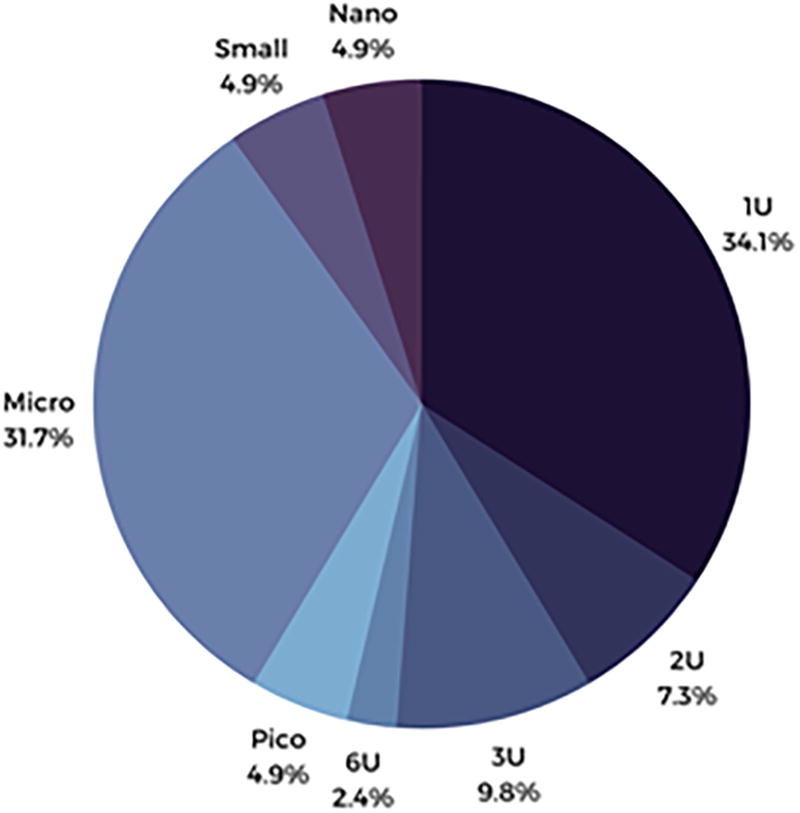
Small satellite by Bus.
Another important fact that can be seen is that the participation of microsatellites in Latin America and Caribbean, powered by a private company, allows the continent to build more complex spacecraft and therefore be able to be its own supply of space data.
Launches by the Small Satellite Orbit
As shown in Figure 2, most of the small satellite missions launched by Latin American and Caribbean countries are to SSO, which can indicate:
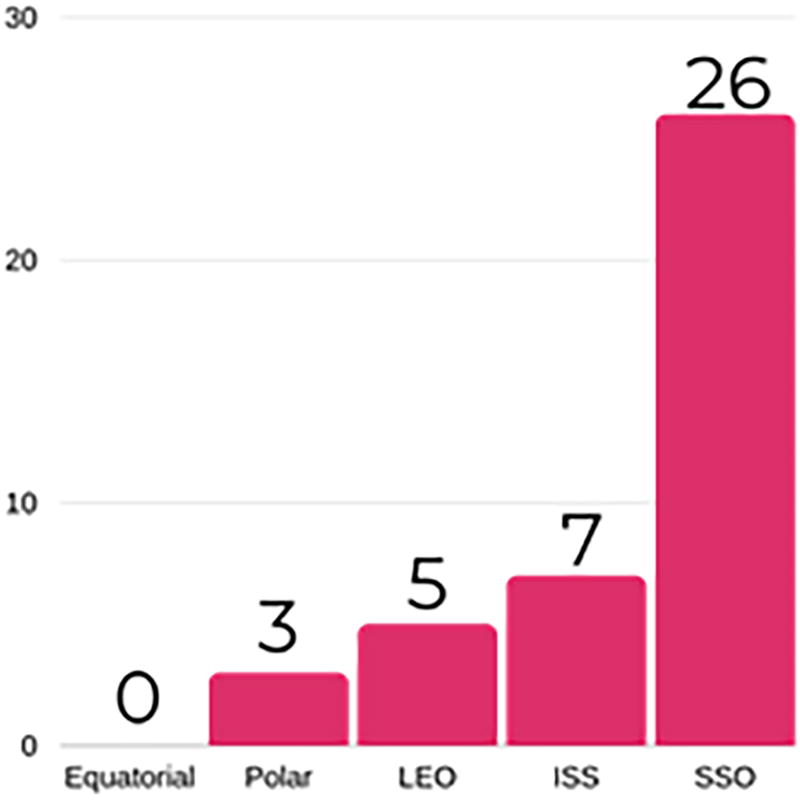
Small satellite by orbit.
Rideshare launch to SSO is a cheaper way to access space for Latin American and Caribbean countries;
ISS deployer is still a challenge for Latin American reach.
It is also important to note that Costa Rica and Guatemala missions were launched by ISS deployer, Costa Rica through NanoRacks, and Guatemala through the KiboCUBO program. Aside from that, just Brazil and Peru have accessed the ISS for launch.
There is also a lack of launch to equatorial orbit, where many Caribbean territories could be beneficial for revisitation of the satellite.
Launches by the Small Satellite Nation Launcher
When analyzed by nations, the former Soviet launcher took the lead with 18 launches made, as shown in Figure 3, which indicates that it might be easier to meet the requirements and pricing during the negotiation.

Small satellite by Nation Launcher.
It is also important that out of the 6 launches delivered by the United States, 4r were supplier missions to the ISS. And of all the countries in the region, Brazil is the only one with a launch attempt, by Brazilian Space Agency VLS program.
Launches by the Small Satellite Mission
When analyzed by mission, the educational purpose of the mission takes the lead, which is a strong indication that the program can pass through the education offices of the countries in the region, as shown in Figure 4. It is also important to note the number of earth observation missions that get a contribution from the private sector in the satellite production and launch of satellites.
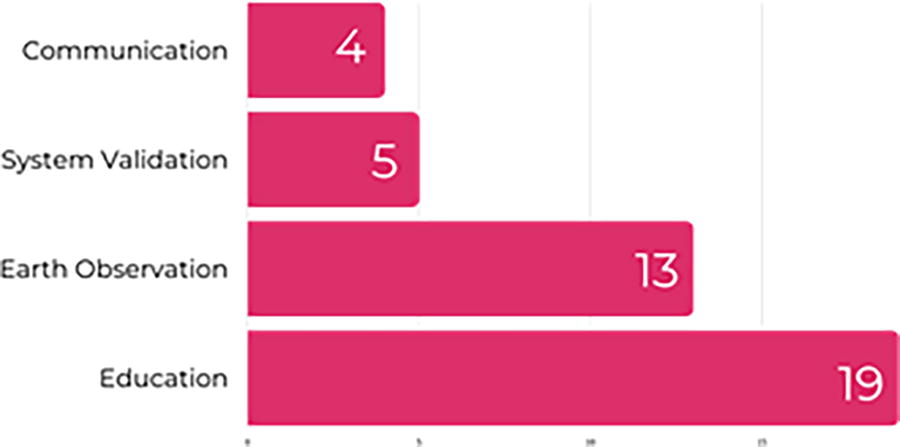
Small satellite by mission.
CONCLUSION
From the data presented, some evidence starts to show the following:
Small satellites are the safest and easiest way for Latin American and Caribbean countries to have a solid space program. Companies can boost the size and therefore the complexity of the satellites produced by Latin American and Caribbean countries. Although some regions could benefit from the equatorial orbit, Latin America and the Caribbean do not use it owing to a lack of rides to this orbit. They do not explore the ISS service for launches. Until now, basically, China has invested in New Space companies in Latin American and Caribbean countries. The small satellite industry in Latin America is maintained mostly for educational purposes. There’s a lack of interaction between the triple helix (university, industry, and government). There’s a lack of cooperative missions among Latin American and Caribbean countries.
However, all of this leads to a question that requires a deep analysis of the innovation, industry, politics, and economy of the region. Some international policies can start to be created in order to make the region more relevant in the New Space economy as those countries have been putting effort into building a critical mass, therefore creating a possible space workforce in the future.
Footnotes
ACKNOWLEDGMENTS
This article is part of an initiative by students from the University of Brasilia who truly believe that the New Space is an important tool for the development of the world. This article is presented by Ideia Space.
AUTHORS’ CONTRIBUTIONS
The authors confirm contribution to the article as follows: S.L.J.C.: Conceptualization and design (lead); S.L.J.C. and F.G.S.: Reviewing and editing (equal); S.L.J.C., L.R.P., B.V.T.R.: Writing—original draft (equal); B.V.T.R.: Investigation; S.D., K.P.: Methodology (lead); L.R.P., S.L.J.C.,: Formal analysis (equal). All authors reviewed the results and approved the final version of the article.
AUTHOR DISCLOSURE STATEMENT
The authors S.L.J.C., B.V.T.R., L.R.P., and K.P. report that they are affiliated with Ideia Space, an organization with a financial interest in the subject matter or materials discussed in this article. And the authors F.G.S. and S.D. certify that they have no affiliations with or involvement in any organization or entity with any financial interest (e.g., honoraria; educational grants; participation in speakers bureaus; membership, employment, consultancies, stock ownership, or other equity interest; and expert testimony or patent-licensing arrangements) or nonfinancial interest (e.g., personal or professional relationships, affiliations, knowledge, or beliefs) in the subject matter or materials discussed in this article.
FUNDING INFORMATION
All the authors certify that they have not received financial support for the research, authorship, and/or publication of this article.

References
Supplementary Material
Please find the following supplemental material available below.
For Open Access articles published under a Creative Commons License, all supplemental material carries the same license as the article it is associated with.
For non-Open Access articles published, all supplemental material carries a non-exclusive license, and permission requests for re-use of supplemental material or any part of supplemental material shall be sent directly to the copyright owner as specified in the copyright notice associated with the article.
