




Abstract
This article offers a deep insight into the Indian space journey, from its beginning as a scientific endeavor to its significant move toward a commercial venture. The Indian space program is unique in comparison to the space programs of Western space-faring nations. It started with a very limited budget, manpower, and a poor industrial base. Initially, the Indian Space Research Organization was highly dependent on foreign technology, but later it developed state-of-the-art satellite launching facilities, which established the foundational base of the Indian space industry. This article examines the involvement of government and private sectors into space in the past and present. It also highlights some of the legal and structural challenges that must be addressed to fully exploit the space for commercial purposes.
INTRODUCTION
By the end of the 20th century, humanity had even pushed into outer space with their rivalry. During the Cold War era, many technologies were invented that later led to innovative civilian uses, and massive industries centered around these technologies began to flourish. The space industry is also one among such diligence. The space race that was started by the launch of Union of Soviet Socialist Republics (USSR) satellite Sputnik, eventually ended up with its downfall in 1990. The United States’ zeal for finding new paths in space exploration was somehow dampened. In 2006, the National Aeronautics and Space Administration (NASA) realized its lack of capability to construct the International Space Station, and hence contracted private space companies through the Commercial Resupply Services (CRS)* system to fill the gap in production. 1 Consequently, a new era began where space technology became a commercial commodity, providing services such as television (TV), radio communication, and data communication. This era is heavily marked by the involvement of private players. At present, there is a huge industry that is thriving in outer space, which according to a Bank of America study is expected to reach up to dollar one trillion in valuation by 2040. Although India accounts for a very small percentage of this massive space economy, approximately 2–3%, its space industry has a good potential to touch $100 billion by 2040. 2
India’s space industry has a unique history, with foreign resupply serving as its catalyst in the initial phase. Support from Western countries including the United States, United Kingdom, and France was readily available to India at the beginning of its industrialization. It started with a very modest budget of about Indian ₹10 crore in 1972, manpower was also limited to about 3,000 people. 3 India’s space activities were extensively dependent on the West as it was much cheaper to use already existing facilities of developed countries rather than establishing its own vast industrial base for the space sector. 4 But in 1992, cryogenic engine’s denial eventually led India to the realization of developing cryogenic engines indigenously. 5 Thus, gaining possession of three types of launch vehicles (Augmented Satellite Launch Vehicle [ASLV], Polar Satellite Launch Vehicle [PSLV], and Geostationary Satellite Launching Vehicle [GSLV]). Later, this elaborate infrastructure helped India to provide satellite services to the domestic market as well as launch satellites for other countries which established a fairly profitable industry.
Initially, private companies showed little interest in this sector as India employed space science solely for socio-economic development and citizen economic empowerment. However, this trend was reversed in the 21st century as commercial usage of satellites grew all over the world. Satellites began to supply many of the fundamental services of modern life, including radio broadcasts and Internet connectivity. In 2003, the first Direct-to-Home (DTH) TV service was introduced in the Indian market by Dish TV with the help of four transponders and 48 channels. 6 Within 10 years, it captured almost 23% of the TV market in India, reaching the most rural and remote areas where cable networks could have never reached. All of it was made possible by the space infrastructure provided by Indian Space Research Organization (ISRO). Meanwhile, transponders of the Indian National Satellite System (INSAT) were given on lease to private companies to provide downstream services. It marked the dawn of the space industry and space-based commercial services in India. Lately, India joined the Artemis Accord † because it can provide a lot of opportunities for international collaboration in space exploration. 7 Space mining is also not a far-fetched phenomenon of the future. Companies such as PTScientists (Germany) and Asteroid Mining Corporation (UK) are already up and running in the asteroid mining business. 8 Meanwhile, the Indian Space Policy 2023 ‡ , already established some legal foundation regarding space mining, although the much-needed technological development for space-based extraction is still far-fetched. This article seeks to measure the evolution of the Indian space program, its past struggle for technology, present commercialization and future possibilities in space economic activities.
INDIA’S SPACE JOURNEY (FROM DEPENDENCY TO SELF-SUFFICIENCY)
Post-independence India, as a third-world nation, committed herself to an almost impossible dream. India’s inclusion among space-faring nations is the result of its commitment to “big science.” The father of Indian space program, Dr. Vikram Sarabhai foresaw India’s potential in space research and technological self-reliance. India’s space program started in a very modest and informal way in 1962, under the aegis of the Department of Atomic Energy (DAE). The Indian National Committee on Space Research or INCOSPAR was established in 1962 and later renamed as Indian Space Research Organization or ISRO in 1969. Since the beginning, ISRO and the Department of Space (DoS), commenced in 1972 have seen space as an area which can be used for the benefit of people. Since then, struggling with technological, industrial and financial backwardness, the Indian space program not only became fully self-reliant but became capable enough to establish its own space industry. Initially, the DoS received only ₹10 crore in 1972, although it later increased drastically reaching up to ₹100 crore in 1984. 3 In the 2023 budget, approximately ₹12,500 crore was allocated to the space sector and India’s current space market is worth nearly $8 billion. 2
India received assistance from the USSR when its first satellite, Aryabhata was launched in 1975. It was the first remote sensing satellite designed and developed by India, and launched by the USSR. The success of this mission thus provided the much-needed experience to the Indian scientists. In the initial phase, the main problem that the ISRO faced was the lack of suitable scientific infrastructure and industrial base. Compared with other third-world nations at the time, India had more developed industry, bureaucracy and human resources, but the main challenges were the absence of technical expertise in industry and the shortage of human resources in the scientific and technology field. Thus, ISRO was dependent on foreign technology for a long time. In the 1970s, ISRO undertook the responsibility to provide the necessary technology to Indian industries in areas including electronics, optics, telecom, meteorology, TV hardware, etc. Within 25 years of its establishment, ISRO has delivered almost 227 technologies. 9 The organization provided the Indian industries with the capability to produce products and services for space projects.
The second assistance came from France when India wished to launch its first Geo-stationary communication satellite, Ariane Passenger Payload Experiment in 1981. Through this mission, ISRO gained experience in using geostationary satellites for telecommunication and weather monitoring services, which influenced the next collaboration. Ford Aerospace and Communication Corporation of United States collaborated with ISRO, designed and developed the INSAT-1 first generation series. 9 Developed countries like the United States, USSR, and France were initially very cooperative due to their geopolitical reasons. This dependency on launching vehicles ended with the success of the fourth test of the Satellite Launching Vehicle-3 conducted in 1983. Subsequently, ISRO built the ASLV and PSLV, which brought to the end of India’s dependency on launching polar satellites. Many satellites of the Indian Remote Sensing (IRS) system were launched successfully by the PSLV vehicle.
FROM SANCTIONS TO SELF-SUFFICIENCY OF INDIAN SPACE INDUSTRY
Foreign assistance in India came without any hindrance till the 1990s. The problem began when India tried to acquire a cryogenic engine in 1992. After achieving SLV, ASLV, and PSLV, the next aim was to achieve the capability to launch communication satellites into geosynchronous orbit. India made use of solid and liquid propellants but did not have the technological expertise or know-how of cryogenic engines which is the heart of GSLV. The collapse of the USSR had huge military and technical implications for India. As ISRO tried to agree to the transfer of cryogenic engine technology with Russian GLAVKOSMOS (a subsidiary of the Russian State Space Corporation Roscosmos), the United States imposed sanctions for a two-year technology transfer on Russia and India under the Missile Technology Control Regime. In this context, the famous Nambi Narayan Espionage case took place, which pushed ISRO’s cryogenic project to further delay for almost one decade. The Nambi Narayan Espionage case took place in 1994, in which he who is an ISRO scientist was framed to have transferred cryogenic engine technology to Pakistan. 10 Meanwhile, the Agni missile project was also temporarily frozen in 1996. However, it could not curb India’s missile program as well as the space program. India finally developed an indigenous cryogenic engine in 2001 with the help of Russia albeit without directly transferring the technology. 5 With the help of this technology, Indian space missions are now on par with those of Western space-faring nations.
SELF-RELIANCE TO COMMERCIALIZATION
In 2001, ISRO developed its first cryogenic engine and used it to launch GSAT-1. Thus, India successfully crossed three bars of space technology—SLV, PSLV, and GSLV. The development of the indigenous space system helped India to be geopolitically independent from Western countries. The IRS system that was launched between 1988 to 1997 decreased India’s dependence on American satellite images. 11 Since then, ISRO’s capability of satellite launching has been increasing every decade (Fig. 1). ISRO is cooperating with erstwhile benefactors—United States, Japan, Russia, and France in various space-related endeavors. India has so far signed cooperation agreements with 42 countries and four multinational bodies to solve the upcoming challenges in the exploration of deep space. 12
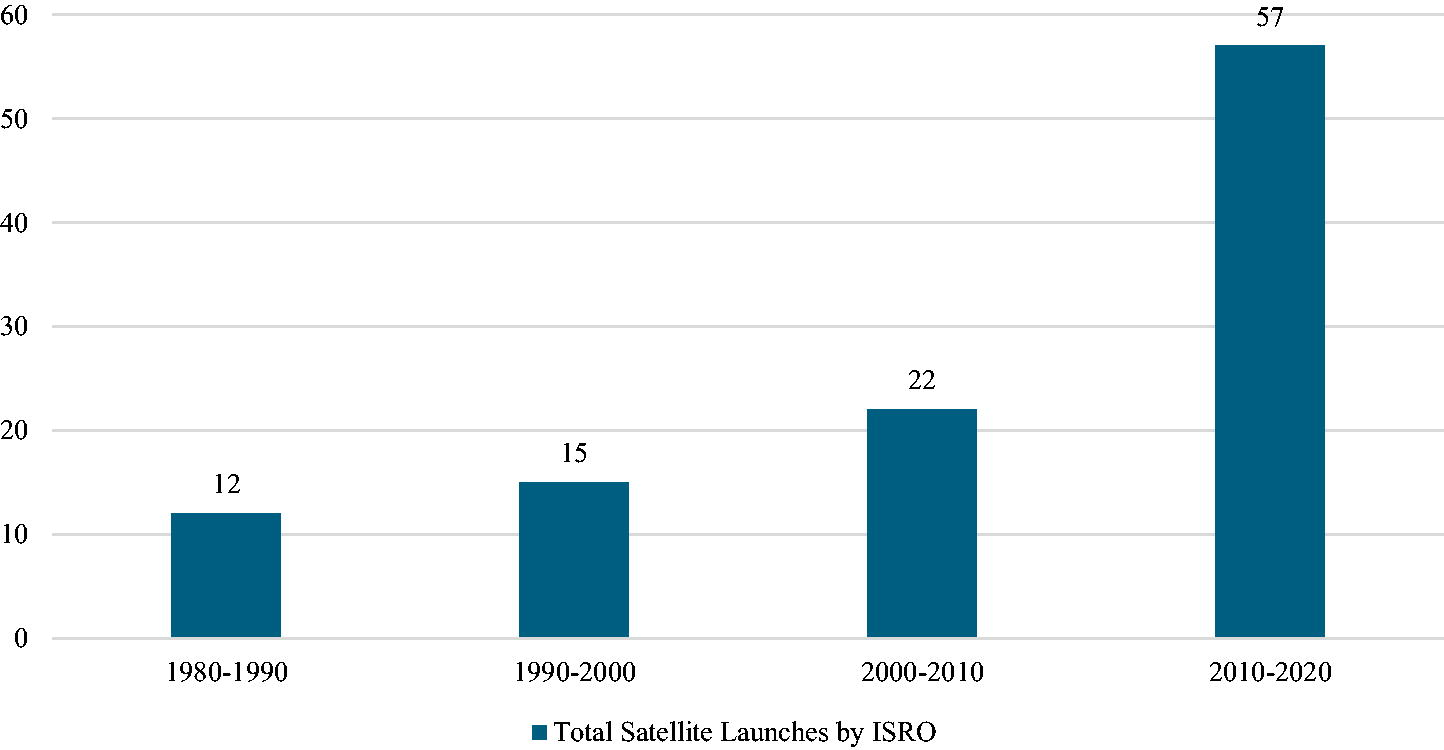
Total satellite launches by ISRO. Sources: Chart prepared by author using data from the ISRO website. ISRO, Indian Space Research Organization.
After achieving self-reliance, commercialization of space technology started with the establishment of Antrix Corporation Limited in 1992, as a commercial and marketing arm of ISRO. Its lean and effective organizational structure proved to be very successful in promoting Indian space products and services. The first commercial mission, Astro-rivelatore Gamma a Immagini Leggero, an Italian satellite was launched in 2007, from Satish Dhawan space center. ISRO’s IRS system gave India the capability to provide remote sensing services at a much cheaper cost. Antrix has also collaborated with Unites States’ company Space Imaging Inc. to cater global remote sensing data market. Antrix uses INSAT satellite capability to provide DTH, VSAT, and TV programs. Since then, this downstream service structure has worked as a money multiplier. 13 At present, the Indian domestic satellite communication market is worth $2.23 billion, dominated by major domestic players such as Tata Communication, Bharti Airtel Ltd., etc. 14
According to the SpaceTech Analytics report, SpaceTech Industry 2021/Q2 Landscape Overview, there are 10,000 space technology companies currently working in the various fields of the space market such as navigation and mapping, cloud technologies manufacturing, 5G communication, material and product supply, etc. (Analytics, 2021). Leading the race, the United States has 5,582 space technology companies followed by the United Kingdom (615), Canada (480), and Germany (402). India holds the fifth position in this list, harboring 368 space technology companies. More than 100 registered start-ups are also working with the government-run Indian National Space Promotion and Authorisation Center (IN-SPACe) (Fig. 2).
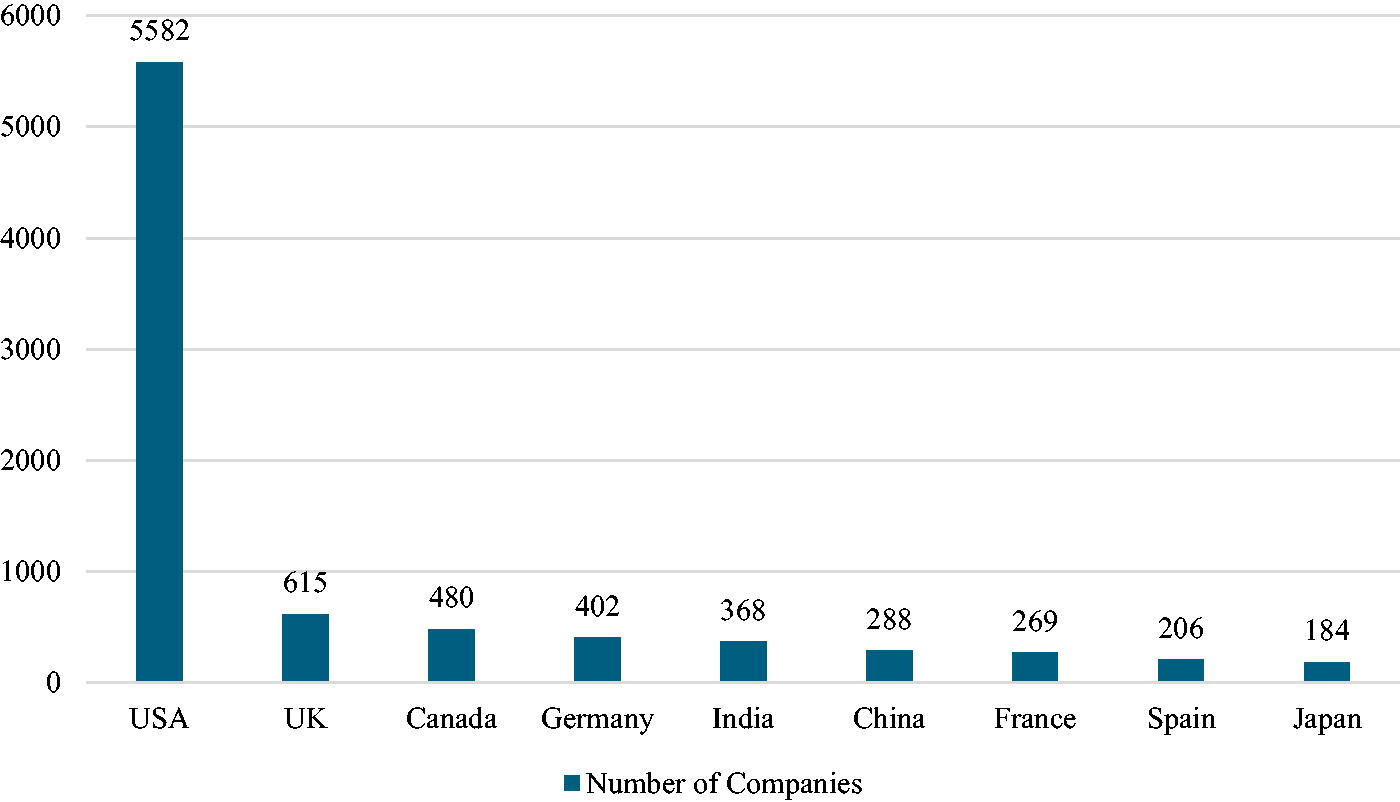
Top 10 countries with high number of private space tech companies. Sources: SpaceTech Industry 2021/Q2 Landscape Overview.
It was assumed that India would never be able to match with the state-of-the-art launching facilities of the United States, France, and Japan. Failing all the assumptions, India developed cutting-edge launch facilities from scratch. The cryogenic technology once denied to India is now helping foreign customers to launch numerous satellites. The satellite launching market of ISRO in the world is shown in Figure 3. ISRO’s launching fee for this mission was around 135 million US dollars whereas the development cost of PSLV and GSLV was 1.3 billion US dollars, which was way cheaper than European Ariane, which cost around 4.0 billion US dollars. 15 India’s space expenditure in terms of GDP is also much lower than that of the United States or Japan. India is incurring a lot of profit in comparison to the initial investment. India is heavily investing in early-stage space technologies in about 110 firms thus acquiring the fourth position after the United States, China, and the United Kingdom to invest in space technologies. 16 Since 2020, to boost corporate involvement and level the playing field in India’s expanding space economy, the government has been reforming the space domain and opening doors to more commercial actors.

International satellite launching market of ISRO. Sources: Prepared by the author using data from the ISRO website.
TRANSFER OF SPACE TECHNOLOGY IN INDIAN MARKET AND ITS COMMERCIAL BENEFITS
In the 21st century, space technology is more than a science that explores outer space, it also acts as a bridge that connects Earth and outer space commercially. Technologies, further developed in the space industry—be they global satellites, sunglasses, or canned food, each has a very real and important application in our daily lives. Without the commercialization of space technologies, these incredible advances would only be deployed in rare cases. Thus, promoting different uses of space technology is becoming a fundamental task for space agencies across the globe. Technology transfer and commercialization helped in dissipating the benefits of space technology to common people. Through these transfers, public investments into space returned back into the market.
The concept of technology transfer was introduced in 1962 by NASA, through its Industrial Application Program to share its responsibilities with the public. Within just one decade, 70,000 non-airspace customers requested collaboration which made this program a structured and intentional system for the application of NASA technology in a broad spectrum of industrial, medical and social needs. 17 Thus, space technology transfer transcended its role as a mere byproduct of space exploration. It has evolved into a distinct scientific discipline, actively generating marketable products by harnessing the unique knowledge and innovations developed in space programs. This process not only extends beyond simply diffusing technology from the space center, but also involves actively seeking new applications, and transforming them into solutions that benefit society. Hence, the main pillar of the space economy lies in the collaboration of different stakeholders in the value chain. The following section centers on examining the positive impact of space technology transfer on the Indian market.
According to the Technology Transfer, a report released by ISRO in August 2022, highlights many technologies (ISRO-based) that can be transferred to industries for commercial purposes. The institute has transferred over 400 technologies to around 235 industries (see Fig. 4). The proliferation of these technologies has spawned diverse commercial applications such as remote sensing services, satellite communications transponder leasing, mission-support systems, launch services, training, and consultancy services to name a few. 18 According to the DoS Technology Transfer Policy and Guidelines-2020, 19 there can be three types of transfer of technology (ToT) in the space sector as described below.
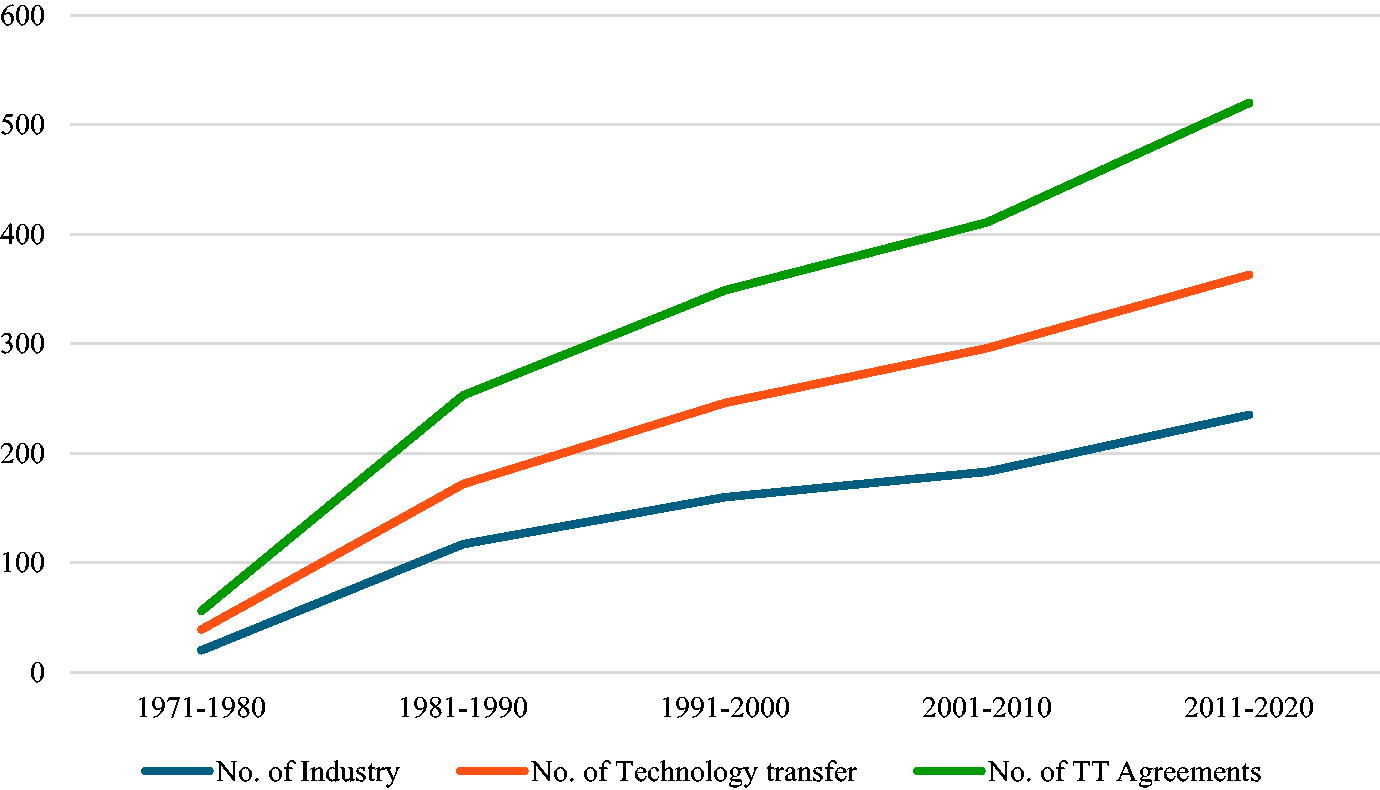
ISRO technology transfers. Sources: Adopted from the Technology Transfer Report of ISRO, released in August.
The first guideline is to conduct joint developmental work with industries with the intent of buy-back which utilizes the services of industries for the procurement of products and services for the advancement of DoS programs. Starting from the 1980s, these transfers took place providing a strong industrial base that supported the Indian space program. For a long time in this one-way trade, private industries stood as vendors or suppliers to government space programmes. 20
The second directive is to maintain collaborative research work with academic institutes. The Indian Government is taking many initiatives to attract youth toward the space sector. It helps to cultivate skilled manpower to run the space sector in future. Recently IN-SPACe published Integrated Launch Manifesto for 2023-24 which highlights upcoming ISRO collaborations with IIT-Madras, Manipal Institute of Technology, C.V. Raman Global University Odisha for Sub-Orbital, and Orbital launches. 21
The third mandate pertains to promoting an in-house research and development (R&D) program. It is where DoS/ISRO is supposed to collaborate with industries in R&D. Transfer of technology with the intent of non-space application (spin-offs) comes under it. This activity of spin-offs holds a secondary position as per the Space Technology Transfer Policy and Guidelines-2020, whereas the primary focus will be on achieving the specific goals and objectives of the space program itself. Spin-offs are a highly underrated segment of space commerce, Indians are somehow adamant about using space technologies in space applications only. The main reason behind this is the lack of R&D in space by private entities. In the case of spin-off space technology, it needs customization to meet the needs of the market, along with dedicated financial and marketing resources. Therefore, smaller companies are not eligible for such ventures.
Technology transfer remained a one-way relationship, with ISRO supplying technology to industries through NewSpace India Limited (NSIL) which the industries then utilize. As a marketing arm of ISRO, NSIL has not been able to attract big industries to focus on collaborative R&D. Powerful industrialists such as Godrej & Boyce, and Larsen & Toubro worked with ISRO to develop launch vehicles. 22 In recent space missions such as Chandrayaan-3 and Aditya-L1, companies such as Godrej & Boyce, and Centum Electronics have collaborated with ISRO as key scientific partners, contributing their expertise to unlock the mysteries of space. 23 Such collaborations between public and private sectors are crucial for India to capitalize on emerging space opportunities such as space mining, in-orbit servicing, and in-space manufacturing. This necessitates increased private investment in R&D. To address this problem, IN-SPACe published Decadal Vision and Strategy for Indian Space Economy through which the government wants to attract big market players to build a strong R&D pipeline. 24 On the positive side, technology transfers to small companies are boosting their image in the market and helping them gather additional financial and marketing opportunities. Data Pattern, a company which develops defense and airspace electronic systems entered into a licensing and ToT agreement with IN-SPACe on October 16, 2023. This partnership will help Data Patterns to build its own miniature Synthetic Aperture Radar§ (SAR) system. After this ToT agreement, the share of Data Pattern increased to six percent in the Bombay Stock Exchange. 25 So, investors’ sentiment takes a positive turn when these cutting-edge technologies get delivered to these companies.
WAYS TO SUPERCHARGE INDIAN SPACE ECONOMY
Eventually, space science has changed the quality of people’s lives on Earth. It has the power to revolutionize sectors such as health and medicine, public safety and security, environment, consumer goods, and other numerous applications yet to be explored in future. Space organizations including NASA, ISRO, and the European Space Agency play a crucial role in scientific exploration. However, translating these advancements into tangible benefits for society often relies heavily on the contributions of industry. The Indian space sector has witnessed remarkable achievements over the years both in terms of scientific and commercial achievements. However, to fully unlock the potential of the space sector and leverage it for the development of the Indian economy, certain steps need to be implemented, as outlined below.
Lack of Proper Marketing and Public Awareness
The Indian private sector cannot be blamed for its late arrival in the business of space technology. Limited awareness of the potential commercial applications of space technology has contributed to the Indian private sector’s delayed adoption. To address the need for wider use of space technology, IN-SPACe released its Decadal Vision and Strategy for Indian Space Economy on October 10, 2023. This document outlines the government’s goal of raising awareness and stimulating demand for space-based products and services. Space Outreach Wing** created within IN-SPACe will take the lead in identifying different industries where space technology can provide unique solutions for problems. It will also make people aware of the benefits of space-related products and services and connect businesses with potential customers. In this domain, NASA has proved its excellence long ago, and there are interesting examples of good marketing, which can be learned from NASA’s early endeavors. The NASA spinoff report 2024 focuses on technology marketing 26 and demonstrates the successful application of aerospace technology in different products and services. 17 This spinoff publication has been issued since 1976 and distributed to government officials, company CEOs, economic decision-makers, news media, and the general public. These reports work as public awareness tools creating interest in the technology transfer concept. Meanwhile, the SatCom Industry Association (SIA-India) collaborated with private institutes such as the National Institute of Advance Studies, Bangalore and carried out joint ventures on the Industrialisation of India’s Space Capabilities in 2023. 27 The initiative discussed the lack of data analysis regarding space market and how big investors are disinterested, as they perceive such endeavors are in too early stage and risky. Indian investors are unaware of the potential of the space industry. Thus, approximately 60% of the Indian population lacks awareness about the space sector, hindering their potential involvement.
New Laws for New Space Era
Laws are the foundation of effective governance. The difference between law and policy is the legal temperament. Policies are not legally binding and they need legal authority to establish their legitimacy. India’s Space Activities Bill is currently under active construction as per Dr. Jitendra Singh, Union Minister of State, Department of Science and Technology, Government of India. 28 This bill will significantly improve the governing structure of the Indian space industry. Legislations regarding space mining, space insurance, foreign investment, and sharing of intellectual property between government and non-government entities, along with international space cooperation, would create a safe and secure route for investment in the space sector from both domestic and international markets.
Lack of Incentives for Scientists
The IN-SPACe decadal vision demonstrates India’s commitment to establishing a robust R&D pipeline for the space industry, comprising both public and private sectors. The space industry is witnessing a surge in innovative applications such as space mining, in-orbit servicing, in-space manufacturing, satellite network interlinking, and quantum communication. Governments are shifting focus from simply replicating existing designs to creating customized solutions that address future demands. To achieve this, strong public–private collaboration in R&D is crucial. In future, if India succeeds in establishing a self-sustaining private–public partnership model in the space sector, there will be a lot of joint intellectual property that will come out of a collaboration between multiple parties. According to the Technology Transfer Policy and Guidelines-2020 of DoS, the rights of Intellectual Property Rights (IPR) arising out of such work shall be mutually decided by DoS/ISRO and the other parties. ISRO-employed inventors should also have their share in royalties from patent licenses. It boosts the morale of the scientists and creates an environment for innovation.
Dedicated Space Think-Tanks
Currently, there is only one dedicated think tank in India known as Spaceport Sarabhai that works exclusively on the domain of space, focusing on space safety, security, and sustainability. In 2022, the organization published a report, Why do Indian Founders in the Space Industry start their start-ups abroad? This report presented some unique research results as to why so many Indian-origin space entrepreneurs register and operate their space start-ups outside India. 29 SIA-India is also another nonprofit organization that represents the interests of the space industry in India. The government must encourage establishing more think tanks working on space activities both from commercial and scientific perspectives, endowed with the work of assessing space policy, diplomacy, commercial growth, and security perspective. 22 SIA-India’s report, Industrialisation of India’s Space Capabilities, recommends the establishment of independent think tanks to analyze both upstream and downstream sectors of the Indian space market and provide interested investors with real-time assessment of market prospects. This will hugely reduce investor’s hesitancy to take the risk of investing in space activities.
CONCLUSION
India possesses enormous growth potential in its burgeoning space industry. Some structural and legal changes can unveil a new era in this sector where all technological development, economic growth, and socioeconomic benefits can be achieved using space technology. Dr. Vikram Sarabhai envisioned the Indian space program for the benefit of society and to meet national development goals. That program found self-reliance and a strong industrial base over the years; however, 70% of the domestic satellite data demand is being fulfilled by external entities. 27 Currently, this market is suffering challenges on many fronts from shortage of funding to the lack of regulatory support and every problem diverts investors with big pockets to spend. The situation has started to change recently in the Indian space domain. Commercial bodies such as NSIL, the Indian Space Association, and regulatory bodies such as IN-SPACe have been established to address the challenges of the space market. Meanwhile, the newly introduced Indian Space Policy 2023 delineated the sectors of space exploration that are still in their early stages of development, including commercial recovery of space resources and space situational awareness. Indian start-ups are also showing some remarkable achievements along with existing space industry companies. Despite its achievements in various areas and contributions on both national and international fronts, India’s commercial space sector demands greater focus from policymakers, academics, and domestic industries considering its immense size, complexity, and ever-evolving nature of the space domain.
Footnotes
AUTHOR DISCLOSURE STATEMENT
No competing financial interests exist.
FUNDING INFORMATION
No outside funding was received.