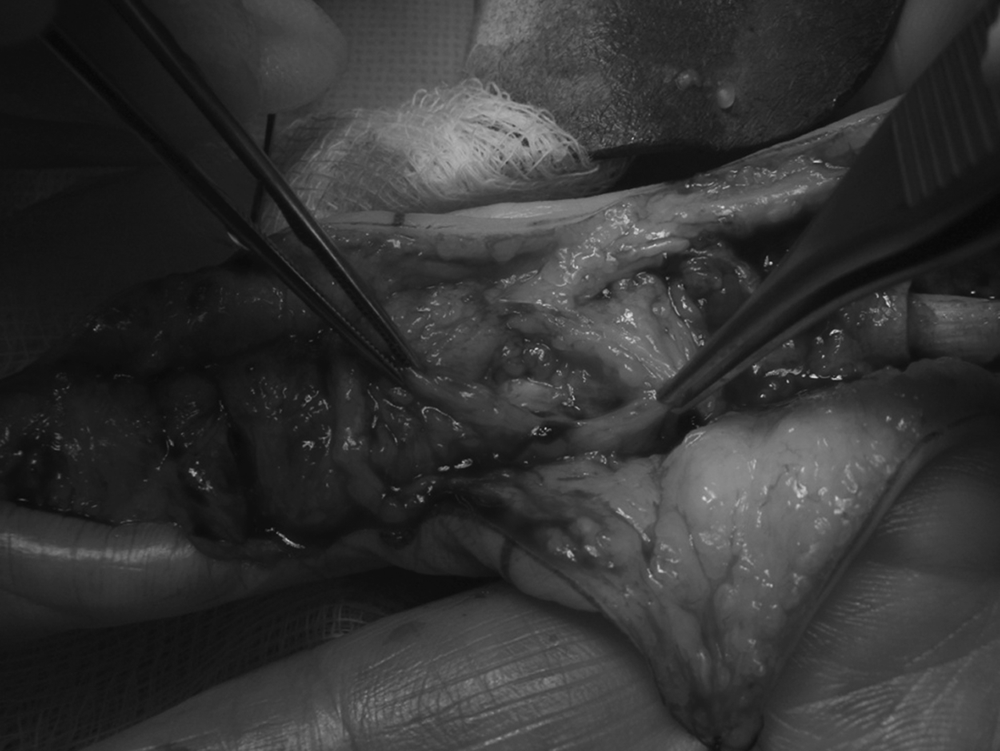
A 59-year-old, right-handed cleaner presented with chronic tenosynovitis affecting her right index finger with pain, swelling, and thickening down to the A1 pulley and tenderness on palpation but no erythema. This condition had persisted despite courses of antibiotics and steroid injections. Radiographs excluded any foreign body, but ultrasonography revealed tendon sheath thickening, with surrounding fluid. Surgical exploration via a volar incision revealed a pinkish/yellow tissue mass encircling and stretching along the flexor sheath, with all tendon pulleys stretched and distended. Several windows made in the sheath released fluid and melon seed bodies—agglutinated protein nodules typical of mycobacterium infection [1] (Fig. 1)—and tissue was sent for culture. Post-operatively, a focused history revealed the patient kept tropical fish in a tank she had been cleaning at the onset of symptoms. She was commenced prophylactically on broad-spectrum anti-mycobacterial therapy in the form of rifampicin, clarithromycin, and ethambutol, and at six weeks had complete resolution of symptoms. Cultures confirmed the clinical suspicion, growing Mycobacterium szulgai, a rare scotochromogen first reported in 1972, named after the Polish microbiologist T. Szulga [2, 3].
Intra-operative photograph showing characteristic melon seed bodies through window made in tendon sheath.
Tenosynovitis can be caused by bacterial infection or inflammatory arthropathy. The majority of soft tissue infective cases are bacterial, with Staphylococcus aureus the most common causative agent [4]. Mycobacterial causations are rare but are becoming increasingly frequent, the commonest being M. tuberculosis, M. kansasii, and M. marinum. Reported cases of M. szulgai tenosynovitis are rare, accounting for less than 1% of all non-tuberculosis mycobacterial infections [5]. To distinguish a cause can be difficult; this case demonstrates how a focused history is essential, and surgical exploration to reveal characteristic features of infection and for culture samples may be required. The involvement of a multi-disciplinary team is essential for success.
References
1.
SankaranB.Tuberculosis of bones and joints. Indian J Tuberculosis, 1993; 40:109.
2.
MarksJ, JenkinsPA, TsukamuraM. Mycobacterium szulgai: A new pathogen. Tubercle, 1972; 53:210–214.
3.
GutierrezM, FeolaM, LengeLet al.Mycobacterium szulgai: A rare pathogen: Description of the first pulmonary case reported in Argentina. J Clin Microbiol, 2007; 45:3121–3124.
4.
LittleJS, O'ReillyMJ, HigbeeJW. Suppurative flexor tenosynovitis after accidental self-inoculation with Streptococcus pneumoniae type I. JAMA, 1984; 252:3003–3004.