




Abstract
Abstract
Background:
Perineal gangrene was first described in healthy, young males more than two and one-half centuries ago. This disease, referred to commonly as Fournier gangrene, was marked by rapid progression, high mortality, and unknown etiology. In the last century the pathologic processes were described and accounts of perineal gangrene were reported in females. This disease still demonstrates a male predominance, but mortality does not demonstrate a gender predilection.
Case Report:
We present a case of a Bartholin abscess progressing to necrotizing fasciitis of the perineum in a 53-year-old female following drainage and marsupialization. Perineal gangrene was treated successfully with serial debridements and a targeted antimicrobial regimen, with wound closure by secondary intention.
Results:
Following retrospective case review, the exact pathophysiologic cause of progression to necrotizing fasciitis of the perineum is unclear though antibiotic resistance was a likely contributor.
Conclusion:
Clinical studies are necessary to investigate the differential incidence of this disease, which may result from diagnostic unawareness of necrotizing fasciitis of the perineum in females due to adherence to Fournier's original description or coding bias. Future clinical studies may define risk factors for disease better, and allow for standardized management and improved outcomes regardless of gender.
N
Case Report
A 53-year-old female presented with complaints of right labial pain and swelling following incision and drainage of a Bartholin abscess at an outside facility 3 d earlier. The patient's medical history was notable for type 2 diabetes mellitus, obesity, hypertension, and allergy to penicillin. Bartholin abscess was diagnosed and treated with incision and drainage 3 d prior to presentation. On admission, symptoms of severe sepsis were present with leukocytosis of tachycardia and tachypnea. A Bartholin abscess with cellulitis of the right labia majora was noted on physical exam. Decreased renal function was noted with blood urea nitrogen/creatinine concentrations of 66 mg/dL and 3.56 mg/dL, respectively. The patient's blood glucose concentration was normal on admission despite a reported history of uncontrolled diabetes mellitus. A broad-spectrum antimicrobial regimen was initiated with levofloxacin and vancomycin. The abscess was incised, drained, and irrigated free of purulent exudate. Standard marsupialization of the abscess cavity was performed, and the extent of the cavity was noted from the mons pubis to the posterior labial commissure without evidence of fascial necrosis. The pathologic specimen demonstrated only an acute inflammatory process, and wound cultures demonstrated growth of Escherichia coli and Group D Streptococcus (not enterococci). The antibiotic sensitivities revealed E. coli resistance to ampicillin, fluoroquinolones, and co-trimoxazole; therefore, the antimicrobial regimen was adjusted to meropenem and clindamycin.
Following initial debridement, the patient remained intubated and was transferred to the intensive care unit (ICU) for resuscitation. Low-dose norepinephrine was started in the operating room but weaned shortly after transfer to the ICU. The patient was extubated by 6 h following operative intervention. The patient's renal function and leukocytosis began to normalize. However, persistent labial erythema and edema on the sixth post-operative day compelled evaluation with computed tomography (CT). The CT scan demonstrated extensive soft tissue stranding and subcutaneous air extending from the right labia to the right medial thigh, the pubic symphysis and the right iliac wing (Fig. 1). Intraoperative re-evaluation through extension of the marsupialized surgical incision confirmed the diagnosis and allowed debridement of necrotic tissue down to fascia of the medial thigh, groin, and lower abdominal musculature. Serial debridements with irrigation and packing afforded healing by secondary intention. Negative-pressure therapy was attempted but abandoned due to an inability to maintain an adequate seal. The patient was discharged home on hospital day 23 with an open wound managed by packing and dressing changes. Physical examination prior to discharge demonstrated an open wound with a base of healthy granulation tissue and no purulent exudate. The patient was followed in an outpatient clinic, and the perineal wound was noted to have closed completely by secondary intention within 3 mo of her initial surgical debridement.
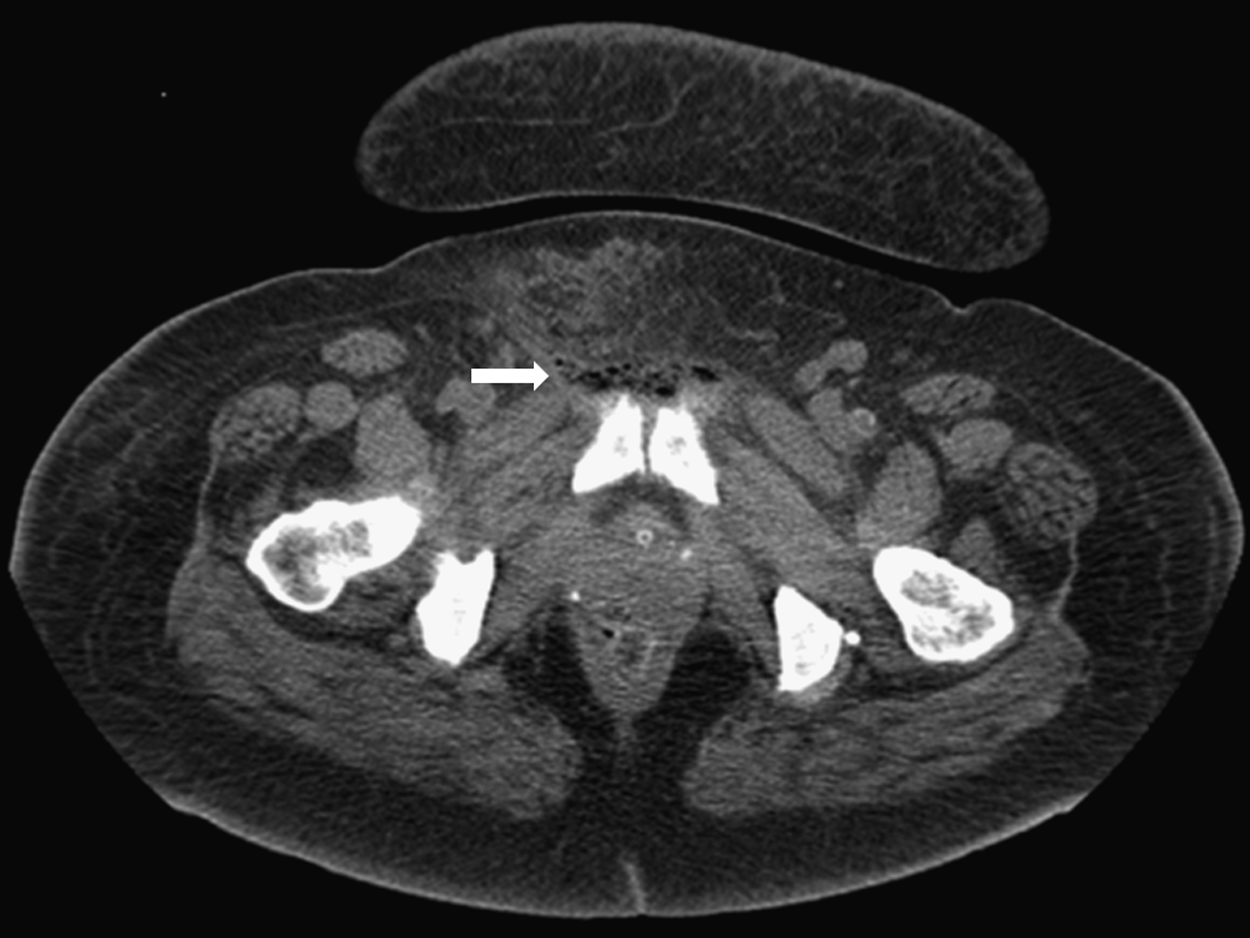
Computed tomography of the subject patient demonstrating inflammatory changes and subcutaneous air overlying the symphysis pubis as indicated by the arrow.
Discussion
Obstruction of the vestibular glands may result in cyst formation and progression to abscess in 2% of women [2]. Incision is a common initial treatment with the rate of abscess recurrence greater than 30% [6]. Marsupialization is associated with a lower risk of recurrence (0–15%), but complications such as extension of infection, hemorrhage arising from the vestibule venous plexus, pain, scarring, and dyspareunia may evolve [2,4–6]. Fistulization with Word catheter or Jacobi ring, and ablation of the cavity with silver nitrate or carbon dioxide laser are additional options for management of a Bartholin abscess, with improved outcome in comparison to incision alone [2,6]. Silver nitrate application demonstrates equivalent efficacy to marsupialization in the management of Bartholin cyst and abscesses, but allows healing with less scar formation [7].
The incidence of perineal gangrene differs markedly by gender. A retrospective database analysis by Sorenson et al. reported a 42:1 ratio of males to females in 1,680 cases of necrotizing gangrene of the perineum [8], and other retrospective studies find male-to-female ratios ranging from 2.5:1 to 27:1 [9,10]. Male predominance is believed to result from suboptimal perineal drainage [9]. The diagnostic unawareness of perineal gangrene in women due to adherence to Fournier's original description and use of the term, Fournier gangrene, has been advanced as one reason for varying incidences [9]. Furthermore, the disease is not referenced as Fournier gangrene in gynecologic texts. Differential coding in the International Classification of Diseases, Clinical Modification 9 (ICD-9CM), provides further obscuration of female perineal gangrene. Fournier gangrene codes as idiopathic gangrene, 608.83. and is in reference to male genital organs. Gangrene, perineum, codes as 785.4., whereas necrotizing fasciitis codes as 728.86. and is in reference to the spread of infection over fascia and muscle. This differential coding underscores the un-reliability of retrospective clinical investigations based on the use of ICD-9CM codes. Due to this coding bias and reporting inaccuracies, the authors of this report support abandonment of the term Fournier gangrene.
Despite a seeming male predilection, gender has not been associated with differential mortality [8,9]. Anatomic extension of necrotizing fasciitis of the perineum appears analogous between genders and pathophysiologic progression exhibits obliterative endarteritis promoting bacterial overgrowth with substantial inflammation, exotoxin-mediated tissue necrosis, and tissue invasion facilitated enzymatically [3,9,11]. Published mortality rates vary, but the largest retrospective meta-analysis reports mortality of 16% [9]. Diabetes mellitus and obesity have been associated with necrotizing fasciitis of the perineum, but statistical analysis has not demonstrated conclusively a correlation between these comorbid conditions and mortality [8,9].
Necrotizing fasciitis of the perineum is a synergistic polymicrobial disease as witnessed in our patient [1,3,9,11,12]. Escherichia coli and Streptococcus comprise a common microbial combination in necrotizing fasciitis of the perineum as well as Bartholin abscesses [1]. Unfortunately, our empiric antibiotic selection did not cover the causative organisms isolated in culture ultimately, and as such, antibiotic resistance may have contributed to the progression to necrotizing fasciitis. Therefore, particularly in patients who present with recurrent or persistent disease following failed source control, we recommend a broad-spectrum empiric antibiotic regimen that can be narrowed later based on culture and sensitivity results. Additionally, aggressive serial debridements are advocated for control of necrotizing fasciitis of the perineum and improved patient survival [3,9–12]. In the subject patient, serial debridements facilitated tissue conservation and afforded healing by secondary intention without the need for reconstructive surgery.
Footnotes
Author Disclosure Statement
No competing financial interests exist.