




Abstract

N
A 71-year old female arrived at the emergency department with a sore throat. A few hours later, she exhibited rapid deterioration, suffering severe dyspnea and the appearance of an erythematous–violaceous hot skin plaque compatible with necrotizing fasciitis (NF), leading to a diagnosis of toxic shock syndrome. Respiratory dysfunction and refractory hypotension required transfer to the intensive care unit.
Empiric antibiotic treatment was initiated with intravenous linezolid, imipenem-cilastatin, and clindamycin. Urgent surgery was performed, at which we identified extensive soft tissue devitalization that covered the submandibular region, the entire anterior chest wall down to the xiphoid process and lateral to both axillae, reaching the right latissimus dorsi muscle (Fig. 1). In addition, there was a large collection in the anterior mediastinum. Extensive debridement and lavage was performed, with placement of intermuscular and mediastinal drains. Blood, tissue, and mediastinal cultures yielded S. pyogenes [1]. After analysis of susceptibility, this regimen was de-escalated to ceftazidime and clindamycin.
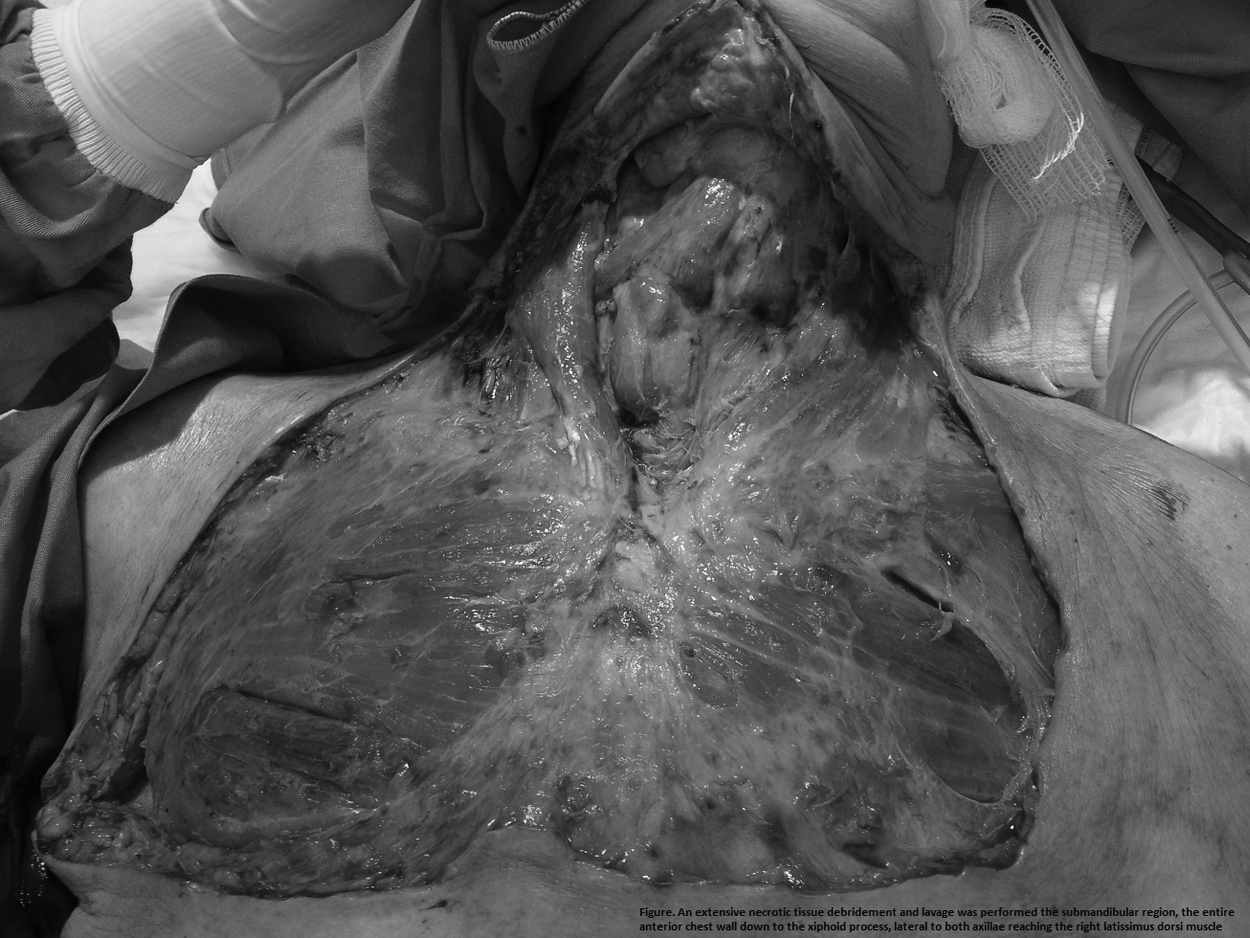
Extensive necrotic tissue debridement and lavage was performed covering submandibular region, the entire anterior chest wall down to xiphoid process and lateral to both axillae, reaching the right latissimus dorsi musle.
Because of the severe inflammation and necrosis, she suffered vocal cord paralysis and was unable to swallow because of muscular atrophy. A tracheostomy was performed for airway management. She was discharged after three months of hospitalization.
Necrotizing fasciitis is an infection of subcutaneous tissue that can spread to the deep fascia, muscle, or skin [2]. It rarely affects the cervical and thoracic regions. In these cases, it is caused usually by a superficial skin infection, pharyngitis, tonsillitis, or dental infection that spreads through deep fascial planes [3]. The peculiarity of our case is that there was no evidence of the source of infection.
The most common clinical signs of necrotizing fasciitis are local inflammation, pain, fever, heat, and symptoms of systemic toxicity often disproportionate to the original injury [4]. The infection has been associated with a high mortality rate, from 6%–76%, although lower estimates were reported in recent studies [5]. Morbidity and mortality rates increase substantially in cases in which the mediastinum is affected, as in our case. Our patient suffered toxic shock syndrome.
Early diagnosis and surgical debridement, extensive broad-spectrum antibiotics, aggressive resuscitation, repeated re-evaluation, and nutritional support are the principles of management [3]. In immunocompetent patients such as ours, with no previous risk factors, early suspicion of the diagnosis is essential to achieve a good outcome. Excision of all necrotic tissue should be carried out to healthy tissue that bleeds freely after the incision is extended. The extent of infection is underestimated easily in a first operation, as in our case, where we had to repeat surgical drainage and debridement after 24 h. Initially, empiric antibiotic treatment was de-escalated to ceftazidime and clindamycin three weeks after admission when susceptibility data became available. After two months in the ICU, she had a clinically satisfactory response, enabling the withdrawal of ventilator support and the hemodynamic and antibiotic regimen.