




Abstract
Abstract
Background:
Although gunshot-induced extremity fractures are typically not considered open fractures, there is controversy regarding wound management in the setting of operative fixation to limit infection complications. Previous studies have evaluated the need for a formal irrigation and debridement (I&D) prior to intra-medullary nailing (IMN) of gunshot-induced femur fractures but none have specifically evaluated tibias. By comparing primary IMN for tibial shaft fractures caused by low-velocity firearms additionally treated with a formal operative I&D (group 1) with those without an I&D (group 2), we sought to identify whether there are: differences in treatment group infection rates; particular fracture patterns more prone to infection; and patient characteristics more prone to infections.
Patients and Methods:
Retrospective cohort study at a single level I trauma center of gunshot-induced tibial shaft fractures managed primarily with IMN in 39 patients from October 1, 2008 to October 30, 2016. The following were studied: demographics, follow-up, fracture characteristics, injury management, and patient outcome. Fractures were categorized based on the Orthopaedic Trauma Association (OTA) classification system for diaphyseal tibia/fibula fractures. All patients had intravenous antibiotic agents at presentation and received three days of post-operative intravenous antibiotic agents per institutional protocol.
Results:
In group 1, 6 of 23 patients (26.1%) developed superficial infections and 4 of 23 patients (17.4%) developed deep infections. In group 2, none of 16 patients (0%) developed superficial infections and 1 patient (6.25%) developed a deep infection, making the total cohort infection rate 28.2% (11/39). Superficial infections were associated with a formal I&D whereas deep infections were not. Tobacco smokers and type 42-A fractures had higher infection rates when treated with a formal I&D.
Conclusion:
A formal debridement, followed by primary IMN in tibia fractures caused by low-velocity firearms is associated with an increased risk of superficial infection that is well managed with antibiotic agents, but the incorporation of a debridement does not affect rate of deep infection. A formal I&D during IMN fixation should be avoided in patients that are smokers and have type 42-A tibia fractures as these are factors associated with increased infection rates.
T
Under the premise that low-grade open fractures can be managed with a primary treatment of IMN [4–10], we sought to determine the safety of performing primary IMN for open tibia fractures caused by low-velocity gunshots with a formal operative debridement and irrigation compared with those without a formal operative debridement of the entry and exit wounds. We hypothesized there would be no difference between the two groups, using documented infection as the principal outcome measure.
Patients and Methods
After obtaining Institutional Review Board approval, our team analyzed retrospectively the medical records of a consecutive series of adult patients reporting a low-velocity gunshot-induced isolated tibia fracture presenting to a single level I trauma center from October 1, 2008 to October 30, 2016. Only patients managed with primary IMN were included with both supra-patellar and infra-patellar approach being used. The data collected included patient demographics (age, body mass index [BMI]), current tobacco use, fracture pattern, comorbidities, antibiotic agents, hospital course, operative time, length of stay, follow-up, and complications. Exclusion criteria included Gustillo-Anderson grade III wounds, compartment syndrome, vascular injuries requiring operative repair, intensive care unit (ICU) admission, segmental tibial bone loss, and fractures stabilized by external fixation or staged repair. Per institutional protocol, all patients received a dose of intravenous antibiotic agents (2 g ceftriaxone) upon presentation, and three days of post-operative intravenous antibiotic agents (2 g ceftriaxone). At initial presentation, gunshot wounds are covered with dry 4 × 4 gauze pad, then cast padding and a long leg splint for temporary stabilization prior to surgical fixation. We avoid bedside irrigations of the gunshot wound. The leg gunshot wound was closed with nylon only if a formal operative I&D extended this wound, and closed by secondary intention if not explored operatively. A debridement usually consisted of extending the gunshot wound several centimeters and removing devitalized bone fragments and muscle edges. Irrigations were performed with 4–8 L of normal saline from cysto irrigation tubing. Post-operative care consisted of 4 × 4 gauze pad coverage; the patient was instructed to wash wounds with soap and water daily and to weight-bear as tolerated. Patients with superficial infections were treated with a 10-day course of oral Bactrim double strength every 12 hours (sulfamethoxazole 800 mg, trimethoprim 160 mg).
Clinical criteria for diagnosis of infection included: new pain/tenderness at the level of the fracture, nail insertion site, or locking screws; episodes of fever/chills; night sweats; tachycardia; localized swelling; erythema; or drainage. In addition, radiographs were reviewed for signs of infection: lucency around the nail or locking screws, loss of cortical density around the fracture site, or periosteal reaction around the intra-medullary nail.
Descriptive statistics for infection rates between groups 1 and 2 were calculated. Student t-tests and analysis of variance (ANOVA) were then used to compare the frequency of infection. A level of significance p ≤ 0.05 was selected to limit the chance of type I error to 5%. Analyses were conducted using statistical package, SPSS version 12.0 (SPSS for Windows, SPSS Inc., Chicago, IL).
Results
Group 1 comprised 23 patients who underwent I&D performed at fixation (mean age 28.8 ± 11.6; range, 15–50 years). Group 2 comprised 16 patients who underwent fixation without formal I&D (mean age 27.6 ± 8.7; range, 18–51 years; Table 1). Based on the Gustillo-Anderson classification for open tibia fractures, group 1 had 8 grade I and 15 grade II injuries. Group 2 had 9 grade I and 7 grade II injuries. Gustillo-Anderson classification was not associated with I&D (p = 0.198), mean operating time (p = 0.911), any infection (p = 0.134), superficial infection (p = 0.252), or deep infection (p = 0.460). Mean group 1 operative time was 208 minutes, and for group 2 it was 155 minutes (p = 0.024). Mean group 1 follow-up was 156.9 days (range, 26–336 days), and 134.1 days (range, 27–460 days) in group 2 (p = 0.597). Patient BMI was comparable between groups (p = 0.931) and obesity was unequivocal for infection (p = 0.374). No patients reported having diabetes mellitus. Tobacco use was reported by 15 of 39 patients (38.5%). Infection rate among tobacco users was 71.4% (5/7) and 0% (0/8) in groups 1 and 2, respectively (p = 0.012).
Note: BMI recorded in 38 patients; p values with statistical significance are in bold.
GA = Gustillo-Anderson open fracture classification; SD = standard deviation; BMI = body mass index.
The rate of infection in all patients was 28% (11/39). Group 1 was associated with a higher post-operative infection rate compared with group 2 (p = 0.010). In group 1, 6 of 23 patients (26.1%) developed superficial infections, successfully treated with oral antibiotic agents. In group 1, 4 of 23 patients (17.4%) developed deep infections; 2 were managed with IMN removal, antibiotic cement nail placement and long-term intravenous antibiotic agents; the other 2 were managed with long-term intravenous/oral antibiotic agents. In group 2, none of 16 patients (0%) developed superficial infections and 1 (6.3%) developed a deep infection managed with IMN removal, antibiotic cement nail placement, and long-term intravenous antibiotic agents. Superficial infections were associated with intervention type (p = 0.026) whereas deep infections were not (p = 0.319; Table 2).
p values with statistical significance are in bold.
Based on the Orthopaedic Trauma Association (OTA) classification system for diaphyseal tibia/fibula fractures, three fracture categories were analyzed: simple (42-A), wedge (42-B), and complex (42-C). Group 1 consisted of five 42-As, 3 42-Bs, and fifteen 42-Cs. Group 2 consisted of three 42-As, ten 42-Bs, and three 42-Cs. Incidence of operative I&D between groups was significantly higher in 42-Cs than in 42-Bs (p = 0.002). Between individual groups, more 42-Cs underwent I&D than 42-Bs (p = 0.0005), but there were no differences in I&D frequencies between 42-As and 42-Bs (p = 0.096) or between 42-As and 42-Cs (p = 0.331; Table 3).
p-values with statistical significance are in bold.
OTA = Orthopedic Trauma Association; Simple fractures (42-A), wedge fractures (42-B), complex fractures (42-C); I&D = irrigation and debridement.
Infection incidence was associated with fracture pattern (p = 0.023). The 42-A type tibia fractures had higher infection rates compared with 42-Bs (p = 0.022); there was no significant difference between 42-Bs and 42-Cs (p = 0.143) or between 42-As and 42-Cs (p = 0.129). Additionally, only for 42-As was infection associated with operative I&D (p = 0.018). Incidence of infection was not significantly associated with intervention group for 42-Bs or 42-Cs (p = 0.850 and 0.500, respectively; Table 4).
p-values with statistical significance are in bold.
OTA = Orthopedic Trauma Association; Simple fractures (42-A), wedge fractures (42-B), complex fractures (42-C).
Discussion
It is well established that operative fractures caused by low-velocity gunshot wounds benefit from a course of antibiotic prophylaxis, but the necessity for formal wound debridement at the time of surgical fixation continues to be a source of controversy. Historically, the debate regarding open fractures was not if they needed a formal debridement, but how emergently this debridement should occur [2,11–13]. It has been shown that low-energy fractures, especially those with a stable fracture pattern or no articular involvement, may not require a formal debridement [2,14,15]. Previous studies have evaluated the appropriate management of gunshot-induced femur fractures, but none have exclusively evaluated tibia fractures [3,16]. Our data indicate that operative tibia fractures can be treated with an intra-medullary nail without a formal exploration and debridement of the gunshot wound without effecting union rates, union time, or deep infections (Table 2).
A formal debridement at the time of the IMN paradoxically increased the rate of superficial infections compared with those patients who did not have a formal debridement. This finding could be related to a selection bias in the retrospective study toward more severe wounds receiving debridement. However, the difference was significant and could also be caused by intragenic disruption of soft tissue coverage at the time of debridement. The additional incision and dissection may compromise the local vascular supply in the superficial layers in areas that it is already tenuous from the gunshot and this additional insult may act as a “second hit” at this site.
After reviewing the fracture characteristics based on the OTA classification, we determined that infections of any type were most prevalent in 42-A fractures overall, and the decision to perform an operative I&D in this fracture pattern increased the risk of infection (Table 4). Interestingly, all five patients with 42-A fractures who underwent operative I&Ds suffered from post-operative infection, while all three patients with 42-A fractures who did not undergo I&D emerged infection-free. Our results therefore suggest that simple fracture patterns undergoing IMN placement are associated with lower infection rates if no I&D is performed, and any benefit of performing an I&D on a simple fracture prior to IMN placement is statistically outweighed by the cost of a potential post-operative infection, lengthy antibiotic course, and prolonged hospital stay. For more complicated fracture patterns, however, our data demonstrate that neither 42-B or 42-C fractures are associated with increased infection risk, regardless of whether an operative I&D is performed. Furthermore, the increased frequency of I&Ds performed in 42-C fractures (Table 3) did not lead to an increased rate of infection, and patients suffering from 42-B fractures did not have a substantial incidence of infection regardless of I&D status. This data suggest that in complicated fractures, because the increased risk of infection is statistically insignificant with respect to intervention, the decision to perform an I&D is best left to the surgeon's clinical judgment and the circumstances of the injury itself (Fig. 1).
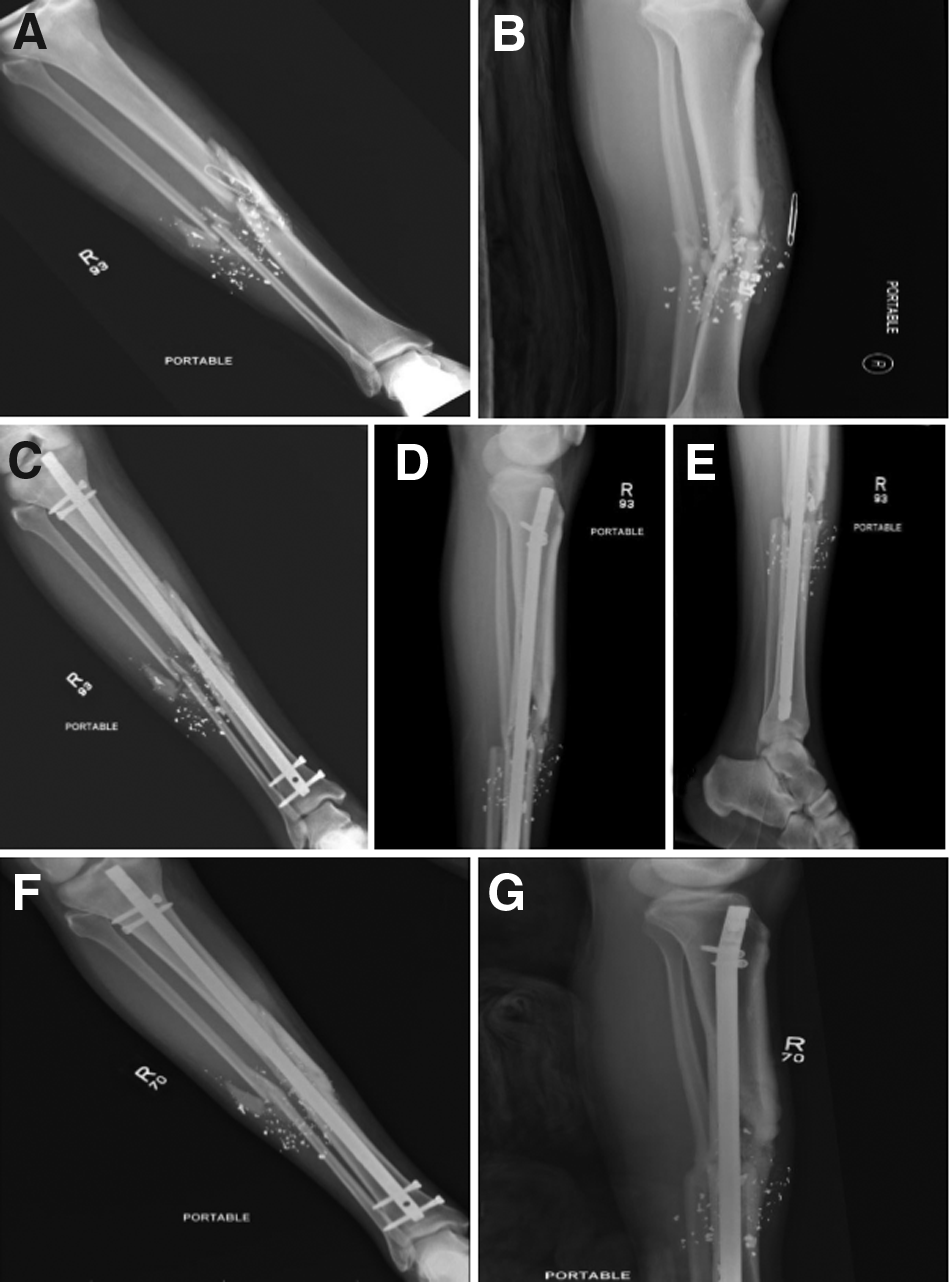
(
Another finding from our study is that operative time between the groups was statistically different between the groups (208 vs. 155 minutes; p = 0.024). This difference is caused by the time needed to perform a meticulous dissection and debridement along with the inherent time of allowing the 4–8 L of normal saline to irrigate the wound. Future studies could evaluate the financial ramifications of incorporating a formal debridement in terms of the cost of the additional equipment needed for a debridement and irrigation and any difference in hospital length-of-stay between the groups.
We also tracked a known infection risk factor for infection of current tobacco use. Comparing our two groups, the rate of tobacco usage was 30.4% (7/23) and 50.0% (8/16) in groups 1 and 2, respectively (p = 0.237). Interestingly, all 5 of the patients who smoked who developed an infection were all initially treated in the I&D group (p = 0.012). This finding supports prior publications that established tobacco use in open tibia fractures increases a patient's likelihood of wound complications, delayed union time, and non-union rates [17]. In that patients who smoke already have a tentative extremity vascular supply, the additional soft tissue trauma caused by an operative I&D is likely one of the contributing factors for this increased infection rate. This pattern could further support the avoidance of an I&D in gunshot-induced tibia fractures, especially in those already at risk for wound infections such as those who smoke.
When examining fractures caused by mechanisms not exclusive to gunshot wounds, Orcutt et al. [18] agreed that there may be no increased benefit in operative debridement for low-grade open fractures and that routine operative debridement could result in a higher incidence of infection and delayed fracture union. Our cohort had two patients who developed a non-union likely resulting from multiple factors. One factor, illustrated by Koval et al. [19] that should be considered by orthopedic surgeons is the amount of bullet fragmentation at the fracture site. Their group showed how bullet fragments more than 20% inversely correlated with fracture healing, which may be used as one of many factors influencing a formal debridement [19].
One shortcoming of this study is the use of the Gustillo-Anderson classification to group our gunshot wound injuries. It has been established previously that gunshot wound-related injuries should be considered in a separate open fracture classification system, the likes of which is controversial and lacking substantial review [14,20,21]. Another potential limitation is variability in treatment between different surgical teams, although practice patterns are similar among all participating surgeons. Another finding from our study was the follow-up time averaged 148 days (4.87 months). A larger study on open tibia fractures by Rommens et al. [22] illustrated that deep infections occurred approximately 4.8 months later, with no additional infections being identified after 12 months. Therefore, we anticipate that our length of follow-up was sufficient to capture the great majority of significant infection. Although the above concerns are relatively minor, the most significant limitation of this study is its retrospective nature and the potential for selection bias toward the worse soft tissue and bony injuries receiving debridement. This risk is impossible to eliminate without a randomized trial. However, we believe that at a minimum this study demonstrates that open tibia fractures caused by low-velocity gunshots can be treated safely at the index surgery with IMN without operative debridement when the surgeon believes debridement is not required.
The incorporation of a formal irrigation and debridement was associated with an increased risk of superficial wound infection that is well managed with antibiotic agents, yet did not affect the rate of deep infection. The data in our study support that open tibia fractures caused by low-velocity gunshots can be treated safely at the index surgery with IMN without operative debridement when the surgeon believes debridement is not required. Any benefit of performing an I&D on a simple fracture or a patient who smokes prior to IMN placement is outweighed by the cost of a potential post-operative infection and should be avoided. A randomized study is needed to evaluate further the safety and efficacy of IMN without debridement at the index operation for all open tibia fractures caused by low-velocity gunshot wounds.
Footnotes
Acknowledgments
None of the authors have a conflict of interest in regards to this study. This study was a retrospective chart review. For this type of study formal consent is not required.
This article and all associated authors are familiar with and agree to the Committee on Publication Ethics (COPE). All authors significantly contributed to the document and have reviewed the final manuscript.
Author Disclosure Statement
No competing financial interests exist.