




Abstract
Objective:
In December 2019, a novel coronavirus infectious disease, coronavirus disease 2019 (COVID-19), began to appear in China. Wuhan, Hubei Province, is the origin and core location of the epidemic. Neurosurgeons were faced with the challenge of balancing treatment of patients with life-threatening conditions and preventing the cross-transmission of the virus.
Methods:
A series of infection prevention and control strategies was adopted for the peri-operative period of emergency surgeries in our department. These strategies include protective measures for the emergency department (ED) and measures for the peri-operative period of emergency surgery. The propensity score matching (PSM) was used to match COVID-19–related patients with patients before the epidemic. Length of wait time in the ED and duration of operation were compared.
Results:
From January 23, 2020 to March 18, 2020, we performed emergency surgery for 19 patients who were either COVID-19–related or COVID-19–suspected. None of the medical staff involved in the surgeries developed viral infection, and no peri-operative virus transmission occurred in our hospital. After the PSM, 32 patients were included in the epidemic group and the pre-epidemic group (16 patients in each group). The duration of wait time in the ED of the former group was longer than that of the latter group (z = −3.000; p = 0.003). During the epidemic, the duration of a craniotomy was longer than before the epidemic (z = −2.253; p = 0.024), and there was no difference in the duration of interventional surgery (z = −0.314; p = 0.753).
Conclusion:
We believe that our experience can provide a useful reference for other surgeons facing the same challenges and as a lesson for similar infectious diseases that may occur in the future.
Since December 2019, cases of pneumonia with unknown origins began to appear in Wuhan, Hubei Province, China [1], and spread rapidly throughout the entire province and country [2]. As research progressed, this pneumonia was named as coronavirus disease 2019 (COVID-19) by the World Health Organization. Chinese scientists extracted a novel coronavirus from the patients confirmed to have this virus that was recently named by the International Society of Virology as severe acute respiratory syndrome coronavirus-2 (SARS-CoV-2) [3,4]. Current studies suggest that patients confirmed to have COVID-19 are the main source of infection and the population is generally susceptible to infection via human-to-human transmission through close contact or through virus-laden aerosols [5,6]. By April 13, 2020, SARS-CoV-2 was responsible for 12,102,328 confirmed cases of COVID-19 worldwide, in 214 countries and regions [7]. It is worth noting that several studies have found that the incubation period of the virus ranges from 0 to 14 days, which means that the virus can remain in the patient's body for many days before showing symptoms [8–11]. Moreover, asymptomatic carriers are also potential infection sources. A study showed that transmission from an asymptomatic carrier had been documented to be between 25% and 50% [12]. This suggests that the virus has the possibility of spreading during the treatment of patients in any department in a hospital.
Wuhan has been determined to be the origin and core region for this outbreak. Up until April 13, 2020, there were 50,008 confirmed cases and 2,579 deaths in Wuhan [2]. Our hospital is one of the largest neurosurgical centers in Wuhan, while at the same time been the designated hospital for receiving COVID-19 patients. Performing surgery during the outbreak became a challenge. According to the guidelines and previous experience [13], we postponed all elective surgery. However, for some critically ill patients, the delay in surgical treatment could result in rapid deterioration and even death. During the exponential growth of the outbreak, because of material and time constraints, detailed screening of COVID-19 was not possible before surgery. Therefore, we developed a series of infection prevention and control strategies and followed it to perform emergency surgery on 19 patients with life-threatening conditions during the outbreak. Moreover, to evaluate the effectiveness of these measures, all related medical staff were followed up and tested for viral infections after the surgeries, while monitoring the occurrence of nosocomial cross-infections. In this article, we summarize these measures and the experience gained that allowed us to achieve zero infection.
Patients and Methods
This research is based mainly on the available data at our hospital during the outbreak in Wuhan and interviews with the involved medical staff and managers. We also reviewed the historic data before the epidemic (from July 1, 2019 to December 31, 2019) to screen the emergency surgical patients for propensity score matching (PSM). The documents for review included: (1) the electronic medical records of patients who underwent emergency surgery, (2) the institutional guidelines for peri-operative infection prevention and control, and (3) the follow-up results of involved medical staff.
Electronic medical records
We reviewed the medical records of patients who sought emergency treatment in the neurosurgical emergency room during the period from the beginning of the outbreak to its relative stabilization. The data included basic information such as the patient's age, gender, time of admission, diagnosis, operation information, and post-operative management, specifically COVID-19–related tests, epidemiologic information, and other clues.
It is particularly important to note that because our hospital is located in Wuhan, which has been closed since January 23, 2019, it can be assumed that everyone was likely to have been exposed to the virus and should be considered to have an epidemiologic history. Therefore, combined with other test results, emergency patients were divided into two categories: COVID-19–related patients or COVID-19–suspected patients. COVID-19–related patients were defined as having a potential risk for COVID-19 infection and having no typical signs (see below) on blood tests and pulmonary computed tomography (CT) other than an epidemiologic history. COVID-19–suspected patients were defined as having any of the above typical signs on blood tests or pulmonary CT in addition to an epidemiologic history.
Institutional guidelines
The institutional guidelines were developed through multidisciplinary team discussions that were hosted by the infection control department at the beginning of the outbreak. The guidelines mainly included emergency department (ED) treatment of patients and the peri-operative period of emergency surgery. In this study, the 19 cases has specific measures from the guidelines implemented throughout the emergency procedure. The specific details follow and are shown in Figure 1.

Flow diagram of neurosurgical emergency patient management. COVID-19 = coronavirus disease 2019.
Emergency department treatment of patients
Identification and triage
Each patient should have their temperature taken; patients with a temperature above 37.2°C should be reported immediately. Patients should be asked about infection-related symptoms including dry cough, chest tightness, fatigue, and nasal congestion and runny nose. In addition to a head CT scan and emergency blood tests, a pulmonary CT scan should also be performed routinely.
Assessment of conditions
If there is no need for emergency surgery, the relevant departments (department of infectious disease) should be consulted. Individual accommodations are recommended for all patients. COVID-19–suspected patients must be admitted to an isolation ward for comprehensive treatment while continuing virus screening and monitoring.
If emergency surgery is considered, the surgical benefit to the patient should be weighed against the severity of the virus infection. Patients with severe COVID-19 pneumonia should be treated first. If emergency surgery is needed, real-time reverse transcriptase-polymerase chain reaction (RT-PCR)
detection of respiratory tract specimens should be performed first if conditions and time permit. Surgery can then be performed after both tests are negative (24-hour interval).
If the patient has a neurosurgical disease complicated by severe COVID-19 pneumonia and is assessed to be difficult tolerating surgery, treatment of pneumonia is preferential. The patient should be admitted to the infection ward for conservative treatment, with the assistance of neurosurgeons.
Peri-operative period of emergency surgery
Pre-operative preparation
Preparations of the operating room, including catheter room, should be as follows. A negative pressure operating room (pressure lower than −5 Pa) or an isolation operating room should be created temporarily. A clean area, buffer zone/semi-contaminated area should be set up in the operating room for medical staff to don and take off protective clothing (Fig. 2) [14,15].

Special routes for coronavirus disease 2019 (COVID-19)–related or COVID-19–suspected patients and medical staff. Route 1 (blue arrow): special route for medical staff. Route 2 (green arrow): special route for the patient to the operating room. Route 3 (red arrow): special route for the patient to be transferred from the operating room to the intensive care unit (ICU).
Preparation of items
Only those items necessary for the surgery were placed in the operating room and disposable items and instruments were used as much as possible to reduce the total number of items in the operating room. Non-disposable items such as microscopes, electronic equipment, and anesthesia machines were covered with a disposable thin film.
Personal protective equipment
For COVID-19–related patients, personal protective equipment (PPE) should at least reach the second level of protection requirements. Specific protection standards were as follows: wear a disposable working hat, medical protective mask (N95 or N99), protective glasses (anti-fog type), protective clothing or protection mask, work clothes coat, disposable protective clothing or disposable impermeable isolation clothing, disposable latex gloves, and disposable shoe covers if necessary. For COVID-19–suspected patients, third-level protection was required in addition to the secondary protection: a full-face mask, full-face respirator, or positive pressure headgear. Anesthesiologists should take the same precautions as surgeons and surgical nurses, especially during tracheal intubation in general anesthesia patients because contamination from the patient's mouth and nose can occur easily. Figure 3 shows PPE for medical staff during emergency surgery in our department.
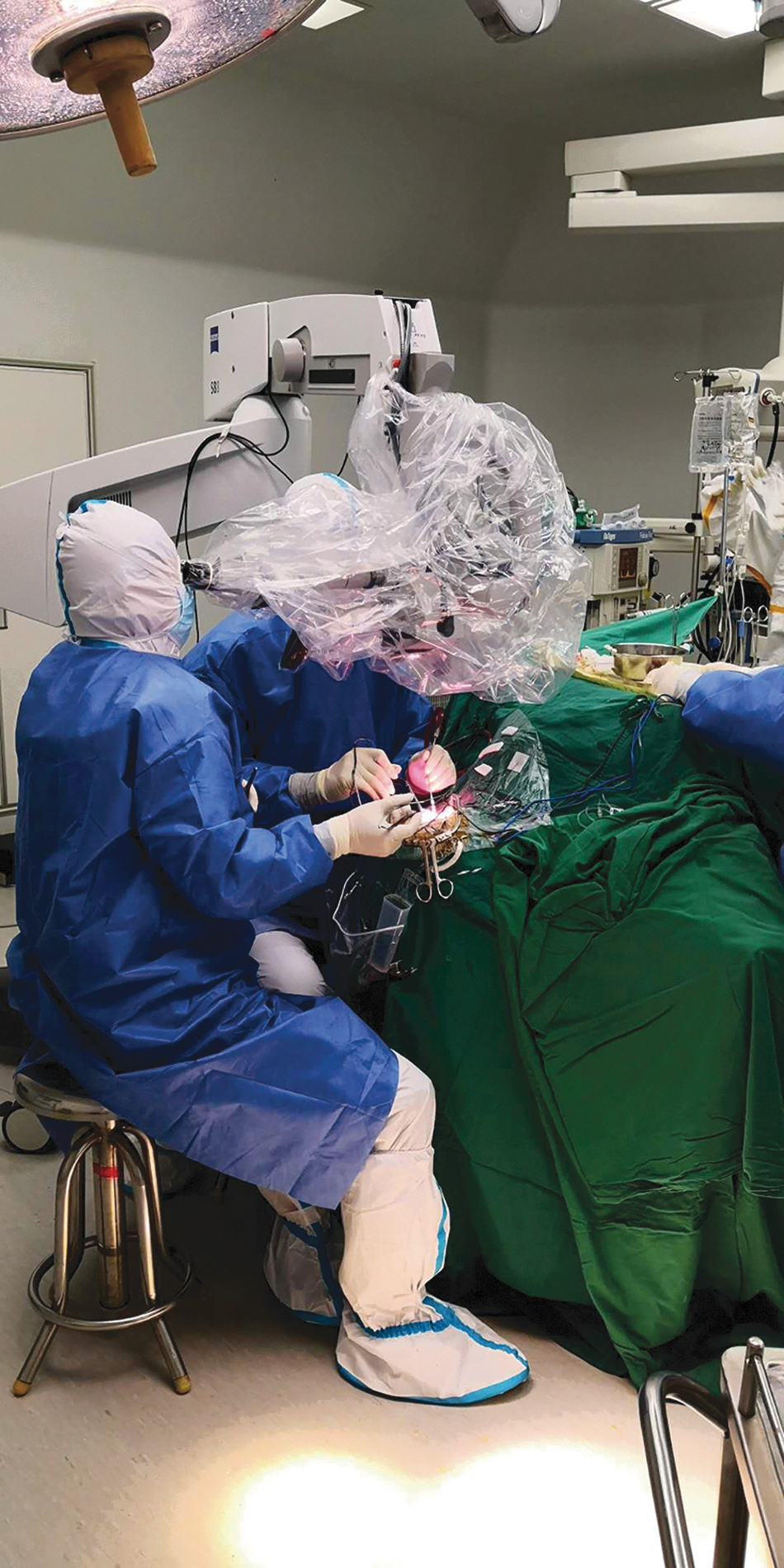
Personal protective equipment (PPE) for medical staff during emergency surgery.
Surgical process
When the patient enters the operating room, the number of personnel in the operation room should be reduced and only the necessary personnel remain. After the operating room is closed, the flow of people should be minimized to create a negative pressure environment. Two circulating nurses are designated specifically: one in the buffer zone to transfer and communicate internal and external affairs and the other to always assist the operation internally.
Anesthesiologists should use the standard rapid sequential intubation to induce anesthesia and use muscle relaxants whenever possible to avoid the spread of droplets in the air to the greatest extent possible. Experienced neurosurgeons are more inclined to reduce the operation duration. For complicated operations, one or two neurosurgeons were required to wait for the necessary rotation. Surgeons should wear double surgical gloves to avoid infection caused by torn gloves. Drilling speed should be slowed to reduce skull bone aerosols. All operations should be completed according to the pre-operative strategy to reduce intra-operative bleeding and shorten the operation time. Surgical masks should be replaced after more than four hours of use. If blood or body fluids come into contact with PPE, it is recommended that the PPE be replaced.
Operating room environment and equipment disposal
After the operation but before leaving the contaminated area, the medical staff should first remove medical gloves and operating clothes, disinfect the hands, remove protective glasses, outer surgical masks, isolation clothing, shoe covers, and other items. After again disinfecting their hands, staff then enters the buffer zone/semi-contaminated area. Alcohol or hydrogen peroxide hand sanitizer is sensitive and effective. The outer disposable protective articles of clothing of the medical staff and all disposable articles used during the operation are marked for special handling. Non-disposable instruments should be disinfected with 2,000–5,000 mg/L chlorine-containing disinfectant. The laminar flow and air supply should be shut down in the operating room and re-opened after disinfecting the air. The best choice is to use qualified air and object surface sampling and testing.
Post-operative transfer
After the operation, medical staff should wear at least secondary protection PPE and transfer the patient to the intensive care unit (ICU) through a specially designed channel without going through the anesthesia recovery room. Before the operation, appropriate preparations and arrangements should be made (Fig. 2). The transfer channel should be covered with disposable film, otherwise standard disinfection is required after transfer. Patients with general anesthesia retain endotracheal intubation for transportation. During the transfer, the anesthesiologist should give a sufficient dose of muscle relaxant to prevent the patient from coughing.
Post-operative management
Patients are monitored closely and treated comprehensively after surgery; the treatment plan should be determined jointly by the doctors of the infectious disease and neurosurgery departments after evaluating the condition. Changes in the patient's body temperature should be monitored closely to distinguish between the common reactive fever after surgery and the fever caused by a viral infection. Attention should be paid to the management of the patient's airway and the time of tracheal intubation removal and ventilator evacuation should be controlled strictly. Under the premise of ensuring patient safety, a comprehensive assessment of the patient's condition can appropriately delay the time. In addition, a more careful evaluation of tracheotomy has been suggested because once a patient has been diagnosed with COVID-19, tracheostomy with inadequate protective measures means a greater risk of infection. For COVID-19–related patients with unexpected condition changes after surgery, it is important to consider fully the possibility of viral infection. All post-operative patients should be quarantined for at least two weeks. Pulmonary CT scan and real-time RT-PCR detection of throat swab are required to be repeated at least three times (in two weeks). After two weeks, if the pulmonary CT scan and real-time RT-PCR detection are negative, the quarantine can be terminated, and the patient transferred to the general neurosurgery ward for further treatment.
Follow-up of related medical staff
All medical staff who may contact or clear contact with the patients are required to be followed up and observed closely and tested for viral nucleic acids twice. The infection control department continuously monitors the occurrence of adverse events in the hospital.
Statistical analysis
Propensity score matching analysis was performed using logistic regression analysis to create a propensity score for the pre-pandemic group and pandemic group with a logistic regression model. The following parameters were entered into the propensity model: gender, age, and operative approach. One-to-one matching without replacement was performed with a 0.01 caliper width, and the resulting score-matched pairs were used in subsequent analyses. Non-parametric quantitative data were analyzed using the Wilcoxon signed rank test; p values <0.05 were considered significant. Statistical analyses were performed using SPSS software (version 26; IBM Corp., Armonk, NY).
Results
COVID-19–related patients
From January 23, 2020 to March 18, 2020, 19 cases of COVID-19–related or COVID-19–suspected patients underwent emergency surgery (Table 1). Six cases (no. 8, 12, 14, 16, 18, and 19) were in comas when they arrived at the ED.
Detailed Information for Nineteen COVID-19–Related or COVID-19–Suspected Patients Undergoing Emergency Surgery in Our Department
ACoA = anterior communicating aneurysms; ICA = internal carotid aneurysm; MCA = middle cerebral aneurysm; ACA = anterior choroid aneurysm; PCoA = posterior communicating aneurysms.
All patients were tested for SARS-CoV-2 immediately after the surgery and half of the six suspected cases tested positive and became confirmed cases after surgery. Subsequently, these six patients received comprehensive treatment. The remaining 16 cases were all negative, but they were also isolated for at least two weeks and were transferred to the general neurosurgery ward after confirmation by repeated nucleic acid tests; all of these patients were eventually discharged.
All medical staff involved in the above surgeries were also tested for SARS-CoV-2. Repeated tests for the virus were negative for two weeks after the last contact with the patient, and no peri-operative transmission of the virus occurred in the hospital.
Comparison of pandemic and pre-pandemic groups
By reviewing the historical data for the six months prior to the outbreak, 161 cases of neurosurgical emergency patients were screened and matched for propensity scores. Thirty-two patients were included; 16 in the epidemic group and 16 in the pre-epidemic group.
There was no statistical difference between the patient's age, gender, and operative approach. The difference in duration of wait time in the ED is statistically significant (z = −3.000; p = 0.003). In the COVID-19 epidemic, a longer time was spent when patients were in ED. In addition, there is no statistically significant difference between the duration of operation in the epidemic and that in pre-pandemic (z = −1.846; p = 0.065; Table 2). However, the duration of craniotomy was longer than before the epidemic (z = −2.253; p = 0.024), whereas there was no difference in the interventional group (z = −0.314; p = 0.753; Table 3).
Comparison of Duration of Wait Time in Emergency Department and Operation between COVID-19–Related Patients and Matching Patients in Pre-Pandemic
ED = emergency department.
Unable to find a matching patient.
Wilcoxon signed rank test.
Comparison of Duration of Operation between COVID-19–Related Patients and Matching Patients in Pre-Pandemic
Wilcoxon signed rank test.
Discussion
COVID-19, as well as severe acute respiratory syndrome (SARS) and Middle East respiratory syndrome (MERS), is caused by a novel coronavirus, all of which have a high affinity to the lower respiratory tract and are prone to produce severe pneumonia [3,16]. In this study, a retrospective study was conducted on patients who received emergency surgery in our department during the outbreak in Wuhan, and the follow-up outcomes of related medical staff were combined. Although there is some literature on infection prevention during surgery for SARS and MERS coronavirus [15], guidelines or studies for COVID-19 prevention during peri-operative patient care were limited. Based on previous literature and experience, at the beginning of the outbreak, a multidisciplinary team organized by the infection control department developed the above institutional guidelines, which were applied to 19 patients with life-threatening conditions and achieved zero infection in our department. Therefore, we believe that these infection prevention and control strategies are effective in preventing the transmission of COVID-19 during the peri-operative period. The highlights of infection prevention and control during the peri-operative period are summarized in Table 4.
Summary of the Highlights of Infection Prevention and Control during Peri-Operative Period of Emergency Surgery
SARS-CoV-2 = severe acute respiratory syndrome coronavirus-2; COVID-19 = coronavirus disease 2019; MERS = Middle East respiratory syndrome; SARS = severe acute respiratory syndrome; PPE = personal protective equipment;
In the COVID-19 epidemic, a longer time elapsed before patients received specialist treatment. This increased time was mainly related to additional testing because of the epidemic, reduced work efficiency of medical staff, and increased procedures for the preparation of wards/operating rooms. This means that strict infection prevention and control strategies indeed come at the expense of patient's time for treatment. Therefore, an efficient ED procedure should be fully weighed and formulated to reduce the waiting time in the ED. The results also show that the duration of craniotomies was increased in the epidemic. The following reasons may contribute to this: (1) medical staff need more time to don and adjust PPE; (2) changes in surgical procedures, for example, surgeons need to protect the area surrounding the surgical field when drilling to reduce the splash of body fluids, to be more careful to reduce bleeding, and so on; (3) limitations to visualization with additional eye protection/face protection. The above factors have a greater impact on craniotomies instead of interventional surgeries. Further reasonable speculation that the length of surgeries during an outbreak depends to a large extent on the complexity of the surgery itself, the experience and proficiency of surgeons, and the degree of interference caused by surgical instruments. When faced with a similar situation, for each surgical department, the above points should be anticipated and considered in advance when determining the surgical plan and the surgical process.
Moreover, we would like to share some experiences for surgeons. Neurosurgeons should pay special attention to the reduction of spattering of blood and cerebrospinal fluid during operations. When using milling cutters and grinding drills, they must be covered to reduce the contamination of the surrounding environment. Although multi-layer gloves were worn during the operation, if the outer layer is damaged, hands should be re-sterilized immediately and gloves changed. Another experience is that general protective glasses are prone to fogging. If the surgeon wears glasses, this may have an impact on the visual field. These disturbances can cause the visual deviation for the surgeon, especially when performing an intracranial operation and using a microscope. The difficulty is increased for the surgeon to complete the operation as usual. It is recommended to use anti-fog glasses or other methods during the expected protracted operation to avoid this situation and adjust the focal length of the microscope before operation [29].
Our experience has limitations. First, because we were in the earliest and most severe outbreak area, our supplies and medical staff were extremely limited. These strategies were put forward out of desperation, under the belief that patients in need of emergency surgery could not be diagnosed and tested before surgery. Therefore, we performed strict post-operative management after surgery and completed the patient's real-time RT-PCR detection and further evaluation of lung infection as soon as possible. Of the 19 emergency surgery patients, three were confirmed to be COVID-19–positive after surgery. Subsequently, we further observed and tested the medical staff who had contact with these patients and found no signs of viral infection or other adverse events. However, if the detection of SARS-CoV-2 can be completed before surgery, it will be more conducive to the prevention and control of the infection. Second, because of the limited sample size, the PSM method was used to match the 19 cases with patients who had received emergency surgery before the epidemic. Therefore, the conclusion that the duration of wait time in the ED and operation was longer than pre-pandemic has certain limitations, which needs further research to confirm.
Conclusion
As we have seen in this COVID-19 pandemic, in an increasingly inseparable trend around the world, similar public safety incidents must not only be faced by a single country or a single region alone. At present, the COVID-19 epidemic in China has been effectively controlled by the efforts of the government and people, but many countries and regions are still in the stage of outbreak or uncontrolled spread. The experience we summarized above comes from the most severe region in China. We believe that these strategies can provide useful reference and experience for surgeons in any other areas facing the same challenges. In addition, we hope it can be a lesson for similar infectious diseases that may occur in the future.
Footnotes
Authors' Contributions
Drs. Jian Song and Guozheng Xu were responsible for the study concept and design. Jiangheng Guan contributed to the acquisition of patient data. Aobo Chen and Tianhao Xie drafted the manuscript. All authors critically reviewed the content and approved the final version for publication.
Funding Information
No funding was received for this research.
Author Disclosure Statement
No competing financial interests exist.