




Abstract
Self-assembling peptide hydrogels were modified to deliver transforming growth factor β1 (TGF-β1) to encapsulated bone-marrow-derived stromal cells (BMSCs) for cartilage tissue engineering applications using two different approaches: (i) biotin-streptavidin tethering; (ii) adsorption to the peptide scaffold. Initial studies to determine the duration of TGF-β1 medium supplementation necessary to stimulate chondrogenesis showed that 4 days of transient soluble TGF-β1 to newborn bovine BMSCs resulted in 10-fold higher proteoglycan accumulation than TGF-β1-free culture after 3 weeks. Subsequently, BMSC-seeded peptide hydrogels with either tethered TGF-β1 (Teth-TGF) or adsorbed TGF-β1 (Ads-TGF) were cultured in the TGF-β1-free medium, and chondrogenesis was compared to that for BMSCs encapsulated in unmodified peptide hydrogels, both with and without soluble TGF-β1 medium supplementation. Ads-TGF peptide hydrogels stimulated chondrogenesis of BMSCs as demonstrated by cell proliferation and cartilage-like extracellular matrix accumulation, whereas Teth-TGF did not stimulate chondrogenesis. In parallel experiments, TGF-β1 adsorbed to agarose hydrogels stimulated comparable chondrogenesis. Full-length aggrecan was produced by BMSCs in response to Ads-TGF in both peptide and agarose hydrogels, whereas medium-delivered TGF-β1 stimulated catabolic aggrecan cleavage product formation in agarose but not peptide scaffolds. Smad2/3 was transiently phosphorylated in response to Ads-TGF but not Teth-TGF, whereas medium-delivered TGF-β1 produced sustained signaling, suggesting that dose and signal duration are potentially important for minimizing aggrecan cleavage product formation. Robustness of this technology for use in multiple species and ages was demonstrated by effective chondrogenic stimulation of adult equine BMSCs, an important translational model used before the initiation of human clinical studies.
Introduction
Transforming growth factor β1 (TGF-β1) has been widely used to promote chondrogenesis of BMSCs in a variety of in vitro culture systems by supplying it in the medium continuously for over four weeks.5–7 Due to the short serum half-life of TGF-β isoforms in vivo 8 and their potent action on other cell types, including induction of inflammation leading to cartilage degradation in vivo, 9 various technologies have been engineered with the goal of local delivery and controlled release of an appropriate concentration of these growth factors in vivo.10–16 Given the wide range of cellular functions regulated by TGF-β1,17–19 the goal of any such technology is to stimulate appropriate intracellular signals, thereby generating desired biologic effects while minimizing potential adverse systemic effects.
Self-assembling peptide hydrogels are a versatile new class of materials that have been developed for tissue engineering applications.20–24 Benefits have been demonstrated for the use of these peptide hydrogels in cartilage,25,26 liver, 27 and cardiovascular28,29 tissues, and they have been shown to provide a microenvironment that enhances the chondrogenesis of BMSCs.26,30 These peptides can also control the delivery and release of functional proteins, 21 therapeutic macromolecules, 22 and bioactive motifs. 20 Taken together, these studies suggest the potential to co-encapsulate growth factors and BMSCs in self-assembling peptide hydrogels to generate cartilage neotissue.
TGF-β1 signals via binding to its type I and II receptor serine/threonine kinases on the cell surface, forming an active complex that phosphorylates Smad2 and Smad3. 17 These phosphorylated receptor Smads in turn propagate the signal by forming a complex with Smad4, the common Smad. This complex then translocates to the nucleus, where it functions as a transcription factor to regulate gene expression.18,19
The goal of this study was to deliver TGF-β1 within a self-assembling peptide hydrogel to induce chondrogenesis of encapsulated BMSCs and the subsequent accumulation of a cartilage-like ECM. To determine the minimum duration of TGF-β1 supplementation required to stimulate chondrogenesis, a pilot study was first conducted in which TGF-β1 was removed from the medium at various time points during a 21-day culture period. Results from this pilot study enabled the design of two strategies for coupling TGF-β1 to the peptide scaffold. The first employed biotin-conjugated TGF-β1 (bTGF-β1), biotin-conjugated peptide monomers, and multivalent streptavidin, which directly tethered TGF-β1 (Teth-TGF) to the scaffold through a high-affinity biotin sandwich bond. 28 The second was to nonspecifically adsorb TGF-β1 to peptide monomers before hydrogel self-assembly and BMSC encapsulation. Functional assays for chondrogenesis of encapsulated newborn bovine BMSCs included cell content and biosynthesis of cartilage matrix macromolecules in cultured hydrogels. Bioactivity of the peptide-delivered TGF-β1 was confirmed by semi-quantitative Western blot analysis of phosphorylated Smad2/3. Finally, peptide-delivered TGF-β1 was tested with encapsulated adult equine BMSCs to assess the potential for translating this technology to a large animal model widely used for translational studies of preclinical human therapies. 31
Materials and Methods
Materials
Self-assembling peptide with the sequence AcN-(KLDL)3-CNH2 (also referred to as KLD or KLD12 in previous literature; subsequent abbreviations in this text will use (KLDL)3) was synthesized by the MIT Biopolymers Laboratory (Cambridge, MA) using an ABI Model 433A peptide synthesizer with FMOC protection. All other materials were purchased as noted below.
Tissue harvest
Equine bone marrow was harvested from the sternum and iliac crest of skeletally mature (2–5-year-old adults) mixed-breed horses as described previously. 26 Horses were euthanized at Colorado State Equine Orthopedic Research Center for reasons unrelated to conditions that would affect marrow. Bovine bone marrow was harvested from the distal femurs and tibias of newborn bovine calves (Research 87, Marlborough, MA).
Cell isolation
BMSCs were isolated from four equine 32 and six bovine 30 marrow donors as described previously. Marrow was not pooled so that each experiment was performed with marrow from a unique donor or multiple donors where indicated. Differential adhesion was used to separate BMSCs from the total nucleated cell population. 26 After reaching local confluence, BMSCs were cryopreserved and stored for future use. before peptide hydrogel encapsulation, BMSCs were expanded by plating at 6 × 10³ cells/cm2 and culturing for 3 days in low-glucose Dulbecco's modified Eagle's medium, 10% ES-FBS (Invitrogen, Carlsbad, CA), 10 mM HEPES, and PSA (100 U/mL penicillin, 100 μg/mL streptomycin, and 250 ng/mL amphotericin) plus 5 ng/mL bFGF (R&D Systems, Minneapolis, MN). After 3 days, cells were detached with 0.05% trypsin/1 mM ethylenediaminetetraacetic acid (Invitrogen) at ∼3 × 10⁴ cells/cm2 (passage 1) and replated at 6 × 10³ cells/cm2. Passage 2 cells were used for three-dimensional peptide and agarose hydrogel cultures.
Hydrogel encapsulation and culture
BMSCs were mixed with 0.35% (w/v) (KLDL)3 and the cell-peptide suspension was cast within preformed acellular agarose rings used as molds to initiate peptide-gel self-assembly. 30 The resulting 6.35-mm-diameter cell-seeded peptide disks, 50 μL initial volume, were cultured in high-glucose Dulbecco's modified Eagle's medium (Invitrogen) supplemented with 1% ITS+1 (Sigma-Aldrich, St. Louis, MO), 0.1 μM dexamethasone (Sigma-Aldrich), 37.5 μg/mL ascorbate-2-phosphate (Wako Chemicals, Richmond, VA), PSA, HEPES, L-proline, sodium pyruvate, and NEAA, with (medium-delivered TGF-β1 [Med-TGF]) or without (Control [Cntl]) 10 ng/mL recombinant human TGF-β1 (R&D Systems). In a similar manner, BMSCs were also mixed with 2% low-melting-point agarose (Invitrogen) and cast within similar acellular agarose rings, and the resulting cell-seeded disks were cultured as above.
TGF-β1 delivery approaches
For TGF-β1 takeaway experiments, hydrogels were cultured in the TGF-β1-supplemented medium (Med-TGF, 10 ng/mL) for 4, 7, or 14 days followed by culture in the control (TGF-β1-free) medium for the remainder of the 21-day culture period. In separate experiments, BMSCs were encapsulated in TGF-β1-tethered (KLDL)3 (Teth-TGF) made from 0.35% (3.5 mg/mL) (KLDL)3 with 35 μg/mL biotin-conjugated (KLDL)3 [biotin-(aminocaproic acid)3-(KLDL)3], 2.1 μg/mL streptavidin (Pierce Biotechnology, Rockford, IL) and 1, 10, or 100 ng/mL bTGF-β1 (R&D Systems). In a third approach, BMSCs were encapsulated in TGF-β1-adsorbed (KLDL)3 or Agarose (Ads-TGF): 0.35% (KLDL)3 or 2% Agarose assembled in the presence of 100 ng/mL unlabeled TGF-β1 (R&D Systems). Both Teth-TGF and Ads-TGF hydrogels were cultured in the control (TGF-β1-free) medium for up to 21 days.
DNA and ECM biochemistry
During the last 24 h of culture, the medium was additionally supplemented with 5 μCi/mL of 35 S-sulfate and 10 μCi/mL of 3 H-proline to measure cellular biosynthesis of proteoglycans and proteins, respectively. Upon termination of culture, hydrogels were rinsed 4 × for 30 minutes in excess unlabeled sulfate and proline, weighed wet, lyophilized, weighed dry, and digested in 250 μg/mL proteinase-K (Roche Applied Science, Indianapolis, IN) overnight at 60°C. Digested samples were assayed for total DNA content by Hoechst dye binding, 33 retained sulfated glycosaminoglycan (sGAG) content by DMMB dye binding assay, 34 and radiolabel incorporation with a liquid scintillation counter. The conditioned culture medium collected throughout the study was also analyzed for sGAG content by DMMB dye binding.
Aggrecan extraction and Western analysis
Aggrecan was extracted from separate sets of hydrogel disks and analyzed as described previously. 35 Hydrogel disks were saturated with PBS and protease inhibitors (Protease Complete; Roche Applied Science) for 20 min on ice and frozen at −20°C until extraction. Disks were extracted for 48 h in 4 M guanidinium hydrochloride and deglycosylated, and the resulting digest was lyophilized. Samples were reconstituted and lanes were loaded with either the extract from one disk (Cntl condition) or 20 μg sGAG (Ads-TGF and Med-TGF conditions) and run on a 4%–15% Tris-HCl gel at 100 V for 1 h. Proteins were transferred to a nitrocellulose membrane and probed with affinity-purified anti-peptide antibodies to the aggrecan G1 domain (JSCATEG). 35
Smad2/3 and pSmad2/3 Western analysis
Selected hydrogels were mechanically disrupted via pipetting with extraction buffer consisting of 50 mM Tris, 150 mM NaCl, 1% Triton X-100, and 1% NP-40 with Complete Protease Inhibitors (Roche Applied Science) and phosphatase inhibitors (2 mM Na3VO4, 100 mM NaF, and 10 mM Na4P2O7). Extracts were sonicated, frozen, and stored in liquid nitrogen. For Western analysis, samples were thawed, vortexed, and analyzed for DNA content by Hoechst dye binding. Proteins were separated by 10% SDS-PAGE loaded with 0.1 μg DNA per lane (due to the dramatic accumulation of ECM proteins in this system, equal DNA loading ensured equal intracellular protein per lane at each time point 6 ). Proteins were transferred to a polyvinylidene fluoride membrane and probed with Smad2/3 or phosphorylated-Smad2 (pSmad2) primary antibodies (Cell Signaling Technology, Danvers, MA) and horseradish peroxidase-conjugated, anti-rabbit secondary antibody. Membranes were stripped and reprobed with β-actin primary antibody (Cell Signaling Technology). For semi-quantification, band densitometry was performed using AlphaEaseFC (Alpha Innotech, Inc., San Leandro, CA) and Smad2/3 and pSmad2 were first normalized to β-actin as a loading control and then to the day 4, Med-TGF sample on each membrane.
Statistical analysis
All data are presented as mean ± standard error of the mean. Data were analyzed with a mixed model of variance with animal as a random factor (Systat). Residual plots for dependent variable data were constructed to test for normal distribution. If this assumption was not met, data were transformed. Pairwise comparisons were made by post hoc Tukey's tests with significance threshold set at p < 0.05.
Results
Four days of transient TGF-β1 medium supplementation stimulates chondrogenesis
To investigate the duration of transient TGF-β1 medium supplementation sufficient to stimulate chondrogenesis, TGF-β1 was removed from the culture medium at several time points during a 21-day culture experiment (Fig. 1). With only 4 days of culture in 10 ng/mL TGF-β1-supplemented medium, followed by 17 days of culture in the TGF-β1-free medium, the DNA content of both newborn bovine (Fig. 1A) and adult equine (Fig. 1C) BMSC-seeded hydrogels was 1.5- and 2-fold higher than TGF-β1-free controls, respectively (p < 0.001). For adult equine BMSCs, the DNA content in peptide hydrogels exposed to TGF for 4 days was statistically equivalent to continuous TGF-β1 medium supplementation for 21 days (Fig. 1C). sGAG accumulation was substantially increased for TGF-β1-containing cultures. sGAG accumulation for bovine BMSCs stimulated with TGF-β1 for 4 days (4D) was 57% of continuous (21D) TGF-β1 (Fig. 1B; p < 0.001), whereas 14 days of TGF-β1 (14D) produced equivalent sGAG accumulation to continuous (21D) treatment (130 μg/gel; Fig. 1B). Equine BMSCs with 4 days of TGF-β1 accumulated 67% of the continuous TGF-β1 result (Fig. 1D; p < 0.01) and with 14 days of TGF-β1 sGAG accumulation was equivalent to continuous (140 μg/gel; Fig. 1D).
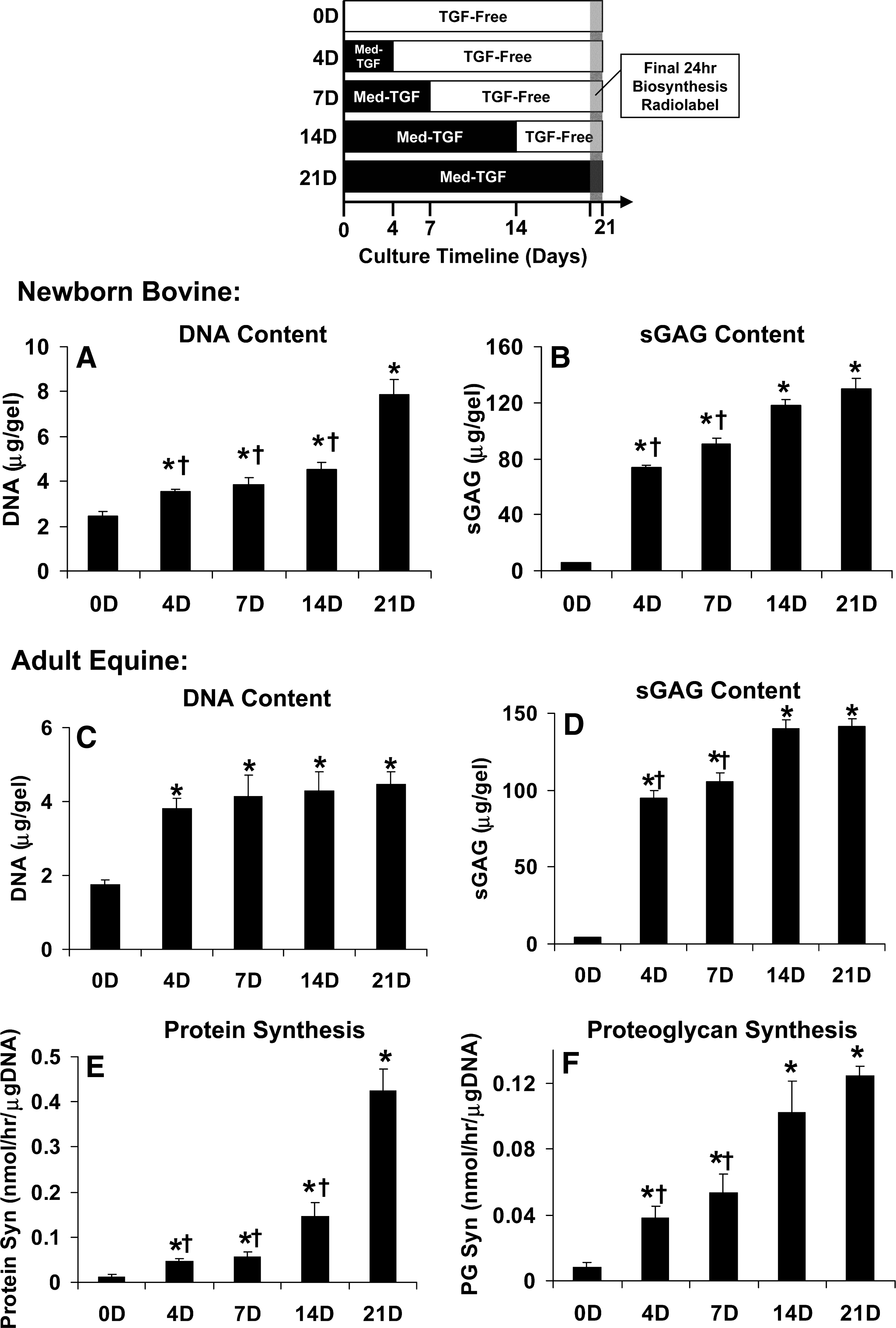
Transient medium-delivered transforming growth factor β1 (TGF-β1) (Med-TGF) stimulates chondrogenesis of both bovine and equine bone-marrow-derived stromal cells (BMSCs). BMSCs were encapsulated in peptide hydrogels and cultured for 21 days. TGF-β1 was supplied in the medium and removed after 0, 4, 7, 14, or 21 days (0D, 4D, 7D, 14D, 21D) as shown in the culture time line. Hydrogels were seeded with either
Equine BMSC cultures were evaluated for protein and proteoglycan synthesis over the final 24 h of the 21-day culture. With 4 days of transient TGF-β1 medium supplementation, protein biosynthesis was >3-fold higher than TGF-β1-free controls (Fig. 1E; p < 0.001). In addition, protein biosynthesis with 4 days of TGF-β1 was 10% of continuous TGF-β1-supplemented hydrogels (p < 0.001), whereas 14 days of TGF-β1 increased protein biosynthesis to 35% of that for continuous treatment (p < 0.001). Proteoglycan biosynthesis for 4 days of TGF-β1 stimulation was nearly five-fold higher than TGF-β1-free controls (Fig. 1F; p < 0.001) and remarkably was 30% of the continuous TGF-β1-stimulated hydrogels (p < 0.001). With 14 days of TGF-β1 treatment, proteoglycan synthesis was statistically equivalent to continuous treatment (Fig. 1F). Taken together, these biosynthesis data show that transient TGF-β1 supplementation of adult equine BMSCs preferentially sustains proteoglycan as compared to total protein biosynthesis.
Biotinylated TGF-β1 bioactivity and peptide hydrogel tethering
The bioactivity of bTGF-β1 was verified by culturing bovine-BMSC-seeded peptide hydrogels in the medium supplemented with either bTGF-β1 or TGF-β1 for 14 days with four gels per condition. sGAG accumulation for peptide hydrogels cultured with bTGF-β1 and TGF-β1 (38 μg and 64 μg of sGAG, respectively) was significantly greater than TGF-β1-free controls (5 μg sGAG, data not shown, p < 0.001). Proteoglycan biosynthesis for bTGF-β1 and TGF-β1 (109 and 151 pmol/h/μg DNA, respectively) was also greater than TGF-β1-free controls (17 pmol/h/μg DNA, data not shown, p < 0.001). Thus, both sGAG accumulation and proteoglycan biosynthesis data indicated that bTGF-β1 stimulated chondrogenic differentiation of bovine BMSCs, although to a lesser extent than did unmodified TGF-β1.
When combined with a molar excess of multivalent streptavidin, bTGF-β1 can be tethered to the biotinylated-(KLDL)3 (b(KLDL)3) hydrogel via a high-affinity noncovalent bond (Teth-TGF). A dose response of Teth-TGF from 1 to 100 ng/mL delivered TGF-β1 was performed. When bovine BMSCs were encapsulated with Teth-TGF and cultured for 14 days, no significant differences from TGF-β1-free hydrogels (which included b(KLDL)3 and streptavidin) were seen in either DNA or sGAG content for any dose of Teth-TGF (Fig. 2A, B). However, when compared to Med-TGF hydrogels (also including b(KLDL)3 and streptavidin), DNA content was 2–3-fold higher for Med-TGF than for any dose of Teth-TGF (Fig. 2A; p < 0.01). Similarly, sGAG content for Med-TGF hydrogels was 4–6-fold higher than Teth-TGF at day 7 (Fig. 2B; p < 0.001) and increased to 12–20-fold higher by day 14 (p < 0.001).
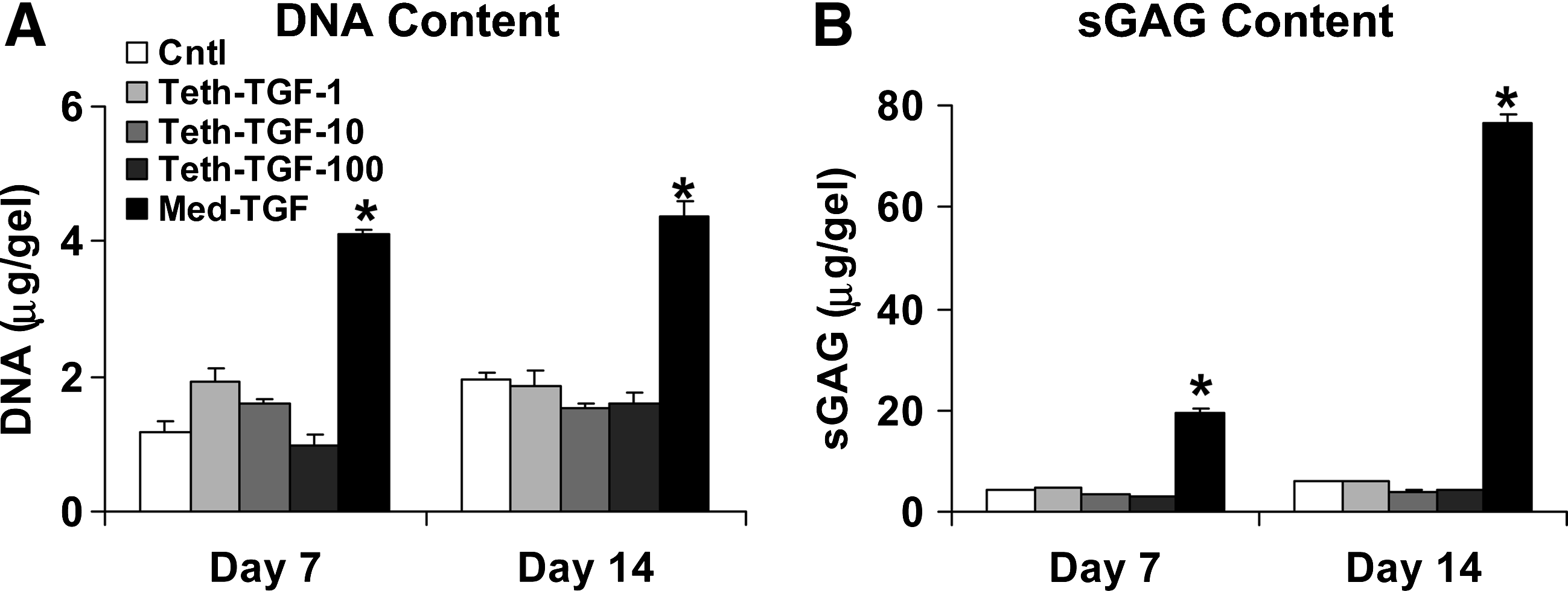
Biotin-streptavidin tethered TGF-β1 (Teth-TGF) did not promote chondrogenesis of bovine BMSCs. Biotinylated (KLDL)3 and streptavidin were added to all (KLDL)3 peptide hydrogels. In addition, for Teth-TGF-1, Teth-TGF-10, and Teth-TGF-100, 1, 10, or 100 ng/mL biotin-conjugated TGF-β1 was also added, respectively. Control (Cntl) and Med-TGF hydrogels contained no biotin-conjugated TGF-β1. All hydrogels were cultured in the TGF-β1-free medium except for Med-TGF, which was supplemented with 10 ng/mL TGF-β1.
TGF-β1-adsorbed peptide hydrogels stimulate chondrogenesis
TGF-β1 can be adsorbed to both (KLDL)3 peptide and agarose hydrogels by mixing with the hydrogel solution before encapsulating BMSCs (Ads-TGF). Chondrogenesis of Ads-TGF was tested using bovine BMSCs. After 7 days of culture, the sGAG content of BMSCs in (KLDL)3 hydrogels stimulated by Ads-TGF was 77% of Med-TGF and 2.5-fold higher than TGF-β1-free controls (Fig. 3A; p < 0.05). In agarose hydrogels, the sGAG content for Ads-TGF was not different from Med-TGF, and was 1.8-fold higher than TGF-β1-free controls at day 7 (Fig. 3B; p < 0.001). By day 21, total sGAG produced by Ads-TGF stimulated BMSCs in (KLDL)3 and agarose was 21% and 38% of Med-TGF (p < 0.001), and was three-fold and two-fold higher than TGF-β1-free controls, respectively (p < 0.001).

Adsorbed TGF-β1 (Ads-TGF) promotes chondrogenesis of bovine BMSCs in peptide and agarose hydrogels. BMSCs were encapsulated in (KLDL)3 peptide or agarose that had been mixed with 100 ng/mL TGF-β1 (Ads-TGF) and cultured in the TGF-β1-free medium. For Cntl and Med-TGF hydrogels, BMSCs were encapsulated in unmodified (KLDL)3 peptide or agarose and cultured in the TGF-β1-free or 10 ng/mL TGF-β1 supplemented medium, respectively.
TGF-β1-adsorbed hydrogels produce full-length aggrecan
To further characterize the bovine BMSC chondrogenic phenotype, proteoglycans were extracted from (KLDL)3 peptide and agarose samples after 21 days of culture and analyzed by Western blotting with an anti-G1 aggrecan antibody. For the Ads-TGF and Med-TGF conditions, equal sGAG was loaded per lane, whereas control lanes were loaded with the entire extract from one entire gel disk (due to undetectable levels of sGAG in TGF-β1-free controls). With both Ads-TGF and Med-TGF, a large macromolecular species was identified running at the molecular weight of full-length aggrecan in (KLDL)3 peptide and agarose (Fig. 4). In (KLDL)3 peptide, full-length aggrecan was the predominant species detected, consistent with the virtual absence of aggrecanase activity in peptide hydrogels. 30 In agarose with Med-TGF, a doublet band near 65 kDa was the major immunoreactive band detected, shown previously to be the G1-NITEGE species, which is generated by aggrecanase activity. 30 However, when TGF-β1 was adsorbed to the agarose, the intensity of this doublet band was decreased and full-length aggrecan was the major product observed. This suggests a reduced aggrecan fragment generation when TGF-β1 was adsorbed to agarose hydrogels compared to Med-TGF.
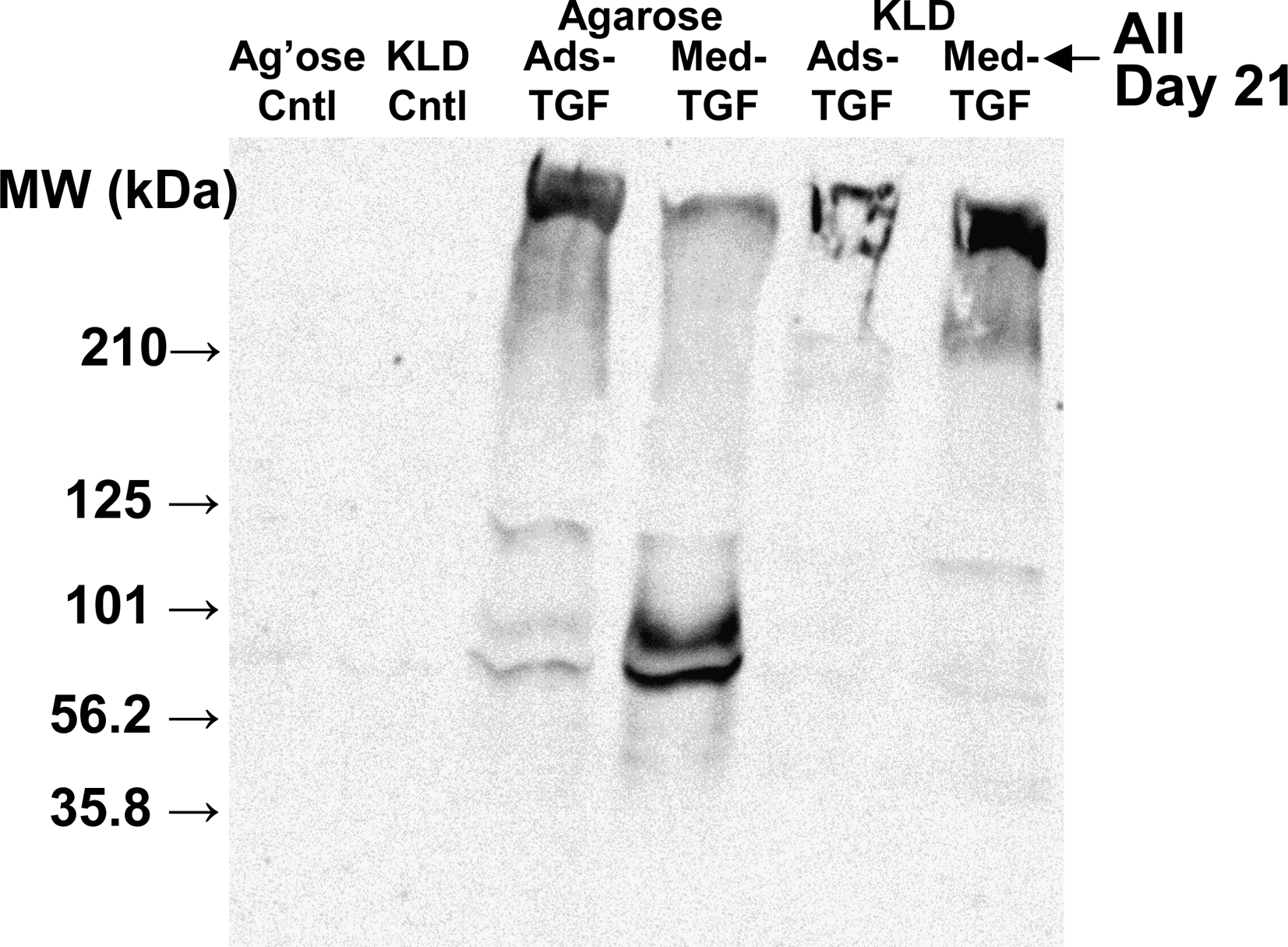
Anti-aggrecan G1 domain Western blot. Aggrecan extracted from bovine (1 donor) BMSC-seeded agarose or (KLDL)3 peptide (KLD) hydrogels after 21 days of culture in TGF-β1-free (Cntl), Ads-TGF, or Med-TGF conditions.
TGF-β1 adsorbed to (KLDL)3 peptide signals via SMAD2/3
Anti-Smad2/3 Western blotting of proteins extracted from bovine BMSCs encapsulated in peptide hydrogels showed the expected 50–60 kDa species in all conditions after 1 day of culture (Fig. 5A). In Ads-TGF- or Med-TGF-treated samples, pSmad2/3 was also detected at day 1. In addition, for one animal donor (animal #2 in Fig. 5A) pSmad2/3 was detected with Teth-TGF treatment, although at low levels. pSmad2/3 was detected throughout 21 days of culture in Med-TGF and through day 4 of culture in Ads-TGF samples (Fig. 5B). Total Smad2/3 was detected in all samples through day 21; however, it was more abundant for Ads-TGF samples than any other condition from days 4, 7, and 14 (Fig. 5B), making it a poor loading control. Therefore, semi-quantitative band densitometry (Fig. 5C) was normalized by β-actin as a loading control and then to the corresponding day 4 Med-TGF condition which was run on every gel. The results showed statistically equivalent pSmad2/3 signaling for Ads-TGF and Med-TGF samples at days 1 and 4, with Ads-TGF pSmad2/3 dropping to levels comparable to TGF-β1-free controls from day 14 to 21. For total Smad2/3, 2-factor ANOVA (for TGF condition and time) confirmed a significant trend with TGF condition (p < 0.05), but not time, although no pairwise comparisons were significant.

Phospho- and Total-Smad 2/3 Western blots. Bovine BMSCs encapsulated in (KLDL)3 peptide hydrogels and cultured in TGF-β1-free (Cntl), Ads-TGF, 100 ng/mL-Teth-TGF, or Med-TGF conditions.
(KLDL)3-peptide Ads-TGF stimulates chondrogenesis of adult equine BMSCs
Ads-TGF increased the DNA content of adult equine BMSC-seeded peptide hydrogels by 70% compared to TGF-β1-free controls at day 7, and ultimately resulted in 2.4-fold higher DNA for Ads-TGF than for Cntl at day 21 (Fig. 6A; p < 0.05). Further, the DNA content for Ads-TGF was statistically equivalent to Med-TGF cultures at days 7 and 14, and was only 17% lower at day 21 (p < 0.05). sGAG content for Ads-TGF-stimulated equine BMSCs was 43% higher than Med-TGF cultures at day 7 (Fig. 6B; p < 0.05) and was consistently higher throughout the experiment, with Ads-TGF cultures containing 39% more sGAG than Med-TGF at day 21 (p < 0.05).
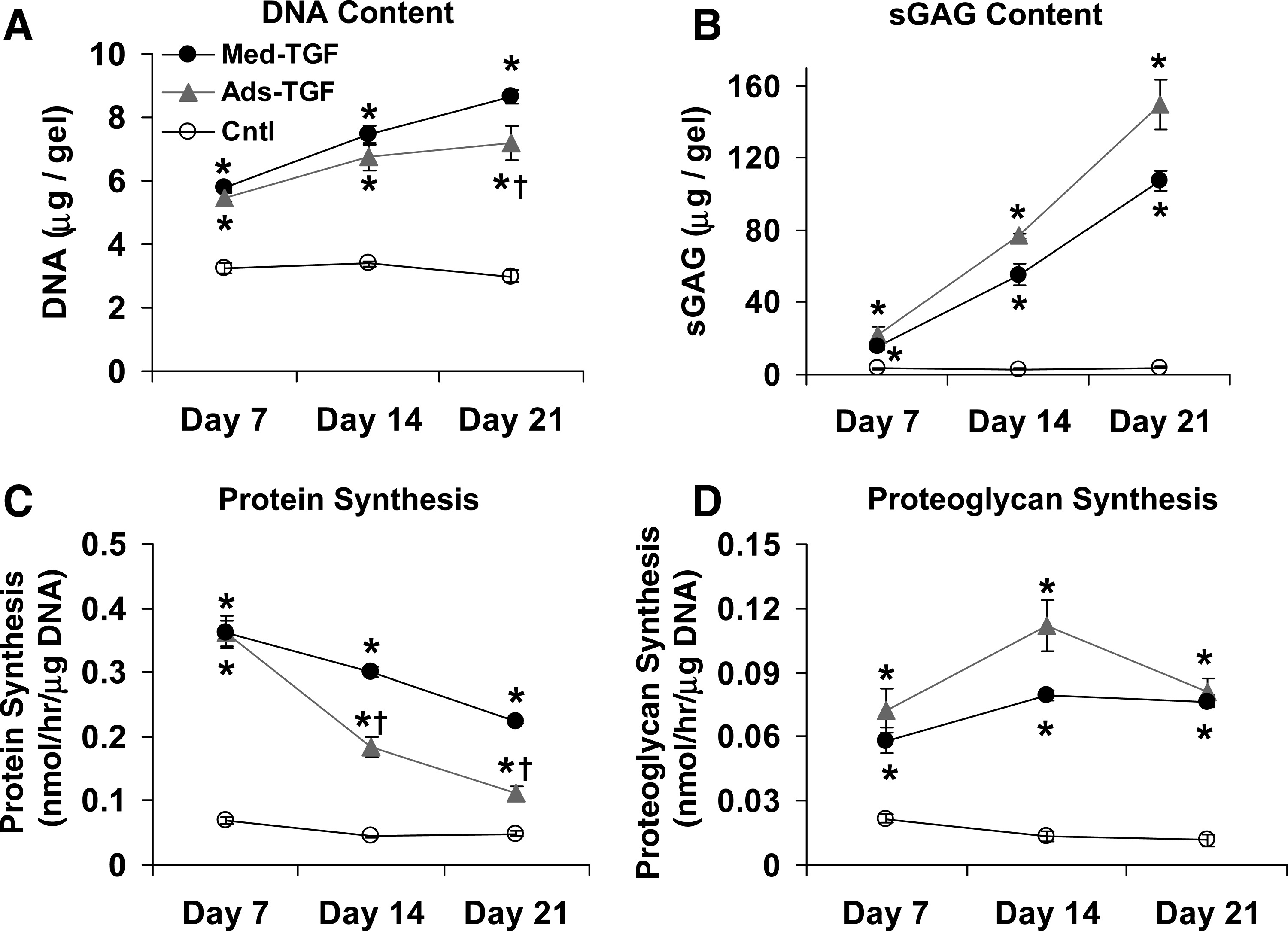
Ads-TGF stimulates chondrogenesis of adult equine BMSCs encapsulated in (KLDL)3 peptide hydrogels. BMSCs were encapsulated in (KLDL)3 peptide hydrogels and cultured in TGF-β1-free (Cntl), Ads-TGF, or Med-TGF conditions.
Protein biosynthesis was equivalent for Med-TGF and Ads-TGF cultures at day 7 (Fig. 6C). Protein synthesis decreased over time for both cultures, although this decrease was more significant for Ads-TGF hydrogels, which had 50% lower protein biosynthesis than Med-TGF at day 21 (p < 0.05). In contrast, proteoglycan synthesis was equivalent for Ads-TGF and Med-TGF at all time points and did not drop with time (Fig. 6D). These data showed that the transient TGF-β1 exposure in the Ads-TGF case preferentially stimulates proteoglycan and not protein biosynthesis.
Discussion
TGF-β1 adsorbed to (KLDL)3 peptide hydrogels (Ads-TGF) stimulated chondrogenesis of encapsulated BMSCs, inducing cell proliferation and producing a cartilage-like ECM that was similar to hydrogels stimulated by Med-TGF. Delivery of an equivalent amount of TGF-β1 by an alternate method, tethering the growth factor to the (KLDL)3 peptide via a biotin-streptavidin linkage (Teth-TGF), did not stimulate any marker for chondrogenesis above TGF-β1-free controls. Robust efficacy of Ads-TGF was demonstrated by the capacity to induce chondrogenesis of BMSCs isolated from two different species, adult equine and immature bovine, resulting in significant increases in hydrogel sGAG accumulation over BMSCs cultured in TGF-β1-free conditions. Increased DNA content for both Ads-TGF and Med-TGF relative to TGF-β1-free controls showed that the peptide hydrogel microenvironment stimulated cell proliferation for both conditions, similar to that found previously for Med-TGF stimulation using peptide gel scaffolds. 30 Adult equine BMSCs stimulated with Ads-TGF produced neotissue with statistically equivalent cartilage sGAG content and biosynthesis to equine BMSCs stimulated by Med-TGF.
In studies exploring BMSC differentiation with transient exposure to soluble TGF-β1, chondrogenesis of BMSCs was shown to require Med-TGF stimulation for just the initial 4 days of culture in peptide hydrogels (Fig. 1). This may be due in part to the capacity of the highly porous (KLDL)3 peptide scaffold to quickly uptake TGF-β1 from the bath and, additionally, to adsorb and thereby sustain TGF-β1 stimulation beyond the initial 4 days. Experiments using radiolabeled 125I-TGF-β1 have demonstrated significant uptake by acellular (KLDL)3 hydrogel disks resulting in an 18-fold higher 125I-TGF-β1 concentration within the hydrogel than in the surrounding bath with 5 days of equilibration. 36 In addition, preliminary studies have shown that over 50% of the imbibed 125I-TGF-β1 remained within the peptide disk specimens even after 21 days of medium washout, a direct demonstration of adsorption to the peptide. 37 Our results are consistent with a recent report for chondrocyte-seeded agarose hydrogels in which transient exposure to TGF-β1 for 2 weeks was shown to produce a higher compressive modulus, higher sGAG content, and equivalent collagen content to continuous Med-TGF stimulation after 8 total weeks of culture. 38 Similarly, 3 weeks of transient TGF-β1 stimulation for BMSC-seeded agarose have been shown to produce equivalent dynamic compressive modulus and sGAG and collagen content to Med-TGF stimulation after 7 total weeks of culture. 39
Ads-TGF stimulated chondrogenesis of BMSCs from both immature bovine and adult equine sources without any additional TGF-β1 medium supplementation. This is consistent with measurement of 125I-TGF-β1 uptake in the Ads-TGF system, which showed a 72-fold higher concentration of 125I-TGF-β1 within peptide hydrogels than in the surrounding bath. 36 This is 4-fold higher than the 18-fold difference for the transient Med-TGF experiments described above, in which TGF-β1 diffused into a pre-assembled peptide hydrogel. We hypothesize that the addition of TGF-β1 to initially unassembled peptide monomers in the Ads-TGF system enables interactions with the hydrophobic groups that are shielded and therefore unavailable when TGF-β1 diffuses into pre-assembled hydrogels, as in the transient Med-TGF system. 40 This additional TGF-β1 uptake in the Ads-TGF system likely provides sustained delivery of TGF-β1 to encapsulated BMSCs, stimulating the observed chondrogenesis.
Teth-TGF did not stimulate accumulation of a cartilage-like ECM or induce proliferation of BMSCs encapsulated in peptide hydrogels (Fig. 2). This is in contrast to recent reports where TGF-β1 covalently tethered to bioactive two-dimensional surfaces induced myofibroblast differentiation, 41 increased matrix production of vascular smooth muscle cells, 42 and initiated cartilage-like ECM production in a magnetic-bead pellet culture system. 12 In addition, biotin-streptavidin sandwich tethered IGF-I in self-assembling peptide hydrogels improved cell survival and function after experimentally induced myocardial infarction in a rat model. 28 Therefore, it was thus surprising that Teth-TGF in the current study was an ineffective chondrogenic stimulus. Potential explanations include Teth-TGF ligand entrapment within peptide nanofibers preventing receptor binding, blocked ligand internalization by the high-affinity biotin-streptavidin linkage leading to altered intracellular signaling, and newly secreted pericellular matrix preventing interaction between the ligand and cell surface receptors. With a dissociation constant of order 10−15 M, 43 the biotin-streptavidin affinity approaches and may exceed some covalent bonds. 44 Thus, Teth-TGF may prevent internalization of the receptor-ligand complex that occurs for the Med-TGF and Ads-TGF conditions. Alternatively, the accumulation of newly secreted matrix proteins in the pericellular space that may block Teth-TGF from its receptor and lead to premature signaling termination. This scenario is supported by the phosphorylation of Smad2/3 by Teth-TGF-encapsulated BMSCs at day 1 for a subset of samples (Fig. 5A), but no detectable Smad2/3 phosphorylation at days 4–21 (Fig. 5C). In addition, these data suggest that pSmad2/3 signaling must be sustained for 4 days to stimulate chondrogenesis.
Aggrecan Western analysis demonstrated that full-length aggrecan was produced by Ads-TGF stimulated BMSCs in (KLDL)3 peptide hydrogels comparable to Med-TGF stimulation (Fig. 4), consistent with a recent report. 30 In agarose hydrogels stimulated by Med-TGF, the major immunoreactive product detected was a doublet band near 65 kDa associated with the aggrecanase generated NITEGE neoepitope. 45 Consistent with this observation, continuous medium stimulation by TGF-β1 has been shown previously to induce accumulation of aggrecan cleavage products in chondrocyte-seeded agarose 45 and in BMSC-seeded agarose hydrogels. 30 Since equal sGAG was loaded per lane for Ads-TGF and Med-TGF conditions, anti-aggrecan G1 Western analysis reveals the relative amount of full length to catabolically processed aggrecan for each condition, rather than comparing aggrecan accumulation between conditions. In contrast to Med-TGF, agarose hydrogels with Ads-TGF stimulated the production of predominantly full-length aggrecan with reduced accumulation of aggrecan cleavage products (Fig. 4).
The reduced aggrecan cleavage for Ads-TGF relative to the medium delivered may be explained by the unique Smad2/3 phosphorylation time courses for these two modes of delivery. Transient signaling as shown by immunoreactive staining for pSmad 2/3 at days 1–4 followed by a loss of pSmad2/3 in weeks 2–3 was observed with Ads-TGF. In contrast, sustained pSmad2/3 signal was shown throughout the 21 days of culture with Med-TGF with pSmad2/3 levels steady for the first week and trending higher in weeks 2–3 (Fig. 5C). Receptor Smad phosphorylation is a dynamic and tightly controlled event which must be carefully balanced by dephosphorylation to achieve the appropriate physiological response.46,47 The differing Smad2/3 phosphorylation for Ads-TGF and Med-TGF may thus play a critical role in the resulting BMSC chondrogenic phenotype. A recent study highlighted the importance of TGF-β1 signaling duration in determining cellular response by showing that endothelial cells sense TGF-β1 dose by depleting it through constitutive receptor trafficking processes. 48 In addition, tumor cells with impaired receptor trafficking led to TGF-β1 overproduction, which correlated with a poor disease prognosis. Thus, TGF-β1 signaling duration can have a significant impact on cell decisions and function. Given the strong chondrogenic stimulus provided by both Ads-TGF and Med-TGF as well as the relative decrease in aggrecan catabolism with Ads-TGF compared to Med-TGF (Fig. 4), it is possible that the two TGF-β1 delivery methods generate unique intercellular signal durations that result in different observed functional outcomes. Thus, the transient pSmad2/3 signal observed for Ads-TGF may be sufficient to initiate chondrogenesis, whereas Med-TGF may provide a sustained signal that in addition to stimulating chondrogenesis also upregulates aggrecan catabolism (Figs. 4 and 5).
Lastly, further support for a chondrogenic benefit of transient TGF-β1 was provided in the adult equine BMSC system by both medium takeaway and Ads-TGF experiments (Figs. 1E, 1F, 6C, and 6D, respectively). In both cases, proteoglycan biosynthesis, a marker for chondrogenesis, was preferentially stimulated relative to general protein biosynthesis, whereas continuous Med-TGF sustained both proteoglycan and protein biosynthesis.
Summary
Adsorption of TGF-β1 to (KLDL)3 peptide and agarose hydrogels stimulated chondrogenesis of BMSCs isolated from both bovine and equine sources. Ads-TGF stimulated the production of full-length aggrecan by BMSCs in both (KLDL)3 peptide and agarose hydrogels, whereas Med-TGF stimulated aggrecan cleavage product formation in agarose hydrogels. Smad2/3 was phosphorylated in response to Ads-TGF stimulation for the initial 4 days of culture, whereas Med-TGF generated phosphorylated Smad2/3 for the entire 3 weeks of culture. Given the wide diversity of cell functions controlled by TGF-β1 signaling18,19 and the importance of TGF-β1 signal duration, dynamic reversible Smad phosphorylation, and ligand depletion kinetics in determining outcome,46–48 tuning the delivery duration and dose for pro-chondrogenic growth factors will likely be critical to the success of BMSC-based cartilage resurfacing technologies.
Footnotes
Acknowledgments
The authors thank Dr. Richard T. Lee for numerous discussions and invaluable advice on strategies to tether and adsorb growth factors to self-assembling peptide hydrogels. This work was funded by the National Institutes of Health (NIH EB003805, NIH AR33236, and NIH AR45779), a National Institutes of Health Molecular, Cell, and Tissue Biomechanics Training Grant Fellowship (P.W.K.), and an Arthritis Foundation Postdoctoral Fellowship (E.J.V.).
Disclosure Statement
No competing financial interests exist.