




Abstract

Early Risk Management
There are many external market forces that cannot be controlled by academics. These include the global economy, market preferences, and acceptance, as well as the competitive landscape as new technologies enter the marketplace. As with other industries, the ebbs and flow of biotechnology are affected by political, economical, social, and technological changes. However, by implementing risk-averting decisions within areas that are under their control, academic entrepreneurs can decrease the contribution of negative external forces. For example, a platform technology can have several clinical applications and therefore be applied to multiple markets. However, if there are more funding opportunities for the academic in one clinical application (market A) versus another, and all else being equal, the risk mitigating decision would be to target market A first. Once that decision has been made, the technology can be further derisked in the preclinical phase by aligning the academic research with the selected target market. This can be accomplished by the choice of a relevant animal model that closely simulates the human clinical application, as well as a choice of controls or comparitive test groups that would demonstrate the superiority of the new technology over existing market-leading treatments. This can be challenging in the current federal funding environment when scientific controls are favored over the types of controls one might select to demonstrate superiority over a standard of care technology current on the market. The reality is that an entrepreneurial investigator must find a way to include both. The Bench to Business workshop aims to provide insights for navigating through the commercialization process, including the forces within an entrepreneurs control such as the target market, the product technology, business development team, and definition of failure. Directing a research program toward a commercializable technology implements the long-term orientation necessary to mitigate risk during commercialization. Academic entrepreneurs are experts in the potential of their core technology. However, the collection of market data early on can aid in targeting a specific application for the technology. This approach allows the technology to be positioned in the most favorable market environment, where the competitive landscape may be well defined and the advantage clear. Whereas positioning a technology that is based on market needs has been utilized in several industries, most notably in information technology, implementation is more complex in life sciences, where the market needs are not limited to only patients but also to physicians, providers, payers, and regulators. Frameworks utilized by other industries, such as Steve Blank's Lean Startup methodology, are now being modified for application in biotechnology. Based on the needs of a specific target market, researchers can design experiments to determine if their technologies are able to match or surpass the design critera set by the market. Academic entrepreneurs can also identify key experiments to assess the feasibility of the technology's potential for clinical success so that if failure occurs, it does so in the least expensive and fastest way possible. A common theme for identifying a competitive new entrant into the market is asking the question, “is it better, faster, cheaper?” This question can often be answered at the bench before any large investment of time and money. For example, if a medical device currently on the market has a lifetime of 2 years before failure, then an academic entreprenuer can conduct an in vitro study to assess the longevity of his/her technology. The caveates of in vitro simulations notwithstanding, if the test does not yield a significant improvement over the 2-year lifespan of the current product, the technology may not be worth pursuing for that particular market. Manufacturing/Production costs can also be estimated early in the commercialization process and used to determine if the technology falls within a feasible selling price sufficient to cover costs and produce a sizable profit. The previous examples relate to market success. However, bench studies related to adverse effects (immune response) and efficacy can increase the chances of clinical success. Determining points of failure before the investment of time, energy, and money is not only efficient, but it allows for approripate allocation of future resources.
Four Pillars of Technology Readiness
Figure 1 is a generalized flow chart for technology commercialization, but also includes questions to ask at each stage based on the Four Pillars of Technology Readiness: (1) Intellectual Property, (2) University Office of Technology Transfer, (3) Outside Capital, and (4) Partnerships and Exit Strategies, each of which is described in more detail below.
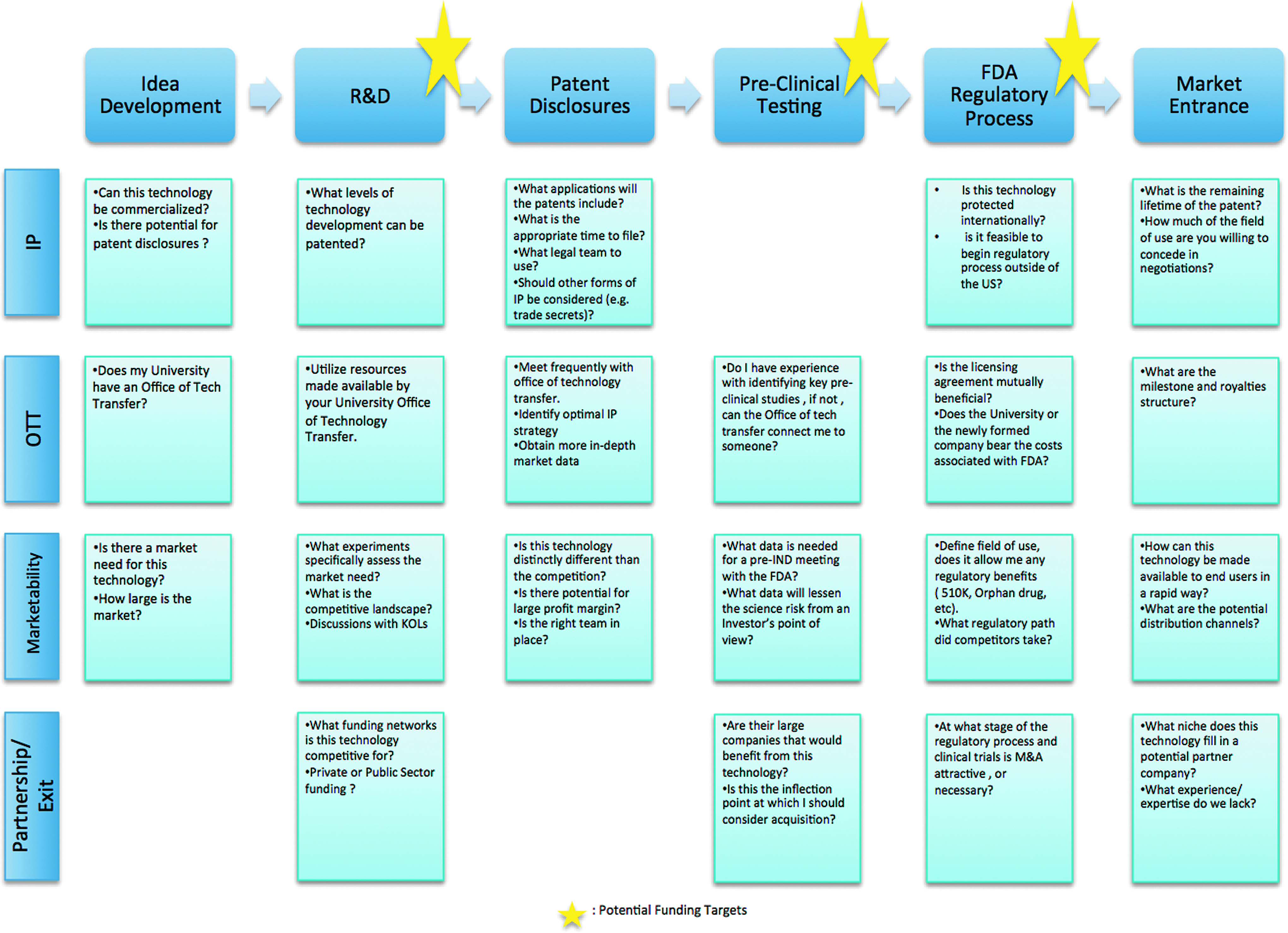
Generalized flow chart for technology commercialization based on the Four Pillars of Technology Readiness. R&D, Research and Development; FDA, Food and Drug Administration; IP, Intellectual Property; OTT, Office of Technology Transfer. Color images available online at www.liebertpub.com/tea
Intellectual property position
In a 2012 survey given to the government, public and private sector funding agencies, the TERMIS Industry Committee found that all four sectors (Academia and Start-Up. Development Stage and Established Companies) in the commercialization stream identified patent protection as an important factor in making investment decisions. 3 Understanding the value that intellectual property creates for inventors, the university and the licensee become vital when making decisions such as the timing of filing, negotiating licensing deals, and interactions with outside funding sources. Since most universities operate on a modest patent prosecution budget, off-loading the patent costs to a licensee is often the primary goal. This is typically balanced against favorable licensing terms and low expectations for monetary return. However, entrepreneurs must understand how this model works in relation to the US and international patent systems, the associated timing of patent application publication, and the increased costs of prosecuting internationally.
The greatest resource for academic entrepreneurs is their university's office of technology transfer, where experts are positioned to appropriately identify patentable technologies and maintain the interest of both the faculty inventor(s) and the university. Whereas patents are almost always the first consideration, thought should also be given to other forms of intellectual property such as trade secrets and know how.
Interfacing with University Office of Technology Transfer
The University Office of Technology Transfer (OTT) facilitates the commercialization of academic research and is often the central hub for filing invention disclosures, filing and prosecuting patents, negotiating licensing agreements, and managing active licenses. OTTs can operate under one of the several different models, including the faculty service (focuses on risk mitigation relevant to faculty), corporate relationship (focuses on risk mitigation relevant to corporate sponsors), revenue generation (focuses on risk mitigation relveant to business development), and IP protection models (simply protect the IP and determine what to do with it later). Behind these storefronts are often budget and political issues, so it is in the best interest of the inventor/potential licensee to understand the model being employed by the university and to invest time in understanding the financial and political climate of the OTT. For example, due to budget constraints, OTTs typically do not perform freedom to operate analyses on many of the inventions for which they file patents. It is up to the potential licensee to determine if the commercialization pathway is clear of any obstacles to exclusivity.
Marketability/attracting outside capital
As technologies move through the commercialization pathway and result in a new company formation, it becomes apparent that outside capital is needed to move forward. The TERMIS-IC has previously presented factors that funding agencies consider valuable when making an investment. 3 Whereas grant dollars can fund the initial stages of R&D and small business innovation/small business technology transfer (SBIR/STTR) funding is designed to aid in the economic viability of start-ups, these funding sources may not be sufficient to cover expenses associated with preclinical testing, business development costs, and regulatory testing. Moreover, while a grant may provide initial seed funding at a low level, the entire process is typically fraught with long grant review/award cycle times and low success rates. Therefore, the technology must be attractive to investors. As previously mentioned, one method to increase attractiveness to outside funding is to derisk the technology before discussions with potential investors through targeting a profitable market, demonstrating efficacy in laboratory models, and ensuring that the appropriate team is in place to move the technology forward to ultimatley result in a positive ROI. The life sciences portion of total venture funding fell by 20% in Q2 of 2012; for start-ups, this reinforces the importance of demonstrating solid potential to be competitive for venture capital funding. 5 Not only does the market size matter, but an understanding of the competitive landscape is necessary (e.g., currently available technologies, their limitations, and the relative improvement offered by the new technology). One must also consider that these competitors may eventually become partners.
Industry visibility and partnerships
Working with industry is often promoted in academia, but not often realized effectively. To facilitate industry–academic partnerships, universities and faculty must learn to deal in the currency of industry, that is, timelines and milestones. Industry operates on hard criteria that are often different than academic goals and objectives; pushing the frontiers of science, publishing an article, or graduating students are not sufficient. Industry sponsored research typically requires more tangible tasks and objectives (e.g., construct working prototype by the first quarter, a complete large animal study by end of the year) that can accommodate other academic objectives. A skilled faculty project manager must be capable of striking this balance. Research directed toward industry partnership or acquisition must provide and preserve the profit motive by targeting an important unmet clinical need, demonstrating superiority over conventional therapies (not simply a scientific experimental control), and protecting intellectual property. These are the main talking points for interactions with potential industry sponsors/partners and necessitate an understanding of the better, cheaper, faster mentality. Whereas here we have focused on partnerships with industry leaders, there is great value in building relationships with regulatory partners as discussed during the recent TERMIS World Congress. 2 Early interactions with regulatory agencies through presubmission meetings allow entreprenuers to tailor their preclinical assessments based on the requirements. It is also advisable to handle these interactions in a highly professional and structured manner, using nondisclosure, material transfer, grant partnering, and other written agreements.
Synopsis
Whereas the risk of failure outweighs the chances of market success, it is important to note that there are several resources available for academic entrepreneurs to gain the skill set for commercialization of their technology. The TERMIS-AM Industry Committee will offer a workshop during the 2013 TERMIS-AM Annual Conference in Atlanta, GA, where experts will specifically discuss strategies for the Four Pillars of Technology Readiness.
Footnotes
Disclosure Statement
No competing financial interests exist.