




Abstract

F
Nearly 100 delegates including the current and incoming presidents of TERMIS-Americas (Profs. William R. Wagner and John P. Fisher, respectively) and the current presidents of TERMIS-Europe (Prof. Heinz Redl) and TERMIS-Asia Pacific (Prof. Yasuhiko Tabata) attended the conference over the duration of 4 days. The welcome address was given by the Executive Mayor Cllr Simon M. Mofokeng, the mayor of Emfuleni Local Municipality, and this was followed by the opening addresses by the Vice Chancellors and Principals of the two Universities Prof. G.N. Zide (Vaal University of Technology) and Prof. Lourens Van Staden (Tshwane University of Technology). Other prominent persons in attendance included Mr. Mmboneni Muofhe (Deputy Director General: Technology Innovation [DST]), Prof. J. Mphahlele (Vice President: SAMRC), Dr. Sepo Hachigonta (Director Strategic Partnership, NRF), Prof. Felix Dakora (African Academy of Sciences), and Dr. Siyabulela Ntutela (CEO AfricaBio).
The conference featured keynote addresses, a number of plenary sessions, invited talks, and contributed lectures focusing on different aspects of tissue engineering and regenerative medicine. Keynote speakers, including Prof. Yasuhiko Tabata from Kyoto University (Japan) and Prof. John P. Fisher from the University of Maryland (United States), presented their work on the successful use of biomaterials and stem cells to treat several health conditions. Prof. Yasuhiko Tabata spoke on “Tissue regeneration therapy based on biomaterial technology of dual drug release” while Prof. John P. Fisher spoke on “3D printing for complex tissues.” Most of these technologies stimulate the body's own molecules and growth factors to initiate the regeneration of the body tissues. Restoration of body tissues and even hearing are some of the benefits of tissue engineering and regenerative medicine. Complex body tissues can be made outside of the human body through the use of 3D printing. Such complex human tissues include the heart, lungs, and blood vessels.
Several keynote presentations were made by international speakers including Prof. Adetola Adesida (University of Alberta, Canada), Prof. John A. Jansen (Radboud University Medical Centre, The Netherlands), Dr. Peter C. Johnson (Principal, MedSurgPI, LLC), Prof. Lydia E. Kavraki (Rice University), Prof. Antonios G. Mikos (Rice University), Prof. Ketul Popat (Colorado State University), Prof. Heinz Redl (Ludwig Boltzmann Institute for Experimental and Clinical Traumatology, Austria), and Prof. Johnna S. Temenoff (Georgia Tech and Emory University). Several speakers associated with the private industry also gave talks on the development of new technologies and the need to be informed of the regulations required for the registration of such technologies.
Several poster sessions were held during the conference with some students scoring best poster presentations and winning awards. The conference showcased ground-breaking work being done by scientists worldwide in tissue engineering and regenerative medicine. The conference also provided an opportunity to showcase the novel and innovative contributions made by researchers on the African continent toward the advancement of the tissue engineering and regenerative medicine. Most tissue engineering and regenerative medicine research on the African continent is still pioneering work.
Currently very few universities and research centers are doing tissue engineering and regenerative medicine research on the African continent. These include Ahmadu Bello University (Nigeria), Alexandria University (Egypt), International Centre of Genetic Engineering and Biotechnology (ICGEB Cape Town component, South Africa), Rhodes University (South Africa), Stellenbosch University (South Africa), Tshwane University of Technology (South Africa), University of Cape Town (South Africa), University of Kwazulu Natal (South Africa), University of Nairobi (Kenya), University of Pretoria (South Africa), University of Zimbabwe (Zimbabwe), and Vaal University of Technology (South Africa). These fields are important to treat diseases and other chronic ailments bedevilling the human population as well as animals especially in developing countries. A wide range of presentations and posters covered several diseases and conditions that are prevalent on the African continent and how tissue engineering and regenerative medicine could be leveraged for treatment.
The conference served as a platform for the launch of the eagerly awaited African Tissue Engineering and Regenerative Medicine International Society (ATERMIS). Currently, there are societies including the Tissue Engineering and Regenerative Medicine International Society with chapters of the Americas, Asia Pacific, and Europe, which have grown their networks and enabled several intercontinental and worldwide collaborations. However, there existed no society to represent African scientists in the fields of tissue engineering and regenerative medicine until now. The main goals of ATERMIS are to grow a strong network of African scientists and also foster collaboration among the African scientists and the rest of the world in the field of tissue engineering and regenerative medicine. ATERMIS hopes to attain these goals by initially drafting guidelines for scientists in Africa doing research on tissue engineering and regenerative medicine with the aim of standardizing methods and research practices so that they meet the internationally accepted standards. By achieving these goals, the contributions by the African scientists will not only be recognized by peers but may also lead to the development of novel and innovative means of treating diseases and chronic problems by leveraging the regenerative ability of the human body. These goals will also create an opportunity for African scientists to engage with policy makers so as to ensure that research in tissue engineering and regenerative medicine does not fall behind technologically and is accessible to all Africans. Therefore, ATERMIS aims to advocate against the main drivers of technological disparities such as the lack of financial support and commitment by African governments for research and development in the fields of tissue engineering and regenerative medicine. In addition, ATERMIS will also provide a voice for scientists in Africa to express themselves on the continental and global policies influencing the direction of research and development in tissue engineering and regenerative medicine.
The following individuals (Fig. 1) were elected as the committee members of the ATERMIS for the next 3 years:
President: Prof. Keolebogile S. Motaung (Tshwane University of Technology, South Africa) Vice President: Dr. Kevin Dzobo (ICGEB/University of Cape Town, South Africa) Secretariat: AfricaBio (South Africa) Committee member: Dr. Idowu A. Aimola (Ahmadu Bello University, Nigeria) Committee member: Dr. Farisai Chidzwondo (University of Zimbabwe, Zimbabwe) Committee member: Dr. Aliyu Muhammad (Ahmadu Bello University, Nigeria) Committee member: Prof. Mona K. Marei (Alexandria University, Egypt) Committee member: Dr. Rania Noaman (Alexandria University, Egypt)
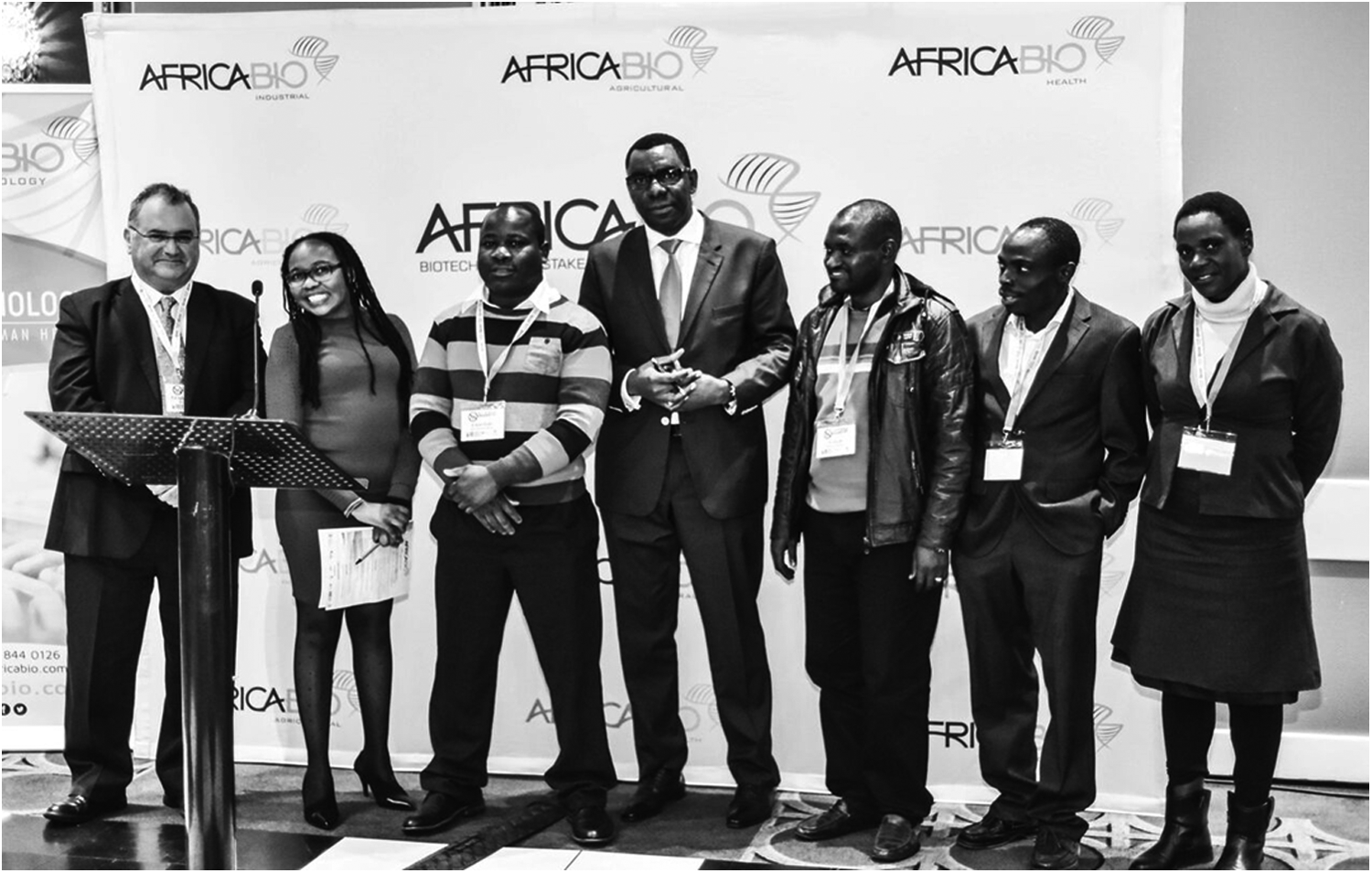
Committee members of the African Tissue Engineering and Regenerative Medicine International Society (ATERMIS) with Professor A.G. Mikos at the launch of the society. From left: Prof. Antonios Mikos, Prof. Keolebogile S. Motaung (President), Dr. Kevin Dzobo (Vice President), Dr. Siyabulela Ntutela (AfricaBio, Secretariat), Dr. Aliyu Muhammad (committee member), Dr. Idowu A. Aimola (committee member), and Dr. Farisai Chidzwondo (committee member).
The regenerative power of the human body has been identified for some time now. Recent advances have shown that a combination of human stem cells, certain biomaterials, and molecules can stimulate the body to regenerate itself and eventually heal the human body. With organ shortages being a hindrance to a good quality of life for people, tissue engineering and regenerative medicine can be used to augment existing resources for the treatment of human ailments around the world.
Footnotes
Disclosure Statement
No competing financial interests exist.