




Abstract
Synthetically designed biomaterials strive to recapitulate and mimic the complex environment of natural systems. Using natural materials as a guide, the ability to create high-performance biomaterials that control cell fate, and support the next generation of cell- and tissue-based therapeutics, is starting to emerge. Supramolecular chemistry takes inspiration from the wealth of noncovalent interactions found in natural materials that are inherently complex, and using the skills of synthetic and polymer chemistry, recreates simple systems to imitate their features. Within the past decade, supramolecular biomaterials have shown utility in tissue engineering and the progress predicts a bright future. On this 30th anniversary of the Netherlands Biomaterials and Tissue Engineering society, we briefly recount the state of supramolecular biomaterials in the Dutch academic and industrial research and development context. This review provides the background, recent advances, industrial successes and challenges, as well as future directions of the field, as we see it. Throughout this work, we notice the intricate interplay between simplicity and complexity in creating more advanced solutions. We hope that the interplay and juxtaposition between these two forces can propel the field forward.
Impact statement
Supramolecular biomaterials based on noncovalent interactions hold the ability to rebuild some of the complexity of natural biomaterials in synthetic systems. While still in its infancy, the field is currently vigorously moving from fundamental experiments toward applications and products in the tissue engineering and regenerative medicine arena. Herein, we review the current state of the field in the Netherlands. While supramolecular biomaterials have incredible potential, systematic studies, balancing complexity and simplicity, efficient translation, and enhanced performance are all required for success of these strategies. As we move the field toward commercial solutions for clinical patients, we must also pay homage and remember the fundamental studies that allow these jumps in innovation.
Introduction
Natural systems have evolved over millions of years to capture and harness intra- and intermolecular interactions to create hierarchically complex and functionally rich materials. As synthetic chemists, we aim to put the keys that nature uses to work, and thus, we have embarked on the systematic exploration and exploitation of such molecular interactions in the construction of synthetic systems. Inspired by natural complex systems and combinations of noncovalent interactions, the design of simpler self-assembling materials can both provide fundamental insights and solve practical challenges, for example, in the biomedical field. Distilling complex molecular systems to simple and controllable units is a mainstay of the supramolecular biomaterial field.
Supramolecular chemistry, defined as chemistry beyond the covalent bond, explores the interactions between (and within) molecules and how they can be used to direct higher order structure and function. 1 While individual noncovalent interactions such as pi–pi, H-bonding, dipole–dipole, charge transfer, metal–ligand coordination, and hydrophobic effects can be individually weak, their collective strength bears influence on the assembled products. Indeed, noncovalent interactions are not unique to the field, and are found heavily throughout the natural world, for example, in protein secondary, tertiary, and quaternary structures; it is from nature that the field derives inspiration.
Supramolecular polymers are defined as polymeric arrays of monomeric units that are brought together by reversible, directional noncovalent interactions, resulting in polymeric properties in dilute and concentrated solutions as well as in the bulk. 2
As synthetic and polymer chemists, we have used knowledge of supramolecular interactions and supramolecular polymers to rationally design electroactive materials, self-healing polymer materials, and biomaterials for biomedical applications, to name a few examples. 3
Supramolecular chemistry is eminently suitable for the synthesis and formulation of synthetic biomaterials. 4 Naturally occurring biomaterials are information rich, while traditional synthetic biomaterials are, comparatively, information poor.
For example, the natural structural protein collagen utilizes optimized noncovalent interactions for its performance. 5 Collagen consists of a linear polypeptide with a tripeptide motif, and an average chain length of 1400 amino acids. These polypeptides assemble into a triple helix (tropocollagen) with a molecular weight of ∼300 kDa, driven by hydrogen bonding facilitated by hydroxyproline residues. This tropocollagen in turn assembles into fibrils of ∼100 nm diameter, which assemble into fibers of 10 μm diameter (collagen I). This incredibly simple polymer, via postassembly modifications, can ultimately hierarchically create more than 11 molecular networks—from strong and stiff fibrous type I, to the soft information-rich network type IV.
With a complex molecule such as collagen in mind, the leitmotif of the synthetic supramolecular community is the interplay between simplicity and complexity. What do we mean by this? Take, for example, the success of ureidopyrimidinone (UPy) supramolecular biomaterials. Years of work went into the development of the UPy motif 6 as an easily accessible hydrogen bonding unit; first to study the self-assembly behavior of these molecules in organic solvent,7–9 and then as supramolecular polymers with true material properties.10,11 At the material level, the dynamicity of these UPy-based supramolecular polymers was first shown through their self-healing behavior in bulk materials,12,13 and later by the design of the UPy-polymers into hydrogels.14,15
From this complex exploratory research came simple design rules, which allowed the rational construction of new UPy architectures. For example, when creating the abovementioned hydrogels, 14 utilizing a hydrophobic spacer and a reinforcing urea created more robust one-dimensional self-assembly; and modular mixing in elastomers created tuneable degradation and mechanical properties. These simple rules now allow the field to tackle more complex problems such as the dynamics of cellular adhesion, 16 or a truly restorative heart valve (vide infra). Also, synthetic chemists are not the only ones who design complex systems from simple principles. After all, our entire genetic code is written from four main building blocks; most of our proteins are built from 20 main amino acids.
Utilizing this information and recreating controllable synthetic systems to build new functional biomaterials can test the limits of our knowledge. For example, the extracellular matrix (ECM) is a dynamic, complex, and information-rich material, which controls, instructs, and responds to cellular activity.17,18 To influence cellular phenotype, steer tissue formation, and create smart systems to integrate with life, there exists a large challenge to recreate and control some of this ECM-like complexity in synthetically designed systems. 19
Supramolecular biomaterials have moved from the laboratory to impactful therapies and products that can be used in daily life. One of the most tangible applications is drug delivery, 20 and now very present vaccine delivery 21 and immunotherapy. 22 Unprecedented progress has been made in the past decades in the creation of vaccines and immunomodulatory therapies, allowing us to rapidly address one of the biggest public health crises of our generation. At the heart of many of these therapies, supramolecular strategies are used to help stabilize, deliver, and present sensitive and specific treatments.
Not less importantly, the synthesis and use of supramolecular biomaterials for regenerative medicine and tissue engineering applications4,23,24 have seen rapid development in the past decades. While many innovative strategies are being developed in the laboratory, we are now witnessing the progress of revolutionary therapies toward the clinic. For example, in 2016, the first truly restorative heart valve was implanted into children to enable endogenous repair and replacement of a defective valve 25 ; this valve is fully based on a supramolecular biomaterial. Just the beginning, these major advances from vaccine delivery to endogenous tissue regeneration set the stage for a bright future of the field to tackle major therapeutic challenges.
On this 30th anniversary of the Netherlands Biomaterials and Tissue Engineering community, we present the state of the supramolecular biomaterial field, in the context of the Dutch academic and industrial research and development activities. While the field is de facto an international community, the Netherlands Biomaterials and Supramolecular communities have developed rapidly alongside our international counterparts. Throughout the years, we moved from simple observations to designing complex systems for advanced function. Along the way, we have seen and learned that creating simplicity from complexity is a common theme to progress knowledge and create solutions for various applications.
Historical Development of Supramolecular Biomaterials in the Netherlands
After the first man-made synthesis of the small-molecule urea by Wöhler in 1828, 26 the organic chemistry field quickly moved forward to the synthesis of large, very complex molecules. Later, the field of supramolecular chemistry originated, in which (complex) assemblies composed of small synthetic molecules were built via directed, noncovalent interactions.
The Nobel Prize for supramolecular chemistry was awarded to Lehn, Cram, and Pedersen in 1987. At the same time, in the Netherlands, a large supramolecular chemistry community arose, with Reinhoudt, Nolte, Feringa, and Meijer being the pioneers. Host–guest chemistry, 27 molecular clips, 28 cages, 29 polyisocyanide polymers, 30 molecular motors, 31 hydrogen bonding units,10,32 and dendrimers 33 are just a few important concepts and topics that were posed and studied in the Netherlands, by the respective groups. Simultaneously, a community of chemistry-oriented Dutch biomaterial researchers started to make and study new polymers for biomedical applications, being Pennings, Feijen, Hennink, and Grijpma, developing novel hydrogels and elastomers for tissue engineering applications.
Internationally, the first group to combine supramolecular chemistry approaches and biomaterial research was headed by Stupp. 34 He designed and synthesized the first small molecule, being a peptide amphiphile (PA), able to self-assemble into hierarchical fibrous structures forming a matrix for biological applications and tissue engineering. In 2000, the community started to make the first supramolecular biomaterials based on a modular approach. 35 Starting with solid materials and thermoplastic elastomers, the Dutch community of supramolecular biomaterial researchers grew to a vivid community working on new, complex, synthetic hydrogel matrices for stem cell and organoid cultures.
Recent Advances
Background on biomaterials as ECM mimicking biomaterial in general
The ECM, being in continuous interaction with cells, is constantly reshaped and restructured to meet the demands of the tissue. This interactive and dynamic behavior is called dynamic reciprocity 36 ; that is, cells interact and react to the ECM, and the ECM reacts to the cells, and vice versa. 37
Inspired by the complex structure, both at mechanical and biochemical levels, the composition, and the intricate dynamic behavior, of the natural ECM, researchers have been pursuing using, rebuilding, and mimicking the natural ECM in various ways.38–41 First, natural ECM components such as collagens, laminin, hyaluronic acid, and mixtures of these macromolecules, either physically mixed or covalently crosslinked, have been explored as cell culture matrices. 42 Also, natural decellularized ECMs processed into powders and formulated into hydrogels have shown to steer cell behavior. 43
Importantly, the ultimate, commercially available, natural mixture of the ECM components is Matrigel, which is used by many researchers all over the world.44,45 Matrigel has been shown to be useful for all kinds of cell cultures, varying from cardiac cells and intestinal stem cells 46 to pluripotent stem cell-derived organoids. 47 It is a very potent natural hydrogel, but is animal derived from immortalized tumors, and is compositionally poorly defined. Therefore, possibilities to translate cell cultures in Matrigel to patients are limited.
For this reason, in combination with scientific curiosity, various synthetic chemists and materials scientists have designed, synthesized, and studied a variety of synthetic (or hybrid) hydrogel materials to interact with cells (including synthetic approaches to mimic Matrigel 48 ).
Without possibly mentioning all the research groups pursuing this goal, important contributions have been made by Discher and Engler (on the importance of mechanobiology and matrix elasticity), 49 Mooney and Chaudhuri (studying mechanical properties and stress relaxation), 50 Lutolf (recapitulating the organoid niche using poly(ethylene glycol) hydrogels), 51 Anseth (developing hydrogels with dynamic covalent and on-demand changeable bonds), 52 Heilshorn (designing recombinant protein matrices for three-dimensional [3D] printing), 53 Weil (synthesizing DNA-based and polymer-protein conjugates),54,55 De Laporte (investigating physical cell guidance in hydrogels), 56 Mata (developing PAs and coassemblies with natural macromolecules), 57 Stupp (designing supramolecular PAs),58,59 Gentleman (introducing approaches to bind the pericellular ECM), 60 Xu (supramolecular assemblies of small molecules), 61 Kouwer and Rowan (developing strain stiffening hydrogels),62,63 Stevens (controlling cell–material interactions), 64 and Burdick (synthesizing supramolecular hydrogels based on host–guest chemistry). 65
From this extensive list of research groups and research subjects, it is clear that various aspects of the cell–ECM interface are sources of inspiration to be mimicked and studied, including mechanical signals (e.g., mechanotransduction 66 ), biochemical signals (such as cell adhesion and cell signaling processes), and changes as a result of degradation and ECM remodeling.
The Dutch advances in supramolecular biomaterials
As described above, the ECM is a complex network of collagen, laminin, elastin, and proteoglycans held together by specific and dynamic noncovalent interactions that can be described as supramolecular or “beyond the molecule.” Such dynamic interactions have been inspirational to many scientists to fabricate simplified two-dimensional biointerfaces to study details of cell–interface interactions and 3D hydrogels for cell encapsulation. The chemical design of how to present ligands on surfaces, on or in materials, and matrices defines the affinity of the cellular ligands with which they are attached to such as a surface, material, or matrix. These designs give entry to control the mobility of ligands, ligand sorting, and temporal ligand availability.
For example, recently developed is a supramolecular cucurbit[8]uril (CB[8])-based host–guest system to generate an electroactive responsive ECM–ligand anchoring system, in which these ligands were temporally displayed to adhere to cells, but site specifically released to trigger cell detachment (Fig. 1A). 67 This supramolecular system probes cell-generated adhesive forces with well-defined focal adhesions and associated actin stress fibers. This is a crucial aspect of supramolecular interactions because, even though dynamic noncovalent interactions at the molecular level involve relatively weaker forces (pN level) compared with covalent interactions (nN level), cell adhesion strengths on the supramolecular coats were at levels similar to their covalent counterparts. 68
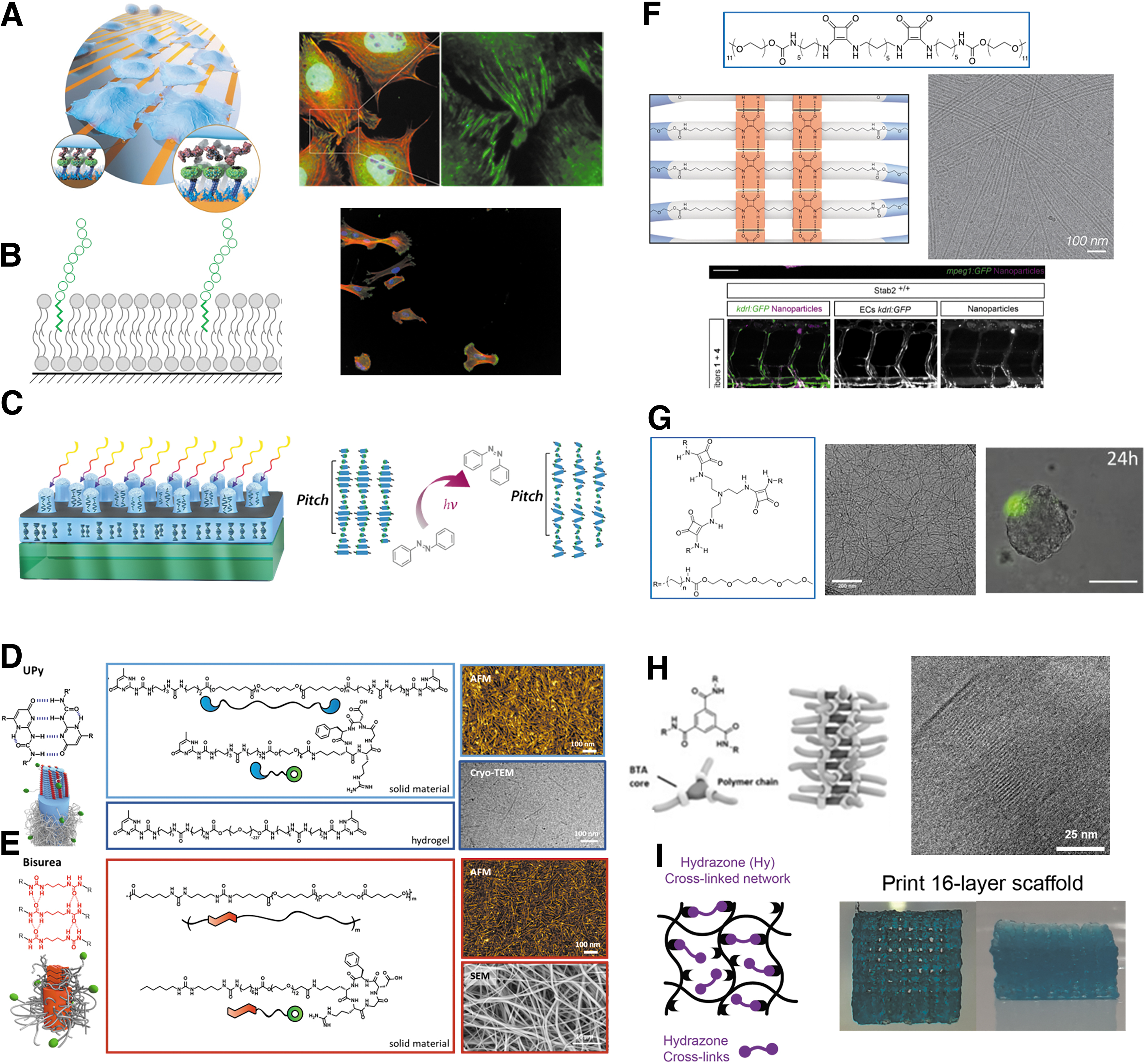
Major efforts from the supramolecular community in the Netherlands.
In another work, supported lipid bilayers have been used as cell membrane mimetic supramolecular entities that can easily form on hydrophilic solid supports and retain physiochemical properties of the cell membrane (Fig. 1B). Defined by the lipid head group, surface chemistry can be tuned, while defined by the lipid tails, the phase behavior of the coating can be tuned. 69 More human mesenchymal stem cells (hMSCs) adhered and spread on coats with mobile, laterally dynamic ligands compared with phases with immobile, laterally static ligands. This is possibly due to increased avidity of the interactions on a surface where ligands can freely move and reorganize for active clustering and integrin activation, which can increase the efficiency of cell adhesion. 70
Size (from micron to nanoscale), arrangement, and geometry of surface topography of biomaterials critically influence cell behavior as revealed by many studies exploiting predefined static topographies.71,72 We fabricated light-responsive changeable surface topographies on films of liquid crystal polymer networks and explored these topographies for controlling cell adhesion, polarization, and migration (Fig. 1C). 73 Switching cell migration patterns upon in situ temporal topographical changes, points out the ability to control dynamically cell behavior on these biointerfaces.
To more closely mimic native 3D matrices, the knowledge gained from such studies on dynamic cell-instructive biointerfaces has been instrumental to develop multiple 3D biomaterial strategies. 74 Synthetic polymers and natural ECM (e.g., proteins and polysaccharides) are used to tailor the physical, chemical, and mechanical properties of the microenvironment surrounding encapsulated cells. 75 Ligand modularity, tunability, and responsiveness have been demonstrated for various material building blocks such as UPy, 6 benzene-1,3,5-tricarboxamide (BTA), 76 cyclodextrin, 77 CB, PAs, and amphiphilic block copolymers to name a few. 78
We have developed the first responsive materials using the UPy quadruple hydrogen bonding allowing for a modular approach to make content-rich biomaterials.35,79 Attaching UPy units to either end of polymers and also to one end of cell adhesive ligands yields processable materials that promoted cell adhesion in vitro and stimulated the growth of new blood vessels in vivo when subcutaneously implanted in rates. 35
We also successfully showed that for load-bearing tissues such as heart valves and blood vessels, elastomeric materials based on hydrogen bonding motives, being either UPy-units or bisurea groups (Fig. 1D, E), are very suitable.80–82 Introduction of additives, that is, small-molecule compounds modified with the same hydrogen bonding moiety, with various functionalities, such as nonfouling, 83 bioactive or adhesive,84,85 or antimicrobial 86 properties, can be easily done by a mix-and-match principle. For such applications, the dynamics of the supramolecular bioactive interaction with the base material is low (i.e., the association constant needs to be large).
Importantly, we in detail studied the molecular design of the additives, and have shown that this design is of great importance in the determination of the ultimate function. 83 Interestingly, selective surface modification can be performed using bioorthogonal chemistries, such as the retro Diels Alder reaction, on reactive additives. 87 Various reactive additives were designed that have shown to stratify to the surface depending on the amount of compound added to the base material, using high-resolution 3D mass spectrometry. 87
In applications that require controlled release of bioactive compounds and drugs, the affinity of the compound/drug to the biomaterial needs to be regulated, and the dynamics of the supramolecular bioactive interactions with the biomaterial should be high. For this reason, we have developed supramolecular transient networks that are composed of hydrogen bonding units and poly(ethylene glycol) prepolymers. 14 These networks have shown to assemble via bundling of long supramolecular fibers in an aqueous environment. The dynamics of coassembled additives, or so-called guest molecules, has been shown to be controlled using either monovalent or bivalent molecules to be assembled in fibrous structures, in dilute solutions.
It has recently been shown that in the hydrogel state, similar phenomena play a role, resulting in an adjustment in design of these hydrogels for both drug delivery and cell culture purposes. The next challenge is to design these supramolecular hydrogels into 3D culture environments for stem cells and organoids. We have recently shown, for the first time, that by controlling the dynamics in the transient network, cell adhesion can be achieved via supramolecular bioactive ligands/additives. 16 In close collaboration with medical doctors, these supramolecular hydrogel systems have been developed into drug delivery vehicles for the infarcted heart. It was shown that these hydrogels can be injected in the myocardium via a 1-m-long catheter while using magnetic resonance imaging for guidance.88,89
Squaramides, minimalistic ditopic hydrogen bonding synthons that contain two hydrogen bond donors opposite two hydrogen bond acceptors on a cyclobutenedione ring, have been examined in the construction of supramolecular biomaterials. When on flexible amphiphilic monomers, such as bolaamphiphiles, they self-assemble into a head-to-tail hydrogen bond array forming rigid fiber structures on the order of several hundred nanometers in length and a few nanometers wide (Fig. 1F). 90 As the peripheral oligo(ethylene glycol) chain length is increased keeping the hydrophobic domain size the same, a transition from fiber to spherical aggregates is observed. 91
Further coassembly with a fluorescent squaramide monomer enabled visualization of the biodistribution and potential to be scavenged by a key liver receptor, stabilin-2 in zebrafish embryos probing the effect of shape and size of the self-assembled nanoparticulate carrier on these processes. 92 Squaramides have also been applied in the preparation of hydrogel materials for 3D cell culture. Through changing the monomer geometry to a tripod, soft and self-recovering squaramide hydrogel materials were prepared that can be used for culture of sensitive cell types such as induced pluripotent stem cells (iPSCs) (Fig. 1G). 93 Coassembly of the tripodal squaramide monomers with one that is oligopeptide Arg-Gly-Asp (RGD)-functionalized provided hydrogels that permit cellular adhesion and migration, and were further used as an alternative to Matrigel for HepG2 spheroid culture. 94
As squaramide monomers provide a modular scaffold to introduce various cell culture-relevant functionalities and they are compatible with stem cells as hydrogels, we envisage their further exploration in solving fundamental and applied questions in development and disease.
Currently, an underutilized supramolecular motif in tissue engineering is the BTA, 76 capable of forming well-ordered, threefold hydrogen-bonded supramolecular polymers (Fig. 1H). With a rich history of fundamental supramolecular studies, the recent translation of these architectures to water-soluble derivatives95,96 bodes well for their ultimate use in tissue engineering, drug delivery, and other biomedical applications. Recent insight into the biocompatibility of these supramolecular polymers, 97 their use in the interfacing with a red blood cell's surface, 98 and improved synthesis toward hydrogels for cellular encapsulation 99 suggests that their use in tissue engineering should be a rich area of exploration in the future.
Although not strictly supramolecular, some of the community has also explored dynamic covalent chemistry for several tissue engineering applications (Fig. 1I). An archetypal example includes the creation of dynamically crosslinked alginate polymers where the hydrogel mechanics is tunable based on the Keq, k1, and k-1 of the imine-type crosslinker used. These dynamic covalent systems are capable of being used as advanced bioinks for 3D bioprinting,100–102 have rationally controllable dynamic mechanical properties,100,102 can be used to probe fundamental cell–matrix interaction phenomena, 101 and can provide decided benefits to kidney organoid culture. 103
Industrial Translation of Supramolecular Biomaterials
Major successes and applications
Initially, supramolecular chemistry could be found in cosmetic and biomedical products, in which natural, biobased (glyco)proteins and polysaccharides such as collagen, alginates, and hyaluronic acid were applied. Especially, collagen found widespread use in cosmetics since collagen strength has a proportional relationship with skin aging. It has been established that the collagen fibers are damaged with the passing of time, losing thickness and strength that have been strongly related to skin aging phenomena. This has led to the development of moisturizing creams and gels. 104 The film-forming properties of collagen, when applied to skin, decrease transepidermal water loss as well as provide a protective function. Biomedical products comprising collagen span a wide variety of biomedical devices or solutions.
Collagen is used as sponges for burn tissue engineering, wound dressings, 105 and vascular closing devices. 106 It has been used in drug delivery, in the ophthalmic field in shields and in drug delivery implants, 107 and in the orthopedic field as bone substitutes and tissue engineering matrices.108–111
Collagen is available in a soluble form with the tropocollagen intact (such as SEMED S from DSM), as well as in fibrous form that retains fibrillar structure (such as SEMED F from DSM, Fig. 2B). 112 Although clinical use and associated outcomes have shown that it remains one of the most effective biomaterials for wound healing, it is difficult to industrially process. Furthermore, collagen is an animal-derived product as it is derived from porcine and bovine tissues after extraction and further treatment followed by freeze-drying or lyophilization.
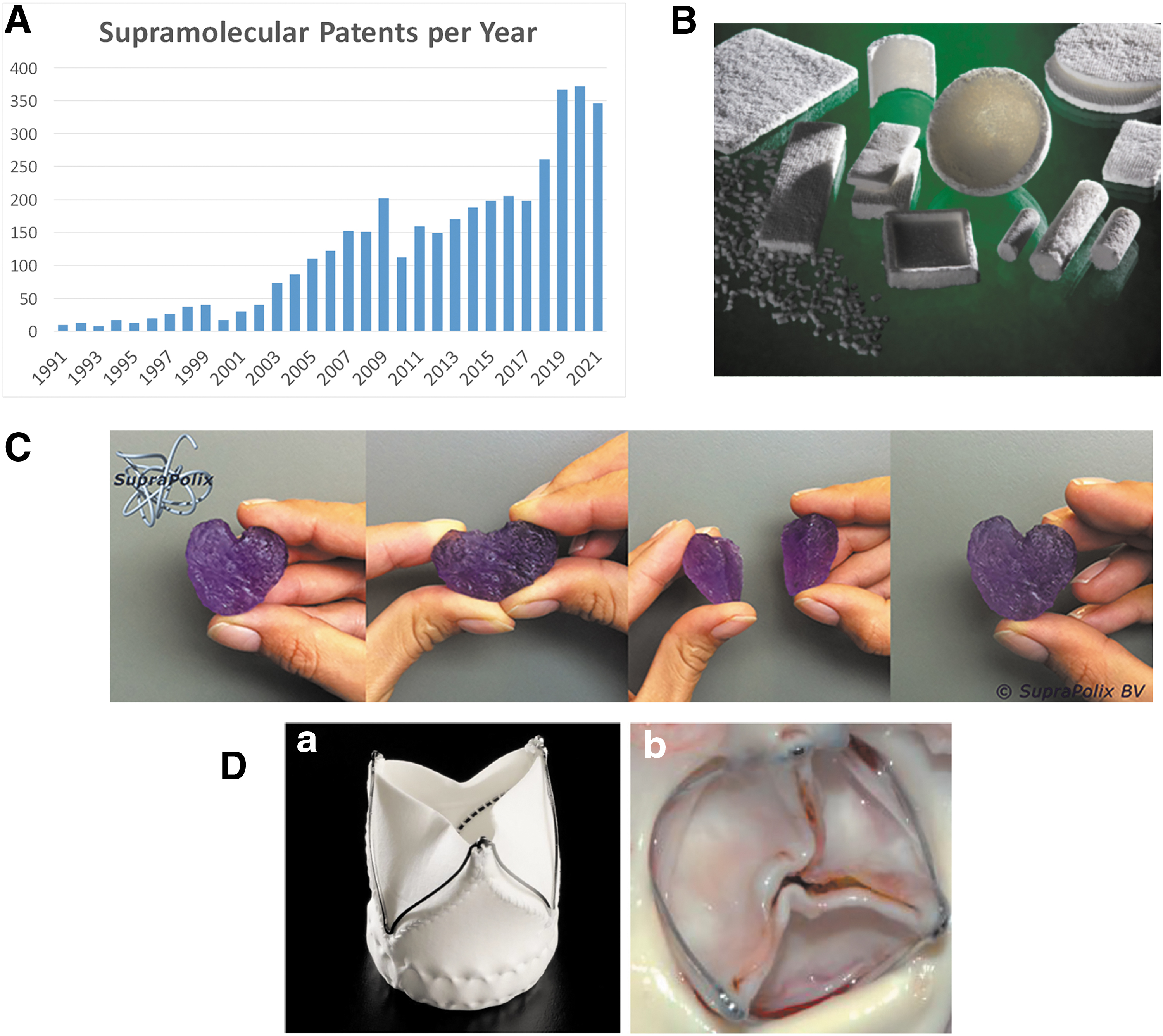
Supramolecular biomaterials have increasing market potential to impact clinical therapies.
Consequently, there are several limitations to scalability and sustainability. Also, a stringent quality control protocol is needed throughout the entire cycle of production and formulation, while animal sourcing leads to a large carbon dioxide-footprint and ethical/religious concerns that become a hurdle in the current and future society. Another option is to use recombinantly produced collagens as substitutes for animal-derived collagens, as pursued by Fujifilm. Here synthetic biology shows much potential as a strategy to engineer biological systems for large-scale production of structural proteins such as new type and/or adjusted collagens. Research to not only develop synthesis routes to the new collagens but also ensure important, functional posttranslational modifications remains an important consideration owing to their effect on the final functional properties. Evonik's recently launched recombinant collagen derived from a fermentative process and that can be produced according to ISO13485 holds much promise as a sustainable source of medical-grade collagen.
Interest of the industry in synthetic supramolecular materials emerged quickly after the conception of the first supramolecular polymers that delivered true material performance, such as strength and elasticity, thereby not only existing just in a laboratory flask.6,11 Continued recent innovation in this area has led to a rapidly increasing number of supramolecular biomaterial patents over the past 30 years (Fig. 2A).
First applications were related to industrial adhesives,113,114 cosmetics, and self-healing materials, 115 especially for the UPy-materials. 13 In the field of industrial adhesives, the supramolecular polymers opened up the possibility to create strong adhesives with favorable processing without the need for high temperatures or chemical curing.114,116 Cosmetic applications benefit from their ease of processing, that is, application of the cosmetic formulation on the skin or hair by a consumer, combined with their good film forming properties117,118 and cosmetic comfort. Importantly, these applications showed that it was possible to make this new class of polymers on an industrial scale and viable economics. However, maybe more importantly for biomedical applications, their cosmetic use indicated that these UPy-polymers can be manufactured in high quality in a controlled manner without the need for animal-derived ingredients, without evoking adverse reactions when applied on human skin. Clearly, the marriage of the material performance of supramolecular adhesives with the biocompatibility of those in cosmetics has made it possible to enter the biomedical arena with structural implants for tissue engineering.
With a clear focus on absorbable materials that are characterized by high strength, elasticity, durability, and controlled absorption, the Eindhoven-based company SupraPolix has developed a library of UPy-materials that are also easily processable into porous 3D structures that constitute many biomedical implants for tissue engineering applications (Fig. 2C). Specifically, telechelic polymers chain-extended with UPy-moieties have been developed, resulting in copolymers comprising multiple UPy-units per polymer chain, 119 which form physical crosslinks with neighboring UPy-polymers thereby strongly improving the mechanical properties of the resulting materials. This ultimately resulted in a library of flexible and bioabsorbable UPy-materials with tunable strength, durability, and bioabsorption profiles.
Typically, the polymer backbone is a biocompatible and biodegradable aliphatic polyester or aliphatic polycarbonate that forms a phase-separated 3D physical network with dynamic crosslinks 120 that bring strength and elasticity to the supramolecular materials. Consequently, by changing the composition of the polymer ingredients, a wide range of mechanical properties can be obtained from soft to elastic, and even stiff, while keeping materials that are easily processable, biodegradable, and biocompatible. 121 The most prominent tissue engineering application with these supramolecular polymers has been developed in the cardiovascular field as discussed below. In addition, the same supramolecular polymers have shown promising results as a biodegradable mesh for the treatment of pelvic organ prolapse, 122 a clinical condition that desperately needs innovative materials since the permanent meshes comprising classical polymers that have been surgically used until recently have failed dramatically, resulting in full market withdrawals. Clearly, a tissue engineering approach in which an e-spun flexible mesh would give mechanical support until a local tissue has restored itself would be a possible and sustainable solution for pelvic organ prolapse.
Restoration of natural heart valves and blood vessels using material-based implants has been a long sought-after goal in cardiovascular tissue engineering. Most of the progress in the field of in situ tissue engineering using synthetic polymer materials has arguably been achieved by the Eindhoven-based company, Xeltis, who are basing their electrospun cardiovascular implants on the well-known UPy motif developed by the Meijer group (Fig. 2D).4,6,121,123
Clinical studies are now ongoing in several applications. Bockeria et al. first reported the use as a Fontan conduit for children born with a single ventricle. 124 Building on this, more recently the results from two First-In-Human studies with a pediatric pulmonary valved conduit further confirmed safety, and demonstrated the tunability of the material toward optimized outcomes. 25 Based on these positive initial results, Xeltis recently announced the start of a pivotal trial. 125 In addition to these pediatric applications, Xeltis most recently reported the start of two adult clinical trials: one with a supramolecular coronary artery bypass graft 126 and the other with a vascular access graft for dialysis patients. 127
A key enabler for this clinical progress is the relative simplicity of the underlying chemistry, to be used in an in situ tissue engineering approach. Xeltis implants do not contain any cells, growth factors, or other bioactive ingredients and are therefore regulated as medical devices, which is an important advantage during clinical and commercial translation. Xeltis relies on the tunability and versatility of the supramolecular UPy-platform, which allows selection of the right combination of processability, mechanical properties, and degradation characteristics, allowing the patient's own cells and tissues to take over functionality while the implant gradually absorbs. This tunability is clearly illustrated in a recent preclinical study toward material selection for a supramolecular aortic valve. 128
A current trend within supramolecular polymers for tissue engineering is the creation of synthetic ECM mimics or replacements. Current cell culture matrices are largely biologically sourced from animals, and have issues with tailorability and scalability/reproducibility. Consequently, there are a few companies that are now commercializing simple supramolecular hydrogels for cell culture. Biogelx™ and Manchester Biogel's PeptiGels® both utilize simple self-assembling peptides for a range of cell culture applications from simple 3D encapsulation to bioprinting. One of the most successful supramolecular matrices for cell culture remains PuraMatrix™ from Corning®, where a simple 4 × 4 amino acid structure has shown significant utility in the use of a synthetic matrix for cell culture.
While this is a demanding and nascent field of application, we are convinced about the great potential for supramolecular systems to enable controlled and scalable biomaterials to control cell growth and differentiation in the future. Biocompatibility and tissue formation are actively being explored in academic laboratories and start-ups, while approval for use in humans remains a challenge on the horizon.
Key success factors for industrialization
Reproducibility at scale, including tight quality control, remains the most important target to drive supramolecular biomaterials into applications. Moving from the controlled laboratory benchtop to complex natural environments is always a challenge. Many of the next-generation supramolecular materials have been translated into applications that demand a higher scale, suggesting that this concern is a surmountable issue. Furthermore simplicity is paramount when developing complex systems. This dogma is even more amplified at the industrial scale. There are many sayings that embody this approach within an industry, including KISS (keep it simple and stupid) and “perfect is the enemy of finished.” The quest to find the simplest chemistry that sufficiently addresses a given problem remains at the forefront of the transition to commercial success.
However, if we take the market size of collagen as any type of indication, the optimization and refinement of supramolecular biomaterials have great promise both for industry and for the impact on society. Collagen is estimated to reach 6.6 billion by 2025, and access to this market will depend heavily on the scalability and reproducibility of supramolecular materials and their functionality. Yet, regulatory concerns for supramolecular materials remain a hurdle. While, for tissue engineering, one can envision a medical device designation for base polymers, the incorporation of bioactive ingredients, pharmaceuticals, and cells increases the regulatory complexity. There remain few synthetic supramolecular polymers used in Food and Drug Administration (FDA)-approved applications, yet this should change in the years to come.
Future Directions
Since the inception of the supramolecular polymer field several decades ago, the ever-growing body of knowledge in the construction of these polymers and their materials provides a wealth of inspiration and new opportunities for their use in the biomedical area. The insight gained into their polymerization mechanisms and the associated thermodynamics and kinetics has opened the door for control over the properties of the formed supramolecular polymers.
Recent reports have shown that approaches such as seeded or chain growth polymerizations can be used to achieve polymers with a low dispersity or block copolymers (Fig. 3A).129–131 It can be envisaged that these strategies could eventually be used to prepare tailored nanoparticles for drug delivery or to tune cellular responses by varying the size and pattern of a bioactive block. As materials, their inherent dynamic character offers several possibilities to further tune such interactions, however, it is necessary to overcome their weak mechanical character to expand their reach, especially as hydrogels. 132
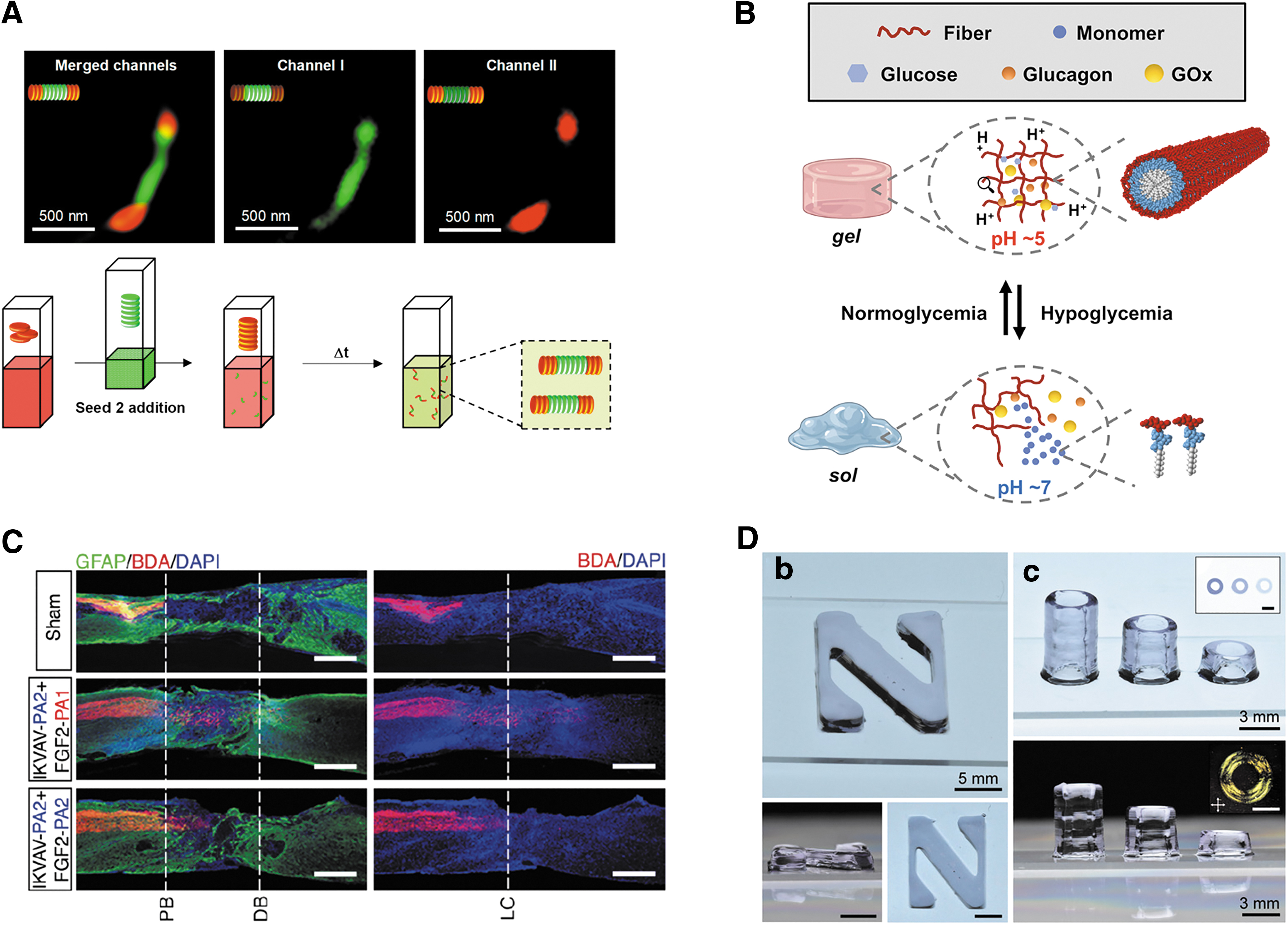
Future directions in supramolecular biomaterials build on fundamental studies.
To this end, the mixing of covalent polymers to yield hybrid materials with improved stability and mechanical characteristics can enable their mimicry of a wider range of tissues while addressing practical issues required for their application in areas such as biofabrication. Although modulation of the stiffness is often aimed for, the weak interactions within these materials can also enable access to complex mechanical characteristics (e.g., viscoelasticity and strain-stiffening properties) observed in ECM proteins that are known to influence cell behavior, 133 and can have relevant consequences for in vitro modeling of developmental and diseased tissue states. In these processes, changes in matrix properties can occur on time scales from seconds to hours, and an outlook toward strategies that involve the use of chemical fuels to sustain the self-assembled state in an out-of-equilibrium manner134,135 can be explored to switch cell-relevant cues, a strategy that could also be applied for therapeutic delivery (Fig. 3B). 136
In parallel, the rapidly developing area of stem cell biology, encompassing iPSCs, their differentiated derivatives, and organoids, is expected to impact several biomedical areas from understanding disease and drug and toxicity testing, to cell therapy.137,138 This area has brought forward new challenges for materials in the preparation of advanced cellular models and their eventual biomedical application. Supramolecular materials can be used to address practical issues encountered in the various stages of the preparation of iPSCs 139 such as reprogramming, expansion, and differentiation.
In addition, numerous open questions still remain on how to best mimic the ECM of various anatomical locations in synthetic materials with respect to their architecture, mechanics, and bioactivity, so as to correctly guide cell fate during differentiation and to encourage maturation. To further disentangle the complex features that the ECM presents to cells undergoing processes encountered in development, responsive chemistries within supramolecular materials that can be triggered on-demand in a cell- or user-defined manner either through crosslinking or degradation will be necessary to shed light on and modulate these evolving processes. Recent reports have demonstrated the use of light-responsive strategies and dynamic bonds in the field of covalent hydrogels to facilitate culture and guide morphogenesis of organoid models.52,103,140 Moreover, combining these areas with the advances in the field of biofabrication, 141 access to increasingly complex cellular and tissue models can be achieved furthering our understanding of cell behavior in development and disease. Initial reports on the 3D printing of supramolecular polymers are just now emerging, with impressive multiscale hierarchy imperative to tissue engineering (Fig. 3D). 142
The increasing range of dynamic character that can be engineered within these materials in combination with the evolving designs of the monomers and resultant polymers provides unparalleled opportunities to interface with biological matter at the intersection of several disciplines in a biomimetic manner. We therefore look forward to the next decade where further implementation of these concepts in the biomedical field can provide solutions to challenging fundamental and applied questions in areas ranging from drug delivery to regenerative medicine (Fig. 3C). 143
Future environment: fundamental research toward innovation
Fundamental research drives innovation. 144 Numerous studies show the power and economic benefit from investing in basic research, for example, a recent working article focusing on the pharmaceutical industry. 145 Whole economy estimates conservatively find a 4 × to 20 × return on investment for funding fundamental research. 146 Without basic research projects, our world would be quite different; CRISPR, 147 mRNA vaccines, 148 lithium batteries 149 all started as fundamental projects and have a major impact on the world we inhabit today and the future we can create. Supramolecular materials also have deep roots in fundamental research, and as we continue to seek the ability to recreate the complexity of living systems, much fundamental research remains. To unlock the innovative potential of supramolecular systems, we need to continue asking basic fundamental questions.
Fundamental research alone does not change the world. Innovation requires a concerted effort from basic science, entrepreneurs, government, and established industry to make progress. While academic fundamentals and industrial application can often be at odds with one another, they also stand to benefit from one another. However, one must be careful to separate and clarify roles. We are proponents of separating the two motivating factors during a project, where it is clear if a project is driven by an industrial need to solve a problem, or academic curiosity. Recombining the two for innovation remains a difficult challenge, and can be addressed via education of academic scientists, dedicated funding for knowledge transfer and development, and well-equipped technology transfer offices at universities.
Translation of the supramolecular chemistries to applications remains important to drive this technology area forward. In this regard we propose, for application drive research, to foster closer interaction between academia and industry facilitated under translational initiatives. While fundamental research should be protected, the translation out of the laboratory must be carefully facilitated. Furthermore, we urge the field to not just focus on patents. In terms of knowledge transfer, disproportionate emphasis on patents has meant that other intellectual assets centered around quality and regulatory requirements are neglected. Intellectual assets should also include material and device master files, as well as supramolecular material processing know how, that can be protected and effectively transferred with patents and/or trade secrets.
Conclusions
In this review, we have provided a brief overview of the historical development and future directions of supramolecular biomaterials from the Dutch perspective. Inspired by nature, the quest to recreate synthetic environments, which mimic the ECM and complex natural systems, remains the mainstay of the field. From these efforts, one can see that a delicate interplay between complexity and simplicity drives the field forward. In reduction, we see the optimization of complex actions from simple molecules.
This rich history of supramolecular biomaterials in the Netherlands enables us to make progress today in a variety of applications, from fundamental studies to improving patients' lives with regenerative valves. With continued room for fundamental and applied research with direct and well-defined collaborations to bridge the two, we will increase our chances to solve the grand challenges in the biomaterial field. The future is bright for the supramolecular biomaterials and is fueled by our ability to rationally study and create new materials for big challenges.
Footnotes
Acknowledgments
The authors would like to thank the supramolecular community in the Netherlands, and throughout the world.
Disclosure Statement
A.W.B., M.A.J.C., and A.D. are employed by companies that leverage supramolecular interactions for commercial purposes; M.B.B., P.Y.W.D., and P.J. are inventors on patents that relate to the use of supramolecular interactions for advanced materials. P.Y.W.D. and P.J. are cofounders of spin-off companies in supramolecular biomaterials (being UPyTher and LipoCoat, respectively).
Funding Information
No funding was received for this article.