




Abstract

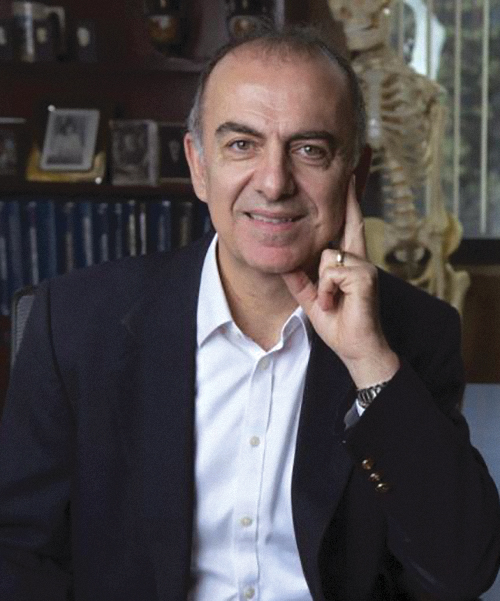
The research group of Kyriacos A. Athanasiou has impacted health science and technology, especially in tissue engineering and regenerative medicine (TERM), addressing significant societal needs through the development of life-saving technologies. Athanasiou is a distinguished professor, Samueli chair, and the director of DELTAi (Driving Engineering and Lifesciences Advancements at Irvine) at the University of California, Irvine. He has served as faculty member at the University of Texas, Rice University, and the University of California (first at Davis and now at Irvine).
The Athanasiou group comprises tissue engineers who develop technologies in the laboratory and then translate them into products to help people suffering from various afflictions. Athanasiou's scientific contributions and translational impacts in TERM are evident through his academic research, inventions and resultant medical products, and service. He has established one of the most recognized TERM research groups, especially of musculoskeletal tissues. The group's work provided the first robust evidence of healing temporomandibular joint (TMJ) defects using TERM implants in large animal models (Science Translational Medicine, 2018) and demonstrated the tissue engineering of cartilage on par with native tissue (Nature Materials, 2017) with the right collagen crosslinking (PNAS, 2014).
Central to their efforts is a scaffold-free tissue engineering platform technology, termed the self-assembling process (Science, 2012), first described in 2003. He has published 20 books, 380 peer-reviewed full-size articles, 360 conference proceedings and abstracts, and 33 patents. An important aspect of his impact on the field is his training of ∼50 PhD students and 30 postdoctoral fellows who continue to follow his systematic approach to TERM.
Thus far, these technologies include 15 FDA-approved products. For example, OsteoBiologics, founded based on patents for biodegradable scaffolds, developed multiple FDA-approved products (acquired by Smith & Nephew). Diabetica Solutions (originally, Xilas Medical), founded based on their work to alleviate the pathological effects of shear stress and elevated thermal loads in diabetic feet, developed three FDA products licensed out to larger companies.
VidaCare, formed based on their patents for intraosseous infusion and acquired by Teleflex Medical, developed three FDA-approved products used in emergency medicine (also featured in TV shows ER, Grey's Anatomy, and National Geographic's “inside combat zone”). He formed his latest company, Cartilage, Inc., using platform technologies that his group developed for addressing TMJ and cartilage pathologies; the company is now performing the Investigational New Drug IND-enabling studies for its biological products that are cell-based therapeutics.
In terms of service, Athanasiou has made major contributions to TERM and to biomedical engineering. He has served as editor-in-chief of the Annals of Biomedical Engineering, president of the Biomedical Engineering Society (BMES), member of the board of directors of BMES, chair of various BMES committees, and member of various scientific advisory boards of companies and other organizations. Every year since 2018, the “Athanasiou Awards” are given at the annual BMES meeting to graduate students and postdoctoral fellows for the best published articles. From 2023, the “Athanasiou Medal” will be given annually to individuals who have made outstanding contributions to the field of biomedical engineering with particular focus on translation.
Dr. Athanasiou was elected to the National Academy of Medicine in 2020 and the National Academy of Inventors in 2014. His list of awards includes the Herbert Voigt Award from BMES, Nemitsas Prize (Cyprus' most significant award, presented by the president of Cyprus), H.R. Lissner Medal from the American Society of Mechanical Engineers (the top award for bioengineers), Savio L.-Y. Woo Medal for translational biomechanics from ASME, distinguished service award from BMES, Wall Street Journal's innovation award, Thomas A. Edison patent award from ASME, Marshal R. Urist award for excellence in tissue regeneration research from the Orthopaedic Research Society, and Van C. Mow medal from ASME.
Other awards include the lifetime achievement award from the Federation of Cypriot American Organizations (presented by the archbishop of America and the president of the Republic of Cyprus), the lifetime achievement award from the Beall Family Foundation, UCI applied innovation (the award also included a “Certificate of Special Congressional Recognition” by the US Congress and citations by the California Legislature Assembly and the California Senate); faculty excellence in research (senior award) and innovator of the year award from the Samueli School of Engineering; and high tech innovation award from OCTANe. He is a fellow of BMES, AAAS, AIMBE, and ASME.
Essential to the TERM work that the Athanasiou group has been performing over the past 34 years has been the National Institutes of Health through grant support to the group primarily through the R01 mechanism and the major research instrumentation program. The group is also indebted to its other sponsors, including the National Science Foundation, National Highway Traffic Safety Administration, California Institute of Regenerative Medicine, Keck Foundation, Howard Hughes Medical Institute, National Football League Charities, Hertz Foundation, Arthritis Foundation, United States-Israel Binational Science Foundation, Whitaker Foundation, Orthopaedic Research and Education Foundation, and various industrial sources.
The research outcomes of the group's work would not have been possible without the critical support of these sponsors, as well as that of the different administrations at the University of Texas, Rice University, and the University of California over the years.
The Athanasiou group has trained dozens of engineers, scientists, and clinicians who have already left their research and teaching marks on the field. More recently, a few of the group's PhD graduates joined the engineered meat and seafood industries, in addition to more established industries related to medical devices, medical instruments, drugs, and biologics. Many of the group's alumni are faculty members in the United States and abroad, including the University of Oklahoma, University of Pittsburgh, Brown University, University of Akron, George Washington University, Drexel University, University of Florida, Medical College of Wisconsin, MD Anderson, Mayo Clinic, Indiana University, University of California Davis, University of California Los Angeles, etc.
A few are captains of industry, serving as chief executive officers of startup and mid-level companies. A number of them are practicing clinician-scientists (orthopedic surgery, plastic surgery, ophthalmology, radiology, urology, neurosurgery, etc.).
TERM has emerged as the best hope for engineering tissues and organs to address multiple health conditions in humans and animals. After an expectedly slow start, TERM products are now being developed rapidly and more robustly. The Athanasiou group will continue its contributions to our burgeoning field through not only basic and applied research, but also translation of technologies to clinical practice.