




Abstract
Wrinkled and loose skin resulting from collagen degradation along with fibers decreasing reflects the youth diminishing. Microneedles (MNs) have opened up new avenues for the development of painless and noninvasive transdermal drug delivery systems for facial rejuvenation. Encapsulated drugs or molecules are transmitted to targeted tissues via percutaneous microchannels, which eliminate potential gastric stimulation or first-pass metabolic effects, as well as boost patient compliance. Although MNs are considered effective and feasible therapeutic alternatives to metals, silicon, and polymers, traditional procedures with reduction processes continue to encounter methodological limitations. In recent years, promising additive manufacturing processes such as three-dimensional printing and two-photon polymerization manufacturing have been developed with the aim of overcoming the limitations by traditional processes to facilitate an efficient and economic production mode. This review summarizes the design, material selection, and manufacturing method for recently advanced MN systems. Furthermore, we also highlight specific polymeric or natural microneedle products, like hyaluronan, plant derivates, and vitamins, for esthetic applications in this review.
Impact Statement
In this review, the materials and manufactural routes of microneedles (MNs) are detailed. Moreover, similar to the diagnostic or therapeutic MNs, the feature of dispensation with training and ready-to-use is perfect for beautification and anti-aging, which necessitate repeated and long-term usage. Furthermore, the specific polymeric or natural products for esthetic applications of MNs are highlighted in this review.
Introduction
The aging of the skin is considered the most obvious sign of aging. As collagen degrades and the number of fibers decreases, skin becomes wrinkled and gradually less firm. Simultaneously, aging of the skin is often accompanied by a duller and rougher complexion. Current interventions for skin aging include the use of functional cosmetics, botulinum toxin injections, hyaluronic acid (HA) fillers, lasers, and surgery. 1 Although invasive treatment strategies are fast, they are also painful, expensive, and demonstrate long recovery periods, which are not suitable for all patients. Furthermore, functional cosmetics have limited permeability and cannot achieve desired results because of the skin's stratum corneum barrier. 2
Microneedle (MN) array is believed a perfect solution to the aforementioned problem. With lengths ranging from 25 μm to 1000 μm, MNs can penetrate the stratum corneum and avoid touching nerve endings, which are only present in the dermis or below the dermis. By creating minimally invasive and painless microchannels, various functionally active factors can be delivered, thereby improving the permeability limitations and maximizing functionality.3,4
MN devices commonly used in clinical practice include MN therapy systems (MTS), radiofrequency MNs (MRF), and MN array patches. Among them, MTS and MRF are widely used for addressing face-related issues, including aging, the appearance of wrinkles, and dull skin. The mechanism of action involves the synergistic stimulation and induction of skin neovascularization and collagen production by MNs and bioactive factors. 5
As carriers for transdermal drug delivery (TDD), MNs must meet several requirements: (1) the needle tips of MNs must possess sufficient mechanical strength to penetrate the stratum corneum skin barrier. (2) MNs must be made from biocompatible materials that do not cause irritation reactions or other immune reactions following their use. (3) MNs must be soluble or biodegradable, and their piggybacked contents should be effectively released. (4) The drug release profile should be a slow, moderate, long-term release. 6
To date, several reported MN delivery methods can be categorized into five typical modes according to the delivery requirements between different drugs 7 : (1) the solid MN, the tip of which penetrates the skin to establish microchannels to improve drug penetration on the skin surface; (2) coated MN, which coats the drug on the surface of the needle tip and releases the drug after the coating dissolves; (3) hollow MN, wherein the drug enters the skin through a hollow channel; (4) dissolving MN, where the tip of the needle made from a soluble material dissolves while releasing the drug; and (5) hydrogel MN, which operates based on the property of the hydrogel to absorb swelling and release the drug while absorbing intertissue fluid. 8 Among these, hydrogel MN is the most commonly used facial rejuvenation strategy. 9
A variety of materials are currently used to fabricate MNs, with common materials including silicon, metals, glass, and polymers. Different manufacturing materials and methods have varying degrees of influence on the mechanical strength, stability, drug loading, drug release profile, and solubility of MNs. Their combinations depend on the desired therapeutic effect and properties of the drug. 6
This article provides an overview of MNs as effective alternative drug delivery devices for TDD, focusing on the types of MNs, the materials and methods used to fabricate them, and their application in facial rejuvenation.
Design and Manufacture of MNs
There are three basic parameters to be considered in the design of MNs: the release strategy (type of MN), manufacturing material, and fabrication method. 10 These three parameters are matched to the type of application (e.g., wound healing, 11 TDD, 12 vaccine delivery, 13 and glucose monitoring), drug of choice, and active factors contributing to the design of a suitable MN. These parameters are described in detail in the following subsections.
Release strategy of MNs
MNs are categorized into the following five typical forms according to their design: (1) solid MN; (2) coated MN; (3) hollow MN; (4) dissolving MN; (5) hydrogel MN (Fig. 1).14,15 The characteristics of each are as described previously. The following sections will highlight the principles, materials, and applications of several types of MNs. The characteristics, advantages, and disadvantages of the above types of MNs are summarized in Table 1.

Schematic of drug release from the five different types of MNs. Reproduced with permission from Xu et al. 14 Copyright [2021]. (http://creativecommons.org/licenses/by/4.0/) MN, microneedle. Color images are available online.
Overview of Different Types of Microneedles
MN, microneedle.
Solid MNs
Solid MNs are based on the “poke and patch” principle and puncture the skin to form micron-sized channels that can be used to increase the absorption of various pharmaceutical preparations, including creams, gels, and solutions. 10 The drug may be precoated on the needle before insertion into the skin or pierced before or after the application of the drug to the skin surface. These needles are typically made of metals [polyvinylpyrrolidone (PVP), titanium, stainless steel, etc.], silicon, or polymer 16 and are convenient for the delivery of low-dose therapeutic active pharmaceutical ingredients (usually no more than 1 mg). 7
Coated MNs
Coated MNs follow the principle of “coat and poke.” The surfaces of these MNs are typically coated with water-soluble drugs, and the drug dissolves immediately after its insertion into the skin.16,17 Coated MNs are generally made of metals, glass, polymers, and ceramics. Although a simple one-step application is possible, the application carries a limited dose of the drug depending on the size of the needle and the thickness of the coating; therefore, coated MNs are only used to carry potent drugs or molecules such as therapeutic peptides, 18 nano-silver ions, 19 and tetanus toxoid nanoparticles.20,21
Existing coating methods include dip coating, air-jet drying, spray drying, electrohydrodynamic atomization (EHDA), and inkjet printing (Fig. 2), and these methods overcome the drawbacks of inaccurate dosing of sprayed drugs, high waste, and loss, along with the uncontrollable coating thickness. The fabrication process of different coating strategies is briefly described hereunder. The dip coating process involves soaking the MNs in the prepared solution and then removing the MNs to form a liquid film connected to them, thereby resulting in the formation of a coating layer on the MN after drying (Fig. 2A). The gas spraying process is similar to the conventional coating method, in which the solution is deposited and consequently adheres to the MN surface by spraying, thereby forming a thin-film coating (Fig. 2B).
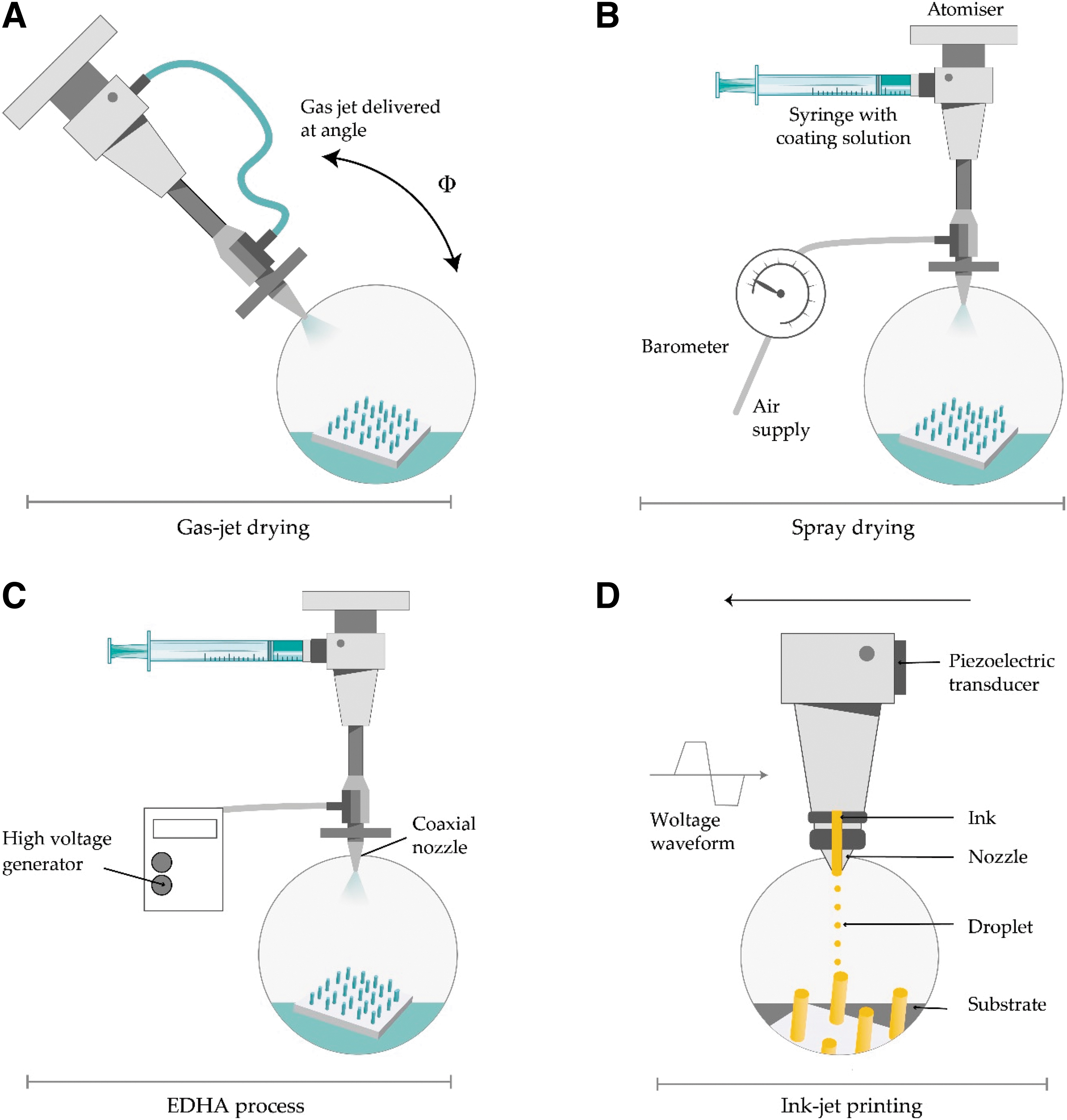
Coating process for coated MNs:
The principle of the EHDA process is the utilization of electricity to produce atomized droplets. The solvent is sprayed after atomization, and the sprayed droplets are collected on an electrically grounded substrate below the tip of the nozzle (Fig. 2C). For inkjet printing (Fig. 2D), solvent droplets are sprayed onto the MN through a piezoelectric distributor to form a film. Therefore, inkjet printing is characterized by the formation of uniform, accurate, and repeatable films, and the droplet size can be adjusted by modifying these parameters. 22
Hollow MNs
Hollow MNs follow the “poke and flow” principle, similar to subcutaneous injection. The MNs are injected into the skin, and the solution is suspended. These needles are typically used for the delivery of insulin and vaccines. 15 Because the flow rate is controllable at the time of injection, drug efficiency is improved, and drug loss is reduced by targeted administration. Hollow MNs can be fabricated using silicon, metals, polymers, and inorganic compounds. To address the possibility of blocking of the needle tip and subsequent flow resistance caused by the skin tissue around the needle tip, a hollow MN with partial opening has been designed. 23
Dissolving MNs
Dissolving MNs follow the “poke and release” principle. These needles are made of biodegradable polymers [e.g., PVP and polyvinyl alcohol (PVA)] or biocompatible materials (e.g., chitosan), wherein the drug is encapsulated in the needle tip and completely dissolves upon insertion into the skin. 17 At present, these types of needles are commonly used to deliver drugs and biological agents. The drug release rate is controlled by the dissolution rate of the MN. However, complete dissolution is time-consuming, and the needle demonstrates a low mechanical strength, is difficult to insert, and is prone to problems resulting from polymer residues.24,25
Hydrogel MNs
The working principle of hydrogel MNs is that of “poke and patch.” 26 These MNs made from hydrogels possess swelling properties that cause them to interact with the interstitial fluid upon insertion into the skin, resulting in swelling and the formation of a channel for the release of the drug. This swelling property makes hydrogel MNs unsuitable for application to extremely moist wounds.27,28 In contrast, no polymer residue is left behind after the hydrogel MN is used and removed, which is an advantage over polymer MNs. In addition, MNs that swells by absorbing tissue fluid cannot be reused, which reduces the risk of infection transmission. These needles do not dissolve or degrade in the skin but can regulate the slow release of active substances by varying the degree of cross-linking.
Fundamental materials for MNs
In recent decades, a variety of materials have been used in the fabrication of MNs, with adequate mechanical strength, biocompatibility, controlled drug release, and stability being the primary requirements of their fabrication. After screening, inorganic materials, metals, and polymers are commonly used for the fabrication of MNs (Fig. 3). In the following section, the characteristics of the most commonly used materials are discussed.

Materials used for the preparation of MNs. Reproduced with permission from Kirkby et al. 17 Copyright [2020]. (http://creativecommons.org/licenses/by/4.0/) Color images are available online.
Several inorganic materials have been used in the fabrication of MNs, such as silicone MNs and glass MNs made of inorganic quartz glass.
Silicon is primarily used in the design of solid and hollow MNs. Silicon MNs are extremely easy to fabricate, although they can break during use, leading to a foreign body reaction and the subsequent formation of an abscess or granuloma. Because the body is incapable of breaking down large amounts of silicon, there also exists a high risk of fragments being left behind in the tissue, leading to scarring and fibrosis. 28 By introducing porosity to form porous silicon, MNs made from porous silicon demonstrate good biocompatibility and exhibit better mechanical properties than polymers and metals, consequently being able to overcome brittleness without causing damage to the skin.29,30 Despite this, complex manufacturing processes, high costs, expensive clean room tools, and toxic and caustic chemicals have limited the widespread use of silicon MNs.
Glass MNs allow for the visualization of flowing fluids and exhibit stable mechanical properties. However, they also demonstrate processing difficulties, time-consuming fabrication processes (usually fabricated by pulling glass rods manually using a pipette puller), 31 and integrity problems (tendency to break when the needle tip inserts into the skin). The integration of glass MNs and polydimethylsiloxane (PDMS)-based microsystems with glass MNs and PDMS-based microfluidic valves have improved glass MNs. The resulting microinjection system is simple to manufacture, inexpensive, does not require highly skilled workers, and has multiple applications in biotechnology. 32
In addition to this, MNs can also be fabricated from metals, including stainless steel and titanium. 28 Porous MNs made of stainless steel and titanium demonstrate good biocompatibility, excellent mechanical strength, a low risk of needle breakage, accurate insertion into the skin with simultaneous rapid drug delivery, and low manufacturing costs. 25 Even so, their manufacturing process generates waste and hazardous substances. 22
Polymeric MNs consist of biocompatible and water-soluble matrix materials, such as carboxymethyl cellulose, PVA, PVP, poly (lactic-co-glycolic acid), HA, and HA methacrylate.14,33 MNs can be degraded in vivo with or without the presence of degradation enzymes to produce nontoxic byproducts, thereby reducing the possibility of in vivo infection and eliminating the production of biohazardous wastes. 34
Although MNs significantly increase the drug delivery capacity by encapsulating the drug in the needle, MNs made from different polymeric materials exhibit different degradation rates and drug release rates. 35 Polymeric MNs made of hydrogels are used to absorb skin interstitial fluid and produce swelling to form a hydrogel block, thereby altering the rate of drug release by adjusting the cross-linking strength of the hydrogel. Despite their advantages, polymeric MNs exhibit limitations concerning their mechanical strength and sterilization conditions; however, sterile production can be achieved by sterilizing the entire fabrication process, but this is more expensive and inconvenient than conventional sterilization methods. It is worth mentioning that several recent studies have pointed out that the incorporation of Ag nanoparticles as antimicrobial agents into MNs can replace the sterilization process, which further enhances the potential for the development of polymeric MNs.36–38
Manufacturing methods
The fabrication method of MNs depends on the material used. Each fabrication strategy involves the modification of several factors, such as needle height, tip radius, mechanical stiffness, and aspect ratio, to varying degrees (Fig. 4). 33 These factors control the ability of the MNs to insert into the skin, their drug loading capacity, and their rate of drug release. In addition, the MNs produced should be stable, reproducible, and precise. 17 Several common manufacturing methods are introduced hereunder, and their respective characteristics are summarized in Table 2.

Each fabrication strategy involves the modification of several factors.
Summary of Fabrication Methods for Microneedles
MN arrays are manufactured by micro-end milling, which is inexpensive, easy to use, and allows for the production of diverse geometric patterns. Furthermore, the choice of production materials is quite rich, although the finished surface is prone to burrs, resulting in roughness. In addition, the engraving fineness is not highly precise, which will need to be improved in the future. 38
The plot-lithography method allows the direct construction of polymers on a two-dimensional plane. Good control over the tip shape and size makes this method ideal for application in large-scale MN production, although it is expensive and not suitable for complex-shaped MNs.33,39
The direct laser cutting method allows for the production of a variety of tip sizes and MN shapes owing to the high precision of laser cutting (Fig. 5A). Thus, this fabrication method meets the requirements of complex-shaped MNs extremely well. However, the method cannot be used for thicker metallic materials, as excessive thickness would affect the cutting effect of the laser, resulting in incomplete penetration.15,40
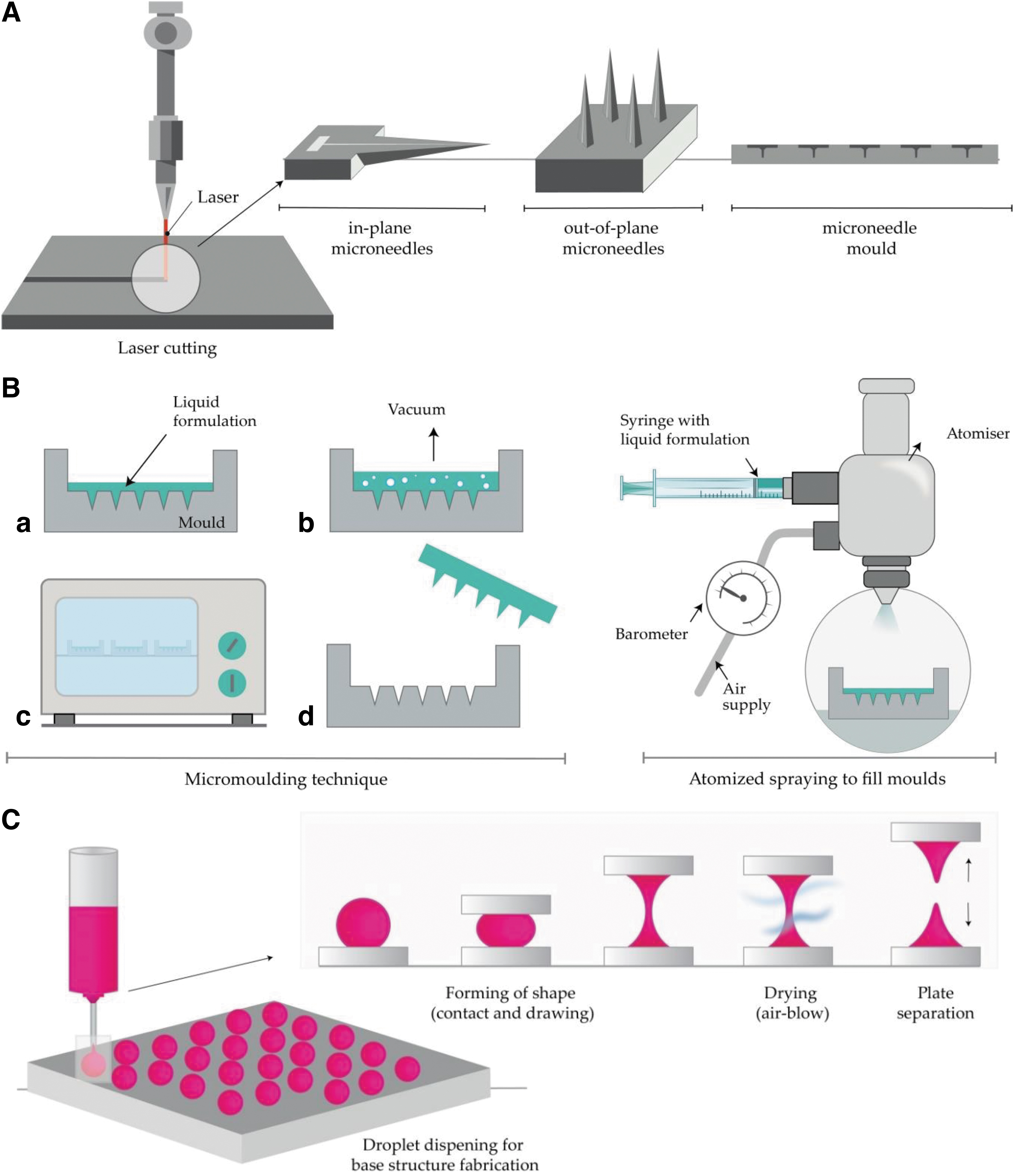
Fabrication process of MNs.
Microplastic molds involve the pouring of polymer solvents into PDMS molds (Fig. 5B), and the fabrication process is facile. Using this method, MNs can be fabricated at room temperature, and the mass production of MNs is cost-effective. However, PDMS molds demonstrate longer fabrication times, and the polymers used to fabricate them are mostly thermoplastic or photoreactive polymers. These polymers necessitate consideration of the heat resistance of the piggybacked drug or bioactive factor and exhibit photosensitivity.17,41
A cryogenic environment (4–25 degrees) is required during droplet-born air blowing fabrication, resulting in a relatively fast fabrication process (<10 min) (Fig. 5C). The problem of drug activity loss can be significantly ameliorated by using appropriate fabrication conditions. Simultaneously, the issue of drug activity loss during the fabrication process can be optimized because heating and ultraviolet irradiation are not required.42,43
These MNs can be designed using CAD software and can be subsequently exported to a three-dimensional printer for printing. This technique presents the advantages of rapid printing, high productivity, controllable stereo structure, and a wide choice of materials. However, the rough surface and limited mechanical strength of the finished product are problems that will need to be addressed in the future.44,45
Applications of MNs in Facial Rejuvenation
Skin aging can be primarily attributed to the loss of collagen and elastin fibers, which leads to wrinkling, relaxation, and roughness.36,37 The purpose of MN application is to encourage the neogenesis of collagen, inducing tissue regeneration and improving and delaying wrinkling and relaxation while correcting uneven skin tones. It is worth noting that sensitive areas, such as the periocular and perioral regions, require more accuracy in an application, as well as pain relief post-microneedling. 38 In other words, in addition to the three basic parameters described earlier, the design of MNs for applications in facial interventions requires the consideration of additional key factors: (1) geometric characteristics (needle length, diameter, density, spacing, and shape); (2) choice of manufacturing materials; (3) manufacturing feasibility (i.e., whether current manufacturing processes support mass production and whether production costs are too high); (4) ease of use and ease of preservation; (5) performance, biocompatibility, and mechanical strength; and (6) selection of active ingredients corresponding to individual needs.
In this section, the properties, site of action, and therapeutic effects of MNs with six different components are discussed. The sites of action and the effects of these components are summarized in Table 3.
Respective Site of Action for Different Constituent Microneedles as Well as Their Therapeutic Effects
Hyaluronan MNs
HA is an endogenous glycosaminoglycan synthesized by hyaluronan synthase and progressive glycosyltransferases, including repetitive N-acetylglucose and glucuronic acid, and connected by glucuronic acid β (1 → 3) bonds. 39 HA is ubiquitously expressed in the skin, accounting for up to 50% of HA in the whole body, exists in the extracellular matrix (ECM) of the epidermis and dermis, and is a key component of ECM. 40 The primary functions of HA in the dermis include the regulation of water balance, osmotic pressure, and ionic currents, as well as the enhancement of extracellular structural domains on the cell surface, and the use of electrostatic interactions to maintain and stabilize the skin structure.41,42 In addition, HA in the epidermis also possesses the ability to bind to and retain water molecules. The high water-binding capacity and swelling properties of HA allow it to maintain tissue structures and, thus, reduce the appearance of wrinkles.43,44
The most significant changes in aging skin result from a loss of skin HA, a decrease in collagen, and an increase in the percentage of collagen fragments. These changes lead to the loss of skin moisture, atrophy, loss of elasticity, reduced mechanical tension, and decreased collagen synthesis in the ECM. 45
MNs fabricated based on HA inherit the advantages of good permeability of injection fillers while simultaneously reducing the invasive and painful limitations presented by injections, thereby providing users with a more attractive rejuvenation strategy.46,47 The application of HA-MN to aging skin can enhance the structural support and mechanical tension of the ECM while inducing morphological stretching and increased proliferation of nearby fibroblasts. This ultimately produces the effect of promoting collagen production, increasing endogenous HA synthesis, and increasing hydration, thereby improving skin elasticity and reducing the appearance of wrinkles and roughness. 48
Fonseca et al developed an innovative patch (BC) for skin cosmetic applications based on the combination of HA MNs and bacterial nanocellulose. In in vivo tests, the patch demonstrated safety and applicability, and at the same time, it opened up new avenues for incorporating different active ingredients, which will help further expand its field of application. 49 An, Ji Hae et al investigated the efficacy of adding AHP-8 or EGF to a HA-based MN patch to improve wrinkles (Fig. 6). 39

Photograph and Antera 3D® image of a wrinkle at days 0 and 29 after treatment of microneedle patch
α-Arbutin MNs
Arbutin is a natural β-
The color of an individual's skin is primarily determined by the amount of melanin produced. Melanin is produced by special cells called melanocytes, which are regulated by tyrosinase during melanogenesis. Tyrosinase activates melanogenesis by performing a series of basic reactions, including the hydroxylation of tyrosine to
Hatem et al combined arbutin with MNs using the minimally invasive TDD characteristics of MNs to overcome the limitations of skin permeability presented by arbutin, thereby allowing MNs to act more effectively on melanocytes to achieve a more desirable whitening effect. 52
Acetyl-hexapeptide-3 MNs
Acetyl hexapeptide-3 (AHP-3) is a botulinum toxin mimetic. Compared with botulinum toxin, AHP-3 is nearly 4000 times less toxic, does not need to be administered via injections, and can be directly applied to topical skin. 2
AHP-3 reduces the frequency of muscle contractions that regulate facial expressions by inhibiting the release of acetylcholine, thereby reducing the appearance of uneven facial lines and wrinkles. 53 In contrast, AHP-3 can promote the synthesis of dermal structures, such as collagen and elastin, as well as reduce and neutralize free radicals, enhance skin resistance to interfering damage factors, and make the skin less susceptible to aging factors. 54
Owing to the limitations presented by the hydrophilic properties of peptides and high molecular weights (889 Da), the effect of topical application is not ideal. Relevant studies have revealed that only 0.01% of AHP-3 can penetrate the skin stratum corneum to reach the site of action. 55 High temperature, light exposure, and changes in pH all contribute to the destabilization of AHP-3. However, the limitations encountered by the topical application of AHP-3 can be overcome by using AHP-3 in combination with HA-based MNs. 56 Lim et al used photopolymers to create three-dimensional printed personalized MNs to enhance the transdermal delivery of AHP-3 and to effectively control wrinkles. The delivery of small peptides via the MN technology overcomes the limitation of the stratum corneum, improves permeability, and improves skin aging better than AHP-3 alone. 49
Adenosine MNs
Adenosine (AD) is a purine nucleoside that regulates the functional expression of cells and organs through four specific receptors (A1, A2A, A2B, and A3). 57 AD A2A receptors are expressed in cells involved in wound healing, including macrophages, fibroblasts, and microangiogenic cells. 58 When the AD A2A receptor is activated, collagen production by dermal fibroblasts is promoted through the A2AR/mitogen-activated protein kinase kinase-1/mitogen-activated protein kinase pathway, contributing to the maintenance of normal skin architecture, a reduction in the appearance of wrinkles, and the promotion of skin wound healing.59,60
Although AD exhibits superior drug efficacy, its hydrophilicity affects its permeability into the skin, which hinders its ability to exert an effect. Yang et al used lysing MN patches loaded with AD for skin barrier repair, moisturization, and wrinkle improvement in a clinical evaluation of 20 women and obtained good feedback on the treatment results. 61 To date, the safety of AD MNs and the evaluation of their efficacy in improving wrinkles have presented impressive results. Furthermore, it has been confirmed that the application of AD microneedling can effectively reduce the appearance of wrinkles and promote facial rejuvenation (Fig. 7).62,63
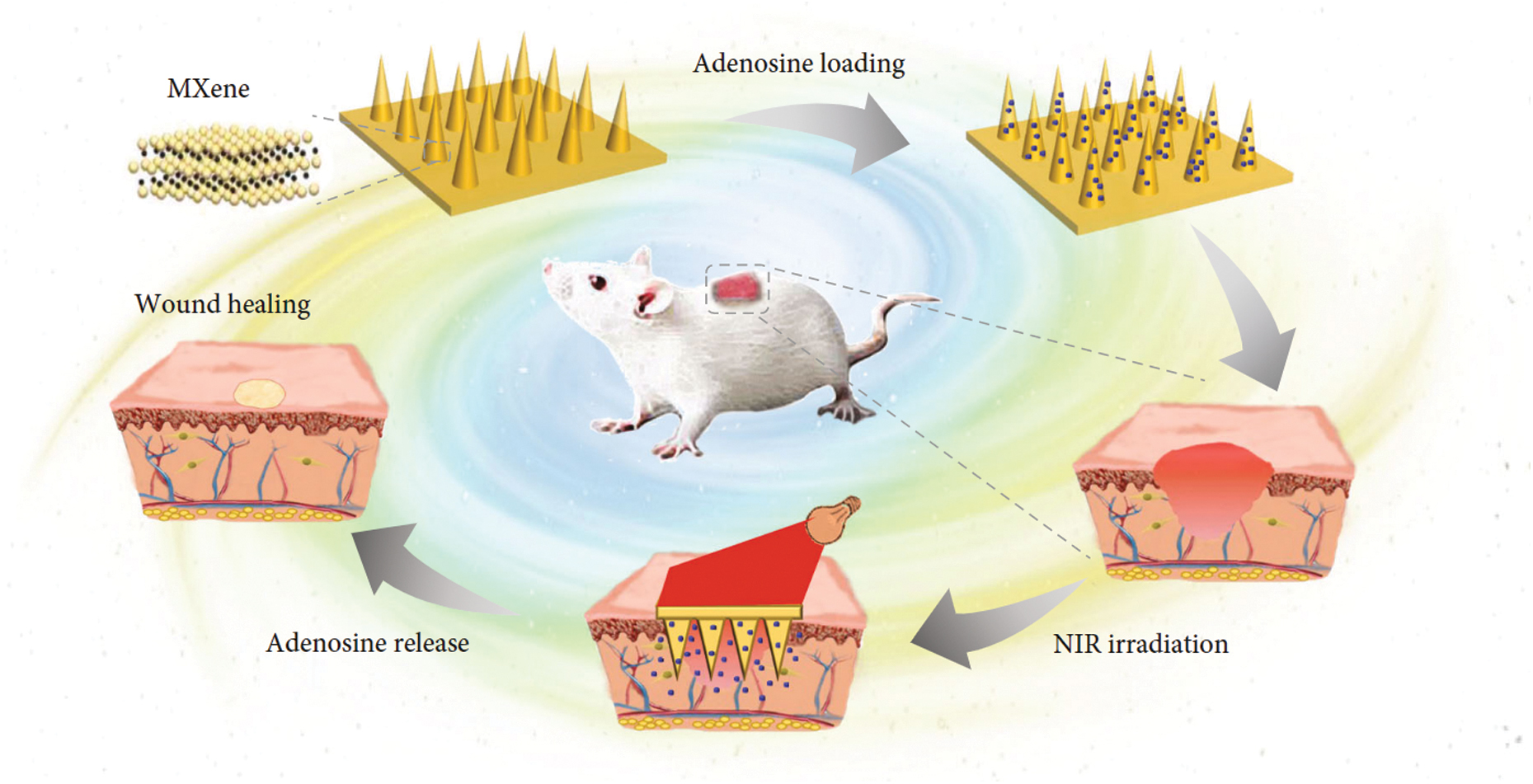
Schematic diagram illustrating the mechanism of MXene-integrated microneedle patches with adenosine encapsulation for wound healing. Reproduced with permission from Sun et al. 63 Copyright [2021]. (http://creativecommons.org/licenses/by/4.0/) Color images are available online.
Glutathione MNs
Glutathione is a natural water-soluble small-molecule thiol tripeptide composed of the following three amino acids: glutamic acid, cysteine, and glycine. Glutathione exists in the body in two forms: reduced and oxidized. 64 Reduced glutathione (GSH) inhibits the activity of tyrosinase in two ways, thereby inhibiting melanin production and making the skin appear translucent and fair. 65 The first of these ways involves direct inactivation, which inhibits the activity of tyrosinase by competitive binding to the active site of copper-containing enzymes, whereas the second approach involves indirect inactivation, which eliminates free radicals and peroxides in cells through the strong antioxidant capacity to protect cells from damage caused by reactive oxygen species. 66
Unfortunately, although GSH demonstrates multifaceted therapeutic applications, its characteristic unpleasant odor and weaker skin permeability result in its limited application in clinical fields. To address this, Lee et al used a biopolymer to deodorize GSH and then loaded it into HA-MN patches, creating odorless, highly permeable, and highly effective GSH-whitening MNs. 67
Retinol MNs
Retinol is a biologically active mode of vitamin A. Retinol and its derivatives are lipophilic molecules that are capable of penetrating epithelial cells, diffusing through cell membranes, and binding to specific nuclear receptors to stimulate or maintain basal skin keratinocytes. Consequently, they form cells that can differentiate to the most superficial layer, ultimately alleviating epidermal cell adhesion, reducing fibroblast proliferation, and enhancing collagen synthesis. 68 In addition, retinol can inhibit the activity of metalloproteinase and activate the production of HA, thereby reducing the breakdown of ECM and promoting its products. Retinol is also effective in improving fine lines, skin elasticity, skin roughness, and uneven skin color. 69
Current conventional forms of retinoid preparations are limited in their use owing to two major barriers. The first is poor drug penetration, as retinol has difficulty permeating to its primary site of action; ∼80% of the dose is known to remain on the skin surface, and only 20% can permeate the skin. 70 Furthermore, retinol is chemically and thermally unstable and sensitive to light; therefore, the dose left behind on the skin surface can be affected by chemical or physical factors, leading to its degradation and loss of efficacy. 71 In addition, the irritating side effects of retinol significantly reduce patient compliance, which primarily manifests as excessive dryness, scaling, itching, burning sensation, and erythema of the skin, similar to irritant dermatitis. Kim et al pointed out that conventional products containing the free form of retinol are more likely to trigger irritant reactions in the skin, as these products release higher concentrations of the active ingredient in a shorter period. 72
To address the inherent limitations of retinol, retinol has been used in combination with dissolving MNs, which successfully addresses the problem of drug penetration rate and maximizes the utilization of the dose. Simultaneously, the sustained-release effect of MNs can effectively reduce the generation of skin irritation and side effects, thereby significantly improving patient compliance and demonstrating extremely good therapeutic effects. 73
Conclusion
The facial skin structure is thinner than other body parts, yet the nerve distribution is denser. Therefore, the pain caused by the traditionally invasive treatments has become the most concern for beauty seekers. Microneedling opens up a new avenue for the development of painless and noninvasive TDD systems for facial youth.
In the clinical trials reported so far, the hydrogel MNs loaded with different drugs and bioactive factors have regeneration-promoting effects on both facial collagen and subcutaneous tissues. Meanwhile, the esthetic parameters of the patient's facial skin improved, including wrinkles, skin texture, red areas (inflammation or spider veins), and rare adverse effects were reported. However, it is worth noting that the longest follow-up period reported in clinical trials is only 12 weeks, 36 and a long-term assessment of safety and stability is desired.
To sum up, the efficacy of MN in the application of facial rejuvenation has been verified, but when it comes to commercialized products for large-scale, longer follow-up periods along with large-scale manufacturing, the safety evaluation accompanying sufficient and stable yield will be urgent to be addressed.
Footnotes
Disclosure Statement
The authors declare that they have no known competing financial interests or personal relationships that could have appeared to influence the work reported in this article.
Funding Information
This work was financially supported by the following foundation: National Natural Science Foundation of China (Grant Nos. 81772101, 82072196, 82002066). We are also grateful for the support from the Science Fund for Distinguished Young Scholars of the Southern Medical University (Grant No. 2020J009).