




Abstract
The consequences of military conflict, accidents, and diseases have led to the definition—and subsequent study—of the pathological condition now known as volumetric muscle loss (VML). VML is a significant injury to skeletal muscle tissue on a scale that is endogenously irrecoverable and leads to chronic functional deficits and long-term disability. Currently, there lacks a definitive approach to meaningfully restore the tissue and function lost by those afflicted, ushering a need for scientific activities and associated funding to both facilitate a deeper understanding of the pathobiology of VML as well as to develop and assess clinically relevant therapeutics and treatment strategies. Thereby, evaluation of the VML field is crucial to gauging the return on resource expenditures and to understand the evolution of the field to guide future directions. This article presents a bibliometric analysis of publicly available data to explore the growth of the VML field since its genesis and to highlight its prosperity through its expanding literature, its development and evaluation of promising treatment strategies, rising financial investments, and innovation. Altogether, the bibliometric analysis reveals the field of VML as an emergent research focus that is productive and translational.
Impact statement
Analyses of a research topic are fundamental toward evaluating the returns on investment and appreciating the evolution of the research toward novel directions. This study aims to highlight the growing field of volumetric muscle loss (VML), defined as a significant injury to skeletal muscle tissue that leads to functional impairment and is irrecoverable through inherent regenerative mechanisms. The analysis of bibliometric and publicly available data provides evidence that the field of VML has an expanding research interest and investment, with biomaterials at the forefront of study.
Color images available online.

Introduction
Volumetric muscle loss (VML) is a significant injury to skeletal muscle tissue on a scale that is endogenously irrecoverable and results in chronic functional deficits that reduce quality of life, leading to long-term disability.1,2 This pathological condition is a consequence of traumatic incidents, disease, or accidents that affect both military and civilian populations. Within the military, this condition is often a consequence of blast exposure, 3 whereas accidents and tumor ablation have warranted studies targeting VML within civilian populations. 4
While there is no effective clinical standard of care for the treatment of VML that facilitates the restoration of full tissue form and function, autologous tissue transfer (e.g., rotational/free muscle flaps) and/or rehabilitation (i.e., physical therapy) have been used to manage these injuries.2,5,6 These tissue transfer procedures, however, are often nonfunctional 6 and rehabilitation therapies have shown a lack of efficacy for promoting functional recovery—only producing modest improvements with respect to range of motion without meaningful improvements in strength.7–10 Thus, there has been a growing interest to identify novel therapeutics and treatment strategies to ameliorate these issues. Efforts from both the military and civilian scientific communities, including the development of new preclinical animal models and evaluation of putative therapeutics have led to a better understanding of the VML pathophysiology and have been essential toward advancing the field.11,12
The progress and extent of VML-related research can be evaluated through an analysis of bibliometric and publicly available data on research funding awards and intellectual property submissions. Herein, a decade of evolution of the VML field (i.e., since the term was first coined in a 2010 publication 7 ) was explored. We highlight how the field has advanced by presenting its expansion through publication and citation growth, its diversification through an expanding base of active investigators, and its potential for promoting innovation as measured by research funding awards and patents. We further delved into the literature, grouping articles according to their model systems, animals studied, and therapeutic interventions evaluated to assess the research trends within the field. Altogether, this bibliometric analysis and associated data paints VML as an emergent research focus that is productive and translational.
Materials and Methods
Bibliometric data
Bibliometric data were obtained from the National Institutes of Health's (NIH) iCite using a query of “volumetric muscle loss” in January 2022. The iCite application 13 is a tool developed by the NIH that provides information for journal publications included within the PubMed database through three modules: (1) Influence, which provides bibliometric data within a defined query, as well as a novel calculation called the relative citation ratio (RCR) 14 ; (2) Translation, which categorizes how the Medical Subject Heading (MeSH) Term associated with each article are oriented toward human, animal, or molecular/cellular biology research 15 ; and (3) Citation, which includes a portfolio of articles to measure the total number of articles within the search, the mean number of articles published per year, and the number of citations for the articles overall and per year.
Within the Influence module, the RCR is calculated by weighing the number of citations an article receives and benchmarking to the median for publications in its cocitation network that are supported by NIH funds for the corresponding year. 14 An RCR value of 1 is considered the standard, where the article is cited as expected based on the NIH median, while values above 1 are considered more influential. Similarly, iCite provides a weighted RCR that is the sum of the RCRs for each year. 14 A weighted RCR can be compared with the number of publications for each year to examine the influence of the field with respect to the number of articles, with a higher ratio indicating a higher level of influence. To avoid including a temporal bias toward recent publications (e.g., December 2021) that are unable to fairly be assessed for citations, the RCR and weighted RCR analyses herein excluded articles published after 2019 as RCRs are calculatable for publications of at least 2 years. 14
As per the Translation module, articles are scored based on the number of MeSH terms that fall into Human, Animal, and Molecular/Cellular Biology categories. Likewise, within the Translation module, a measure named the Approximate Potential to Translate (APT) is provided, 15 which is a machine-learning model that attempts to predict the likelihood that an article will be cited and/or used by clinical articles and, thus, an indicator of the bench-to-bedside paradigm. The APT is expressed as a probability from 0.05 (low) to 0.95 (high).
For the grouping of the publications, the articles were first classified by iCite as either primary research articles or other scholarly works (e.g., book chapters, reviews, etc.). The primary research articles were then binned by the investigative model, animal system studied, and therapeutic intervention based on a review of the Materials and Methods section. For investigative model, articles were grouped into categories of in vivo, in vitro, ex vivo, in silico, or the various combinations thereof depending on experimental design. For animal system studied, articles were grouped according to the species (i.e., rat, mouse, porcine, ovine, or human). For intervention, articles were grouped according to the therapy studied and placed into categories of biomaterials (B), cells (C), drugs (D), rehabilitation (R), any combination (+), or if it studied the pathophysiology (P) of VML (Supplementary Table S3).
For the analysis of the institutional affiliations, only the first listed affiliation of the senior (last) author was considered. All articles affiliated under the umbrella of the Department of Defense (DoD; e.g., Uniformed Services University of the Health Sciences [USUHS], United States Army Institute of Surgical Research [USAISR], etc.) were categorized as the DoD.
Funding data
Funding data were obtained using a query of “volumetric muscle loss” in January 2022 as an abstract keyword in the Congressionally Directed Medical Research Program (CDMRP) database for the DoD, as an advanced search in NIH RePORTER database for the NIH, and as a simple search in the NSF database for the National Science Foundation (NSF). It is important to note that information on research funded by the DoD through core/intramural mechanisms is not publicly available; thus, studies funded through the CDMRP mechanism are not fully representative of the overall DoD funding. Funding listed in NIH RePORTER as appropriated by the Department of Veterans Affairs (VA) were obtained using query of “volumetric muscle loss” in the VA Office of Research and Development (ORD) database. Due to NIH RePORTER not providing award totals, some total award amounts presented in the data are assumed/calculated (i.e., the average amount allocated for available fiscal years summed over the project period of performance).
Patent data
Patent data were obtained from the United States Patent and Trademark Office (USPTO) databases in January 2022. Information for issued patents and patent applications was collected using a query of “volumetric muscle loss” as a quick search of the USPTO Patent Full-Text and Image Database (PatFT) and USPTO Patent Application Full-Text and Image Database (AppFT), respectively.
Results
Quantification of the VML literature
The term “volumetric muscle loss” was first coined in 2010 within a clinical case study by Mase et al. 7 Since then, the number of publications per year has increased in a quadratic manner, totaling 249 articles within this portfolio, with 69 of those articles being published in 2021—the most active year to date (Fig. 1A). Similarly, the number of citations follows a quadratic growth pattern between 2010 and 2021, reaching a total of 5,383 from this portfolio, with 1,582 citations in 2021 (Fig. 1A).
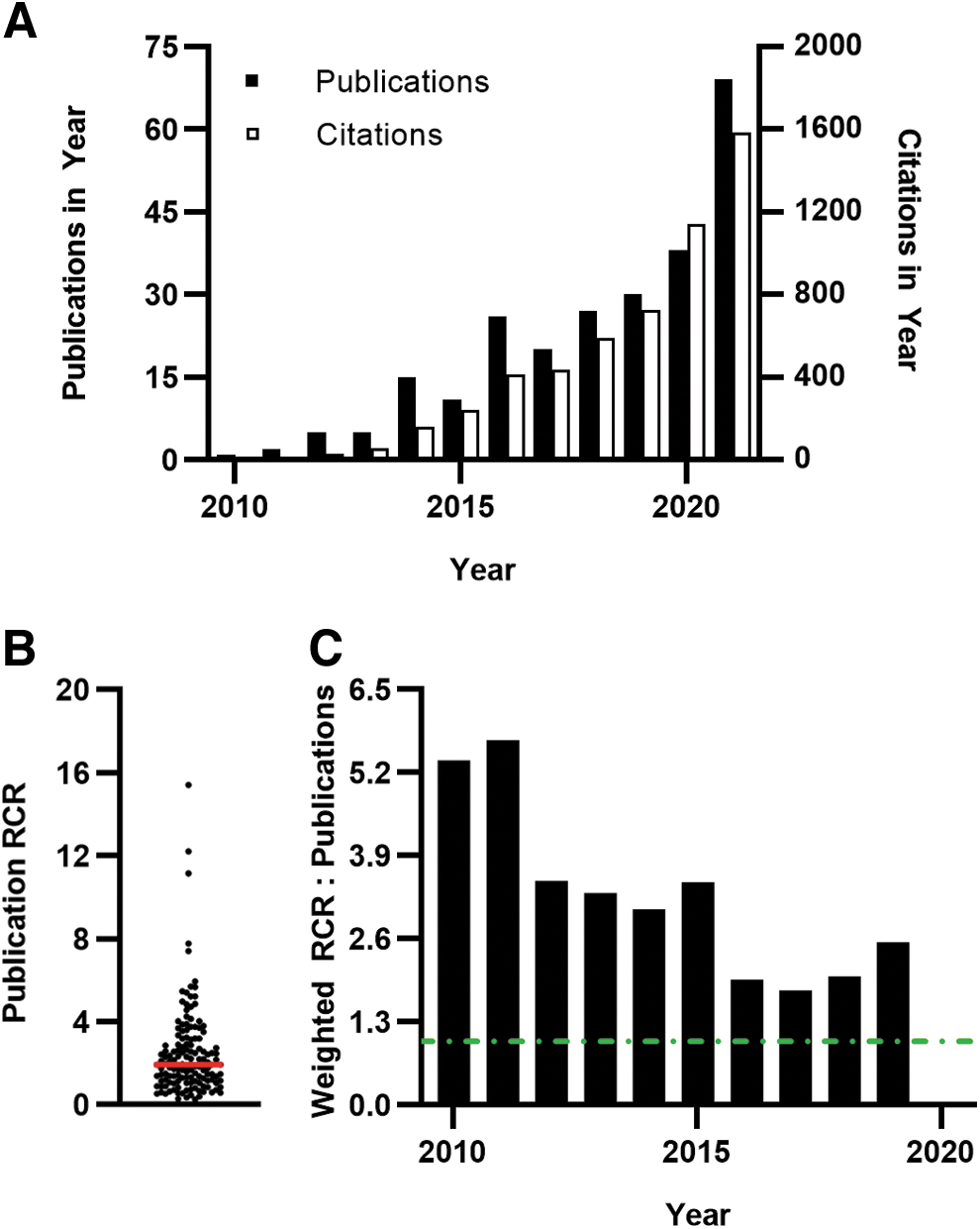
VML research is expanding with highly citable publications.
The portfolio as a whole holds a median and mean RCR of 1.94 and 2.48, respectively (Fig. 1B). Figure 1C presents ratios of the weighted RCRs against the number of publications throughout the portfolio's range, with the weighted RCR always exceeding the number of publications through 2019. The overall weighted RCR summed through 2019 for the portfolio is 352.73 compared with the total 142 publications.
Article rankings of the VML literature
The most cited article within the portfolio was by Sicari et al 9 in Science Translational Medicine (Sci Transl Med) with 255 citations (Table 1). Within the Top 10 Most Cited list, 8 articles are primary research works and 2 are reviews. When evaluated by citations per year, the article produced by Guo et al 16 leads with 32.33 citations per year in Acta Biomaterialia (Acta Biomater) (Table 2). Within this Top 10 list (2 tied for 10th), there are 8 primary research works and 3 reviews.
Ranking of Articles by Total Citations for Volumetric Muscle Loss
IF, impact factor.
Ranking of Articles by Citations per Year for Volumetric Muscle Loss
Journal rankings of the VML literature
Within the portfolio, most articles were published in Tissue Engineering Part A (Tissue Eng Part A) at 23 counts (9.2%), which is almost double that of articles published in Biomaterials (Biomaterials) that ranks below it with 14 counts (5.6%) (Fig. 2A and Supplementary Table S1). For the portfolio as a whole, the median and mean impact factor of the journals in which VML-related research is published is 4.322 and 5.839, respectively (Fig. 2B).
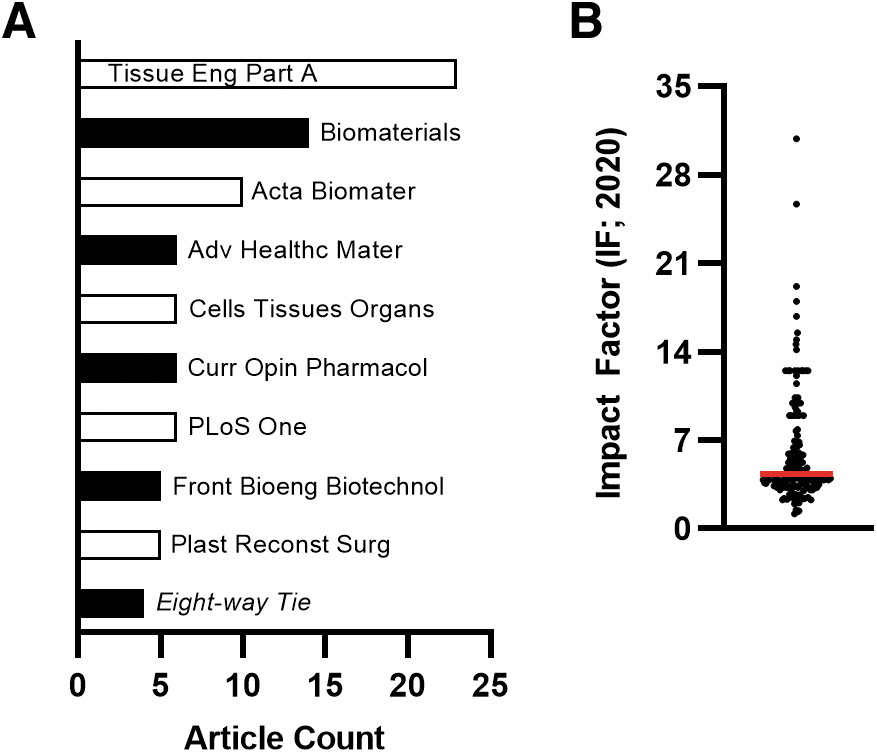
VML literature is published in impactful journals.
Affiliation analysis of the VML literature
To gain appreciation for the geographical distribution of the researchers that have engaged in the field of VML, the institutional affiliations of the senior (last) author from each article in the portfolio were cataloged (Supplementary Table S2). A tree-map chart displaying the distribution of the leading affiliations by number of publications is presented in Figure 3A. The portfolio is heavily weighted by articles led by DoD-affiliated researchers with a total count of 47 articles through 2021, which account for 18.9% of the overall portfolio. The DoD is followed by the University of Michigan (U. Mich) and the University of Pittsburgh (U. Pitt) with 16 (6.4%) and 15 (6.0%) articles, respectively. Notably, the portfolio contains an increasing number of affiliations throughout the time span, with 41 different institutions publishing research in the field of VML in 2021 (Fig. 3B).
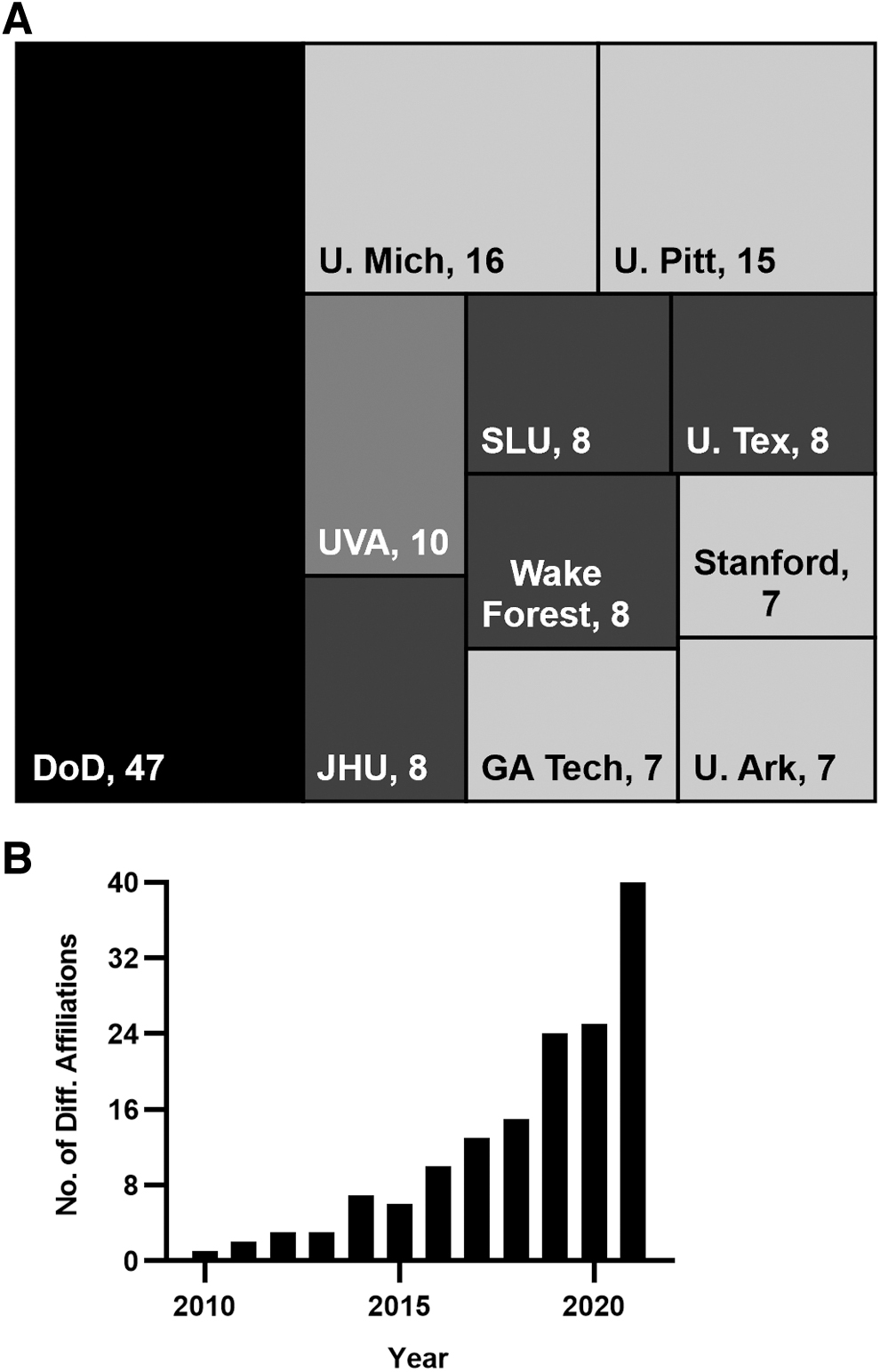
VML research is expanding in active researchers.
Translational potential of the VML literature
The distribution of the portfolio with respect to each article's Translation score can be seen through the triangle of biomedicine visualization (Fig. 4A). 17 The highest density of articles falls under the solely Animal category (40), with 25 and 11 publications with MeSH terms solely associated with Human and Mol/Cell, respectively. Fifteen articles have scores with an equal interest in each category. Eight articles do not possess relevant MeSH terms that fall under any of the categories and are plotted outside of the triangle.

VML research has translational potential.
The translation scores for each category over the portfolio timeline are presented in Figure 4B. As Mase et al had published, the only VML-themed article in 2010, 7 research from their human case study is prominently displayed as solely Human for 2010. As the VML field and associated research efforts expanded, a diversification of the type of studies occurred with the inclusion of animal and molecular/cellular studies. Animal scores have remained steady and continue to show their value as important tools in VML research. Molecular/Cellular scores, on the other hand, have been steadily increasing, displaying a rise in this avenue of research.
The mean APT value for the VML portfolio is 0.19 (Fig. 4C); therefore, about 19% of the articles are expected to be cited by clinical articles. The APT value overtime is plotted in Figure 4D. The initial years' (i.e., 2010–2013) score values around 0.50 and decline afterward.
Publication categorization of the VML literature
In addition to the Translation scores, the portfolio was dissected further to understand the components that contribute to the impact of the research. iCite bifurcates the articles in the portfolio based on whether they represent an original work, resulting in 176 (70.7%) entries being identified as primary research (Fig. 5A).

VML research is highly inclusive of preclinical and biomaterials research. Pie charts that segment the portfolio first by
From the primary research, the articles were then grouped by model system (Fig. 5B), animal species studied (Fig. 5C), and type of therapeutic intervention (Fig. 5D). With respect to model system, the majority of research utilized in vivo models (104, 59.1%). The combination of in vitro and in vivo approaches follows with 41 (23.3%) articles, and then in vitro models with 24 articles (13.6%).
With respect to animal studies, the vast majority (87.4%) of primary research articles were performed in rodents. Specifically, over half of the studies included the use of rats (79, 52.3%), whereas mice were the next highest utilized species (53, 35.1%). Larger animals such as porcine and ovine were studied in 6 (4.0%) and 3 (2.0%) articles, respectively, and human subjects and/or tissues were noted for 10 (6.6%) articles.
With respect to therapeutic interventions, biomaterials were pervasive, with 68.2% of the total investigations to date focusing on biomaterials alone (63; 35.8%) and/or as part of a combinatorial therapeutic. To the latter point, biomaterials combined with cells, drugs, or both accounted for 33 (18.8%), 21 (11.9%), and 3 (1.7%) articles, respectively. Almost a quarter of the primary research articles fell under an Others category, where 32 articles studied the pathophysiology of VML and 9 articles incorporated rehabilitation into their therapeutic approach.
Financial support of the VML literature
Increased research funding is a known driver of scientific productivity. 18 Herein, databases of several government agencies that fund biomedical research were queried: the DoD, the NIH, and the NSF. It was found that the DoD funded 35 awards since 2011, the NIH funded 24 awards since 2012, and the NSF funded 2 awards since 2012. The average award amount was $1.22M by the DoD, $1.13M by the NIH, and $0.28M by the NSF (Fig. 6A, C, E). The early years of the VML field saw comparatively smaller award totals by the DoD and NIH: $1.36M in 2011 and $0.12M in 2012, respectively. In contrast, research investments in the VML field have risen dramatically over time, with the highest totals of $17.1M in 2019 from the DoD and $7.42M in 2021 from the NIH: a 12-fold and 60-fold difference, respectively (Fig. 6B, D). The NSF had awarded their prestigious CAREER award in 2012 and later supported an Innovation Corps (I-Corps) project in 2020 (Fig. 6F).

VML research has seen increasing government investments.
Innovation of the VML field
A criterion toward gauging the ingenuity of a field is the number of patent applications submitted and the number of patents issued. A query of the USPTO database resulted in 43 patent applications from 2012 through 2020 and 12 patented inventions from 2010 through 2018 (Fig. 7). As with the expansion of the VML field as a function of publications and citations, a rise in technological innovation over time is seen in patent applications. Patent issuances, however, expectedly lag behind the applications, but have been relatively steady in recent years.
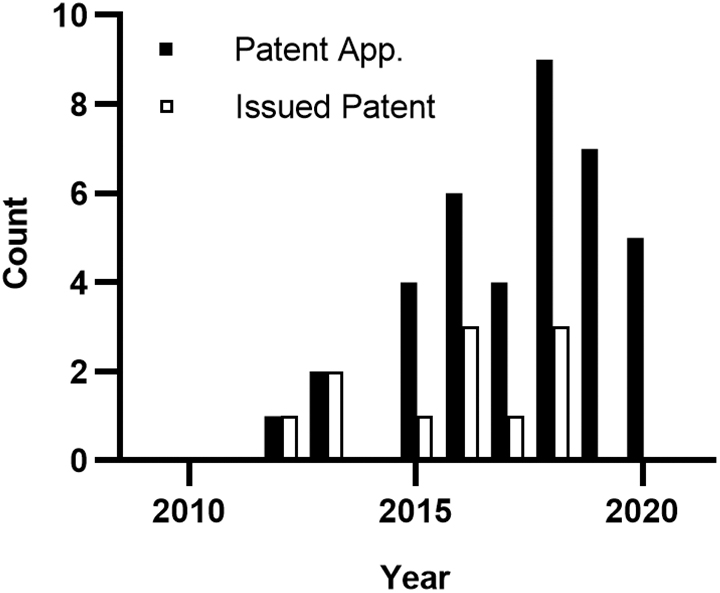
VML research has facilitated intellectual property. Counts of patent applications (black) and issued patents (white) associated with VML and derived from the USPTO database. USPTO, United States Patent and Trademark Office.
Discussion
The VML field is prospering with publications, translation, and funding availability
Since its coinage in 2010, the amount of research efforts toward understanding the pathobiology of, and developing therapies for, VML has risen dramatically as supported by the bibliometric analysis presented herein. The long-term, detrimental effects of VML, in addition to the fact that no universally agreed-upon standard of care currently exists, has emboldened researchers to drive advancements within the field, as both military and civilian populations stand to gain from the success of the work. The literature and accompanying data reveal the expansion of the VML field and its focus on ingenuity and translational activities.
The growth of the VML field is evidenced by the continual increase in publications, citations, and number of researchers at a myriad of operationally distinct institutions. The number of publications has steadily increased since 2010. 7 In parallel, the number of citations has also increased, notably at a rate almost twice that of the median NIH-funded publication as defined by the portfolio's median RCR of 1.94 (mean RCR of 2.48), which ranks above the 70th percentile.15,19 These metrics can be further evaluated using the weighted RCR that has consistently surpassed the number of publications of each year, indicating together how VML literature is considered more influential compared with other NIH-funded publications in its cocitation network.
VML research has historically focused on military medicine as evidenced by the first publication being affiliated with the DoD (i.e., USAISR). Under the umbrella of the DoD, the VML literature is abundant with publications by military researchers, where their contributions exceed the sum of the three next most populous affiliations. However, throughout the years, the number of different affiliations publishing VML-related articles has rapidly expanded, reaching 41 different affiliations in 2021. Stated differently, numerous academic institutions have sought to join the battle alongside the military toward understanding and developing therapies for VML injuries, and thus, broadening the talent pool available and emphasizing the benefits of interdisciplinary research.
Probing further into the literature, the majority of the VML field is associated with preclinical (animal) and clinical (human) research; a point which emphasizes the field's focus toward translational applications. The APT score suggests the budding clinical relevance of VML literature. 15 Specifically, the machine-learning predictor valued the VML portfolio with an overall mean APT 0.19, which is below the APT 0.25 for the cumulative data, but above the APT 0.12 fundamental-focused data based on the PubMed database from 1995 to 2014. 15 This can be attributed to the model systems used, where over 80% of the primary research articles used in vivo models as a component of their experiments. 15 The studies used animal models that ranged from rodents to large animal models, and human subjects (although to a far lesser extent), which highlight how the VML field is striving for translational goals.
As noted, the APT decreases over time, which is expected given the rise in fundamental research within the VML field as shown by the Translational scores. Ian Hutchins et al noted that APT scores are stable for established publications, but newer publications with lower APT scores tend to move into higher bins as they age, 15 which the authors attribute to the evolving clinical landscape associated with the citation network of the articles.
Alongside the expanding research and its translation, government agencies have increasingly invested more into VML research. Given that the effective treatment of VML has been a high priority, clinical unmet need (i.e., requirement) within Military Medicine, the DoD invested in the field early, beginning in 2011, and has continually provided funding to facilitate the generation of knowledge and materiel products aimed at advancing the care of affected Service members. The NIH progressively invested in the VML field, beginning in 2012 with total award sums reaching the millions in 2021, similarly representing the rising interest in VML-related research. Excitingly, these investments by government agencies have borne additional fruit, beyond traditional publications, as evidenced by a number of patent applications and issuances. To date, 43 patent applications have been filed and 12 patents have been issued thereby demonstrating the innovativeness, and potential translatability of VML research.
Biomaterials play an important role in VML
A bulk of the VML literature has investigated the use of biomaterials as a therapeutic approach. Specifically, biomaterials are utilized as an intervention to treat VML in over 70% of the primary research articles within the portfolio. For example, not only did the initial case report by Mase et al described the use of a biomaterial-based regenerative medicine strategy for the repair of a VML injury, 7 the most cited article from the VML portfolio described herein 9 also evaluated the use of a similar biomaterial to treat a VML defect (in both mice and humans). Moreover, the use of biomaterials within the VML field can be seen throughout the list of top overall cited articles7,20,21 as well as those at the top with respect to citations per year.16,22–24
As the popularity of biomaterials was seen in the citation rankings, the trend continues in the targeted journals—that is, Tissue Eng Part A, Biomaterials, and Acta Biomater are the top journals within the VML portfolio that publish extensively on biomaterial-related projects. These journals are ranked within the second (Q2; 17/47), first (Q1; 2/47), and first (Q1; 3/47) quartiles, respectively, in the category of Materials Science, Biomaterials through the Journal Citation Indicator (JCI) by Clarivate, further reinforcing how biomaterials in the VML space are influential and impactful. Overall, the popularity of biomaterials through the perspective of publications is pronounced in the VML literature.
Study limitations
While the data presented herein are informative and represent the field of VML in a positive light with respect to growth and scientific impact, these analyses are not without limitations. Foremost, the accessibility and functionality of iCite positions it as an effective tool toward bibliometric analyses, but it relies solely on the PubMed database, publications, and other documents (i.e., abstracts, conference proceedings, reports); outside of those indexed on PubMed are not included within the analyses herein. 25 This limitation also affects the citation analysis as PubMed only counts citations within its own database. Thus, the current bibliometric analysis may differ if using another database (e.g., Google Scholar), which may include more or less, publications and utilize a different citation algorithm. 26 iCite was selected for the current analysis as it provided the most encompassing dataset and translational analyses for our interest that is not readily available through other literature databases.
Similarly, given the search term “volumetric muscle loss” was used within the queries conducted, outcomes (i.e., publications, grants, patents, etc.) that do not include this exact terminology would not be included in this portfolio. To that end, we note, regrettably that there may be VML-relevant publications, grants, and patents that have not been included within these analyses. As such, the data presented herein are likely an underestimation of the total VML-associated literature. While a broader query search may have enabled a more encompassing level of inclusion, the goal herein was to specifically examine the term “volumetric muscle loss,” as it was originally defined.
In terms of the citation analyses, recent articles (relative to the date of data abstraction) are unfavorably disadvantaged, where their impact is likely not fully recognized until maturation. To help alleviate this issue, our analysis excluded RCR and weighted RCR metrics for publications past 2019 because the more recent articles would not have a reasonable time allotted to be appreciated by the literature. Provisional RCRs can be provided, but they are considered unstable for the newer publications.
Additionally, iCite's reliance on MeSH terms may introduce a bias that may not accurately portray articles, with respect to the Translation module. MeSH terms are used to more efficiently catalog and index publications within PubMed, but the terms are manually assigned by librarians with extensive effort. However, studies have shown that this complex task has a 48% consistency rate due to the reliance on indexer's familiarity with the various topics; 27 thus, the selection of specific keywords or differential phrasing of concepts may skew an article toward a categorization that does not wholly represent it. This is evident in our data, where the Translation module captures 25 articles that are categorized as solely Human based on MeSH terms, but only 10 articles per our scrutiny of investigative models fall under the category, although nonprimary research articles may contribute.
With regard to funding data, it should be emphasized that the data presented herein represent only what could be obtained from publicly available government databases. However, privately funded research, funds derived from large consortiums, and discreet military funds were not readily accessible, and thus not included herein. Therefore, the presented results are not fully representative of the values with regard to funding. Similarly, some total award values for the NIH are estimates due to the unavailability of the data, where available data for 1 fiscal year was summed over the project length, since NIH RePORTER does not present total award values. However, in both cases, the data are conservative estimates and the trends in funding are likely instead underestimated.
Furthermore, although PubMed is inclusive of articles published internationally, the complimentary grant and patent data are solely United States based as they are procured through databases from government agencies of the United States. The bibliometric analysis of the portfolio does include articles published by international researchers, so it may be assumed that foreign governments and entities would be interested in funding VML-related research; however, unfamiliarity of foreign systems limited the probe into such avenues.
Lastly, the authors recognize that a number of publications within the VML-themed portfolio are associated with them, that is, authorship or affiliation. We aimed to minimize biases by using publicly available sources that are broad in scope and accessible to the general public, while using a strict search criterion that was defined independently from the authors.
Conclusion
VML has been a detriment to military and civilian populations as the condition can have a consequential, life-long impact on function and quality of life. Over a decade, the VML field has seen significant expansion as evidenced by the growing scientific literature that has garnered an above-average citation rate compared with NIH-funded publications, the rising institutional diversity that enhances the talent pool, and the increasing amount of funding by government bodies that have summed in the millions. The clinical translatability of VML research also supports its importance as many studies incorporate preclinical—inclusive of large animals—and clinical studies. A significant portion of VML research has included the use of biomaterials such that over half of the primary research articles are biomaterial inclusive and many of the reigning citation-ranked articles have incorporated the use of a scaffold. Thus, VML is a major disorder affecting a broad population, where a growing interest by the scientific community through published literature alongside funding from government agencies has led to translational research, with biomaterials at the forefront of interest.
Footnotes
Acknowledgment
The authors would like to acknowledge Dr. Andrew Clark for his critical review and commentary.
Authors' Contributions
J.K.: Conceptualization (supporting); methodology (equal); data acquisition (lead); data analysis (lead); writing—original draft (lead); writing—review and editing (equal); and approval of the final version (equal). S.M.G.: Conceptualization (supporting); methodology (equal); writing—original draft (supporting); writing—review and editing (equal); and approval of the final version (equal). C.L.D.: Conceptualization (lead); methodology (equal); writing—original draft (supporting); writing—review and editing (equal); and approval of the final version (equal).
Disclaimer
The contents of this publication are the sole responsibility of the author(s) and do not necessarily reflect the views, opinions, or policies of USUHS, the DoD, the Departments of the Army, Navy, or Air Force. Mention of trade names, commercial products, or organizations does not imply endorsement by the U.S. Government.
Disclosure Statement
The authors do not declare any conflicts of interest.
Funding Information
Support of this work was provided by the Department of Defense—Veterans' Affair (DoD-VA) Extremity Trauma and Amputation Center of Excellence (EACE; Award No. HU00012020038). J.K. is supported by a fellowship through the Oak Ridge Institute of Science and Education (ORISE).

References
Supplementary Material
Please find the following supplemental material available below.
For Open Access articles published under a Creative Commons License, all supplemental material carries the same license as the article it is associated with.
For non-Open Access articles published, all supplemental material carries a non-exclusive license, and permission requests for re-use of supplemental material or any part of supplemental material shall be sent directly to the copyright owner as specified in the copyright notice associated with the article.
