




Abstract
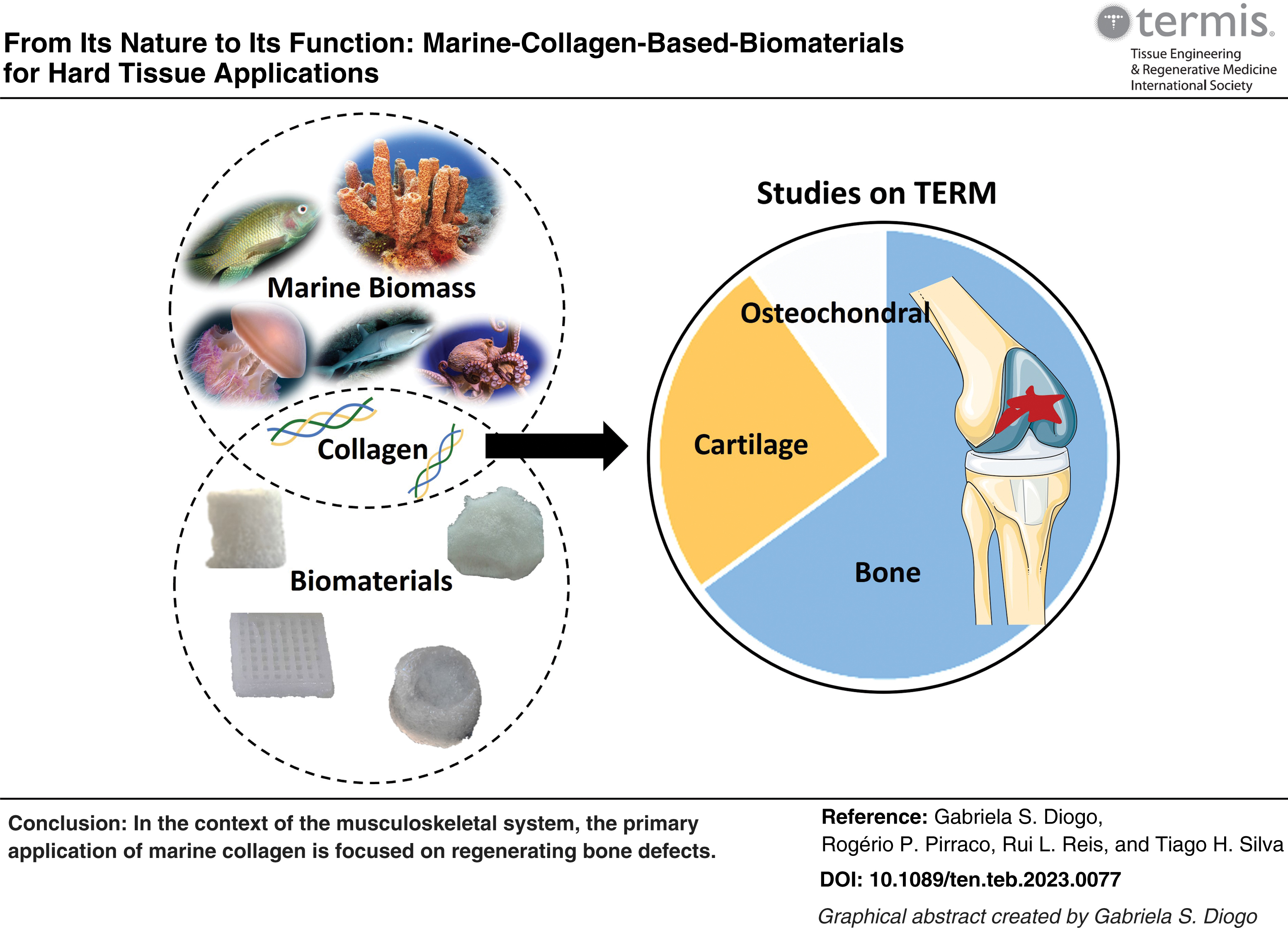 (Color images are available online)
Rapidly growing demand for collagen-based therapeutic applications requires a great amount of collagen stock. Commercial collagen is mainly confined to mammalian sources, which have concerns about zoonotic disease transfer and, additionally, the problem of terrestrial animals' overexploitation, which, even so, does not meet the crescent demand for collagen. The extraction of collagen from marine organisms, including the wastes of vertebrates and invertebrates, has both economic and environmental benefits. Marine collagen (MC) is easy to extract, has excellent biocompatibility and good absorption properties, is low in zoonotic and immunological risks for patients, and has fewer religious and regulatory restrictions. This review discusses the research done using MC on biomaterials for bone, cartilage, and osteochondral tissue regenerative applications and the underlying technologies that enable their development. The main challenges on processing MC associated with specific features, such as the low denaturation temperature and weak mechanical properties, are also addressed. A combination of blends and physical or chemical crosslinking treatments with conventional processing methodologies is still traditionally used to prepare MC biomaterials. However, the growing role of MC in the health care-related field, particularly in the treatment of musculoskeletal defects, has been pushing the scientific community to explore advanced techniques to design and develop safe, yet functional materials to better meet tissues' functionality.
Impact statement
This review discusses the research done using marine collagens (MCs) on biomaterials for bone, cartilage, and osteochondral tissue regenerative applications with the underlying technologies that enable their development, and explains the methodologies used to characterize MCs highlighting their importance, namely regarding the performance of derived biomaterials, and the inherent properties of such collagens. In the second part, the applicability of MCs as biomaterials for hard tissue applications was studied, focusing on the mostly applied fabrication techniques. In conclusion, this review describes the major challenges to be overcome and the forecast for the upcoming years concerning the use of MCs.
Introduction
Collagen is a structural and the most abundant protein present in the extracellular matrix (ECM) of vertebrate animals. 1 In mammals, collagen accounts for one-fourth of the whole-body protein, three-quarters of dry-weight skin, 90% of human tendon and corneal tissues, and 80% of the organic content in bones.2,3 In lesser amounts, it can be found in cartilage, teeth, vessels, and others. Since collagen is the major component of all tissues, collagen-based materials have been extensively applied in Tissue Engineering (TE) field. 4 Collagen is biocompatible, provides natural biological cues for cells, induces their migration and proliferation, and can be remodeled in vivo, being thus recognized by its good biological performance, proper degradation properties, and stability.5–7
Primary sources of the whole industrially used collagen have mammal origin with particular emphasis on bovine and porcine animals due to the structural and organizational similarity with humans. 8 The risk of diseases transmission to humans (zoonosis) such as transmissible spongiform encephalopathies and bovine spongiform encephalopathy, limits its use, particularly on medical context.8,9
Taking this into account, the European Union (EU) defined specific criteria for the sourcing and processing of collagen and its derivates used in the manufacture of biomedical products for human applications (detailed in Supplementary Data S1). The concern to find safe sources of collagen free of mammalian diseases amenable to be transmitted to humans is a key factor driving the batch for alternatives. 10 Regulatory agencies periodically enquire about companies using mammal origin materials on the absolute need of using them and if alternatives are available. Moreover, cultural and religious beliefs limit the usage of bovine and porcine products. In 2025, Muslims are expected to represent 30% of the world population 11 and they, together with Jews, refrain from the consumption of porcine products. 12
On the other hand, consumption of bovine products is seriously hampered in Hinduism, a religion followed by about 1000 million people. 13 These disadvantages represents significant drawbacks for manufacturing biomaterials containing collagen of mammalian origin, motivating the investigation of other potential sources of collagen.9,14 Recombinant collagen is a possible option to reduce potential immunogenicity and viruses; however, the translation from laboratory to clinic, giving high cost, low yield, and sensibility to enzymatic degradation when compared to animal-derived one, has been limiting its use. 15 Marine ecosystem represents an attractive alternative, with different species being studied as potential sources of collagen, offering high-quality product with few regulatory and quality control problems. 4
This review aims to understand the biomedical applications using marine-origin collagen, especially focusing on the ones targeting hard tissues, described so far. Marine collagen (MC) emerges as a promising approach to promote and enhance hard tissue regeneration due to its potential to induce human mesenchymal stem cell (hMSC) chondrogenic and osteogenic differentiation and the fast formation and orientation of collagen fibrils with impact on the performance of derived biomaterials regarding both mechanic and cellular perspectives. 16 These and other studies will be discussed in the following sections, considering the pros and cons in comparison to mammal collagen, and building a forecast of their use in regenerative medicine in the coming years.
Collagen from Marine Organisms: Properties
MC can be isolated from vertebrates like fishes, and invertebrate animals,9,17,18 including cuttlefish, prawns, starfish, 19 sea anemones, jellyfish, 20 sponges, octopus, sea urchin, and squid. 21 The extraction process is divided into two main steps, pretreatment of raw materials and the extraction itself (Fig. 1). Pretreatment involves alkaline (like sodium hydroxide) solutions22–25 to remove noncollagenous proteins, while chelanting agents like ethylenediaminetetraacetic acid and/or inorganic acids such as hydrochloric acid22,26,27 to remove inorganic materials.
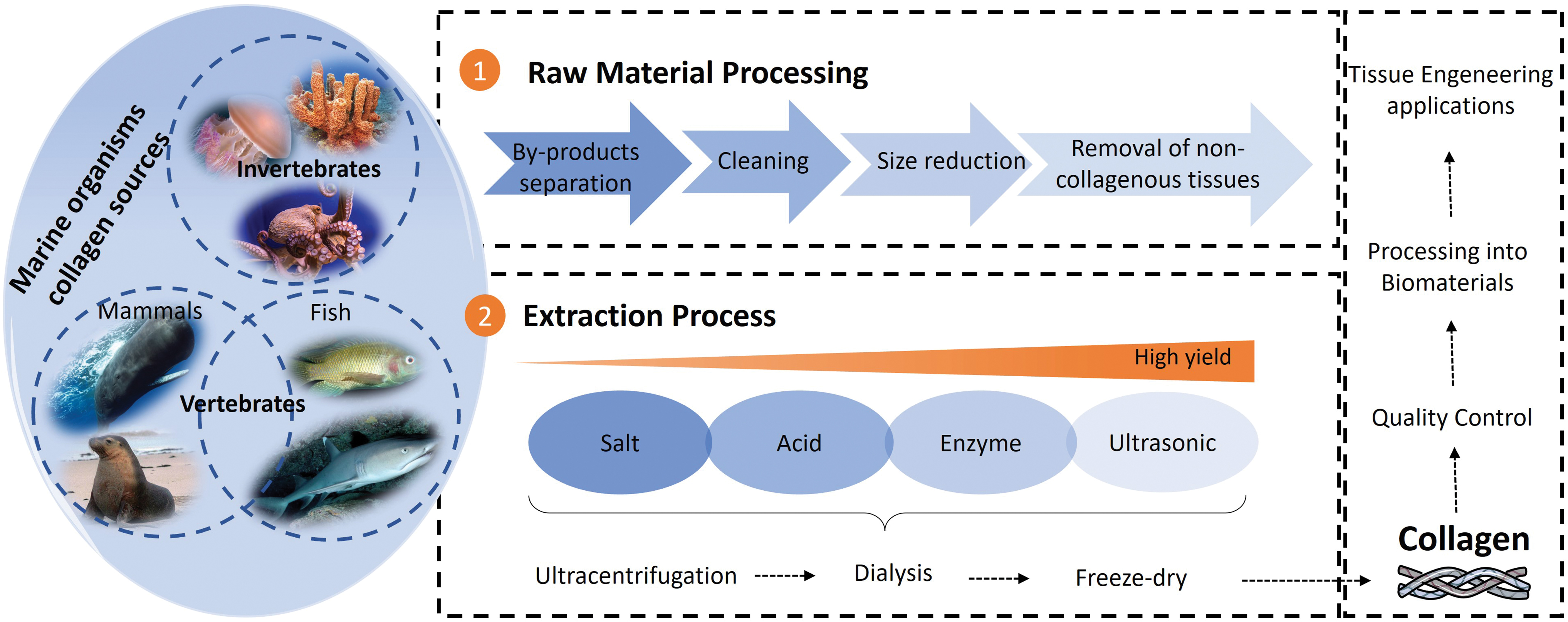
Representative image of collagen extraction processes from marine vertebrate and invertebrate organisms envisaging biomedical applications. Color images are available online.
Depending on the extraction method, the extracted collagen can be classified as neutral salt-solubilized collagen, acid-solubilized collagen (ASC), and pepsin-solubilized collagen (PSC). To achieve better yields, neutral salt solutions are often replaced by dilute acid solvents like citrate buffer, 0.5 M acetic acid, or hydrochloric acid (pH 2–3)8,28 or enzymes such as trypsin, pepsin, and collagenase.
Pepsin is the most commonly used enzyme due to different reasons: (1) Improves collagen purity–noncollagenous proteins can be hydrolyzed and removed by salt precipitation; (2) enhances collagen extraction efficiency–solubilization in acidic conditions can be facilitated by collagen telopeptide hydrolysis; and (3) reduces antigenicity–by elimination of telopeptides commonly associated with immunogenic reactions.8,28 Ultrasonic treatments have been also used to improve the yield of collagen extraction that is directly proportional to the amplitudes and duration of the treatment. The yield of collagen extraction from sea bass skin was higher when ultrasonic treatment was applied, compared to the traditional method without affecting its structural integrity. 29
All extraction methods overlap the steps of dialysis, precipitation, and centrifugation to purify the extracted material. Different species, tissues, animal ages, and extraction parameters result in different yields.28,30–32 Generally, higher acid concentrations, extraction temperature, and time result in a higher yield of collagen extraction. Low temperatures, acid concentrations, and extraction time have been applied when it is intended to obtain collagen with preserved triple-helix structure for applications in biomedicine.
The following sections will describe the MC properties, highlighting its advantages and disadvantages (Fig. 2).

Marine collagen features highlighting its advantages and disadvantages. Color images are available online.
Protein chains and amino acid composition
Sodium dodecyl sulfate polyacrylamide is commonly used to characterize collagen through separation of proteins according to their molecular weight (MW), charge, size, and shape. 33 Most fish collagens have been found to consist of two α-chains, designated as α-1 and α-2 with the former being present in the double amount of the latter, like type one in mammals. 9 In addition, the presence of β and γ components can be related to the higher MW of collagen that increases with animal age due to its higher crosslinked form. 34 Collagen-specific helical structure and its stability are highly influenced by the amino acid composition (Fig. 3). Glycine, is one of the most important and abundant (30%) amino acids in mammal collagen, as well as Pro and OHPro. 2
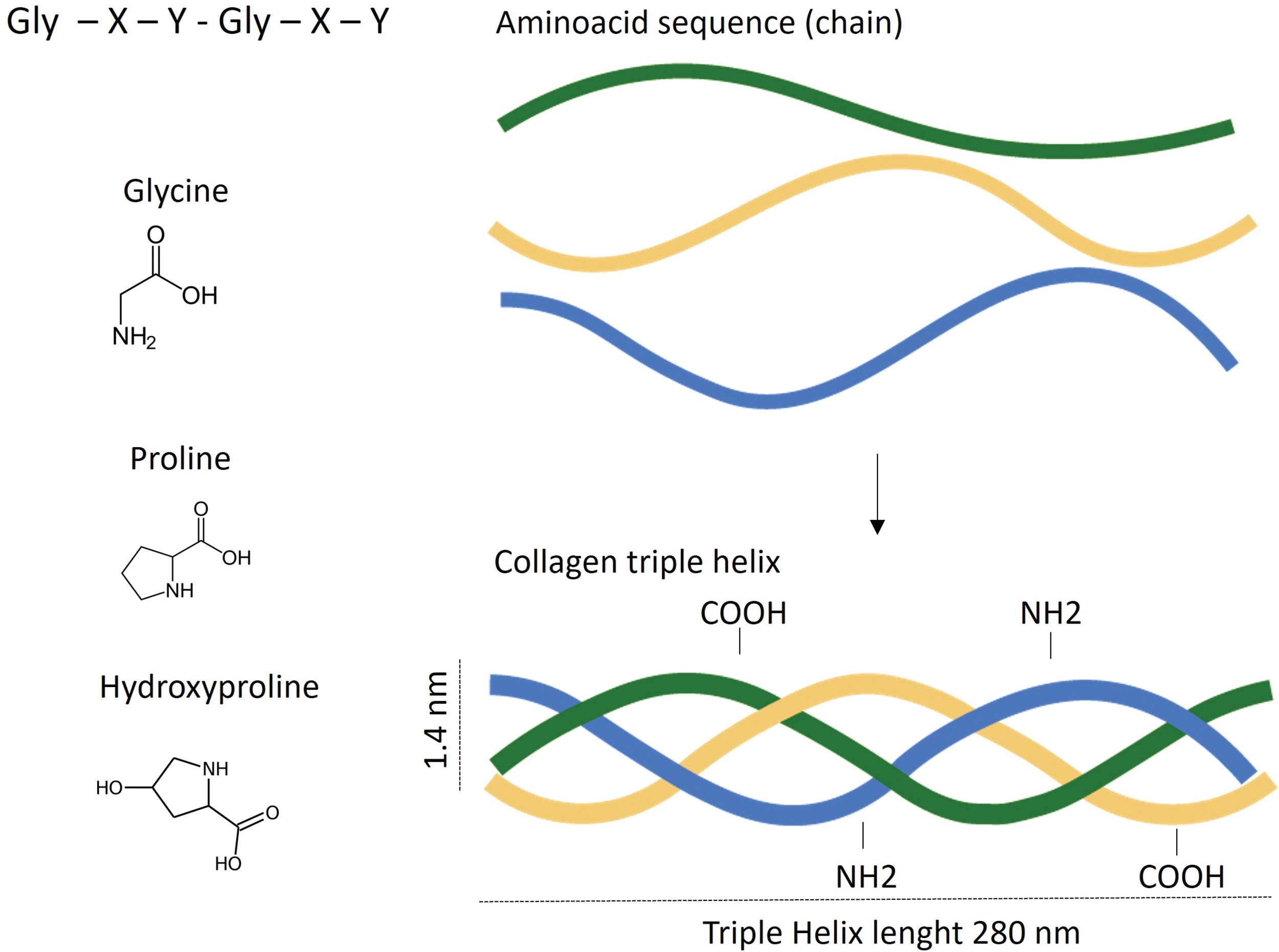
Schematic representation of the more representative collagen amino acids and their repeating sequence (Gly-X-Y), in which generally proline and hydroxyproline occupy the X and Y position three polypeptide alfa-chains wrap around each other to form the characteristic triple helix. Color images are available online.
Such amino acids have a key role in the stability of the polyproline II conformation of the individual chains, increasing the stability of the collagen triple helix. Through intramolecular hydrogen bonds between glycines in adjacent chains, the triple helix stability increases. 2 In MC, glycine is also the most common amino acid, but its ratio varies according to the species, tissue source, and extraction method. 9 In a total of 1000 residues per gram of protein, ASC and PSC from the skin of brown banded bamboo shark have in its composition 318 (ASC) and 323 (PSC) residues of glycine, 24 silver carp skin 329 (ASC), carp skin 332 (ASC), cod skin 342 (ASC), 25 blue shark collagen 392 (ASC) and 387 (PSC), and Nile tilapia 333 (ASC) and 338 (PSC). 35 Such amounts are in the range of the ones obtained for mammal collagen (Table 1).
Summarized Table of Glycine, Proline, and Hydroxyproline of Acid Soluble and Pepsin Soluble Collagen Obtained from Different Tissues of Diverse Marine Origin Organisms
ASC, acid-solubilized collagen; PSC, pepsin-solubilized collagen.
However, marine sponges present a lower content of glycine. The amount of glycine in Chondrosia reniformis was 189/1000, quite similar to those obtained for Spongia graminea 163/1000.36,37 Recently, a content of glycine around 257/1000 and 295/1000 was found for Axinella cannabina and Suberites carnosus, respectively. 38 Other marine invertebrate organisms like squid present similar glycine content when compared with marine vertebrates or terrestrial mammals. Collagen from skin and muscle of Kondakovia longimana was found to have 303/1000 (ASC), 323/1000 (PSC) and 315/1000 (ASC), 278/1000 (PSC), respectively. Skin collagen of Illex argentines was found to have 315/1000 (ASC) and 327/1000 (PSC) glycine content. 21
Collagen triplex helix is also stabilized by intramolecular hydrogen bonds between the hydroxyl groups of OHPro residues.2,39 In general, MC has low Pro and OHPro content (Table 1), which is dependent on the organism and surrounding environmental temperature. ASC of salmon and codfish revealed a lower content of Pro and OhPro when compared with blue shark (Prionace glauca) (Table 1) 40 that prefers higher water temperatures. Collagen isolated from 12 fish species, 6 from warmer habitats and 6 from colder habitats, was compared and the results showed collagen with different properties. In general, higher Pro and OHPro contents were found for fishes from warm seas. 41
Thermal stability
Circular dichroism spectroscopy (DSC) is traditionally used to study thermal stability through the assessment of collagen denaturation temperature (DT), together with differential scanning calorimetry (micro-DSC). Generally, the body temperature of fishes is lower compared with mammals, being its DT also lower. 47 At human physiological temperatures, MCs melts faster when compared with mammalian collagen, which compromises its use in terms of clinical applications. 48
For instance, the higher OHPro content of P. glauca significantly influences its higher DT (28°C–30°C) when compared with chum salmon (Oncorhynchus keta), which has a lower DT (19°C). MC thermal stability is also affected by the pH of the solution, wherein the collagen is dispersed. Collagen melting temperature from jellyfish varied from 29°C to 33°C when pH was changed from 3.0 to 7.5. 49 Surprisingly, it was recently found that tilapia collagen has higher DT when compared with sea bass and even porcine collagen. The authors suggested that this result might be attributed to the high content of OHPro and cysteine in tilapia collagen. 50 It was suggested that the triple-helix stability did increase due to the disulfide bonds formed between cysteine intermolecular crosslinking. 2
Collagen extraction from marine mammals is not common. So far, there is just one scientific publication 51 reporting the extraction of collagen from marine mammals, which was from Minke Whale (Balaenoptera acutorostrata), identified as type I collagen. Its DT was found to be ∼31.5°C, 6°C–7°C lower than porcine collagen, but significantly higher than most fish species. 51 It could be a potential collagen source for biomedical applications in terms of collagen properties, but not suitable in terms of source sustainability. This and similar species are covered by generic regulations for the protection of cetaceans or marine mammals in several range states.
Biocompatibility and biodegradability
The RGD [arginine (Arg)-glycine (Gly)-aspartic acid (Asp)] complex, present in collagen, has cell adhesion properties, making it an excellent building block for biomaterial development.
Collagen processing methodology, from its native form to the final product, must be fully validated to ensure reproducibility and safety for humans use. 52 Several studies have been conducted to assess the biocompatibility of MC and the devices derived from it, in agreement with ISO 10993 guidelines.35,53 In Europe, for collagen commercialization, a set of conditions should comply with the essential requirements defined in the Annex I of the Council Directive 93/42/EEC (replaced by the Medical Device Regulation (MDR) 2017/745).
Cytocompatibility evaluation of MC-based materials has been assessed in different studies. In vivo cytokine responses and in vivo inflammatory potential of crosslinked electrospun tilapia collagen membranes (CETC) were evaluated and compared with the commercial membrane Bio-Gide® (collagen from porcine origin) for oral tissue regeneration. CETC membrane exhibited a lower tissue response from the host when compared to that of Bio-Gide. 54 Also, Tilapia type I collagen did show high in vitro and in vivo biocompatibility. 54 C. reniformis has also been shown to be a sustainable source for safe collagen, due to its reduced toxic compounds. 55 The ability of marine-derived organisms to provide collagen that is both safe and enriched with biological signals supports its potential as an alternative to mammalian collagen for the production of medical products.
Generally, collagen from marine organisms presents a faster biodegradability due to its lower DT, but it occurs in the same way as collagen from mammalian origin. The cleavage by collagenase digestion of blue shark collagen occurred similar to pig collagen, although in a much faster rate. 42 This can be overcome by applying crosslinking agents that results in more stable forms, as discussed above.
MC for Hard Tissues: Fabrication Methods of Biomaterials
MC in the native, denatured (gelatin), or peptide form, instead of processed systems based on this biopolymer, leads the global market of MCs. 56 MC activity has been studied as a supplementary diet to assist skeletal development during growth57,58 and through coatings for cell culture. 58 MC and its derivates have been shown to promote the absorption of calcium and other minerals, contributing to bone homeostasis and growth. The development of MC medical devices is more challenging and still poorly explored, with only a few approaches reporting its processability into biomaterials. 59
MC processing demands a strict control of surrounding conditions, including pH and temperature to maintain its intrinsic structural, chemical, and biological properties. The crosslinking routes to increase MC stability are the same as the mammal ones since they have similar amino acid content and the same functional groups. Aldehydes (glutaraldehyde), 60 isocyanates (HMDI), 61 and carbodiimides (1-ethyl-3-(3-dimethylaminopropryl) (EDC) 62 have been by far the most widely used chemical crosslinking agents. To avoid the adverse effects associated with the chemical crosslinkers, physical or biological methods, like dehydrothermal (DHT), ultraviolet irradiation (UV), and transglutaminase, have been assessed. Physical and biological methods are often weak, and in the case of the physical methods, there is a great association with collagen denaturation. 2 For instance, salmon collagen scaffolds crosslinked with DHT demonstrated poor stability when compared with salmon collagen scaffolds crosslinked with EDC. 63
Therefore, its processing, including solvent conditions to disperse collagen and the production techniques, is still very limited to the most conventional techniques of structure fabrication, like solvent casting, electrospinning, hydrogelation, and freeze-drying, mainly resulting in simple materials such as membranes, gels, sponges, or similar others. 64 Freeze-dry holds the lion's share in preparation of marine-based biomaterials for biomedical applications—as it seems to occur with mammal collagens—particularly for hard tissue applications. This technique is straightforward, although time-consuming, using solvents that are rapidly cooled and gradually removed through vacuum sublimation, resulting in porous structures with great interest for cell attachment and spread. However, in many cases, these structures are deprived of desired network vasculatures due to inadequate porous and microarchitecture distribution, which often result in inadequate nutrient and oxygen diffusion to cells, leading to necrotic events and structure failure.
Due to their poor stability and mechanical properties, even after employing crosslinking agents, MCs as biomaterials in TE are often only possible after the combination with other polymers or robust materials, like ceramics, specifically when applied to the regeneration of bone tissue that must sustain higher compression forces. 65 Methodologies for collagen mineralization have been also applied to prepare polymer-ceramic materials. Biomimetically mineralized salmon collagen and fibrillated jellyfish collagen render in biphasic structures that simultaneously allowed the differentiation of hMSCs into osteogenic and chondrogenic lineage, resulting in promising osteochondral constructs. 66
Considering the advantages of MCs over mammalian collagens, there has been interest in exploring advanced techniques of collagen processing to generate more sophisticated and complex structures. Although there has been an increase in the number of attempts to employ the use of collagen for bioprinting, the use of marine-origin collagens is still poorly explored, and the arising studies have been focusing on the development of skin models.67,68 MC has poor mechanical properties for printing. Low concentrations of collagen do not allow enough viscosity, while increasing concentrations can result in high stiff (bio)inks, which can compromise cell viability. In addition, the long time needed for collagen gelation compromises the printing accuracy due to the rapid collapse of deposited layers.
The use of support materials, like natural biopolymers, is often required to improve ink performance.15,69,70 Alginate is one of the most used biopolymers, as support material, due to its shear-thinning behavior and fast polymerization with divalent cations. 71 Other polymers like chitosan are preferred due to its biological and anti-inflammatory properties and accessibility to be modified. For instance, the printing of eel collagen was only possible after its combination with methacrylated hydroxybutyl chitosan. The bioink was proposed for in situ bioprinting. 72 In another study, bioprinting of blue grenadier collagen was compared with porcine collagen and, it could be concluded that MC bioink presented lower viscosities, which allowed the printing without compromising cell viability. 69
To date, there is no standardized approach to prepare effective and biocompatible inks of collagen (both marine and mammalian) for 3D bioprinting. The use of marine origin collagens for bioprinting of orthoregeneration models is yet to be explored. In a first attempt, the in situ mineralization process was employed with blue shark collagen using a co-precipitation method, with the goal of 3D bioprinting models that incorporate living cells, aiming to enhance the regeneration of bone tissues. 73 The authors suggest the employment of advanced techniques of processing to avoid the use of crosslinking agents that, in most cases, cannot be directly used in cell-laden strategies due to its cytotoxic effects for cell.
Table 2 represents an exhaustive list of all the main works published so far with marine-origin collagen for bone, cartilage, and osteochondral applications. Collagen obtained from fish by-products shares a major part of all marine exploitation. This is likely due to the large availability of fish discards from the fish processing industry, which ultimately results in a higher sustainability of the source, both in quantity and supply costs. 56 Type I collagen extracted from tilapia, salmon, and sharks has been the most widely explored and applied in the biomedical field within the marine ones and will be particularly discussed.
Marine Origin Collagens Used on Different Strategies for the Engineering of Hard Tissues Applications (Bone, Cartilage, and Osteochondral) and Main Outcomes
The amino acid content is represented in gram per 1000 residues of protein. Calf and porcine skin and human tendon collagen were used as a mammalian collagen as comparative control.
ND, nonidentified; ECM, extracellular matrix; hMSC, human mesenchymal stem cell.
Tilapia collagen for hard tissue-related applications
Tilapia is a globally cultured fish, with an important position in China, being therefore widely available.35,105 Collagen obtained from its skin has been tested for different biomedical applications, namely the fabrication of scaffolds for bone and16,81 cartilage applications. 97 Compared to other marine-origin collagens, tilapia collagen has a high DT (nearly 37°C), which makes its use suitable for cell culture conditions. Tilapia scale collagen and porcine collagen fixed at 3 mg.mL−1 were used to cover culture dishes, being then placed in contact with hMSCs. 16 Collagen fibril formation was faster for tilapia collagen and upregulation of osteogenic markers was observed when hMSCs were cultured on a tilapia collagen surface, especially in the early osteoblastic differentiation stage.
These results suggest that the degree of fibril formation of tilapia collagen positively influenced the osteoblastic differentiation of hMSCs. Afterward, they studied the potential of using tilapia scales for the engineering of cartilaginous tissue. 97 According to the obtained results, tilapia collagen formed thicker fibrils in comparison with porcine collagen. According to the quantitative RT-PCR findings, the expression of chondrogenic markers such as SOX9 and AGGRECAN in hMSCs cultured on tilapia collagen exhibited a notably higher level in the early stage compared to those cultured on porcine collagen-coated dishes and control dishes. In addition, collagen II expression was significantly higher on the tilapia collagen, 6 days after cell culture, compared with that of porcine and the control treatment. They hypothesized that the special fluctuations of tilapia scale collagen might make the binding of integrin and collagen easier to trigger not only osteoblastic differentiation but also chondrogenic differentiation of hMSCs.
Salmon collagen for hard tissue-related applications
Salmon by-products are highly available, and collagen is easily isolated from its skin, being one of the most studied marine organisms. Nagai et al. studied its potential for different biomedical applications, including periodontal ligaments.58,63 In a groundbreaking study involving porous scaffolds made from crosslinked Oncorhynchus keta salmon collagen using EDC, the researchers showcased its capacity to stimulate the proliferation and alkaline phosphatase (ALP) activity in human periodontal ligament cells. Hoyer et al. demonstrated the feasibility of using porous scaffolds made of mineralized salmon collagen by freeze-dry technique. The resulting scaffolds exhibited interconnective porosities with stable mechanical properties. hMSCs adhered abundantly to these scaffolds and the osteogenic differentiation was demonstrated by the alkaline phosphatase activity. 75 In vivo, the potential of using salmon-derived atelocollagen sponges was tested in osteochondral defects of the femoral trochlea. Twelve weeks postimplantation, the regeneration of the critical-sized bone defect was evident when salmon collagen crosslinked sponges were used, compared with the empty control group. 103
Shark collagen for hard tissue-related applications
Collagen production from sharks has been getting increasing attention, especially from blue shark. The worldwide annual capture of blue sharks is estimated to be approximately 20 million individuals, making their by-products readily abundant. P. glauca is one of the widest ranging shark specie. 106 Nomura et al. published, for the first time, a comparative study between the biochemical features of P. glauca collagen in comparison with porcine collagen. 42 The results demonstrated a similar amino acid composition, although shark collagen has revealed a lower content of Pro. 42 Type-II collagen from blue shark cartilage comparatively with collagen from bovine origin was also studied after collagen processing into composite scaffolds by combination with chitosan or hydroxyapatite. 79
Marine-based composites showed higher stiffness, lower biodegradation rate, and better biocompatibility when compared with those of bovine collagen. In addition, they exhibited a higher ALP activity, suggesting its osteogenic potential. Elango et al. did investigate the potential of using P. glauca collagen (PSC and ASC) before its processing. Due to the higher OHPro content, PSC had higher thermal stability than that obtained for ASC, with DTs being 29.8°C and 28.3°C, respectively. Proliferation of differentiated mouse bone marrow-mesenchymal stem and of differentiated osteoblastic (dMC3T3E1) cells was enhanced in collagen-treated groups rather than in the controls, with upregulation of Runx2 gene expression.
P. glauca collagen was also studied by combining it with calcium phosphates 82 to produce scaffolds by freeze drying. EDC/NHS or HMDI was used to increase scaffold stability. In general, EDC/NHS-crosslinked scaffolds revealed a smaller pore size, suggesting a higher efficiency of crosslinking. In vitro, EDC/NHS-crosslinked scaffolds revealed a less cytotoxic effect over Saos-2 cell line. Functionalization of P. glauca collagen carboxylic groups with calcium ions resulted in collagen mineralized with nano-hydroxyapatite. Composites resulted in stable bioinks that supported hASC survival and differentiation into osteogenic lineage.73,90
Marine invertebrates' collagen for hard tissue-related applications
Collagen from invertebrates is mainly obtained from jellyfish and squid. Jellyfish from Rhopilema esculentum species has been used for the production of collagen, mainly type II collagen, being thus preferred for cartilage applications. In 2012, a new rat model for nasal cartilage replacement to evaluate the in vivo biocompatibility of jellyfish collagen was, for the first time, created. Due to the specificity of the immunological environment, subcutaneous animal models do not meet the requirements to study nasal cartilage reconstruction.
The freeze-dried jellyfish collagen scaffolds did provide good microenvironmental conditions to produce cartilaginous ECM. 76 Also, Pustlauk et al. studied the potential of combing R. esculentum type II collagen with alginate to make collagen scaffolds for chondrogenic differentiation of hMSCs. R. esculentum collagen did show a similar composition when compared with mammalian type II collagen, supporting the chondrocytic phenotype. 96 Hoyer et al. studied the potential of type II collagen from R. esculentum for cartilage repair, after its processing into 3D structures. 20 The freeze-dry technique resulted in cytocompatible scaffolds with upregulation for chondrogenic markers (SRY-box transcription factor, aggrecan, and Collagen II). Ribbon jellyfish (Chrysaora sp. morphotype) was also used to extract type II collagen with a maximum yield of 19%. 107
Type II collagen extracted from squids was also studied for cartilage repair in degenerative osteoarthritis cases,108,109 being also demonstrated as a useful material for biofilm preparation in composites with chitosan 110 and hierarchical scaffold production with improved mechanical properties and cell seeding efficiency. 21
Still, within the invertebrate organisms, only a few works reported the extraction of sea urchin, star fish, cuttlefish, prawn, and octopus collagen and their potential for biomedical applications.19,111,112
Conclusions and Future Remarks
The performance of MCs to be used as biomaterials is highly dependent on several parameters, including (1) preservation of marine biomass: to avoid collagen decomposition and contamination. Raw materials should be stored in specific conditions, such as freezing and/or a CO2 atmosphere, and extracted at the earliest convenience. (2) Source: sources such as fish scales, skin, and bones are primarily abundant in type I collagen, whereas fish cartilage, such as shark cartilage, predominantly contains type II collagen. Type IV collagen is mainly obtained from marine sponges and some jellyfish. The structural properties of MCs can affect their functionality and suitability for TE applications.
Type I collagen is the preferred choice for bone applications, while type II collagen is commonly needed for cartilage applications. (3) Extraction methods: collagen extraction from marine sources can be challenging due to the presence of other proteins and impurities. The yield and purity of collagen are affected by the selected methodology of extraction. ASC and pepsin render collagens with better properties. (4) Biocompatibility: MCs are recognized for their excellent biocompatibility, but further research is needed to fully understand their interactions with cells and tissues.
Improving the biocompatibility of MC can enhance its effectiveness in TE and regenerative medicine applications. (5) Processability: considering biomaterials for the engineering of hard tissues, MCs are mostly processed by conventional techniques, like freeze-dry and solvent casting, which are limited to the creation of simple structures such as membranes, gels, powders, and sponges, unlike the need described by physicians of more complex structures to better mimic the human native tissue. Although a huge variety of marine-origin collagen-based scaffolds have been explored in in vitro studies for bone and cartilage regeneration, there is still a scarcity of in vivo animal experiments. To our knowledge, there is still no MC-derived product applied to hard tissues in the market.
The future trends in the use of MC for the regeneration of hard tissues are as follows:
Prioritization of collagens with higher thermal stability and enhanced mechanical properties. When selecting the marine source, consider its sustainability and the potential properties of the collagen that can be obtained. Improvement of collagen performance through the employment of nontoxic crosslinking agents to increase collagen thermal stability; functionalization of collagen to allow faster and more efficient crosslinking and improve its mechanical properties and degradation rate; functionalization with growth factors to stimulate cells; and blends with polymers or ceramic materials to enhance mechanical properties and degradation rates. Provide an adequate synergy between material chemistry and 3D microarchitecture to enhance the regenerative capabilities. Advanced processing techniques (3D (bio)printing, gene therapy, and biomimetic technologies) should be investigated to render biomaterials to meet the hierarchical structure and function of targeted tissues. Modifying collagen structure can result in more sustained degradation. Further in vivo experiments to deeply investigate the impact of collagen-derived biomaterials to better elucidate the safety, efficacy, and immunological response in the host, to reach the clinical trial phase, and to finally develop market solutions.
As summary, MCs are highly available making them sustainable and scalable with industrial relevance. Its usage minimizes the risk of zoonotic disease transmission to humans, reduces most religious restrictions, and has fewer regulatory and quality control constraints. Biologically, it is biocompatible and easily absorbed. The multitude of sources from which collagen can be obtained and the diversity of collagen types that can be attained transform the aquatic environment into an inspire reservoir with huge potential for future medical advancements.
Authors' Contribution
D.G.S.: Conceptualization, methodology, writing - original draft preparation, and writing - review and editing. P.R.P.: Writing - review and editing. R.R.L.: Funding acquisition and supervision. S.T.H.: Writing - review and editing, supervision, and funding acquisition.
Footnotes
Disclosure Statement
No competing financial interests exist.
Funding Information
This study was funded by the Portuguese Foundation for Science and Technology (FCT) under the scope of the BiogenInk project (M-ERA-NET2/0022/2016), by European Regional Development Fund through INTERREG Atlantic Area Program, under the scope of BLUEHUMAN (EAPA_151/2016) project and through Norte de Portugal Regional Operational Program (NORTE 2020), under the scope of Structured project NORTE-01-0145-FEDER-000021 and NORTE-01-0145-FEDER-000040 (ATLANTIDA) and through the Next Generation EU European Fund, under the incentive line “Agendas for Business Innovation” within Component 5 - Capitalization and Business Innovation of the Portuguese Recovery and Resilience Plan (RRP), under the scope of the project “BLUE BIOECONOMY PACT” (Project No. C644915664-00000026). The Doctoral Program NORTE-08-5369-FSE-000037 supported by NORTE 2020, under the PORTUGAL 2020 Partnership Agreement, through the European Social Fund, is also greatly acknowledged by the PhD fellowship of GSD. RP thanks FCT for the contract IF/00347/2015.

References
Supplementary Material
Please find the following supplemental material available below.
For Open Access articles published under a Creative Commons License, all supplemental material carries the same license as the article it is associated with.
For non-Open Access articles published, all supplemental material carries a non-exclusive license, and permission requests for re-use of supplemental material or any part of supplemental material shall be sent directly to the copyright owner as specified in the copyright notice associated with the article.
