




Abstract
Wound healing has been a challenge in the medical field. Tremendous research has been carried out to expedite wound healing by fabricating various formulations, some of which are now commercially available. However, owing to their natural source, people have been attracted to advanced formulations with herbal components. Among various herbs, curcumin has been the center of attraction from ancient times for its healing properties due to its multiple therapeutic effects, including antioxidant, antimicrobial, anti-inflammatory, anticarcinogenic, neuroprotective, and radioprotective properties. However, curcumin has a low water solubility and rapidly degrades into inactive metabolites, which limits its therapeutic efficacy. Henceforth, a carrier system is needed to carry curcumin, guard it against degradation, and keep its bioavailability and effectiveness. Different formulations with curcumin have been synthesized, and exist in the form of various synthetic and natural materials, including nanoparticles, hydrogels, scaffolds, films, fibers, and nanoemulgels, improving its bioavailability dramatically. This review discusses the advances in different types of curcumin-based formulations used in wound healing in recent times, concentrating on its mechanisms of action and discussing the updates on its application at several stages of the wound healing process.
Impact statement
Curcumin is a herbal compound extracted from turmeric root and has been used since time immemorial for its health benefits including wound healing. In clinical formulations, curcumin shows low bioavailability, which mainly stems from the way it is delivered in the body. Henceforth, a carrier system is needed to carry curcumin, guard it against degradation, while maintaining its bioavailability and therapeutic efficacy. This review offers an overview of the advanced technological interventions through tissue engineering approaches to efficiently utilize curcumin in different types of wound healing applications.
Introduction
Curcumin (diferuloylmethane) is a lipophilic bioactive compound present in turmeric (perennial herb Curcuma longa) and belongs to the Zingiberaceae ginger family. 1 It is commonly called “Indian Saffron” and has been found in 133 species worldwide.1,2 The use of turmeric dates back to the Vedic age, when it was utilized primarily as a culinary spice and in religious ceremonies. India produces most of the turmeric crop virtually globally, and its domestic consumption amounts to 80%. 1
Indian turmeric is considered the finest due to the presence of many bioactive components. Over the past millennia, curcumin mixed with lime has long been used as an anti-inflammatory and wound-healing home remedy. It has been seen as a potential medicine to treat malignancies, senescence, and tissue repair in contemporary times.1–5 Curcumin exhibits a wide range of therapeutic properties such as antioxidant (free radical scavenging), antimicrobial, hyperlipidemic, anti-inflammatory, anticarcinogenic, antimutagenic, hepatoprotective, neuroprotective, cardioprotective, and radioprotective.
Moreover, curcumin can bind and inhibit various growth factor receptors, thus positively influencing wound healing.2–8 Food and Drug Administration of the United States of America (FDA)-approved curcumin is generally regarded as safe. 4 Grand View Research released new research on “Curcumin Market Size, Share & Trends Analysis Report By Application (Pharmaceutical, Food, Cosmetics), 2020–2028.” The global curcumin market was valued at USD 65.36 million in 2021 and is projected to reach USD 191.89 million by 2028, registering a CAGR of 16.1% from 2020 to 2028. 9 In 2020, the pharmaceutical segment accounted for >51.82% of the worldwide curcumin market. 9
Because of expanding public knowledge of its medical characteristics and health advantages, product demand has increased worldwide in recent years. Due to its nontoxicity, curcumin is also widely used in tissue engineering, and businesses are progressively devoting themselves to research to improve its use in the medicinal industry. 9 Therefore, scientists have explored these properties for developing wound-healing materials.4,5,10,11 Curcumin's therapeutic efficacy is restricted due to its lower solubility and extensive first-pass (rapid degradation) metabolism into inactive metabolites.
As a result, it becomes unstable during processing and is difficult to dissolve in water.4,5,12,13 Therefore, a carrier system is required to pack curcumin, protect it from degradation, maintain its antioxidant effects, and increase its bioavailability and efficiency. To significantly increase curcumin's bioavailability, it is encapsulated in various artificial and organic substances, including microspheres, hydrogels, liposomes, nanoparticles (NPs), films, matrices, scaffolds, and nanoemulgels.14–17 A brief outline of the curcumin properties and their tissue engineering-based formulations for wound-healing applications has been described in a pictorial form, as shown in Figure 1. This review assesses different types of “advanced formulations of curcumin” used in “wound healing,” concentrating on its mechanisms of action and giving evidence for its effects at various phases of the wound-healing process.

Schematic illustration showing curcumin properties and their formulations for wound-healing applications. Color images are available online.
Role of Curcumin in the Wound-Healing Process
A wound is a break in the skin or tissue integrity (as from surgery, accident, or violence), which may be associated with disruption of the structure and function. 18 Wounds are of various types, classified based on causes (traumatic, malignant, thermal, surgical, electrical), contamination (cleaned, contaminated, dirty wounds, wound base colour, and many other reasons),19,20 as shown in Figure 2. According to a WHO survey, >5 million people die each year from wounds, including burns, falls, drownings, and traffic accidents. More than 10 million people suffer from nonfatal injuries requiring effective treatment. 21
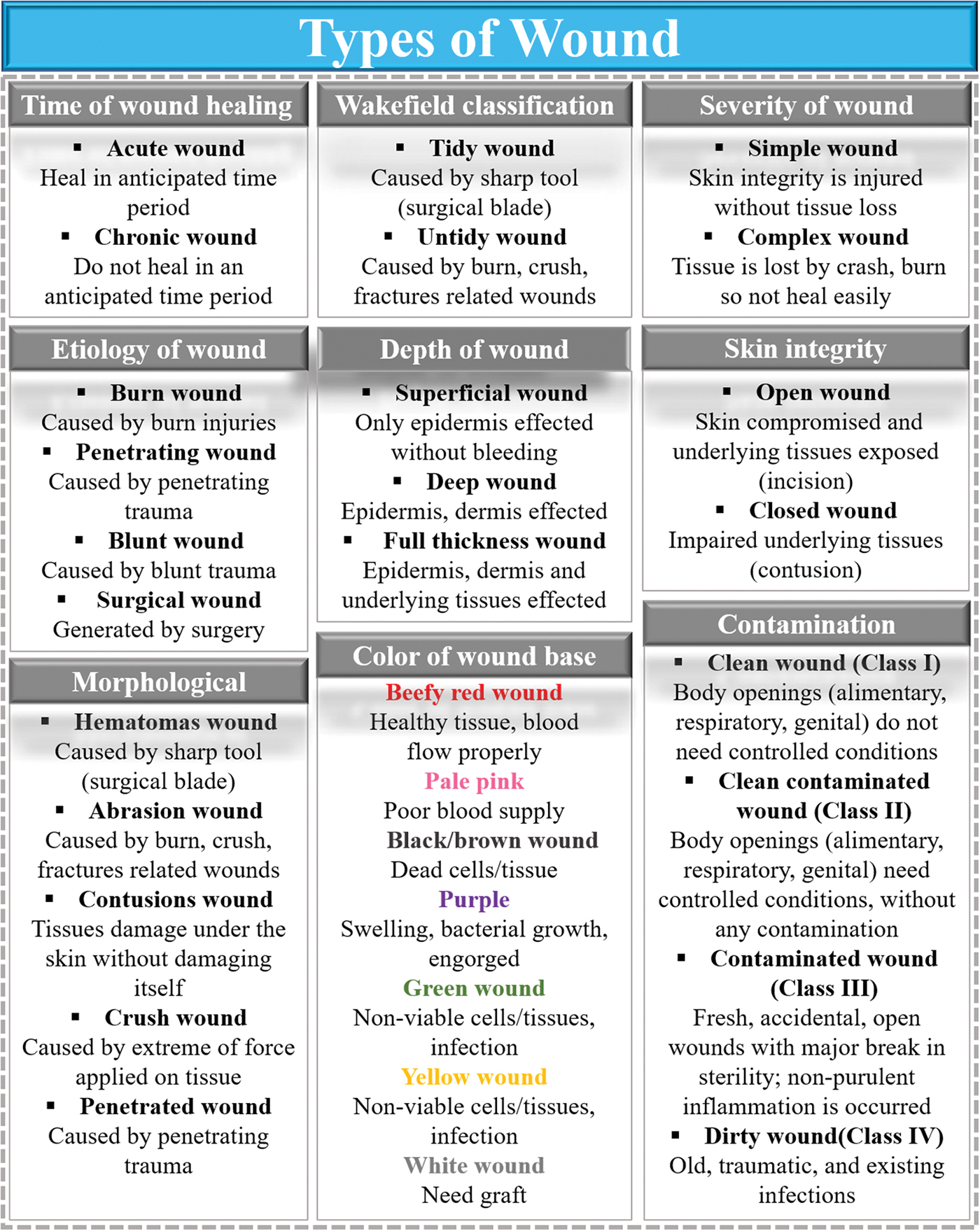
Classification of different types of wounds. Color images are available online.
Primarily, all wounds may be designated as acute and are expected to pass through natural wound-healing phases; that is, hemostasis, inflammation, proliferation, and maturation/remodeling,19,22 as shown in Figure 3. Acute wounds generally occur due to mechanical stress, heat, electrical shock, light, and exposure to corrosive chemicals. They usually heal completely within 6 weeks. In point of fact, wound healing is regulated by activating various biological pathways, cell growth factors, cytokinins, and chemokines, interacting in a highly sophisticated and systematic sequence.
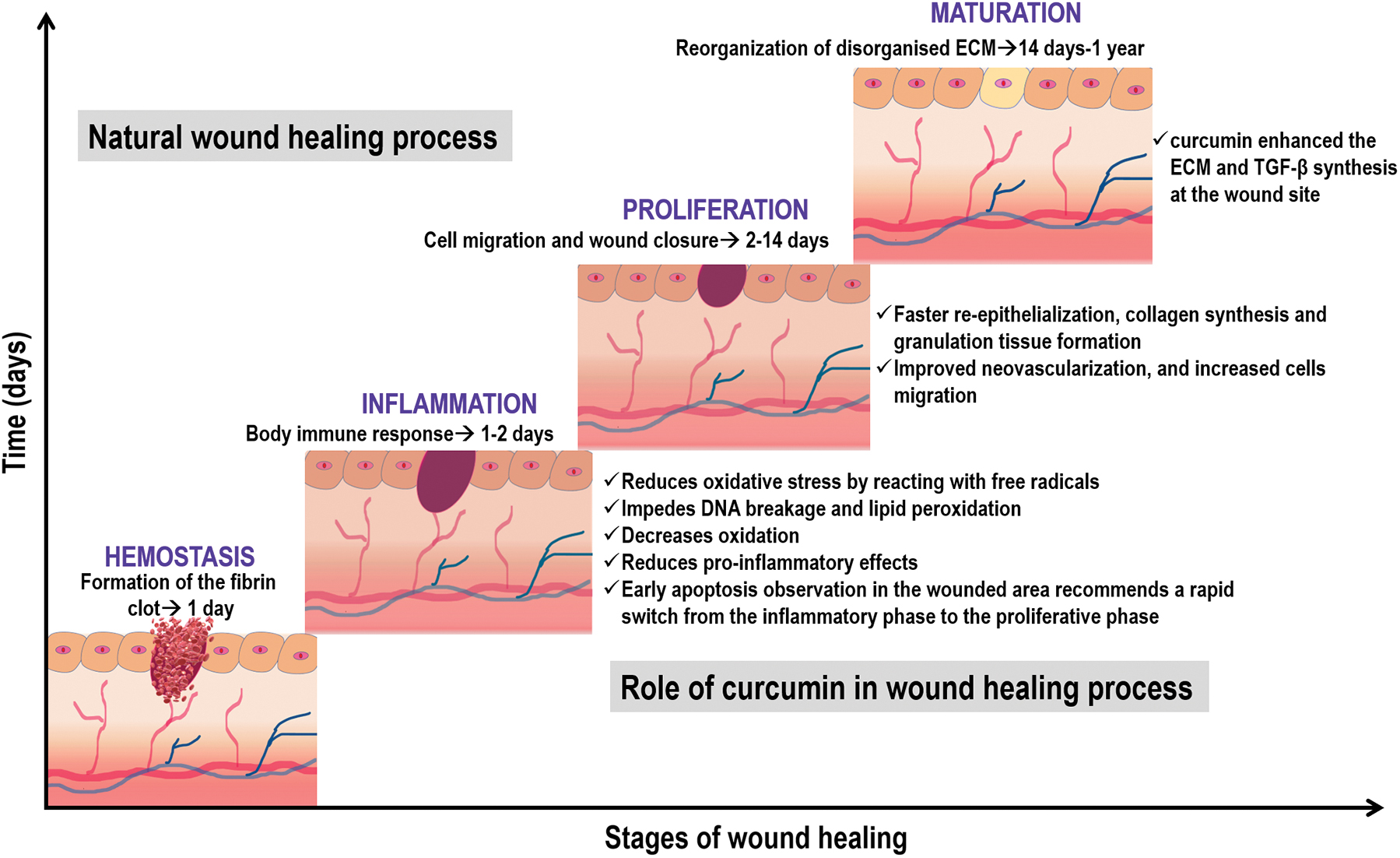
Timeline of four sequential and overlapping phases of the natural wound-healing process and the role of curcumin in different stages of wound healing. Color images are available online.
The wound-healing phase maintains an intricate and sophisticated balance between each healing phase.22–24 If one of the four wound-healing phases lasts >6 weeks, it is considered chronic, for example, leg or pressure ulcer.18,25 However, chronic wounds are mainly the outcomes of diseases (such as diabetes, vascular insufficiency, cancer, and severe infections) that require >12 weeks for wound healing and may fail to gain an everyday healthy life. According to the depth of wounds, there are three different wounds: superficial wounds (only the epidermis is affected without bleeding), deep wounds (entire skin is affected), and full-thickness wounds (entire skin, muscles, tendons/bones are damaged).
At the wound site, there will be an elevation in reactive oxygen species (ROS) production and biofilm growth, causing wound healing to be delayed and restoration of complete skin function to be hampered. 26 In addition, for chronic illnesses, including diabetes, malignant lesions, chronic ulcers, tissue dysfunctions, and postsurgical problems, delayed wound healing is a significant worry. Abnormal inflammation during wound healing may lead to chronic wounds, especially in type 2 diabetes. Exaggerated proliferation may result in scar formation, which is not aesthetically pleasing and reduces the quality of life. 27
Chronic wounds are challenging wounds that have not responded well to the available therapies during the healing process and are substantially more expensive than standard wound management. Millions of people have suffered worldwide, and ∼5.7 million in the United States suffer from chronic wounds. The global market for chronic wound care in 2021 was USD 11.61 billion.1,2 From 2022 to 2029, the market is projected to grow at a CAGR of 6.7%, from USD 12.36 billion in 2022 to USD 19.52 billion. Therefore, an effective and economical chronic wound-healing technology is required to develop to expedite wound healing and eliminate the life-threatening risk.
To accelerate wound healing, researchers have developed various types of wound dressings, antibiotics, ointments, herbal extracts, gauze, and bandages available on the market.19,25,28,29 Among various herbal extracts, turmeric extract (curcumin) has gained significant attention since ancient times due to its wide range of therapeutic properties such as antioxidant (free radical scavenging), antimicrobial, hyperlipidemic, anti-inflammatory, anticarcinogenic, antimutagenic, hepatoprotective, neuroprotective, cardioprotective, and radioprotective. Thus, curcumin can help at different stages of the natural healing process and impede numerous growth factor receptors, thus positively influencing the wound-healing process.2–8
According to the research literature on “Curcumin for wound healing,” a search was conducted using “Web of Science” to find published articles in peer-reviewed scientific journals. A comprehensive literature review has revealed that curcumin plays a significant role in facilitating the wound-healing cascade. This is achieved through its ability to enhance epithelial regeneration, promote increased fibroblastic proliferation, and enhance vascular density. 10 Curcumin's role in various stages of the wound-healing process is explained below.
Hemostasis
To stop blood loss at the site of an injury while preserving normal blood flow elsewhere in the circulation, clot formation occurs due to the natural physiological phenomena known as hemostasis. It is the first phase of the wound-healing process, which involves blood coagulation to stop bleeding. When an injury occurs, the exposed tissue factors and endothelium will stimulate platelet aggregation, resulting in degranulation and discharging of chemokines and growth factors, vital for blood clot formation.
In brief, endothelial cells produce von Willebrand factor to start hemostasis, and arterial vasoconstriction, which limits blood flow, and release adenosine 5′ diphosphate, which in turn leads to platelet plug formation and initiates the thrombosis process. The last step in the hemostasis is the fibrin clot formation encouraged by releasing plasma factor VII (FVII) and prothrombin. White blood cells and red blood cells become engaged in fibrin plugs. The platelet and fibrin plug seal the blood vessel's injury until the tissue is regenerated.22–24
Inflammation
Inflammation is the second overlapping phase of the wound-healing process in which a protective response of the body tissues (e.g., immune cells) will activate against the harmful stimuli (e.g., pathogens, irritants, or damaged cells). First, neutrophil cells will clean the cell debris and bacterial cells at the wound site to create a suitable environment for routine wound healing. Then, macrophage cells aggregate, which helps in the phagocytosis of bacteria and damaged tissue. During the inflammation period, macrophages (e.g., TNF-α, TGF-β, PDGF, tumor necrosis factor-α) and cytokines (e.g., IL-1, IL-6) produce growth factors that help endothelial cells and fibroblasts proliferate more easily later in the postinflammation stage.22–24
Curcumin is widely recognized for its anti-inflammatory properties, and it is found to interact with a variety of inflammatory cytokines. When a curcumin-based formulation was applied to the wound, curcumin displayed a suppression of the nuclear factor-kappa B (NF-κB) activation, which is a leading factor for the expression of proinflammatory genes and cytokines. 30 By downregulating NF-κB activation, curcumin was found to decrease the production of cytokines (TNF-α and IL-1) produced through monocytes and macrophages that regulate inflammatory responses.31,32
Furthermore, oxidative stress is generated during the inflammatory phase of wound healing, leading to tissue damage and hindering wound healing. Curcumin is also known for its antioxidant properties. It reduces oxidative stress by scavenging excessive free radicals, enhancing the activity of endogenous antioxidant enzymes such as superoxide dismutase and catalase.
Moreover, curcumin inhibits DNA breakage and lipid peroxidation, facilitating healing. Curcumin (dose-dependent) increases and decreases the expression of antioxidant enzymes, and decreases oxidation through nonenzymatic/enzymatic mechanisms.5,33–36 Moreover, curcumin affects the movement and behavior of immune cells. It can control the flow of neutrophils and macrophages to the area of the wound, which will aid in tissue regeneration and the reduction of inflammation.7,37,38
Proliferation
The proliferation/granulation (growth of new tissue) phase begins mainly on the second day after an injury. In this phase, new cells/tissues form by wound contraction, collagen deposition, angiogenesis, epithelialization, and granulation tissue formation. Vascular endothelial cells create new blood vessels during angiogenesis, then the provisional extracellular matrix (ECM) is formed by secreting fibronectin and collagen. Simultaneously, Re-epithelialization of the epidermis occurs when epithelial cells multiply and crawl over the wound bed to protect developing tissue.
Myofibroblasts grab the borders of the wound during wound contraction and contract using a method akin to that of smooth muscle cells to reduce the size of a wound. New cells undergo apoptosis when their functions are nearly complete.22–24 To build a new epidermal layer over the wound, keratinocytes must move and multiply in a process known as re-epithelialization. Curcumin has been found to encourage keratinocyte migration and proliferation by influencing growth factors and signaling pathways. To promote keratinocyte migration and proliferation, it upregulates the expression of the epidermal growth factor receptor, and stimulates the ERK1/2 and Akt signaling pathways.31,32,39
Furthermore, curcumin can affect angiogenesis by controlling the expression of fibroblast growth factor and vascular endothelial growth factor (VEGF). The ECM is degraded during angiogenesis by factors including matrix metalloproteinases (MMPs) associated with angiogenesis.31,32 An important phase in wound healing is the development of granulation tissue, which curcumin has been shown to encourage. Fibroblasts, collagen, and ECM substances make up granulation tissue. To build a robust and supporting tissue, curcumin increases collagen production and fibroblast proliferation.3,7,31,40
Overall, curcumin-treated wounds depict faster re-epithelialization, collagen synthesis, granulation tissue formation, improved neovascularization, and increased cell migration (e.g., dermal fibroblasts and myofibroblasts into the wound bed). If early apoptosis occurs in the injured region, it quickly transitions from the inflammatory to the proliferative healing phase. Compared with type I, it produces more type III collagen.5,33–36
Maturation
Maturation is the final stage of the wound-healing process, characterized by remodeling newly developed tissue and restoring its functional integrity, which arises from days 14 to 1 year or even longer. In this phase, the granulation tissue formation stops by apoptosis or differentiation of fibroblasts, and collagen synthesis continues to strengthen the tissue.
Maturation takes place as the wound contracts and the fibers reorganize. Scar tissue approaches ∼80% of the tensile strength of uninjured skin as the wound begins to contract. Since this healed tissue's tensile strength is no longer equal to uninjured skin, it will still be more vulnerable to breakdown. If the skin were reinjured in the same region currently at 80%, skin tensile would be between 60% and 70% at the end of those four phases of healing. The maturing scar exhibits controlled anabolic and catabolic processes under normal physiological conditions, ultimately favoring the scar maturation in connective tissue.22–24
Various research studies have already demonstrated the potential of curcumin in the maturation phase of wound healing.1,5,10,41,42 Collagen, a significant component of the ECM in injured tissue, undergoes reorganization during maturation to enhance tissue strength and flexibility. Curcumin has been shown to influence collagen production and organization, improving the injured tissue's tensile strength and overall integrity.43,44
Furthermore, MMPs, which are responsible for breaking down and remodeling ECM components, play a crucial role in tissue remodeling. Reports indicate that curcumin modulates MMP expression and activity, preventing excessive collagen degradation and other matrix proteins.31,43,44 This controlled MMP activity contributes to appropriate tissue remodeling. Excessive scar tissue formation, known as fibrosis, can negatively affect both tissue function and appearance.
Curcumin's antifibrotic properties come into play by regulating the production of cytokines and factors associated with fibrosis. This helps reduce the excessive formation of scar tissue, ensuring tissue remodeling occurs with minimal accumulation of fibrotic tissue.31,43,44 As a result, researchers have been exploring the development of various curcumin-based wound dressings aimed at accelerating wound healing. These dressings harness curcumin's multifaceted effects to support the different stages of wound healing, including the crucial maturation phase.5,33–36
Use of Curcumin in Wound-Healing Application
Unformulated curcumin for wound-healing application
Curcumin is considered safe and effective in pharmacological tests, making it a promising chemical for treating and preventing many human illnesses. Research suggests that curcumin has poor solubility in an aqueous solution and low bioavailability. Wahlstrom et al. reported that after oral treatment of 1 g/kg curcumin to Sprague–Dawley (SD) rats, minimal quantities of curcumin were found in the blood plasma of the rats, perhaps due to inadequate gut absorption. 45 Several investigations on the bioavailability of curcumin have reported that a specific quantity of curcumin is bioavailable in animal serum.1,2,4,10,46
In an investigation done in freely moving rats, it was found that curcumin treatment (500 mg/kg, p.o.; via mouth) resulted in 1% of its bioavailability in rat plasma. 47 Oral treatment of curcumin (1000 mg/kg) in rats resulted in 15 ng/mL blood plasma concentrations after 50 min. In contrast, after 1 h, an oral curcumin dosage of 4–8 g resulted in a peak plasma level of 0.41–1.75 M. Similarly, in a human clinical study, 3.6 g of curcumin taken orally produced a plasma curcumin level of 11.1 nM after an hour of treatment.45,47,48 Another case study reported that when rats were injected with 10 mg/kg curcumin intravenously, it resulted in a maximum serum curcumin level of 0.36 g/mL, but also a 50-fold greater curcumin dosage given orally resulted in a maximum serum curcumin level of 0.060.01 g/mL in rats. 49
Formulated curcumin for wound-healing application
According to accumulating evidence, formulated curcumin has superior absorption and biological activity than unformulated curcumin in most, if not all, cases.10,48 Curcumin liposomes containing dimyristoyl phosphatidylcholine and cholesterol suppress prostate cancer cell growth 10 times better than curcumin alone. 48 Aside from that, poly-lactic co-glycolic acid (PLGA)–loaded curcumin is added more actively than unformulated in apoptosis in leukemic cells and inhibits tumor cell growth in various tumor cell lines. Inhibition of NF-B activation and reduction of NF-B-regulated proteins implicated in cell proliferation and angiogenesis were similarly more effective than curcumin.
Diethylnitrosamine-induced hepatocellular cancer in rats was eliminated by PLGA nanocapsule curcumin. 48 Curcumin has been encapsulated with cyclodextrin (CD) and cyclic oligosaccharides to enhance transport and bioavailability. Such encapsulated complexes exhibit higher cellular absorption and longer life. Furthermore, compared with free curcumin, CD-encapsulated curcumin exhibited relatively improved curcumin permeability through animal skin tissue by ∼1.8-fold.
Compared with curcumin, these results show that CDC has better bioavailability and chemotherapeutic effectiveness in vitro and in vivo.50,51 Researchers recently developed various curcumin-encapsulated formulations to enhance curcumin's bioavailability and expedite the wound-healing rate. Table 1 shows different curcumin-based formulations developed for wound-healing applications in the last 5 years.
Recent Advances (Last 5 Years) in the Curcumin-Based Formulations for Wound-Healing Application
DG-SIS, decellularized goat small intestine submucosa; TiO, titanium dioxide; GO, graphene oxide; rGO, reduced graphene oxide; EGF, epidermal growth factor; PCL, poly(ɛ-caprolactone); MFSC, curcumin-Fe-mesoporous silica nanoparticle; PCU, APEGylatedcurcumin; PVA, polyvinyl alcohol; PVP, polyvinyl pyrrolidone; PLLA, poly (L-lactic acid); hEGF, human epidermal growth factor; MSC, mesenchymal stem cell; CMC, carboxymethylcellulose; PLGA, poly-lactic co-glycolic acid); PHB, polyhydroxybutyrate; HELP, human elastin-like polypeptide; SPU, amphiphilic-block segmented polyurethane; PEG, polyethylene glycol; PEGMA, PEG methyl ether methacrylate; PHBV, poly(3-hydroxy butyric acid-co-3-hydroxy valeric acid); THC, tetrahydro curcumin; curcumin; HP-γ-CyD, 2-hydroxypropyl-γ-cyclodextrin; HPG, hyperbranched polyglycerol; PLA, poly (lactic acid).
Curcumin in films
Film dressings are polymeric sheets that provide injured tissue a wet healing environment. Li et al 52 used the solvent casting evaporation method to load curcumin NPs into a methoxypoly(ethylene glycol) (MPEG)-graft-chitosan composite film. Curcumin NPs were utilized in their investigation to overcome the drug's limited water solubility and stability. When the fabricated curcumin-MPEG-chitosan film was applied over the rat wound resulted in effective re-epithelialization, wound contraction (90%), and collagen production within 2 weeks at the injured region. Their findings support the idea that topical application of curcumin-MPEG-chitosan films might be a viable and effective way to aid cutaneous wound healing.
In another study, 53 curcumin was combined with ethyl cellulose and polyvinylpyrrolidone. Rat wound demonstrated considerable wound contraction in a short period than control. Patches depict arranged collagen fibers and better angiogenesis effect than other groups. Curcumin-incorporated collagen films (CICMs) were proposed by Gopinath et al. to quicken cutaneous wound healing. When CICMs were applied to Wistar rat's wound, the wounded rat exhibited a more significant wound reduction, increased collagen expression, and granulation tissue production showed encouraging results than other formulations.
Histological investigations revealed substantial infiltration of inflammatory cells, fibroblast expression, and granulation tissue development, indicating that topical use of CICMs might be a viable and effective strategy for cutaneous wound healing. 54 Leng and coworkers fabricated the curcumin NPs-loaded PVA/collagen film (CPCF), which depicts antibacterial properties, good histocompatibility, and sustained release of curcumin in the long term (Fig. 4).

Curcumin in film-based formulation for wound-healing application.
Moreover, CPCF displays an expedited wound-healing rate (98.03% ± 0.79%), and promotes collagen fibers and mature epithelialization on day 15 after wound creation more than other formulations. Hematoxylin–eosin (H&E) staining depicts noticeable hair follicles and earlier re-epithelialization in CPCF-treated group. 42 Many other researchers developed curcumin-loaded films to improve the curcumin bioavailability and expedite the healing rate, as shown in Table 1.
Curcumin in fibers
Nanofibers are garnering much interest in creating an optimum wound dressing that may be utilized to treat challenging wounds. Nanofibers have structural similarities to native ECM, and such morphological characteristics offer different sites for binding cells, facilitating successful adhesion and proliferation, making them excellent for wound dressing.27,38 These nanofibers' high surface area to volume ratio also helps them absorb different exudates from the wound site. A highly porous nanofibrous network with tiny pores also promotes effective gaseous exchange and inhibits microbial infiltration. 55
In addition, some bioactive compounds, antibiotics, and growth factors may be readily encapsulated in the fibers during the manufacturing process for effective delivery of bioactive substances at the site of wounds, speeding up wound healing.56–61 Various scientists have loaded curcumin into various fibers in this regard. Pandey et al. developed curcumin-encapsulated nanofibers for wound-healing applications, as shown in Figure 5. The fabricated fibers were hemocompatible, antibacterial, and biocompatible, and expedited the wound-healing rate with higher content of collagen at the wound site.

Curcumin-incorporated nanofibers for wound-healing application. Reprinted with permission from Brochhausen et al. 61 Color images are available online.
Curcumin's synergistic antioxidant effect aided in hunting ROS and reduced oxidative stress for faster antiscar healing of a full-thickness wound. Curcumin's natural properties aided in scar reduction. 62 Furthermore, Merrell et al. established curcumin-loaded poly(ɛ-caprolactone) nanofibers for cutaneous wound healing. Under oxidative stress, they showed cytocompatibility with human fibroblast cells. Some studies have depicted enhanced wound healing in the streptozotocin-induced diabetic mouse model by free radical scavenging characteristics. 38
Mohanty et al. developed a curcumin-loaded oleic-acid bandage that proved the curcumin is solubilized in oleic acid and showed sustained release of curcumin over prolonged periods at the wound site. In their study, curcumin-loaded bandages effectively healed the full-thickness wounds in SD rats. The bandage confirmed the maximum collagen synthesis and minimum apoptosis, inhibited oxidative damage, and minimized inflammation through the NF-κB pathway downregulate at the wound site. 10 Furthermore, Lian and his coworkers formulated the curcumin-loaded nanofibers.
Curcumin depicted a sustained-release behavior, and nanofibers kept their antioxidant properties and effectively inhibited the growth of Staphylococcus aureus. 63 Prakash et al 64 loaded the curcumin in cellulose acetate nanofiber, which depicts sustained curcumin release behavior, considerable antibacterial activity, hemocompatibility, and biocompatibility. Further, Kulkarni and coworkers 65 fabricated a curcumin-encapsulated gelatine nanofibrous mat. In their study, the crosslinking density of fibers exaggerated curcumin release behavior, and mats displayed efficient cell growth and antibacterial and anti-inflammatory effects.
Furthermore, Perumal et al 66 developed curcumin-incorporated poly (lactic acid) and hyperbranched polyglycerol-based nanofibers that exhibited high swelling behavior and curcumin release in a controlled way. The nanofibers also illustrated significant cell growth of 3T3 fibroblast, capable of 100% healing in 36 h at in vitro scratch test. Several other scientists also loaded the curcumin into different fibers to improve the curcumin bioavailability and expedite the wound-healing process, as shown in Table 1.
Curcumin in hydrogels/scaffolds/sponges
Hydrogels are three-dimensional frameworks of water-insoluble polymer chains capable of storing vast quantities of water. These are the first materials intended for use in the human body, and their biomedical uses are expanding rapidly. Combined with moist dressings like hydrogels, curcumin is ideal for topical treatments and seems promising to treat chronic wounds. In this regard, curcumin NPs were synthesized and loaded into gelatin microspheres-based thermoresponsive hydrogel with MMP9-responsive diabetic wound healing, 67 as illustrated in Figure 6i.
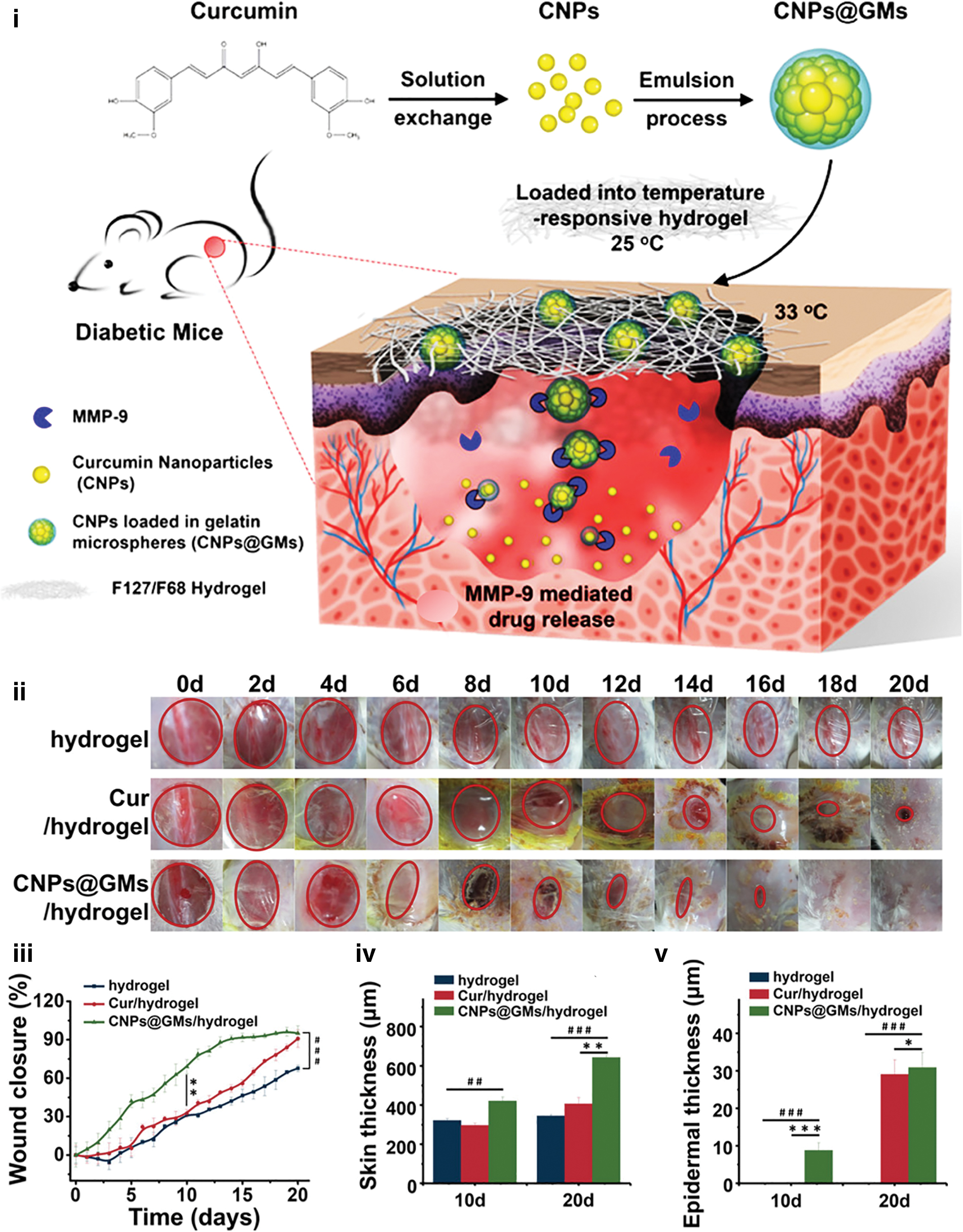
Curcumin-loaded hydrogel formulations for wound-healing application.
After that, hydrogels were applied over the streptozotocin-induced diabetic mice wound, depicting the efficient wound healing observed in the hydrogel with curcumin and curcumin NPs (Fig. 6ii, iii). Skin thickness (Fig. 6iv) and epidermal thickness (Fig. 6v) were also determined, showing the efficient thickness recovery in the treatment groups loaded with curcumin. Mobaraki et al. fabricated the curcumin-loaded scaffold and checked the effect of curcumin on the skin wound healing of a traumatic patient, as shown in Figure 7.

Curcumin-loaded scaffold for wound-healing application.
The fabricated scaffolds were biocompatible and depicted sustained release of curcumin. Curcumin-loaded scaffold showed ∼90% of wound healing with re-epithelialization, growing hair follicles, and blood vessels in 14 days. 68 Dai et al. investigated use of a polymeric dressing sponge to administer curcumin topically. On an SD rat wound model, sponge resulted in significantly faster wound closure than void-sponge and gauze-treated controls. MT staining revealed the compact structure, dense bundle, and well-arranged collagen fibers, and H&E staining revealed the fast granulation construction escorted by angiogenesis. 69
Nguyen et al. loaded the curcumin in a sponge for wound-healing application. Their study enhanced the curcumin bioavailability, and combined curcumin could improve wound healing compared with chitosan and gelatin without curcumin. 33 Li et al. fabricated a curcumin-encapsulated hydrogel for wound healing. In their study, curcumin-loaded hydrogel accelerates full-thickness wound healing in the mouse. Results showed more significant DNA, protein, and hydroxyproline content and considerably more re-epithelialization, collagen deposition, and neovascularization in creating granulation tissue in the injured tissue compared with the control. 52
Gong et al. established curcumin-loaded in situ hydrogel. The curcumin-loaded hydrogel exhibited a tissue-adhesive nature and sustained release of curcumin. In their study, curcumin-loaded hydrogel expedites the restoration of inflammatory processes, wound closure, re-epithelization score, and collagen arrangement, and promotes angiogenesis in excision wounds on the albino rat model. 70 Singh et al. fabricated curcumin-loaded decellularized goat small intestine submucosa (DG-SIS) scaffolds. One wt% curcumin in DG-SIS depicted enhanced antioxidant and antibacterial properties, and the DG-SIS scaffold exhibited constant curcumin release, which may be used as a potent biomaterial for wound healing. 11
Several other researchers have been developing a curcumin-loaded scaffold/hydrogel/sponge to enhance the curcumin bioavailability and wound-healing rate (Table 1). Qu et al. reported the development of curcumin-loaded benzaldehyde-terminated Pluronic®F127 (PF127-CHO)—quaternized chitosan (QCS)-based antibacterial adhesive injectable hydrogel as wound dressing for joint skin wound-healing application. 71 The hydrogel was formed by Schiff base reaction and copolymer micelle crosslinking between the polymeric systems.
The reported hydrogel showed pH-dependent biodegradation, modulus properties similar to human skin, good adhesiveness, and fast self-healing ability. The in vivo showed accelerated wound-healing rate with granulated tissue thickness, collagen deposition, and upregulated VEGF in a full-thickness skin defect model. 71 In another study, Chen and group 72 reported the modified PluronicF127 (PF127-CHO)—QCS hydrogels by incorporating Mg2+ and curcumin for exhibiting anti-inflammatory and prodifferentiation effects for the tendon to bone healing.
The results suggested that the release of curcumin showed anti-inflammatory and antioxidation effects in protecting stem cells and tendon matrix, while the release of Mg2+ improves stem cell aggregation and chondrogenesis. The synergistic effect of Mg2+/curcumin-loaded hydrogel on the animal model for 8 weeks showed regeneration of neofibrocartilage tissues and formation of ordered collagen fibers, resulting in strong tendon healing to the bone system. 72
Curcumin in nanoformulations
Designing curcumin nanoformulations primarily aims to improve their solubility, avoiding their rapid metabolism. Several nanoformulations, including NPs, nanoemulsions, and nanoemulgels, have been developed, and looked at for their accuracy and safety.10,17,73 Recently, Singh et al. fabricated a curcumin-loaded nanoemulgel system. Nanoemulgel enhanced the curcumin bioavailability, and curcumin-loaded formulations expedited the full-thickness wound contraction and collagen synthesis at the wound site in a rabbit model. 74
Similarly, Alyoussef et al. fabricated a carbopol loaded with curcumin and resveratrol. Curcumin-loaded nanoemulgel enhanced the antioxidant and anti-inflammatory potential, and elevated amino acid and collagen levels in the burnt skin of a rat model. 35 Alqahtani et al. developed curcumin and lignin-based NPs for wound healing. In their study, NPs exhibited potent antibacterial activity against S. aureus and supported the healing of wounded keratinocytes, a crucial feature of wound healing. After 12 days, NPs achieved nearly complete wound contraction. 41
Furthermore, Alqahtani and group 75 prepared the curcumin nanoemulgel through ultrasonication, as shown in Figure 8i. In their study, the optimized curcumin nanoemulsion had a droplet size of ∼56.25 nm, zeta potential of −20.26 mV, and a polydispersity index of ∼0.05 (Fig. 8ii). The effect of the Smix (surfactant/cosurfactant) ratio on the droplet size of the developed nanoemulsion is more prominent at lower Smix (25%) than at higher Smix (30%). Curcumin nanoemulsion showed sustained release of curcumin and exhibited thixotropic rheological behavior, and significantly increased skin penetrability characteristics (Fig. 8iii).
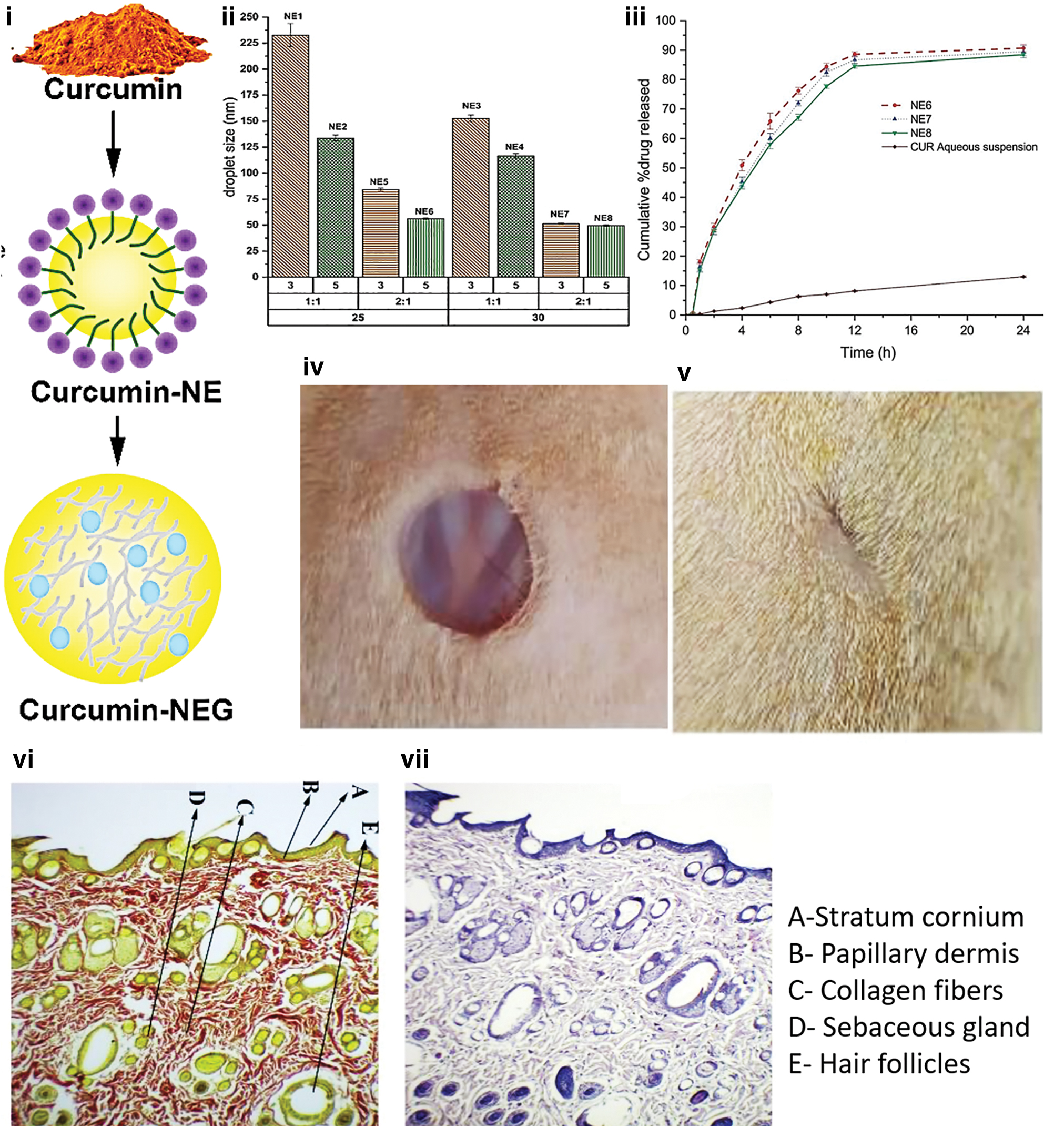
Curcumin in nanoemulgel formulation for wound healing.
The Wistar rats' wound-healing activity of nanoemulgel illustrates the expedited healing effect, 75 as shown in Figure 8iv, vii. H&E-stained image (Fig. 8vi) of newly healed tissue of Wistar rat treated with curcumin nanoemulgel depicts the efficient regeneration of skin, and Vangeison-stained image (Fig. 8vii) of newly healed tissue of Wistar rat treated with curcumin nanoemulgel at day 20 shows efficient collagen formation. Other than nanoemulgel, curcumin was loaded with different polymers to develop NPs.
In their study, in vitro curcumin release from CMC was 74.96% for 24 h, and good entrapment efficiency was depicted in the sequence PLGA>chitosan>CMC. Nevertheless, curcumin-loaded chitosan NPs fasten the wound-healing process. 76 Sadeghi-Ghadi and his group fabricated a curcumin-quercetin coencapsulated in hyaluronan-based nanovesicles. The fabricated nanovesicles depicted sustained release of the curcumin, which significantly accumulated in the skin, and showed more potent activity against Candida than fluconazole. 77
Another self-assembly approach is Nanoplex, which uses electrostatic interactions to insert curcumin molecules into polyelectrolyte layers. Nguyen MH and coworkers have developed a curcumin (CUR)-oligochitosan(OCHI)–based nanoplex system for wound healing. OCHI improved the colloidal stability, solubility, and bioavailability of curcumin and its biocompatibility compared with native CUR. Nanoplex shows wound healing of >90% in 7 days, whereas native CUR shows wound closure after 9 days. 78 Karahaliloğlu et al. fabricated the curcumin-loaded silk fibroin gel system (e-gel). E-gel enhanced the bioavailability of curcumin in terms of antibacterial activity and expedited wound healing. 34
Moreover, Azami et al. developed curcumin nanoemulsion to address the issues of poor water solubility and limited bioavailability, and assess its efficacy in treating acute and chronic toxoplasmosis in mice models. Their study showed potentially enhanced curcumin bioavailability and efficient treatment of acute and chronic toxoplasmosis in mice models. 17 Curcumin-loaded emulsion and nanoemulsion are more topical treatments for improved wound healing; nevertheless, these research studies were proven in vitro and in vivo investigations to determine eligibility for wound dressing usage.10,16,17,53,73,,79
Curcumin-Based Commercial Products for Wound Healing
Curcumin is a unique molecule that is considered one drug with multiple applications such as various skincare/diseases, cosmetics, and wound healing. Therefore, various types of curcumin-based products are available in the market. Some of the curcumin-based commercial products for wound healing are shown in Table 2. ExirNanoSina marketed two curcumin-based products (Sinanomin® and SinaCurcumin®). Sinanomin is a topical gel that contains 1% curcumin as a nanoliposome, which is used to reduce inflammation, pain, and wounds in dermatological conditions due to burns, insect bites, injury, and diabetic neuropathy. It may also be helpful for skin sensitivity and inflammatory diseases such as itching, burning, eczema, psoriasis, and acne. It is effective for alleviating gingivitis and aphthous.
Commercially Available Curcumin-Based Products for Wound Healing
SinaCurcumin is a Nano-Micellar Soft gel containing 80 mg of curcumin. It is helpful for bone and joint inflammation (rheumatoid arthritis, osteoarthritis), gastrointestinal inflammation (crown, gastritis, colitis, irritated bowel syndrome), buccal cavity inflammation (gingivitis, plague), and dermatological conditions (psoriasis, eczema, wound healing). It acts as an antioxidant to prevent different cancers, and reduce the adverse effects of chemotherapy and radiation. Further, Abbott India Ltd. developed the CURENEXT ORAL GEL containing Curcuma longa extract (10 mg) in gel base as an active ingredient that aids in treating oral and gum-related problems. Effective in treating gingivitis, it reduces inflammation of the mouth and gum. Turmeric acts as an anti-inflammatory herbal drug.
Moreover, India's widely used Vicco cream (Turmeric with cooling and fragrant Sandalwood oil) offers healthy skin with a shiny appearance, eliminating spots and avoiding and curing skin infections, blemishes, inflammations, acne, and burnt wounds. Further, curcumin Effervescent Tablets contain Curcuminoids and 95% Piperine. These tablets can heal wounds, fight acne, reduce scars, and treat skin conditions such as eczema and psoriasis. Moreover, Neuhack gel is an Ayurvedic antiacne scars cream, which is also helpful for burns and other wound healing. Although various curcumin-based formulations are available in the market as a supplement, only a few are directly involved in wound-healing applications.
Conclusion
Over the past millennia, curcumin has been used as a home-ready herbal medicine to treat various wounds. Curcumin exhibits a wide range of therapeutic properties such as antioxidant (free radical scavenging), antimicrobial, hyperlipidemic, anti-inflammatory, anticarcinogenic, antimutagenic, hepatoprotective, neuroprotective, cardioprotective, radioprotective, and many others. Moreover, curcumin can bind and inhibit various growth factor receptors, thus positively influencing wound healing. Various research studies have been developing a curcumin-based system to expedite wound healing in the last 5 years, as shown in Table 1.
Among all systems/formulations, curcumin-loaded hydrogel and nanoemulgel systems have been getting more attention for treating different wounds. There are several limitations to curcumin and wound therapy, such as the scarcity of competent clinical studies and the absence of research focused on clarifying curcumin's mechanisms of action at many stages of the complicated wound-healing process. Studies on aberrant healing, such as keloids and hypertrophic scars, are lacking. These studies, particularly clinical trials, will allow dose determination and delivery form selection, despite curcumin's limited bioavailability and possible adverse effects that have yet to be well investigated. Finally, curcumin has been a well-known wound-healing biomolecule since ancient times, but only a few curcumin-based formulations are available in the market for wound-healing applications.
Footnotes
Acknowledgments
The authors acknowledge the Indian Institute of Technology Roorkee, Indian Institute of Technology Gandhinagar, India, and Gosia Yaqoob for help and moral support.
Disclosure Statement
No competing financial interests exist.
Funding Information
S.H. thanks Khalifa University for funding through Grant No. 8474000442/FSU-2022-022.