




Abstract
In recent decades, cultured meat has received considerable interest as a sustainable alternative to traditional meat products, showing promise for addressing the inherent problems associated with conventional meat production. However, current limitations on the scalability of production and extremely high production costs have prevented their widespread adoption. Therefore, it is important to develop novel engineering strategies to overcome the current limitations in large-scale cultured meat production. Such engineering considerations have the potential for advancements in cultured meat production by providing innovative and effective solutions to the prevailing challenges. In this review, we discuss how engineering strategies have been utilized to advance cultured meat technology by categorizing the production processes of cultured meat into three distinct steps: (1) cell preparation; (2) cultured meat fabrication; and (3) cultured meat maturation. For each step, we provide a comprehensive discussion of the recent progress and its implications. In particular, we focused on the engineering considerations involved in each step of cultured meat production, with specific emphasis on large-scale production.
Impact statement
In this review, we discuss how engineering strategies can be extensively applied throughout the production steps of cultured meat, which are (1) cell preparation; (2) cultured meat fabrication; and (3) cultured meat maturation. Furthermore, we specifically highlight the state-of-the-art engineering strategies involved in each step, with specific emphasis on large-scale production.
Introduction
Meat consumption is widely recognized as a fundamental part of the human diet. Over the past 50 years, the global demand for meat has tripled, reaching 340 million tons in 2018. 1 However, traditional meat production poses various sustainability and environmental challenges, including the depletion of land and freshwater resources, greenhouse gas emissions, and inefficient conversion of nutrients. 2 The recent emergence of cultured meat has attracted significant attention as a potential solution for the inherent problems of traditional meat production. 3 Cultured meat, also referred to as cell-based or laboratory-grown meat, is a meat analog produced by tissue engineering. 4
Instead of slaughtering livestock, small biopsies can be taken from animals to obtain starter cells, which can then be expanded in a controlled environment to produce meat. 5 The major requirements for cultured meats include mimicry and high efficiency. For widespread acceptance, cultured meat must accurately mimic the properties of conventional meat, such as appearance, smell, texture, and taste. 6 In addition, extremely high production costs constitute a major limitation. 7 Therefore, achieving high production efficiency and reducing production costs are essential for successful commercialization. 8
The production of cultured meat can be divided into three steps (Fig. 1). The first step is cell preparation, which typically involves the isolation and expansion of starter cells. Small biopsies of live animals undergo various purification, isolation, and cell modification processes to obtain the desired starter cells, including muscle satellite cells (MuSCs), mesenchymal stem cells (MSCs), embryonic stem cells (ESCs), and induced pluripotent stem cells (iPSCs). 9
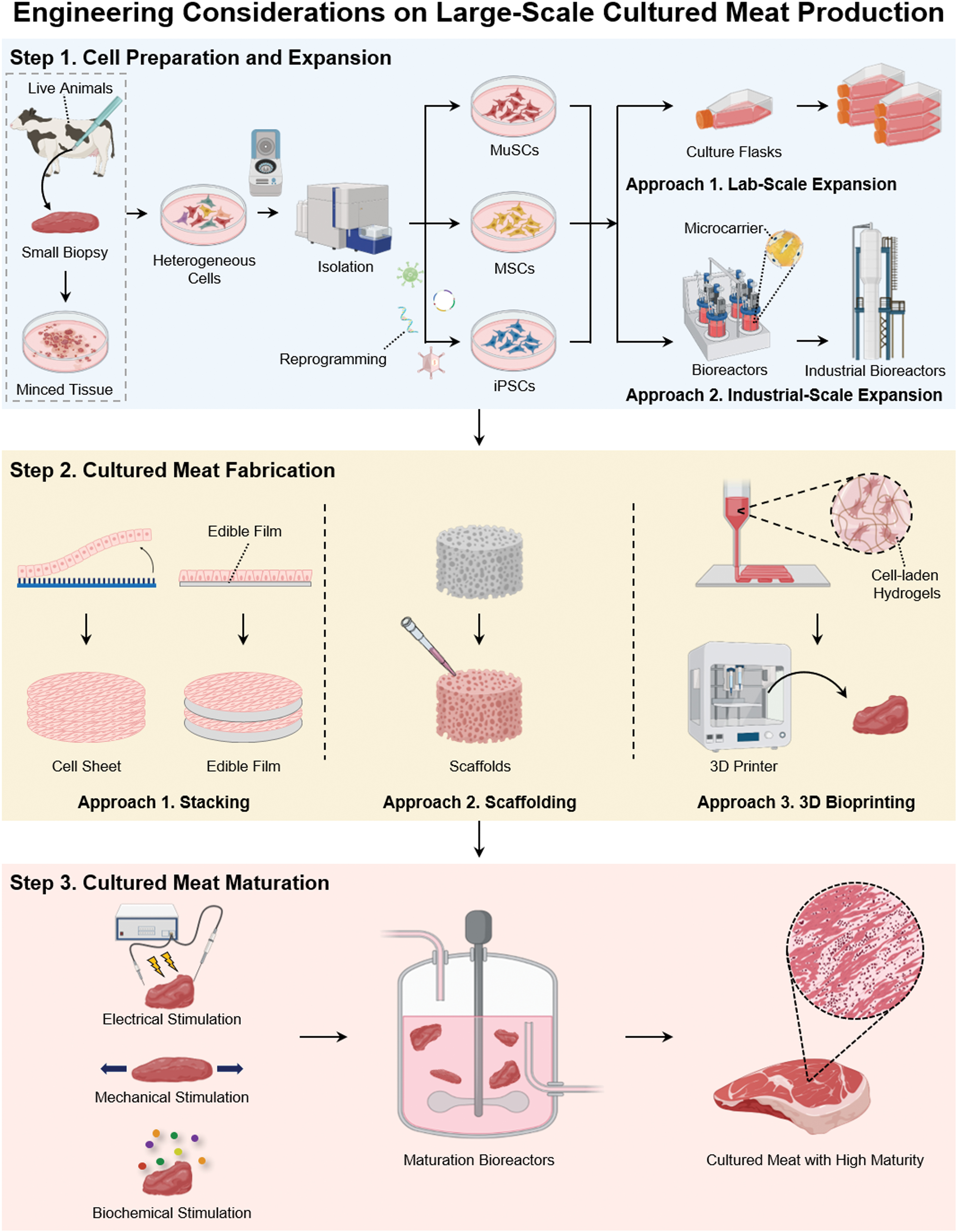
Overview of the cultured meat production process.
Various expansion techniques such as multitray flasks, bioreactors, and microcarriers are utilized to acquire sufficient amounts of starter cells. 3 The second step involves the fabrication of cultured meat. In this step, various engineering approaches were introduced, including the stacking of two-dimensional (2D) cell structures, induction of cell growth into three-dimensional (3D) tissues using biomaterials (scaffolding), and the production of cultured meat using 3D bioprinting techniques. The third step involves the maturation of cultured meat. The fabricated cultured meat undergoes a maturation process for several days. During this step, cultured meat is either simply incubated or placed in maturation bioreactors. Various stimuli, including electrical, mechanical, and biochemical factors, can be applied in this step to enhance maturity.
Over the past decade, extensive studies have been conducted on cultured meat, including those on edible films, scaffolding technologies, food-grade microcarriers, and 3D bioprinting.10–13 Despite the abundance of research on cultured meat and its potential for sustainable food production, numerous obstacles for the large-scale production of cultured meat remain unresolved. The major challenges in the scalable production and commercialization of cultured meat include the development of media alternatives to reduce production costs, 14 as well as scaled-up production, ensuring food safety, obtaining regulatory approval, and addressing consumer perception. 15 Among these challenges, the large-scale production of cultured meat with high maturity is particularly important for successful commercialization. Therefore, achieving large-scale production requires careful consideration of the engineering strategies that can be applied to each production step.
While other reviews on cultured meat have mostly focused on fabrication technologies16,17 or materials,18,19 we specifically highlight how engineering strategies can be comprehensively applied throughout the production steps of cultured meat, emphasizing the importance of scale-up studies. In this review, we first introduce the engineering strategies utilized for each production step of cultured meat, ranging from cell preparation to cultured meat maturation. Furthermore, we discuss ongoing advancements in state-of-the-art engineering strategies that consider scalable production of cultured meat. Finally, we discuss the limitations and prospects of engineering strategies for large-scale cultured meat production.
Current Progress on Cultured Meat Production
The production of cultured meat is divided into three steps: (1) Cell preparation, (2) cultured meat fabrication, and (3) cultured meat maturation. Each step entails distinct procedures and additional scientific processes that are necessary to achieve high-quality outcomes (Table 1). During cell preparation step of cultured meat production, engineering strategies play a pivotal role in ensuring the isolation, purification, cell modification, and expansion of starter cells. Furthermore, engineering strategies can contribute to the fabrication of cultured meat with high maturity. Therefore, in this section, we focus on the current progress in engineering approaches for cultured meat production.
Engineering Strategies of Cultured Meat Production
FACS, fluorescence-activated cell sorting; MACS, magnetic-activated cell sorting; DLP, digital light processing; MuSC, muscle satellite cell.
Cell preparation
The first step in cultured meat production is cell preparation, which includes the selection, isolation, purification, and expansion of appropriate cell sources. Various types of starter cells such as ESCs, MuSCs, MSCs, and iPSCs are used in cultured meat applications. 9 The most straightforward method for acquiring starter cells involves their isolation from the skeletal muscle tissues of livestock. Starter cells obtained from livestock muscles are considered to be edible and safe. 20
To obtain the desired starter cells, small biopsies are obtained from live animals and subsequently subjected to various purification, modification, and isolation processes. Engineering techniques such as fluorescence-activated cell sorting and magnetic-activated cell sorting are commonly utilized to purify starter cells based on specific markers or surface antigens.21,22 Among the various types of starter cells, MuSCs are the most widely used due to their ability to differentiate into myocytes and myotubes, thus forming muscle fibers. 23 Notably, MuSCs obtained from porcine muscle tissues have the potential for multilineage differentiation into adipogenic, osteogenic, and chondrogenic lineages, thereby making them promising candidates as starter cells for cultured meat. 24
Following the isolation step, starter cells must be further expanded to obtain a sufficient number of cells for cultured meat fabrication. Engineering strategies play a crucial role in optimizing expansion processes and ensuring scalability. Various expansion techniques have been developed, ranging from traditional multitray flasks to bioreactors and microcarriers. 25
Microcarrier-based bioreactor systems, in particular, provide an efficient scale-up strategy. Microcarriers coated with biocompatible and edible materials, such as collagen, laminin, fibronectin, or vitronectin, serve as scaffolds to facilitate cell attachment and growth by offering a large surface-to-volume ratio. 26 However, conventional microcarriers may require cell dissociation or degradation steps to separate cells from the microcarriers. Cells cultured on microcarriers can be grown in suspension, allowing easy scalability and enabling continuous or perfusion-based culture. For example, Verbruggen et al. investigated the growth of bovine myoblasts grown on commercially available microcarriers (Synthemax® II, CellBIND®, and Cytodex® 1) in a spinner-flask bioreactor. They found that bovine myoblasts could be successfully cultured on microcarriers, without interfering with their innate properties, thus providing the potential for large-scale production. 27
Cultured meat fabrication
The cultured meat fabrication can be classified into three approaches, which are stacking, scaffolding, and 3D bioprinting. First, the stacking approach refers to the technique to assemble a meat-like construct by stacking 2D structures of cells. 28 For example, the cell sheet technique, based on the assembly of monolayers of cells, enables the production of high-protein cultured meat without the need for scaffolds.29,30 Tanaka et al. fabricated cultured meat using temperature-responsive culture dishes (TRCDs) (Fig. 2A). The TRCDs used in this study were modified through electron beam irradiation to exhibit hydrophilic properties at temperatures below 32°C and hydrophobic properties at 37°C, which are suitable for cell sheet applications. Ten separated cell sheets from the dish were stacked, and a 3D tissue with a thickness of 1.3–2.7 mm was fabricated. 31
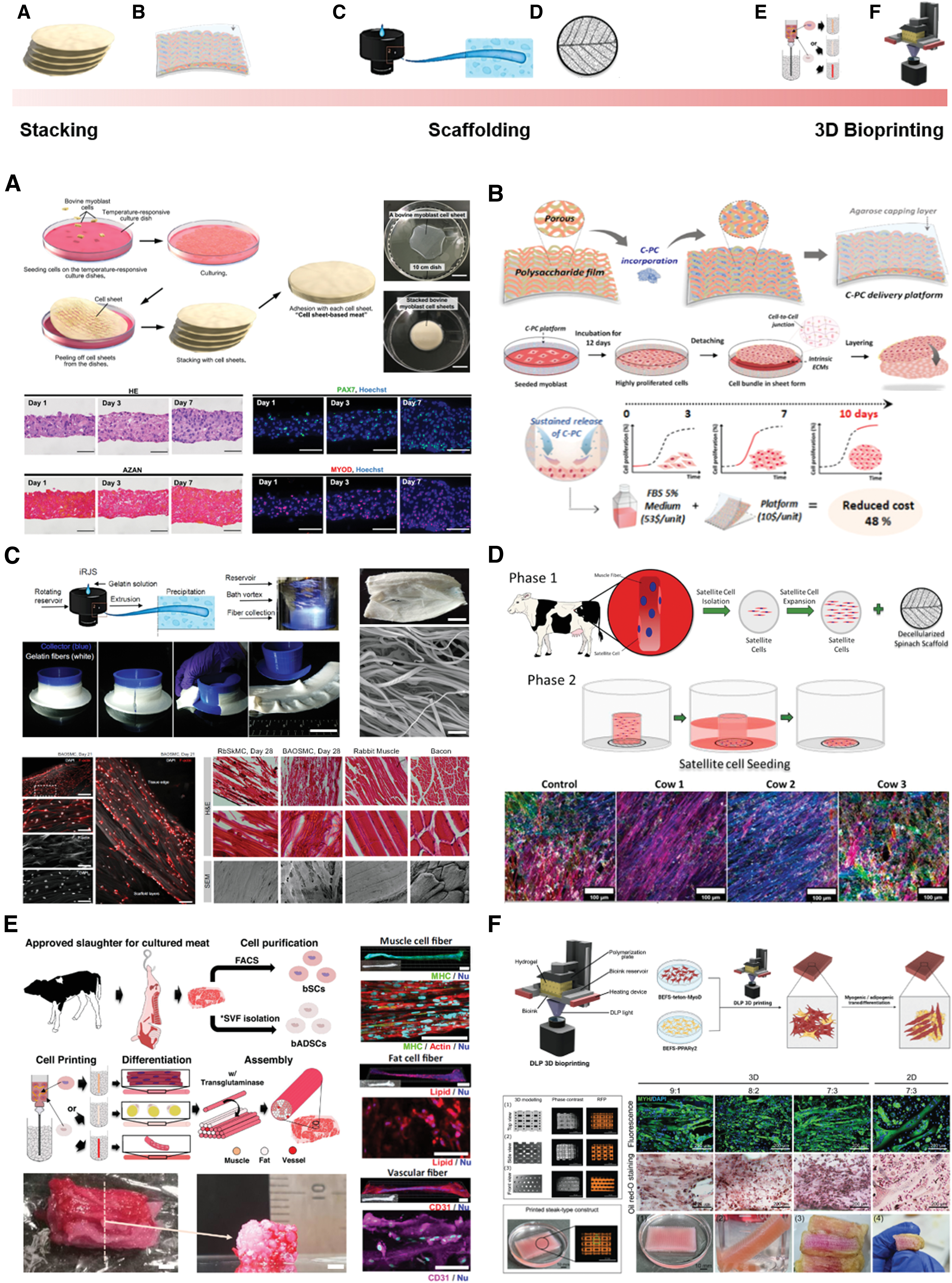
Various engineering strategies of cultured meat production.
Furthermore, Park et al. implemented a nutrient delivery film based on polysaccharides (chitosan and carboxyl methylcellulose) in cell sheet-based cultured meat (Fig. 2B). The film was easily applied to a culture dish, promoting the proliferation of myoblasts in a long-term culture environment with reduced fetal bovine serum. 32 Overall, stacking 2D structures to construct a 3D framework holds great promise for facile fabrication of cultured meat.
Second, the scaffolding approach refers to the technique of producing cultured meat using biomaterials. This includes methods such as employing polymeric scaffolds to aid the formation of 3D tissue constructs. Chen et al. developed an aligned porous structured scaffold through directional freeze-drying (Fig. 2C). They controlled the growth of ice crystals within the hydrogel to create an aligned porous structure. The aligned structure of the scaffolds was confirmed to promote the myogenic differentiation of MuSCs. 33
Regarding the aligned structure of the scaffold, MacQueen et al. created a meat analog using immersion rotary jet spinning (iRJS) (Fig. 2D). They used food-safe solvents and solutions to fabricate fibrous gelatin scaffolds. The fibrous gelatin scaffolds produced by iRJS promote cell aggregation and cell alignment, resulting in an aligned fibrous structure resembling processed meat products, such as fish balls or ground beef. 34 Recently, various studies have been conducted on developing edible scaffolds using plant-derived materials (decellularized plant, cellulose, and alginate, etc.). 35
Among them, decellularized plant materials have been extensively investigated as scaffolds for cultured meat applications owing to their cost-effectiveness, biocompatibility, and porous structure. 36 Jones et al. developed an edible scaffold for cultured meat using decellularized spinach. The proposed scaffolds demonstrated excellent biocompatibility, concurrently promoting the expression of the myosin heavy chain in MuSCs during the differentiation study. 37 In addition to decellularized plant-based scaffolds, textured vegetable protein (TVP) has recently attracted interest due to edible, biocompatible, and cost-effective character.38,39 Lee et al. developed a cultured meat using TVP-based edible scaffolds coated with fish gelatin and agar. 38 After cooking at a temperature of 150°C–180°C, developed cultured meat exhibited the Maillard reaction, a chemical reaction that causes the meat to turn brown when grilled, confirming the replication of the flavor and taste of real meat.
Finally, the 3D bioprinting approach refers to the technique of producing cultured meat by systematically patterning cell-laden hydrogels and scaffolding materials in a layer by layer manner. 40 In contrast to conventional techniques, which entail multiple stages such as stacking methods or fabricating scaffolds, this approach enables the fabrication of meat-like structures in a single process. 41 Three-dimensional bioprinting technology provides an efficient approach for the fabrication of cultured meat, enabling the simultaneous printing of diverse starter cells, biochemical factors, and biomaterials to create the desired structures with a high level of precision. 42
Dutta et al. used plant- and insect-derived protein hydrolysates to develop an edible alginate-gelatin platform for the mass production of bone marrow-derived MSCs in a low-serum environment. 13 The developed bioink exhibited good shear-thinning behavior and mechanical stability during 3D bioprinting, and supported the rapid proliferation of myoblasts in a low-serum environment. Kang et al. fabricated whole-cut meat-like tissues by printing muscle, adipose, and capillary cell fibers (Fig. 2E). They modified the supporting bath-assisted printing method, a bioprinting method, to develop a tendon-gel-integrated printing method that enables the printing of muscle, fat, and vascular cell fibers. The fabricated cell fibers were combined based on the cross-sectional image of Wagyu to mimic real meat and included 42 muscle cell fibers, 48 fat cell fibers, and 2 vascular cell fibers. 43
Jeong et al. produced cultured meat through the digital light processing-based 3D bioprinting technique (Fig. 2F). Immortalized bovine embryonic fibroblasts (BEFS) were transfected with MyoD and PPARγ2 to induce myogenesis and adipogenesis, respectively. The bioink containing BEFS-teton-MyoD and BEFS-PPARγ2 was used to create the cell-containing hydrogel structure, which are subsequently co-cultured to induce myogenic/adipogenic transdifferentiation. They proposed a facile fabrication of cultured meat through the simultaneous fabrication of muscle and fat tissues, followed by the induction of transdifferentiation. 44
Cultured meat maturation
It has been reported that the texture, nutrition, and flavor of cultured meat are closely related to the maturity of fabricated tissues. 45 Therefore, employing diverse engineering strategies to enhance proliferation and differentiation is a promising strategy for improving the maturity of cultured meat. Cells, culture media, and microenvironments (temperature, humidity, oxygen concentration, and air composition) are important factors that influence cellular responses.
In relation to this, Park et al. investigated the impact of hypoxia on the proliferation and differentiation of bovine MuSCs. 46 They observed that when muscle cells derived from Hanwoo cattle were cultured under hypoxic conditions, cell proliferation increased by 1.5–2 times for 5–6 days, and myotube formation increased by 1.5–3 times for 2–3 days. Furthermore, several studies focusing on biochemical stimulation to enhance cell proliferation and differentiation have been reported. Fang et al. discovered that vitamin C (VC) promotes the proliferation and myogenic differentiation of pMuSCs. 47 After culturing pMuSCs with 100 μM VC for 29 days, the total cell number increased by 2.8 × 10⁷ ± 0.8 × 10⁷, which was 360 times higher when compared to the group without VC treatment.
Achieving the replication of real meat texture requires careful consideration to induce the alignment of constituent cells. Several studies have demonstrated the utilization of mechanical, electrical, and magnetic stimulation to accomplish cell alignment.48–50 Furuhashi et al. induced cell maturation from bovine myocyte by applying electrical stimulation to create a striped structure. 51
For the maturation of myotubes, a 1 Hz electrical pulse was applied, resulting in myotubes with multiple striped patterns of α-actinin. Engineering techniques such as uniaxial channels or micropatterns have been widely used in research to facilitate the alignment of cells that make up the tissue and promote myotube formation. Connon et al. reported that milliscale curvature promotes the self-organization and differentiation of myoblasts. 52 They revealed that hemicylinder-shaped concave surfaces could promote C2C12 myoblast migration when compared to those grown on planar surfaces. They also formed highly aligned multilayers, fused and differentiated into a greater number of myotubes, ultimately achieving the highest level of self-organization.
In this section, we introduced various studies related to the progress of cultured meat production, covering cell preparation, cultured meat fabrication, and maturation. For cell preparation, the majority of studies utilize MuSCs isolated from livestock. However, a limitation arises as MuSCs exhibit a decreased differentiation ability with passages, posing challenges for large-scale production. 53 Regarding cultured meat fabrication, the primary goal of current studies is the replication of structural and physiological characteristics of real meat. However, the proposed fabrication methods are still expensive and complex, hindering their extension to large-scale production. 16 For instance, cell sheet-based cultured meat often exhibits poor mechanical properties, making it difficult to create large structures. 30 In addition, research on cultured meat maturation is predominantly at the laboratory level, with limited investigation for large-scale production.3,54 Consequently, current studies necessitate further investigation to address the limitations associated with large-scale production.
Engineering Considerations on Large-Scale Cultured Meat Production
Large-scale production plays a pivotal role in achieving the successful commercialization of cultured meat. The laboratory-based development of cultured meat has made notable progress over time; however, there remain some challenges associated with the scale-up production of cultured meat, including low growth rate of starter cells, inefficiency of culture methods, and low cost-effectiveness. 55 Therefore, in this section, we focus on the engineering considerations involved in each stage of cultured meat production, with a specific emphasis on large-scale production.
Engineering considerations on large-scale cell preparation
The main challenge in cell preparation for cultured meat production is acquiring a sufficient quantity of homogeneous starter cells capable of undergoing effective proliferation and differentiation. 3 Thus, the aim of large-scale cell preparation is to generate a considerable number of cells, while minimizing resource utilization, which can reduce production costs. Minimal handling and a short culture period to obtain an adequate number of harvested cells are important factors for achieving efficient mass production of cells. 56 Recent studies have highlighted the generation of immortalized cell lines with stable and high-yield characteristics.
An evaluation of cell-based foods conducted by the Food and Agriculture Organization (FAO) and the World Health Organization (WHO) concluded that there was no substantial risk associated with consuming immortalized cells, highlighting their potential as food sources. 57 For example, Stout et al. established immortalized bovine MuSCs by genetically modifying the constitutive expression of bovine telomerase reverse transcriptase and cyclin-dependent kinase 4 (Fig. 3A). Their immortalized MuSCs demonstrate remarkable capability for cell proliferation, surpassing 120 doublings, while maintaining their potential for myogenic differentiation. 57 Pasitka et al. isolated primary chicken embryonic fibroblasts from fertilized embryos and subsequently cultured them repeatedly to obtain spontaneously immortalized fibroblasts. The resulting immortalized cells, generated without genetic modifications, showed remarkable visual and sensory (i.e., flavor, aroma, and texture) similarities between cultured and farmed chicken. 58
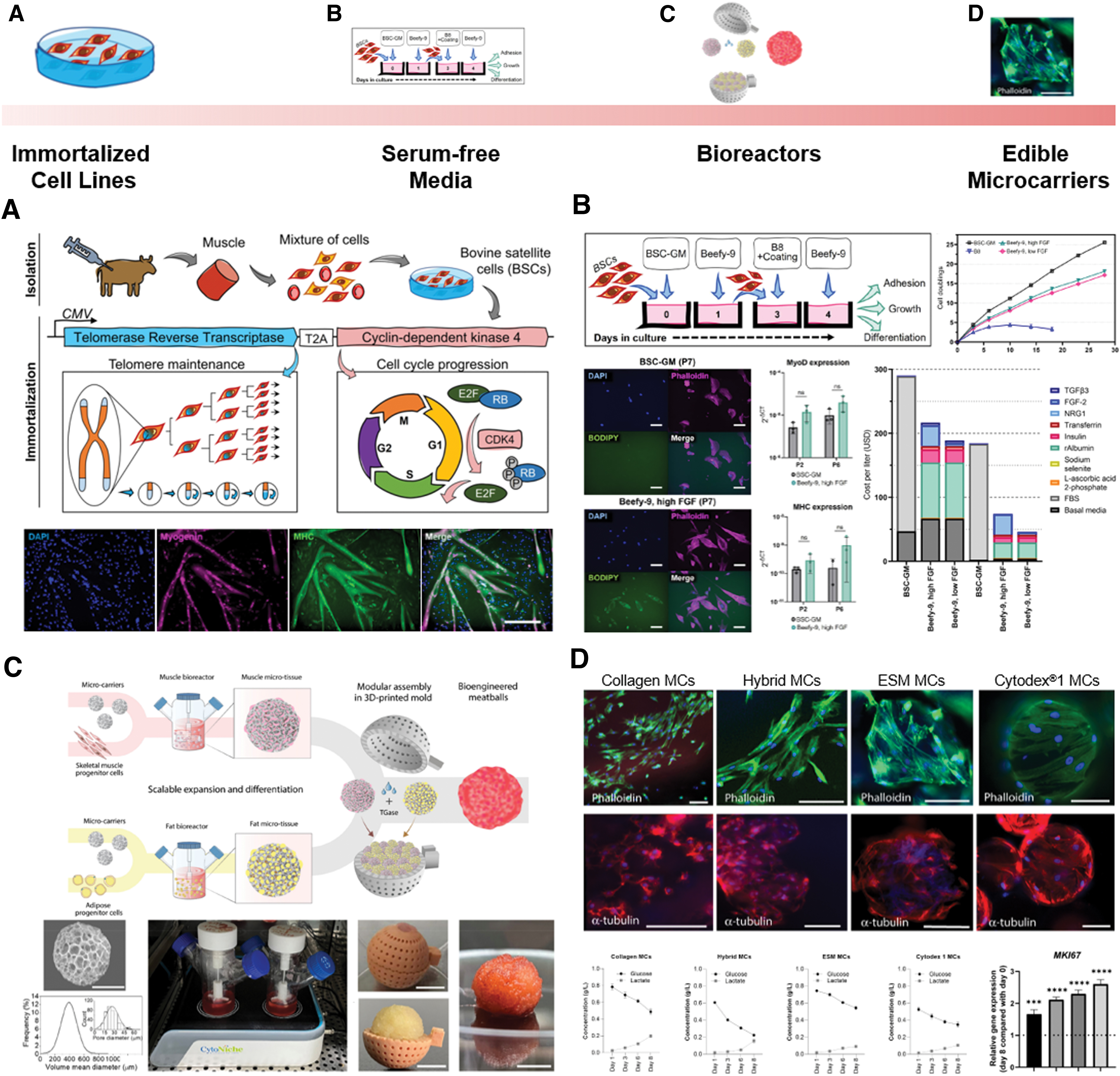
Engineering strategies of large-scale cultured meat production.
Serum-free media and media alternatives are also essential components of cultured meat production, particularly when considering large-scale expansion and cost-effectiveness. The use of serum-free media offers significant advantages by eliminating dependence on animal-derived components and providing a controlled and well-defined environment for cell growth and differentiation. 59 Moreover, they provide improved scalability as they can be easily formulated and manufactured in large quantities. This enables streamlined production processes and reduces the overall cost associated with media preparation. 60 Over several decades, researchers have conducted investigations into the cell culture in serum-free environments.61,62
Through their research, they successfully identified key components necessary to culture cells in the absence of serum, leading to the establishment of chemically defined medium. 63 Recently, one research team introduced a modified media formulation called Beefy-9, which incorporated recombinant albumin to support the long-term expansion of bovine MuSCs, while preserving their myogenic properties (Fig. 3B). The application of this new medium enables sustained cell proliferation over multiple passages, with an average doubling time of 39 h, thereby presenting an efficient strategy for cultured meat production. 14
In addition, several media supplements, such as vitamin C and N-acetylcysteine, have been introduced to further enhance the expansion of starter cells for large-scale production. These supplements aim to optimize cell growth and improve the efficiency of the cell preparation step.47,64 Overall, the development of immortalized cell lines, along with serum-free media suitable for cultured meat, significantly reduces production cost and thus facilitates scalable cell preparation.
Engineering considerations on large-scale cultured meat production
Bioreactors play an essential role in scalable cultured meat production, ranging from cell expansion to the 3D tissue maturation. For instance, bioreactors are employed to maintain the exponential growth of starter cells, while simultaneously inhibiting their differentiation. Following the fabrication of 3D tissue constructs, it can be transferred to a perfusion bioreactor to facilitate tissue maturation. 65 Stirred tank bioreactors are most widely used for their ease of operability and simple manufacturing. They consist of relatively simple vessels with a centrally located impeller that ensures homogeneous conditions with a sustained supply of oxygen and nutrients. 66
However, the mixing facilitated by the impeller may induce high shear stresses on cells, 67 leading some cultured meat companies to use rocking platform bioreactors. Rocking platform bioreactors induce lower shear stress through a gentle wave-like fluid motion in the cellbag. 68 Both stirred tank and rocking platform bioreactors can be equipped with a disposable bag, utilized as single-use bioreactors (SUB). This provides significant advantages in scalability and sterility using already commercially available SUB configurations. 69 In addition, perfusion bioreactors enable a continuous flow of media through tissue constructs, resembling the in vivo vascular system, making them promising candidates for maturation bioreactors in cultured meat production. 65 However, conventional bioreactors employed in tissue engineering, particularly for cell-based therapies, generally operate at significantly smaller scales when compared to those required for cultured meat production.
Consequently, the successful scale-up of cultured meat production requires careful bioprocess design and integration of innovative technologies to ensure that it can effectively meet the growing demand. 65 From this perspective, Li et al. suggested a rational approach for the design of a large-scale air-lift reactor within the context of cultured meat manufacturing. Their computational study suggested the design of a 300 m3 air-lift reactor, incorporating considerations of mass transfer, mixing, and energy dissipation through the utilization of computational fluid dynamics. Their findings presented a scalable bioreactor design that holds promise for applications in the cultured meat industry. 70
In a recent study, Liu et al. introduced porous gelatin microcarriers (PoGelat-MCs) as scaffolds for efficient cell expansion and 3D printed modular building blocks for the integration with bioreactor systems (Fig. 3C). The edible nature of PoGelat-MCs allowed the direct bioassembly of microtissues into 3D printed modular building blocks, resulting in the formation of centimeter-scale meatballs. This study demonstrates a scalable culture system capable of producing large quantities of highly mature cultured meat. 71
Second, the development of edible microcarriers has recently attracted considerable interest from a scalability perspective. The use of edible microcarriers has emerged as a promising strategy to overcome the challenges associated with commercial microcarriers. 12 Commercial microcarriers often require a cell-dissociation step following cell expansion, which can reduce the process efficiency. In this respect, a research group developed food-grade microcarriers using by-products from the food industry, such as turkey collagen and eggshell membranes (Fig. 3D). Importantly, these edible microcarriers eliminate the need for cell dissociation, and can thus be included in the final meat product. 72 However, animal-derived materials like collagen are nonreplicative and have the limitation of having to be obtained by slaughtering livestock. From this point of view, plant-based materials such as cellulose, starch, and alginate can be considered desirable options for edible microcarriers. 8
Yen et al. presented a cultured meat fabrication approach by integrating edible microcarriers and an oleogel-based fat substitute. Cellularized microtissues were generated through the optimized scalable expansion of bovine MuSCs on edible microcarriers, followed by their combination with a fat substitute to fabricate cultured meat. They suggested the feasibility of using edible microcarriers in commercial-scale cultured meat fabrication. 73 Recently, Norris et al. proposed an innovative approach for the development of cultured meat using edible microcarriers with a grooved topology. The grooved topology of edible microcarriers provides mechanical cues that enhance both the proliferation and myogenic differentiation of C2C12 cells. They demonstrated novel edible microcarriers with a single bioreactor system, offering valuable insights into scaling up cultured meat production. 74
In this section, we introduced various researches related to the progress of large-scale cultured meat production, including immortalized cell line, serum-free media, bioreactor systems, and edible microcarriers. Overall, the utilization of edible microcarrier-based bioreactor systems, along with immortalized cell lines cultured in serum-free media, would significantly increase the productivity of cultured meat. Although investigations related to bioreactors and edible microcarriers suitable for cultured meat applications are still in the early stages, by carefully addressing these engineering considerations, advancements can be made toward achieving cost-effective and scalable cultured meat production. This, in turn, can ultimately lead to the large-scale production of high-quality, commercially viable cultured meat products.
Limitations and Prospects
Cultured meat presents both limitations and promising prospects as the field progresses toward commercialization. Although notable progress has been made in the development of cultured meat, the challenges associated with scale-up studies remain. Scaling up the production process from small-scale laboratory settings to industrial levels requires comprehensive studies to ensure efficient and cost-effective production, while maintaining product quality and safety. 75 These include the selection of appropriate cell sources, engineering strategies to enhance cell proliferation and differentiation, and the development of cost-effective media alternatives. 3 Furthermore, it is important to develop large-scale production methods that are suitable for cultured meat applications. Specifically, the production of 1 kg of proteins would necessitate conventional 5000 L bioreactors, which is impractical for cultured meat applications. 76
Therefore, the rational design of bioreactors, along with the use of edible microcarriers to meet the needs of industrial production of cultured meat, should be considered.12,70 Moreover, social acceptance and regulatory concerns present additional obstacles to the successful commercialization of cultured meat. 77 Overcoming these challenges requires collaborative efforts between academia, regulatory agencies, governments, industries, and the public to establish appropriate guidelines and promote social acceptance. 55 Despite these challenges, advancement in tissue engineering technology and the engineering considerations described in this review have enhanced the feasibility of cost-effective and efficient production. Furthermore, the potential benefits of cultured meat, such as reduced environmental impacts, improved animal welfare, and increased food security, provide compelling incentives for further research and development.
Conclusion
Cultured meat has attracted considerable interest owing to its remarkable potential as a sustainable meat substitute. Its growing demand for replacing traditional meat commodities emerged as a new research trend. However, scaling up production is the first priority to its commercialization. The most challenging aspect is to replicate the characteristics of genuine meat at an industrial scale. In this review, we comprehensively discussed engineering strategies to develop cultured meat and outlined recent progress made in its scalable production. The ongoing advancements in the biomanufacturing techniques of cultured meat will optimally provide the global society with viable and sustainable solution to growing meat demand and relevant environmental footprint. The scale-up production and commercial viability of cultured meat can be achieved with the help of the engineering considerations presented in this review.
Authors' Contributions
Conceptualization, S.P. and J.K.; investigation, S.P., Y.H., S.P.(Sunho Park), W.K., Y.G., H.S., K.-J.J., and J.K.; resources, J.K.; writing—original draft preparation, S.P. and Y.H.; visualization, S.P. and J.K.; supervision, K.-J.J. and J.K.; project administration, J.K.; and funding acquisition, J.K. All authors have read and agreed to the published version of the article.
Footnotes
Disclosure Statement
The authors declare that they have no known competing financial interests or personal relationships that could have appeared to influence the work reported in this article.
Funding Information
This work was supported by the National Research Foundation of Korea (NRF), funded by the Korea government (MSIT) (grant numbers NRF-2020R1A5A8018367, NRF-2021R1A4A3025206, NRF-2019M3A9H1103737, NRF-2021M3E5E7026407, and NRF-2022M3A9E4017151). This research was supported by Basic Science Research Program through the National Research Foundation of Korea (NRF), funded by the Ministry of Education (NRF-2022R1I1A1A01065625).