




Abstract
Decellularized adipose tissue (DAT) has great clinical applicability, owing to its abundant source material, natural extracellular matrix microenvironment, and nonimmunogenic attributes, rendering it a versatile resource in the realm of tissue engineering. However, practical implementations are confronted with multifarious limitations. Among these, the selection of an appropriate gelation strategy serves as the foundation for adapting to diverse clinical contexts. The cross-linking strategies under varying physical or chemical conditions exert profound influences on the ultimate morphology and therapeutic efficacy of DAT. This review sums up the processes of DAT decellularization and subsequent gelation, with a specific emphasis on the diverse gelation strategies employed in recent experimental applications of DAT. The review expounds upon methodologies, underlying principles, and clinical implications of different gelation strategies, aiming to offer insights and inspiration for the application of DAT in tissue engineering and advance research for tissue engineering scaffold development.
Impact Statement
The clinical applicability of DAT is substantial due to its ability to mimic the natural tissue environment while avoiding immune rejection. Despite its potential, the practical use of DAT faces numerous challenges, primarily in selecting suitable gelation strategies for different clinical applications. This review (1) places a special focus on the diverse gelation strategies recently employed in experimental applications of DAT, (2) provides an in-depth analysis of various cross-linking strategies under different physical and chemical conditions, (3) methodically examines the process of DAT decellularization and the subsequent gelation phase and introduces innovative perspectives on the selection and optimization of these strategies, and (4) contributes to offer a comprehensive understanding of how these conditions affect DAT’s structure and efficacy in therapeutic applications.
Level of Evidence: IV.
Introduction
Decellularized adipose tissue (DAT) is a biomaterial employed in the fields of medicine and biology. After deriving from animal or human adipose tissues, the process of DAT preparation involves decellularization, sterilization, and gelation. 1 During the decellularization process, cells and immunogenic molecules are predominantly removed, whereas a majority of structural proteins and macromolecules are preserved, 2 which include functional proteins, collagen, fibronectin, glycosaminoglycans (GAGs), and proteoglycans (PGs; Fig. 1). 3 As it preserves the natural environment matching the native tissue’s physicochemical properties and cell–matrix interactions, DAT functions as a material with a scaffold structure while mitigating the impact of immunogenicity. 4 Owing to its extensively porous network structure, viscoelastic characteristics, substantial water content, and adjustable mechanical properties, hydrogel based on DAT has been considered a more attractive 3D cell scaffold for tissue engineering, 5 which has much utility in tissue engineering, regenerative medicine, plastic and reconstructive surgery, and medical device manufacturing (Fig. 2).
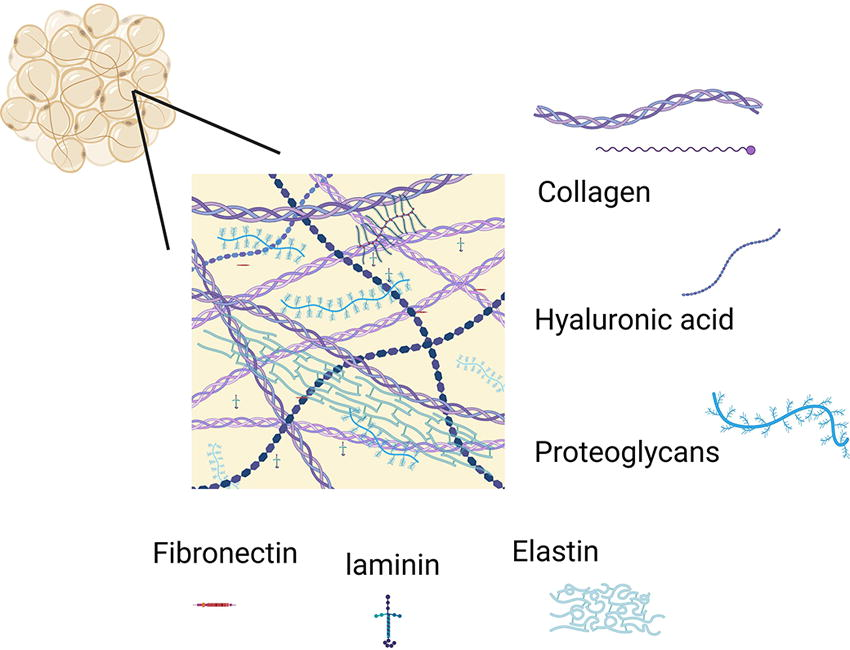
Main components of DAT and applications: collagen, hyaluronic acid, proteoglycans, elastin, laminin, and fibronectin. DAT, decellularized adipose tissue.

Different kinds of application forms of DAT: hydrogel, scaffold, microneedle, injection, powder, microcarrier, 3D printing, and sheet; in vivo applications of DAT: injury healing, scar repairing, cartilage engineering, nose job, bone regeneration, facial tissue filling, breast reconstruction, and tendon repairing.
In various application methods, DAT must possess specific morphological and mechanical properties, such as for injectable hydrogels in intervertebral disc repair, wound dressings for cutaneous injuries, and substrates for nasal cartilage reconstruction.6–8 Also, the therapeutic efficacy of DAT hydrogels is primarily determined by their biological and mechanical attributes in vivo. 9 Actually, the process of decellularization can considerably affect the structural integrity and mechanical characteristics of entire decellularized organs or DAT sheets, 10 such as mechanical fragmentation and lyophilization-induced brittleness. 11 The large-volume DATs acquired through direct decellularizing agent perfusion of tissues also require other techniques for filling and have a more limited range of applications. 12 Ideally, converting the decellularized matrix into a gel for 3D printing or injection can not only effectively fill and treat target areas but also provide the physicochemical cues such as nutrient, metabolite, and oxygen gradients and the structural scaffold with mechanical cues that drive physiological phenotypes to suit diverse clinical applications.13,14 Although adjusting the pH, salt or ion concentrations, and temperature during the preparation of DAT hydrogels can promote gelation to some extent, it cannot markedly enhance the degree of cross-linking and mechanical properties of DAT hydrogels. Therefore, novel cross-linking approaches, involving physical and chemical methods, have been employed to enhance the mechanical performance of DAT hydrogels and facilitate their effectiveness. The use of innovative cross-linking techniques promotes the progression of synthetic hydrogel development.
In advancing research for tissue engineering scaffold development, we need to focus on the application methods and gelation properties of DAT hydrogels. This review elucidates potential challenges associated with the utilization of DAT in tissue engineering and aims to summarize the gelation strategies for DAT-based scaffolds currently explored in studies, offering insights and inspiration for the application of DAT in future.
Preparation of DAT Pregel
To obtain DAT pregel, the initial step involves the decellularization of DAT. Various decellularization techniques are employed to remove cellular components and matrix cells from the entire tissue, minimizing the potential for in vivo rejection of the synthesized extracellular matrix (ECM). Decellularization techniques for tissue vary depending on the specific application of DAT. Once obtained, adipose tissue is subjected to physical, chemical, and/or enzymatic treatments to produce DAT.
The initial stages of adipose tissue decellularization typically involve methods to solubilize tissue-resident cells. Common approaches include (1) agitation in surfactants such as sodium deoxycholate or sodium dodecyl sulfate to disrupt cell membrane components, (2) repeated freeze–thaw cycles (at −80°C and 40°C), (3) multiple washes in hypotonic or hypertonic solutions, (4) urea dissolution, and (5) a combination of 0.25% trypsin and 0.1% EDTA digestion to further degrade cell membrane proteins. 15
Subsequent removal of lipids from proteinaceous ECM is achieved through methods such as lipase soaking, centrifugation, and isopropanol polar extraction.16,17 For instance, nonionic detergents like Triton X-100 are used to disrupt lipid–lipid and lipid–protein interactions, eliminating residual lipids. Nucleases such as RNase and DNase are applied to further eliminate remaining nucleic acids, limiting the potential scope of immunogenic reactions. Nowadays, new methods for preparing decellularized adipose matrix resemble those used for collagen preparation. Mechanical homogenization is employed to increase surface area, followed by cleansing over times and centrifugation to obtain fibrous coarse particles. 18 These are then digested using pepsin, and the resulting material is freeze-dried and ground into DAT powder for storage or dissolved for pregel. A typical scheme as followed in Table 1 has been used (Fig. 3). 19
Decellularization Schedule
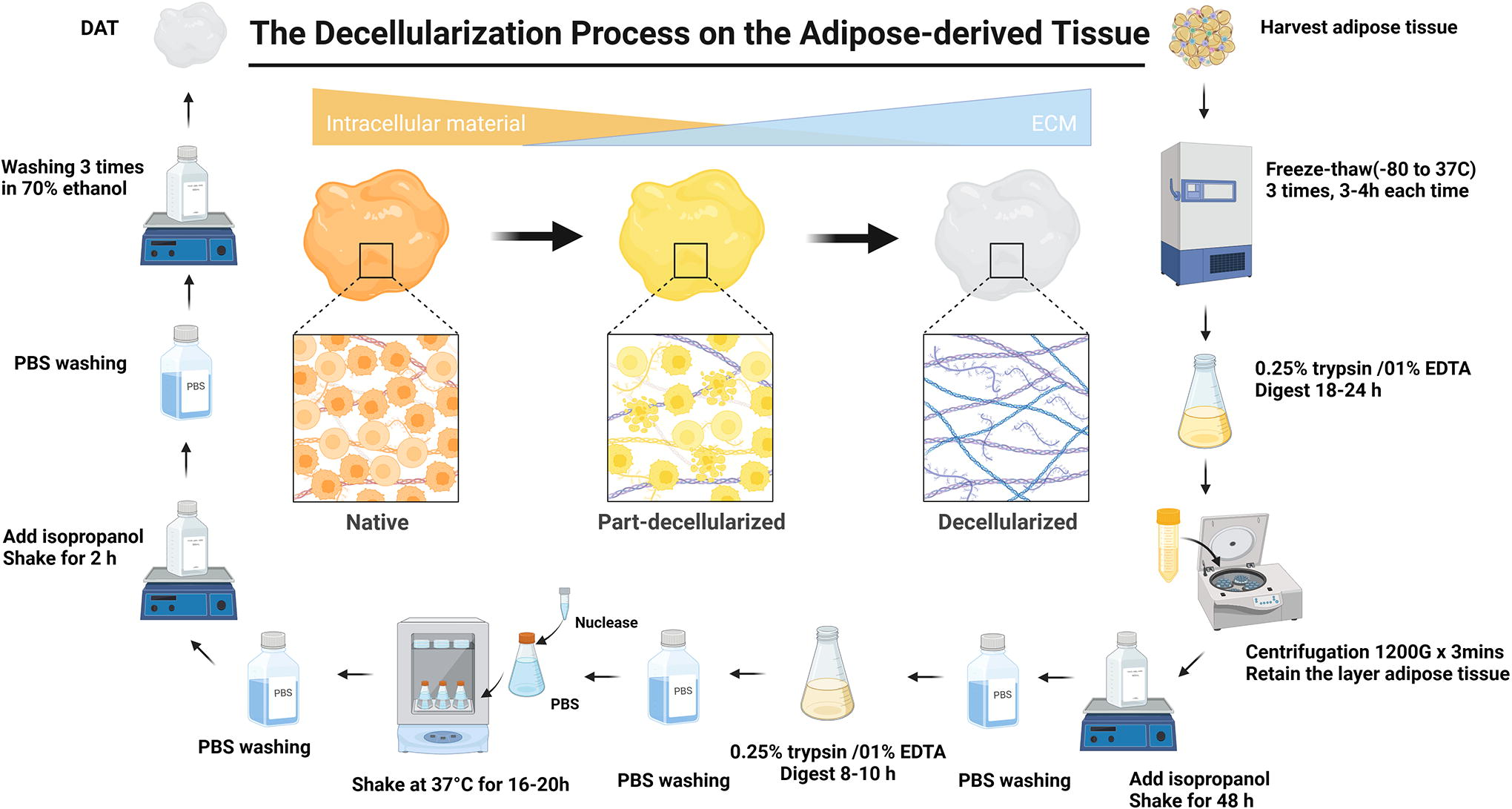
The decellularization process on the adipose-derived tissue. As the decellularization process advances, intracellular materials in native tissue derived from adipose are gradually removed, leaving behind a portion of ECM. Delineate a mature decellularization process following the steps outlined in Table 1. ECM, extracellular matrix.
Employing different treatment approaches can influence the composition of DAT, but the primary aim is to retain the entirety of ECM components and structure, which remains challenging to achieve with current methodologies.
Gelation
DAT is formulated into a gel for better application. Based on the morphological properties, gel is defined as (1) a continuous microscopic structure that maintains macroscopic dimensions permanently during the duration of an analytical experiment and (2) a solid-like rheological behavior, despite being predominantly liquid. Based on the continuous structures of gels, they are categorized into four types: (1) well-ordered lamellar structures, including gel mesophases; (2) covalent polymeric networks, which are completely disordered; (3) polymer networks created through physical aggregation, mostly disordered with areas of local order; and (4) particulate and disordered structures. 20
Although we are aware that the primary components of DAT include collagen, GAGs, laminin, and elastin, the composition and cross-linking structures of DAT remain unclear due to variations in tissue sources and decellularization methods. 21 As the main components of ECM, collagen molecules stabilize as neighboring collagen molecules cross-link with each other, during which amino acids were thought to be cross-linking points between the collagen subunits. 22 After that, covalent cross-links can form enzymatically between the nonhelical domains and the helical domains of adjacent collagen molecules. 23 In addition to collagen fibers, abundant structural components of the ECM, such as GAGs, including hyaluronic acid (HA) and PGs, bind and form PG aggregates, whose cross-linking to other matrix proteins, such as the collagen network, leads to the formation of supermolecule structures.24,25 Some studies indicated that self-assembling components of ECM, such as laminin, elastin, and fibronectin, makes cross-linking by itself achieved.26,27 The process and mechanism of DAT autonomously cross-linking into a gel require further in-depth investigation.
Typically, the DAT pregel is processed with pepsin under acidic conditions, aimed at achieving greater dispersion and lower weight of fragmented fibrin in the sol. After the sol system neutralized to temporarily halt the digestion by pepsin, it leverages the intrinsic properties of the sol to facilitate cross-linking and ultimately achieve gelation. The resulting DAT was made into a hydrogel ink for 3D printing and injection. 3 With the increase of application requirements, a variety of gelation methods have been developed (Fig. 4).

The gelation of DAT achieved in the literature through different kinds of methods.
However, there are still shortcomings in the existing cross-linking strategies: (1) Efficiency in tissue regeneration is limited due to the inability to adjust the stiffness of DAT in vivo by modifying its concentration. In addition, developing a biocompatible scaffold with suitable mechanical properties presents a further challenge. (2) The establishment of blood supply is crucial for the survival of all kinds of grafts at defect sites since cells in thick implants cannot reach to nutrients and oxygen by diffusion. Current DAT materials for tissue augmentation also lack the capability to promote vascularization in large defect areas. 28 (3) In the realm of 3D-printed biomaterials, DAT exhibits certain limitations in practical applications. The typical approach involves utilizing traditional printing ink to create stable scaffolds, upon which DAT is dispersed, resulting in a punctate distribution of the ECM within the grafts. 29 (4) DAT-constructed scaffold materials need to exhibit sufficient versatility, enabling the loading of drugs, exosomes, regulatory factors, and other substances. This will facilitate the modulation of local microenvironment at the injection site, including correcting the disorder of anabolism and catabolism in the ECM. 6 To enhance their applicability, we need to focus on developing more strategies for hydrogel construction.
New Methods of DAT Gelation
Different methods are employed to cross-link hydrophilic polymer chains to create hydrogels, typically chosen based on the chemistry of the materials and their intended functions. Generally, these methods fall into two categories: physical and chemical cross-linking. There are many methods to prepare physically gelated hydrogels for tissue engineering applications with mild conditions and stimuli-responsive properties, such as simple mixing, mechanical vortex, ionic interaction, and thermogelation. Chemical gelation is a technique for preparing gel materials through chemical reactions. It involves adding one or more chemical substances to a liquid solution, initiating the formation of the gel material through a chemical reaction. By introducing cross-linking agents and specific gelling agents that can react with functional groups in molecules or polymers, cross-linking structures are formed, resulting in the formation of the gel.
Physical gelation methods
Simple mixing
Tissue regeneration efficiency is influenced by the stiffness of the cell growth substrate, and during the self-gelation process of DAT, stiffness is unstable and challenging to modulate. 30 Hence, to adjust the stiffness of a cell-free hydrogel system, DAT has been physically altered for the ideal repair of large-volume soft-tissue defects. By physically mixing DAT with methyl cellulose in different concentrations until it becomes adhesive, the stiffness of the cell-free gel system could be regulated and proved to be injectable and moldable. Results indicate that this physical mixing method for gel preparation significantly enhances adipose-derived stem cells’ (ASCs) adipogenesis and adipose tissue regeneration. 31
To optimize the scaffold’s effectiveness and vascularization in large-scale adipogenesis, mixing with other decellularized components is also under investigation. DAT and heart decellularized extracellular matrix (hdECM) hydrogels based on poly(l-lactide-cocaprolactone) can promote adipogenesis and angiogenesis. 32 In vivo experiments aimed at optimizing the ratio of two hydrogels revealed that a blend of 80/20 DAT to hdECM exhibited optimal outcomes in terms of angiogenesis, apoptosis, and adipose tissue formation. This ratio has proven to be an effective treatment approach for regenerating large, patient-specific adipose tissues. 33
In various practical applications, DAT mixed gels need to exhibit different performance characteristics. For instance, toexclude invasive fibroblasts and prevent adhesions, the injectable DAT must be gelated with a material that is compatible with ASCs and antiadhesive to tissue. HA–aldehyde (HA–CHO) and HA–adipic dihydrazide (HA–ADH) solutions feature in situ gelling property.34,35 After mixing with soluble DAT, in situ formation of DAT-containing HA hydrogel can provide temporal protection from scar tissue invasion and generate an adipogenic microenvironment without inducing cytotoxicity.36,37
Mixing DAT with other substances that can effectively gel significantly enhances and adjusts the gelation properties of hydrogel. However, this process substantially dilutes the concentration of DAT, thereby diminishing its efficacy in practical applications.
Mechanical force
Gelation of hydrogel solutions can be induced by vortexing. 38 Vortexing-induced gel flow increases the formation of macromolecule clusters containing numerous β-sheet structures, leading to permanent gelation. ECM components in DAT may stabilize fibroin molecules, preventing irregular β-sheet formations and enhancing gelation kinetics. 39 Research has shown that when DAT−fibroin mixtures are vortexed, a homogenous gel is formed. 16 Vortexing causes fibroin to develop a fibrous structure, while DAT contributes natural ECM components, leading to enhanced cell adhesion and structural integrity. 40 Similarly, Badylak introduced a novel method for preparing ECM hydrogels using ultrasound cavitation (Fig. 5A). Starting with fragmented ECM as the material, it is resuspended in a neutral buffered salt solution and then dissolved using ultrasound treatment at 20 kHz. Rapid gelation is induced by lowering the temperature of the ECM solution to below 25°C. 41

Physical gelation methods.
DAT can successfully undergo solation through mechanical force, but their cross-link into a gel that supports cell growth is influenced by multiple factors such as the nature, duration, pressure, temperature, vector of the mechanical force, and other variables. 42 Despite uniform mechanical equipment and parameter adjustments, the gelation of DAT after purely mechanical methods remains low-probable in practical experiments, limiting its broader applicability. 43
Ionic cross-linking
Alginate hydrogel is the most representative of the gels that are formed through ionic cross-linking.
44
The formation of junction zones occurs through the cross-linking of guluronic acid units, which involves exchanging sodium ions with divalent cations such as calcium (Ca2+), barium (Ba2+), and magnesium (Mg2+).
45
Owing to the reversible dissociation and reassociation of α-
The hydrogel prepared using alginate and DAT through ionotropic gelation, while possessing advantages such as biocompatibility, biodegradability, and a relatively simple and rapid gelation process, also exhibits some limitations: its stability decreases under specific conditions, like in the presence of certain ions (e.g., phosphate or sulfate ions), and it is highly sensitive to the ion concentration in the environment, which may impact their performance in settings with substantial ion concentration changes. 49 Moreover, alginate hydrogel typically has lower mechanical strength and elasticity, restricting their application in scenarios involving high mechanical stress.50,51
Thermogelation
Thermogelation creates a physically cross-linked network through temperature modification. Poly(N-isopropylacrylamide) (PNIPAM), known for its thermoresponsive properties, is the most prominent stimuli-responsive polymer utilized in the biomedical sector.52,53 This polymer undergoes a temperature-dependent phase transition at 32°C, which is near body temperature, altering its hydrophobic/hydrophilic characteristics, modifiable by the addition of hydrophobic and hydrophilic monomers (Fig. 5C).54,55 However, in biomedical engineering, PNIPAM’s disadvantages include volume shrinkage during thermogelation and a lack of biological signals essential for cellular adhesion and proliferation. 56 A thermoresponsive hydrogel, binding to DAT, was prepared by mixing DAT powder with mussel adhesive protein-PNIPAM (MAP-PNIPAM). In an experiment involving the preparation of an injectable body temperature-activated adhesive hydrogel, to prepare the DAT-incorporated MAP-PNIPAM hydrogels, the DAT powder was mixed with 55 wt% MAP-PNIPAMLow at different DAT concentrations of 5 wt%. Results showed scaffold experienced the rapid thermoresponsive sol-gel transition of syringe-injectable MAP-PNIPAMLow in phosphate-buffered saline (PBS) at 37°C. It was demonstrated in in vitro experiments that the DAT component provides biochemical cues to drive the differentiation of encapsulated stem cells and host preadipocytes (Fig. 5D). 57
Another novel preparation technique, termed temperature-controlled platelet-rich plasma (t-PRP), which eschews the use of exogenous thrombin and anticoagulants, was developed. The mechanism of fibrin network development in PRP mirrors the gelation process of fibrin hydrogels, where thrombin catalyzes the conversion of fibrinogen into fibrin, subsequently forming fibrin gels. Temperature variations governed both the activation of PRP and the establishment of the fibrin network. 58 Initially, coagulation was suppressed in a hypothermic setting, followed by platelet activation through the restoration of autologous thrombin activity upon rewarming. As the temperature rises, the collagen–fibrin hydrogel forms an interpenetrating polymer network. 59 Fibrin hydrogels are transitory materials in vivo that degrade rapidly compared to collagen hydrogels, whereas DAT primarily composed of collagen can compensate for this deficiency. Furthermore, after mixing the prepolymerized forms of collagen and fibrin hydrogels, strong interactions occur within the collagen–fibrin hydrogel. 60 In a study focusing on a thermosensitive DAT/platelet-rich plasma interpenetrating polymer network (t-DPI) hydrogel, unactivated t-PRP and DAT (8 mg/mL) pregel were mixed in screw syringes and Luer-Lok connectors under hypothermic conditions to obtain t-DPI pregel and then were gelled and activated at 37°C. The injectable and thermosensitive hydrogel, which features sustained release of growth factors, demonstrated optimal therapeutic effects in wound healing (Fig. 5E). 61
For DAT-PNIPAM hydrogel, simultaneous improvement in mechanical properties, quick thermoresponse during gelation, and controlled degradation in biological applications are still needed to be addressed. 62 Platelet-mediated cross-linking, despite its material accessibility and suitable cross-linking temperature, is limited by potential allogeneic rejection. More research is needed to enhance the control, biocompatibility, affordability, and applicability of thermosensitive DAT hydrogels.
Chemical gelation methods
Photocrosslinking
Photoreactive moieties, such as methacrylate or acrylate groups, can modify DAT. 63 Under ultraviolet (UV) or visible light, the photoreactive macromer solution cross-links in the presence of a photoinitiator. These photoinitiators produce free radicals that initiate chain polymerization by transferring to the carbon double bonds in the modified macromers (Fig. 6B). To date, no study has been reported on the grafting of methacrylate or acrylate groups onto DAT followed by photopolymerization. Nonetheless, the combination of photopolymerizable materials with DAT has been demonstrated to be an efficacious approach for gelation, yielding substrates that are favorable for cellular proliferation.

Chemical gelation methods.
This method is used to harness the distinct proadipogenic traits of DAT within a customizable hydrogel delivery system, aiming to develop composite biomaterials with adjustable properties. In particular, methacrylated glycol chitosan and methacrylated chondroitin sulfate (MCS) were explored as photocrosslinkable carriers for encapsulating ASCs in a cryomilled DAT matrix. 64 A prepolymer solution containing MCS [10% (w/v)] dissolved in water and cryomilled ECM [8% (w/v)] combined with Irgacure 2959 photoinitiator [0.05% (w/v)] forms the basis for the hydrogel. This pregel solution undergoes cross-linking under long-wavelength UV light (∼365 nm) at 12 mW/cm2 for 4 min (2 min per side). Subsequent studies showed that MCS-DAT composite hydrogels, compared to DAT alone, exhibited increased expression of adipogenic genes and proteins. 65
Similarly, the precursor of DAT-gelatin methacryloyl-hydroxypropyl methacrylamide (DAT-GelMA-HAMA), consisting of 1.125% (w/v) DAT, 7.5% (w/v) GelMA, and 1% (w/v) HAMA, is created by blending the GelMA and HAMA polymer solution with a pregel of DAT. To this mixture, a photoinitiator is added (either 2.5% lithium phenyl-2,4,6-trimethylbenzoylphosphinate or 2.5% lithium phenyl-2,4,6-trimethylbenzoylphosphinate [LAP]). The DAT-GelMA-HAMA precursor, which exhibits a sol-gel phase transition and a porous structure after cell encapsulation, is suitable for use as a biomaterial in 3D printing. Each printed layer of the scaffold was subjected to 405 nm UV irradiation for 4–5 s to photocrosslink the GelMA and HAMA polymers. This process has shown promising results in wound-healing experiments. 66
However, the utility of photocrosslinked gels can be limited due to a loss of viability and motility in encapsulated cells. Furthermore, direct exposure of these cells to light and the LAP photoinitiator has been shown to significantly increase reactive oxygen species (ROS) levels. 67 Also, the volume and light transmissibility of DAT itself may lead to uneven cross-linking in photopolymerization, whereas the heat generated during light irradiation, the control of reaction depth and scope, and the toxicity of photoinitiators affect the practicality of DAT’s functionality. 68
Michael addition reaction
A cell-free, chemically modified thiolated adipose-derived ECM (mECM) hydrogel was developed by incorporating it into polyethylene glycol (PEG) diacrylate through Michael addition. In the system composed of PEG, ethoxylated trimethylolpropane tri-3-mercaptopropionate (ETTMP), and mECM, an increased concentration of mECM with thiol groups can chemically cross-link with other components for enhanced gelation. This strategy, featuring a uniformly distributed ECM component that promotes the proliferation and adipogenesis of human adult cardiac stem cells in vitro, establishes a proadipogenic niche that facilitates the infiltration and differentiation of host stromal/stem cells in vivo (Fig. 6A). 69 Other studies indicate that thiol-functionalized collagen and HA, main components of the DAT, efficiently cross-link through the Michael addition reaction and demonstrate that this rapid in situ gelating hydrogel has great potential as a cell delivery carrier.70–72
Cross-linked PEG-based hydrogels are favored for their low protein adsorption characteristics, minimal inflammatory response, and proven safety in vivo. These hydrogels, leveraging a Michael addition reaction, provide a versatile biochemical composition, biomechanical adaptability, and ease of use in vivo. 73 DAT, incorporated with a thiol-acrylate fraction at various concentrations, is polymerized using a Michael addition reaction to form hydrogels. 74 Specifically, the initial reaction involves mixing ECM proteins with PEG acrylate in PBS, followed by the addition of a solution containing ETTMP and NaOH, leading to gelation.
However, this method typically involves reactions between unsaturated compounds and nucleophiles, requiring specific pH, temperature, reactant ratios, and times to optimize cross-linking efficiency for creating suitable networks. 71 The starting materials or by-products used may also pose toxicity to cells or tissues.
Secondary network
By introducing ethanol after γ-ray radiation and further establishing the “secondary network,” a versatile scaffold composed of peptide and DAT can be developed with desirable stiffness and biochemical properties. 75 Cross-linking initiated by γ-ray exposure involves a radical polymerization mechanism, akin to the γ-ray-induced cross-linking observed in collagen. 76 This process leads to the combination of polypeptide radicals, culminating in a chemical conjugation that forms a cross-linking network between the silk fibroin (SF) and collagen within the ECM. 22
A primary hydrogel was formed by mixing SF solution with DAT suspension, followed by gamma irradiation at room temperature. Following its preparation, the hydrogel was submerged in anhydrous ethanol to form a secondary hydrogel (Fig. 6C). The final hydrogel demonstrated that the DAT component, along with the scaffold’s multichanneled structure, enhanced the differentiation of ASCs in in vivo experiments. 77
γ-ray radiation’s impact on collagen involves complex radical generation and gelation. 78 It is crucial to precisely dose radiation to maintain collagen’s structure and bioproperties during gel formation. 79 Also, alcohol solvents’ dehydration might tightly aggregate collagen molecules, leading to nonspecific cross-links, inhomogeneity, and weaker gels. 80 Further studies are needed to assess the viability of secondary network gels.
Prospective and Discussion
Currently, extensive studies have been conducted in various domains, including myogenic differentiation, adipogenic differentiation, and chondrogenic differentiation, aiming to construct cross-linked scaffolds using DAT that are conducive to cell growth and their application in diverse clinical scenarios.81,82 Scientists in the field of stem cell biology recognize the pivotal role of the ECM environment in cell proliferation and differentiation. 83 However, the influence of hydrogels with varying mechanical strengths on cell differentiation remains inadequately explored, with limited understanding of the underlying mechanisms. Further investigation is warranted in this area. Furthermore, this study is extending its focus to investigate the use of these biological scaffolds in systemic metabolic disorders such as diabetes and liver failure.84,85 This signifies that scaffolds not only serve as valuable delivery tools in tissue repair and regeneration, including soft-tissue and bone defects, but also hold significant potential as beneficial delivery vehicles in the context of systemic metabolic diseases.
In various applications, researchers will delve deeper into the composition and structure of DAT to achieve precise control over the properties of gel materials. 86 This entails altering the source, processing methods, and components of DAT to obtain gels with specific biological, mechanical, and chemical characteristics. For gel fabrication, although chemical cross-linking strategies usually induce greater stability, cytotoxic issues from the cross-linking agents remain prohibitive obstacles for cell delivery applications. 87 In comparison to chemical cross-linking, physical cross-linking typically exhibits lower mechanical strength. This implies that physically cross-linked gels may not be as durable as chemically cross-linked gels and may not withstand high stresses or prolonged usage. Advancements will also continue in the cross-linking and gelation techniques of DAT gels to enhance their mechanical performance and stability. This may involve exploring novel physical and chemical cross-linking methods to ensure long-term functionality within the body. Furthermore, building upon the successful integration of other decellularized matrices in 3D bioprinting, forthcoming investigations might pivot toward the utilization of DAT gels as optimal substrates for both bioimprinting and bioprinting endeavors, facilitating the fabrication of intricate tissue architectures and organoid models. 88 Such personalized approaches can meet diverse clinical needs, offering expanded possibilities in tissue engineering and regenerative medicine.
Conclusion
The exploration of gelation strategies using DAT has opened promising avenues in the fields of biomaterials and tissue engineering. These hydrogels exhibit fundamental properties such as support, anti-inflammatory characteristics, and regenerative capabilities. Leveraging DAT’s unique components, including GAGs, laminin, collagen, and elastin, offers tremendous potential for developing injectable, thermosensitive, and highly tunable hydrogels. This review comprehensively surveyed the research on DAT gelation under various physical and chemical approaches. Different gelation methods have provided versatility and tunability for DAT applications. Researchers have successfully tailored DAT gels’ properties using techniques like thermosensitivity, photocrosslinking, and chemical cross-linking. The development of novel cross-linking methods, both physical and chemical, has enhanced the mechanical performance of DAT-based hydrogels, promoting tissue repair and regeneration. Such diversity enables the precise design and preparation of gel materials to meet specific application needs, such as soft-tissue engineering, adipose regeneration, and wound healing. However, challenges persist in understanding the exact composition and structural changes of DAT during the gelation process. A deeper understanding of the biological properties and mechanisms underlying DAT gelation is necessary for further optimizing its characteristics and performance. In summary, DAT gelation research offers substantial innovation opportunities in the biomedical field. Future research is expected to delve deeper into DAT gelation processes, driving the advancement of gel materials to meet the increasing demands of biomedical applications.
Footnotes
Authors’ Contributions
Q.L.: Writing, editing, and review draft (lead), and methodology (equal). W.L.: Conceptualization (lead), methodology (equal), and funding acquisition (equal). H.W.: Conceptualization (supporting). J.L.: Conceptualization (supporting). G.W.: Conceptualization (supporting). Y.Z.: Administrative, technical, or material support (supporting). Y.A.: Administrative, technical, or material support (lead), and funding acquisition (equal).
Disclosure Statement
No competing financial interests exist.
Funding Information
This project was supported by the National Natural Science Funder of China (No.