




Abstract

The gods placed sweat before achievements.
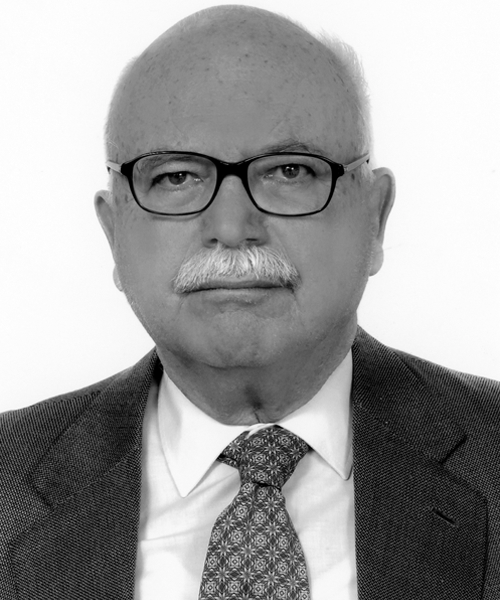
Prof. Demetrios Koutras was born in Athens, Greece, where he later studied Medicine. He did his training at the Western Infirmary Glasgow as a British Council Fellow under the supervision of Sir Edward Wayne and with Dr. Donald Alexander, after which he spent a year at the National Institutes of Health in Bethesda, Maryland. On his return to Greece, he devoted himself to the study of iodine deficiency and its disorders. Prof. Koutras was the promoter of a “silent salt iodination program” throughout his country, which was implemented in the 1980s to counteract endemic goiter, once highly prevalent in Greece. This program eventually led to the virtual eradication of endemic goiter. He was one of the founders of the Hellenic Endocrine Association and, together with several outstanding colleagues, he substantially contributed to establishing the field of endocrinology in Greece.
Prof. Koutras's first publication appeared in 1959 in Schweizerische Medizinische Wochenschrift. It was focused on the role of radiochromium in determining blood volume changes and served to show his profound interest in radioisotope techniques. In the same year, in collaboration with Prof. Malamos, he published a pioneering article on the use of radioiodine for the diagnosis and treatment of thyroid diseases (Acta Endocrinologica, 1959), this being his first international thyroid paper. He carried out several studies on the metabolism of stable iodine in goiter (Lancet, 1961) and, among other investigations, on the genetics of endemic goiter. His studies with regard to twins in the regions of endemic goiter in Greece revealed a higher prevalence of goiter among monozygotic twins as compared with dizygotic twins (Journal of Medical Genetics, 1967). More recently he reported with his colleagues on the immunogenic effects of iodized oil in patients with endemic goiter, demonstrating that about 42% of the patients had positive anti-microsomal and anti-thyroglobulin antibody titers despite being negative for these factors prior to treatment (Journal of Clinical Endocrinology and Metabolism, 1983).
Professor Koutras authored or co-authored about 200 peer-reviewed articles (183 in PubMed) and numerous book chapters and also edited a major textbook of endocrinology in Greek.
Prof. Koutras's exhaustive studies into iodine metabolism and deficiency brought him worldwide renown, and he is also vividly remembered as one of the founders of the European Thyroid Association (ETA). For many years he supported the ETA, serving on the Executive Committee (1967–1970) and as Vice President (1970–1973), and participated in all the annual meetings of the association with rare zeal and commitment. The two annual meetings of the ETA that he organized in Athens in 1969 and 1998 stand out as being among the most successful and fruitful in the association's history. In 2004, the ETA awarded Prof. Koutras the Lissitzky Career Award for his lifetime contribution to thyroid research and clinical practice.
In 2000, a special meeting on bronchocele was organized in Athens to pay tribute to him upon retiring at the end of an illustrious career. The meeting took place at the Zappeion Mansion and was attended by a large number of colleagues and friends of Prof. Koutras from Europe and the United States. Among these was Dr. Alexander who came over from Glasgow and who in his tribute addressed to Demetrios spoke appreciatively about the rounds that Prof. Koutras did each day, recalling that it was “Demetrios's typical practice to meticulously write in the case sheet what dose of the anticoagulant warfarin each patient should receive, as he noticed that the house physicians were not controlling anticoagulant therapy properly.” Dr. Alexander also stressed the deep regard Prof. Koutras' colleagues had for him in the Glasgow thyroid clinic, as had his colleagues in Athens, and their custom of asking him for advice.
Prof. Koutras was endowed with exceptional discernment, an attribute that was especially observable in his article reviews and his comments on meetings and scientific discussions. He was a benevolent and caring person, who was socially very agreeable, and an excellent conversationalist whose discourse was characterized by an exceptional sense of humor. He loved good company and was particularly partial to conducting lively discussions with friends and colleagues while taking a walk. In this connection, I distinctly remember a pleasurable discussion we had while strolling around the gardens of the Broadmoor Hotel in Colorado in 1997 during our attendance of the annual meeting of the American Thyroid Association (ATA)—paraphrasing a George Bernard Shaw quote, he amusingly observed that “in thyroidology, in solving a problem you often create ten more”!
Prof. Koutras is survived by his wife, Maria, his loyal and dedicated life companion. Maria regularly accompanied him at the meetings of the ETA and ATA and her presence, no less than that of Prof. Koutras, was very highly appreciated.
I would also like to mention that Prof. Koutras was, as is Maria, a skillful player of bridge, a game in which he once again demonstrated a sophisticated capacity for analysis and astute judgment.
The thyroid community is deeply saddened by its loss of this greatly accomplished scientist who devoted his life to thyroid research and practice. We will sorely miss his deep humanity, his exceptional knowledge … and his razor-sharp wit that was illustrated, among so much else, by his unforgettable anecdotes with which he graced the closing of each one of our meetings.