




Abstract

W
PLEKHS1 noncoding mutations were identified at low frequencies in thyroid and other tumor types in the early cancer whole genome sequencing efforts (3), and recently confirmed by the Pan Cancer Analysis of Whole Genomes (4). However, these studies doubted the oncogenic status of PLEKHS1 mutations because (a) they occur in palindromic sequence contexts believed to form hairpin DNA structures targeted by APOBEC enzymes (associated with passenger events) and (b) there is no reproducible association with PLEKHS1 expression levels, since different mutant cancer cohorts show either slight downregulation or no significant changes.
We surveyed our set of 30 thyroid cancer cell lines to assess whether PLEKHS1 mutations are subjected to positive selection, as previously shown for key thyroid cancer lesions (e.g., BRAF, TERT, TP53) (5) and correlated the presence of PLEKHS1 alterations with our existing expression data. We found that two cell lines harbored clonal heterozygous PLEKHS1 promoter mutations (Fig. 1A): THJ16-T, an ATC-derived cell line, had a PLEKHS1 115,511,593C>T change, whereas TT2609-CO2, derived from a follicular thyroid cancer (FTC) recurrence, showed mutations at both 115,511,590G>C (different than the reported G>A) and 115,511,593C>T, further stressing the idea of this locus as a mutation-prone region in the genome. Interestingly, three additional cell lines maintained subclonal PLEKHS1 mutations (VAFs = 3–15%, detected by digital droplet polymerase chain reaction). Overall, PLEKHS1 messenger RNA (mRNA) levels in cell lines were low and homogeneous, and none of the PLEKHS1-mutant samples were expression outliers (Fig. 1B), in line with the lack of correlation of PLEKHS1 mutations and mRNA expression in thyroid primary tumors (3,4).
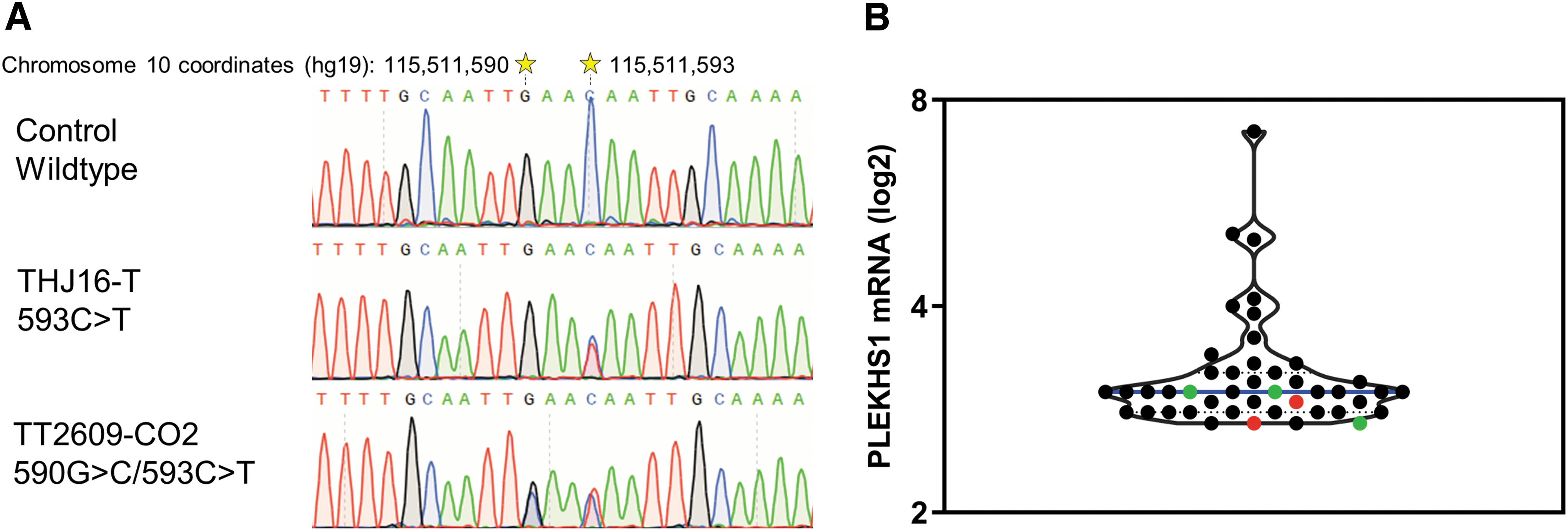
PLEKHS1 status in thyroid cancer cell lines. (
Taken together, we show that PLEKHS1 promoter mutations are also present in a subset of FTC- and ATC-derived cell lines, but their consequences on PLEKHS1 gene expression remain elusive. We believe that the inherent difficulty of assigning functional effects to noncoding mutations requires a more thorough examination of the role of PLEKHS1 in thyroid cancer biology. The former will help determine to what extent these lesions and/or other surrogate markers (expression levels, DNA methylation, or others) become useful indicators in thyroid cancer prognosis.
Footnotes
Acknowledgments
The author thanks Victoria Petkova, Aron Gyuris, and Jingzhu Hao for their technical assistance and helpful discussions.
Author Contributions
I.L. designed the study, performed experiments, analyzed data, and wrote the article.
Author Disclosure Statement
The author declares no potential conflicts of interest.
Funding Information
I.L. received funding from the NIH/NCI K22 Career Transition Award 1K22CA 230381-01A1.