




Abstract
Objective:
To clarify the association between levothyroxine (LT4) treatment and various adverse pregnancy outcomes in pregnant women with thyrotropin (TSH) levels ranging between 2.5 and 10.0 mIU/L in the first trimester, stratified according to thyroid peroxidase antibody (TPOAb) positivity and TSH level.
Methods:
This retrospective analysis of retrospectively and prospectively collected cohort data included Chinese pregnant women with TSH levels of 2.5–10 mIU/L and normal free thyroxine levels (11.8–18.4 pmol/L) in the first trimester. All participants were followed up until the completion of pregnancy, and information on LT4 treatment, pregnancy complications, and pregnancy outcomes was recorded. A 1:1 nearest-neighbor propensity score matching (PSM) between the LT4-treated and - untreated groups with a caliper distance of 0.02 was performed using a multivariable logistic regression model. Multivariable-adjusted modified Poisson regression was used to estimate the relative risk (RR) and 95% confidence interval (CI) of LT4 treatment for adverse pregnancy outcomes. Subgroup analyses were also performed in four subgroups simultaneously stratified by TPOAb status (negative or positive) and TSH levels (2.5–4.0 mIU/L as high-normal group and 4.0–10.0 mIU/L as SCH group). The study was registered in the Chinese Clinical Trial Registry (ChiCTR2100047394).
Results:
Among the 4,370 pregnant women in the study, 1,342 received LT4 treatment and 3,028 did not. The 1:1 PSM yielded 668 pairs of individuals and revealed that LT4 treatment was significantly associated with a decreased risk of pregnancy loss (RR = 0.528, 95% CI: 0.344–0.812) and an increased risk of small-for-gestational-age infants (RR = 1.595, 95% CI: 1.023–2.485). Subgroup analyses suggested that the above effects of LT4 treatment were mainly from TPOAb-negative participants. LT4 treatment was associated with an increased risk of preterm birth (RR = 2.214, 95% CI: 1.016–4.825) in TPOAb-positive pregnant women with high-normal TSH levels.
Conclusion:
LT4 treatment was significantly associated with a lower risk of pregnancy loss and a higher risk of small-for-gestational-age infants in pregnant women with TSH levels of 2.5–10 mIU/L. An increased risk of preterm birth was observed in the LT4-treated group among TPOAb-positive participants with TSH levels of 2.5–4.0 mIU/L.
Introduction
Subclinical hypothyroidism (SCH) is defined as elevated thyrotropin (TSH) levels that occur with normal serum-free thyroxine (fT4) levels, which is the most common thyroid dysfunction during pregnancy, affecting 3.5–14.4% of pregnant women according to different cutoff values for TSH. 1 –3 SCH increases the risk of various adverse maternal and neonatal outcomes. 4 –8 Thyroid autoimmunity (TAI), mainly represented by thyroid peroxidase antibody (TPOAb) positivity, may further increase the risk of adverse pregnancy outcomes in pregnant women with SCH. 8,9
Although levothyroxine (LT4) is widely used in clinical practice, clinical guidelines have not reached a consensus on the optimal treatment for pregnant women with SCH. 10 –12 Although the 2017 American Thyroid Association’s guideline updated the ideal upper limit of serum TSH from 2.5 to 4.0 mIU/L for SCH diagnosis, recommendations for LT4 treatment differed according to TSH levels and TPOAb status, similarly to the 2019 Chinese Medical Association guidelines for gestational SCH; however, some of these recommendations were based on low-quality or inconsistent evidence. 2,13 –17 The debate on this issue may be because of the heterogeneity in the characteristics of pregnant women with SCH in the studies, particularly different TSH cutoff values and TPOAb status, and the relatively small sample size of previous studies. Therefore, we conducted this large-scale study to clarify the association between LT4 treatment and multiple adverse pregnancy outcomes in pregnant women who were simultaneously stratified by TSH levels and TPOAb status.
Materials and Methods
Study population and design
In this cohort study, we included pregnant women who participated in the China Birth Cohort Study (CBCS) between February 2018 and December 2020 at Beijing Obstetrics and Gynecology Hospital, Capital Medical University. This study was approved by the Ethics Committee of Beijing Obstetrics and Gynecology Hospital, Capital Medical University (Approval number: 2019-KY-052-01 on August 12, 2019). Retrospectively collected data were included from women preceding the ethics approval date, and prospectively collected data were included from women enrolled after the ethics approval date. All the participants provided written informed consent. The study was registered in the Chinese Clinical Trial Registry (ChiCTR2100047394) on June 16, 2021, as a retrospective study; however, the registration amended March 11, 2024, indicating this was an observational study with a factorial design.
The CBCS is a cohort study performed in China and intended to investigate the risk factors for birth defects. Pregnant women joined the CBCS at 6–13+6 gestational weeks (GWs) and continued regular follow-ups until completion of pregnancy. 18 Pregnant women with singleton fetuses completed a baseline obstetric health questionnaire and underwent thyroid function tests in the first trimester. After screening for thyroid dysfunction, pregnant women with TSH levels of 2.5–10 mIU/L and fT4 levels of 11.8–18.4 pmol/L in the first trimester were included. Pregnant women with thyroid disease before pregnancy, those who took drugs that may affect thyroid function before pregnancy, and those lost to follow-up were excluded from the study. In this study, LT4 treatment was defined as exposure. We collected data on LT4 treatment as well as dose and timing of initiation. Treatment data were obtained at face-to-face follow-up visits in each trimester and confirmed through review of medical records by obstetric staff. The participants were divided according to TPOAb status (negative or positive) and TSH levels (2.5–4.0 mIU/L as high-normal TSH and 4.0–10.0 mIU/L as SCH). The four subgroups were defined as follows: subgroup A, high-normal TSH levels, TPOAb-negative; subgroup B, SCH, TPOAb-negative; subgroup C, high-normal TSH levels, TPOAb-positive; and subgroup D, SCH, TPOAb positive. 13
Measurements
Maternal demographic and obstetric characteristics, including age, education status, maternal height and weight before pregnancy, maternal smoking, method of fertilization, last menstrual period, obstetric history and medical history, were obtained at baseline using a standardized questionnaire through an electronic data capturing system. The last menstrual period was recorded after ultrasound-confirmation in the first trimester. Medication use before pregnancy and obstetric and medical histories were confirmed using medical records. The prepregnancy body mass index (BMI) was calculated as weight (kg) divided by height (meters) squared. Pregnancy complications and outcomes were extracted from the diagnoses in the medical record system. Participants who did not continue antenatal examinations in the study hospital were followed up by telephone.
Baseline blood samples were obtained after an overnight fasting for at least 8 hours. All samples were stored at 4°C no more than 24 hours or at −20°C for longer. Serum levels of TSH, fT4, and TPOAb were measured using electrochemiluminescence immunoassays (ADVIA Centaur XP; Siemens Healthcare Diagnostics, Tarrytown, NY, USA). All measurements were performed according to standard operating procedures recommended by the manufacturer. TPOAb positivity was defined as a TPOAb level >60 IU/L, based on the kit instructions.
Definition of maternal and neonatal outcomes
Complications and pregnancy outcomes were diagnosed by obstetricians using the unified criteria. The primary outcome was pregnancy loss, defined as spontaneous abortion or stillbirth occurring during pregnancy at an average of 12.2 GWs in the study population. Secondary outcomes included preterm birth, gestational diabetes mellitus (GDM), preeclampsia, small for gestational age (SGA), large for gestational age (LGA), low birth weight (LBW), macrosomia, and birth defects. Live births at <37 GW were considered preterm. GDM was diagnosed if the 75 g-oral glucose tolerance test results reached or exceeded at least one threshold at 0 hours for 5.1 mmol/L, at 1 hour for 10.0 mmol/L, and at 2 hours for 8.5 mmol/L during 24–28 GW. 19 Hypertension (systolic blood pressure ≥140 mmHg or diastolic blood pressure ≥90 mmHg) with new-onset proteinuria (urine protein ≥ 300 mg/24 hours, urine protein/creatinine ratio ≥0.3 mg/dL, or urine dipstick reading >1+) after 20 GW was diagnosed as preeclampsia. SGA and LGA were diagnosed if the birth weight was less than 10th or more than 90th percentile, respectively. 20 LBW and macrosomia were defined as newborn birthweight <2.5 kg or >4.0 kg, respectively. Birth defects at any stage of pregnancy were also recorded.
Statistical analyses
Normal-distributional continuous variables were expressed as the mean ± standard deviation and compared by independent t-tests. Skewed-distributional continuous variables were expressed as median (interquartile ranges, IQR) and compared through the Wilcoxon rank sum test. Categorical variables were expressed as proportions (%), and the χ2 test was used for comparisons. A 1:1 nearest-neighbor PSM with a caliper distance of 0.02 without replacement was performed using a multivariable logistic regression model to balance differences in baseline characteristics of participants between the LT4 treatment and nontreatment groups. The matched variables included maternal age, prepregnancy BMI, gravidity, GW at thyroid function measurement, fT4 levels, TSH levels, and TPOAb status, which were imbalanced between LT4-treated and - untreated groups. Multivariable-adjusted modified Poisson regression was used to calculate the relative risks (RRs) and 95% confidence intervals (95% CIs) of LT4 treatment for adverse maternal and neonatal outcomes before and after PSM. The models were adjusted for maternal age, prepregnancy BMI, gravity, GW at thyroid function measurement, and GW at birth (only for LBW and macrosomia). Subgroup analyses were performed in the four subgroups stratified by TSH levels and TPOAb status only before PSM because of the limited sample size. All statistical analyses were performed using R (version 4.2.1, MatchIt package) and SAS software (version 9.4). A two-sided test p value of <0.05 was considered to be statistically significant.
Results
Baseline characteristics
Of the 34,649 pregnant women initially included in the study, 5,121 were eligible. Pregnant women who had thyroid disease before pregnancy (n = 500), took drugs that may affect thyroid function before pregnancy (n = 30), or were lost to follow-up (n = 221) were excluded from the study. There were 4,370 pregnant women included in the final analyses, of which 1,342 (30.7%) underwent LT4 treatment, and the remaining 3,028 (69.3%) did not (Fig. 1). The initial dose of LT4 therapy in subgroups A1 to D1 had a median of 50 μg/d (interquartile range 25–50 μg/d) and ranged from 12.5 to 150 μg/d; 90.1% of the participants started the LT4 treatment in the first trimester. LT4 was administered orally in the morning or on an empty stomach from the first trimester until delivery. Of the 1342 pregnant women treated, 1242 (92.5%) had more than one TSH test result during the follow-up period. A total of 937 (75.4%) pregnant women had a final TSH concentration of <3 mIU/L. After 1:1 PSM between LT4-treated and - untreated groups, 668 pairs of pregnant women were included. The quality of PSM is shown in Supplementary Figure S1. The baseline characteristics of the LT4-treated and - untreated pregnant women are presented in Table 1. Before PSM, maternal age, prepregnancy BMI, fT4 levels, and GW at thyroid function measurement were significantly lower, but TSH levels, TPOAb levels, and the proportion of TPOAb positivity were higher in pregnant women treated with LT4 than in those without LT4 treatment. All these factors were balanced between the two groups after PSM, whereas the proportion of primiparas was significantly lower in LT4-treated women. The differences in baseline characteristics between matched and unmatched participants are presented in Supplementary Table S1.
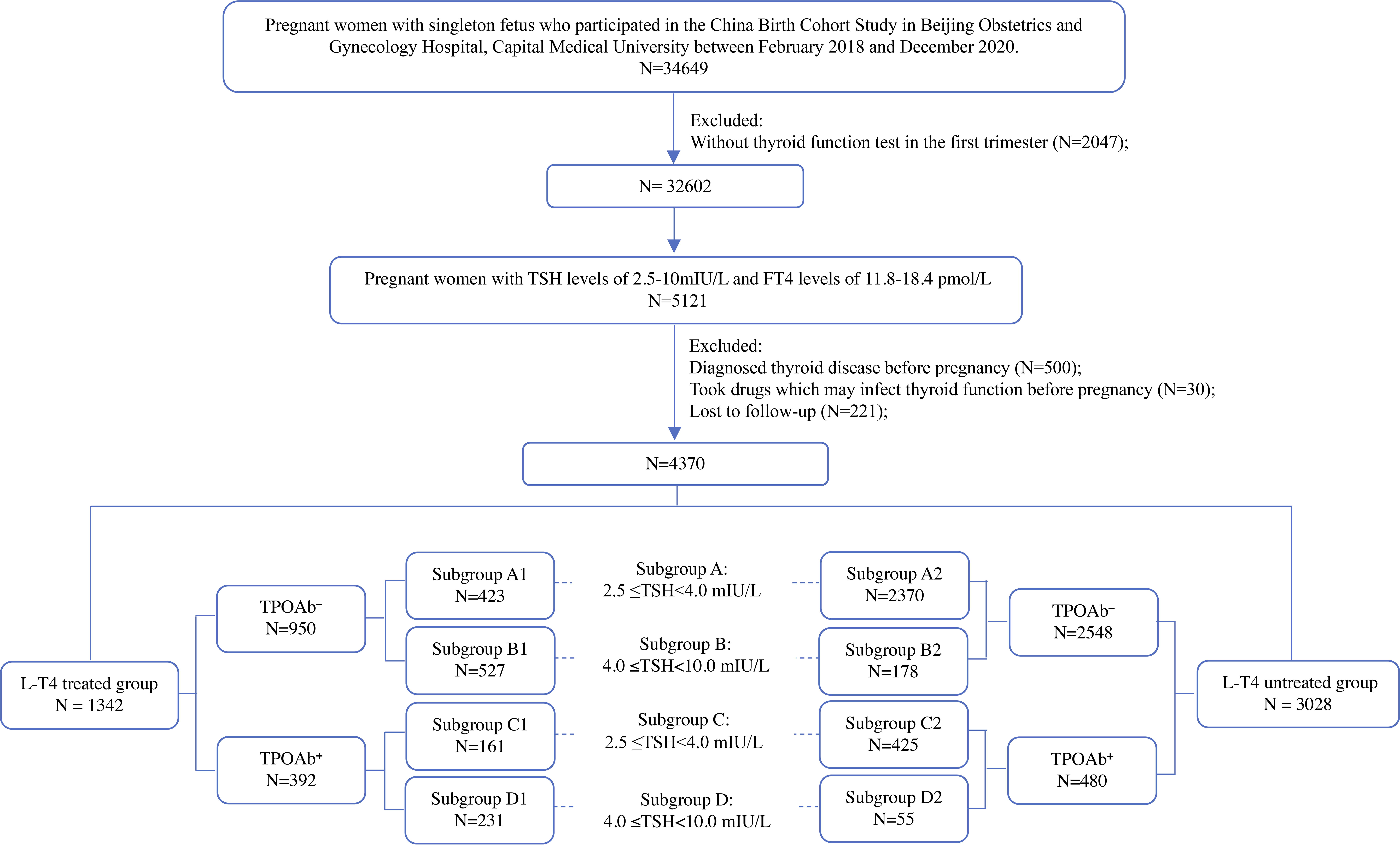
Study participant flowchart.
Baseline Characteristics of Study Subjects with or Without LT4 Treatment Before and After PSM
BMI, body mass index; fT4, free thyroxine; GW, gestational week; PSM, propensity score matching; TPOAb, thyroid peroxidase antibody; TSH, thyrotropin.
Maternal and neonatal outcomes
There were no significant differences in maternal and neonatal outcomes between the matched and unmatched participants (Supplementary Table S2). Table 2 shows the maternal and neonatal outcomes of LT4 treatment after PSM. Among the matched 1,336 participants, the rate of pregnancy loss in LT4-treated participants was significantly lower than that in untreated ones (4.8% vs. 8.8%, p = 0.003). In addition, the rate of SGA mildly increased in the LT4-treated group, although the difference was not statistically significant (7.5% vs. 4.9%, p = 0.056). After adjustment for confounders in a multivariable analysis, LT4 use was significantly associated with a reduced risk of pregnancy loss (RR = 0.667, 95% CI: 0.513–0.867) and an increased the risk of SGA (RR = 1.595, 95% CI: 1.023–2.485). Results similar to those obtained before the PSM are presented in Supplementary Table S3. After PSM, the associations between LT4 treatment and adverse outcomes in TPOAb-negative and TPOAb-positive participants are presented in Supplementary Table S4.
Maternal and Neonatal Outcomes Associated with LT4 Treatment After PSM
Adjusted for maternal age, prepregnancy BMI, gravity, TSH, TPOAb status and GW at thyroid function measurement. LBW and macrosomia also be adjusted for gestational age at birth.
GDM, gestational diabetes mellitus; LBW, low birth weight; LGA, large for gestational age; PSM, propensity score matching; SGA, small for gestational age.
Subgroup analyses according to TPOAb status and TSH levels are shown in Table 3. A considerable negative association between LT4 treatment and the incidence of pregnancy loss was found in multivariable analyses among participants from subgroups A (high-normal TSH levels, TPOAb-negative, RR = 0.566, 95% CI: 0.347–0.922) and B (SCH, TPOAb-negative, RR = 0.498, 95% CI: 0.295–0.841). Conversely, multivariable analyses suggested that LT4 treatment was significantly associated with increased risk of preterm birth (RR = 2.214, 95% CI: 1.016–4.825) among TPOAb-positive participants with high-normal TSH levels (subgroup C). There was no statistically significant association with SGA risk in the LT4 treated group among TPOAb-negative pregnant women with high-normal TSH levels (subgroup A) after multivariable adjustment (RR = 1.409, 95% CI: 0.953–2.084).
Relative Risks and 95% Confidence Intervals for Maternal and Neonatal Outcomes Associated with LT4 Treatment Among Subgroups Stratified by TSH Levels and TPOAb Status
Adjusted for maternal age, prepregnancy BMI, gravity, and GW at thyroid function measurement. LBW and macrosomia also be adjusted for gestational age at birth.
SGA, small for gestational age.
Discussion
In this cohort study, which included 4370 pregnant women with TSH levels of 2.5–10.0 mIU/L, LT4 treatment was associated with decreased risk of pregnancy loss and increased risk of SGA. Moreover, LT4 treatment was associated with a more than twofold increased the risk of preterm births among TPOAb-positive pregnant women with TSH levels of 2.5–4.0 mIU/L.
Several studies have focused on the effects of LT4 treatment on adverse pregnancy outcomes in pregnant women with elevated TSH levels, with inconsistent results. The most recent systematic review and meta-analysis of 11,273 pregnant women with TSH levels >4.0 mIU/L concluded that LT4 usage was not beneficial for maternal and neonatal outcomes, including preterm delivery, miscarriage, and preeclampsia. 15 Another meta-analysis, including 7955 pregnant women with SCH from six studies, had opposite conclusions: LT4 treatment significantly improved pregnancy outcomes, especially pregnancy loss, preterm birth, and gestational hypertension. 14 A meta-analysis of 13 studies involving 7342 pregnant women demonstrated that LT4 treatment significantly decreased the risk of pregnancy loss in pregnant women with TSH levels >2.5 mIU/L. 21 Similar lower risks of pregnancy loss in LT4-treated pregnant women with TSH levels >2.5 mIU/L were reported in two previous meta-analyses by Nazarpour et al. and Rao et al., which included 11,503 and 7970 participants, respectively. 22,23 The benefit of LT4 treatment on pregnancy loss was revealed in a retrospective cohort study of 5405 pregnant women with TSH levels >2.5 mIU/L, the largest study on this topic. 24 Our results in the main analyses revealed a >50% decrease in the risk of pregnancy loss in LT4-treated pregnant women with TSH levels of 2.5–10.0 mIU/L, which agrees with previous studies. 14,21 –24 Moreover, an increased risk of SGA in the LT4-treated group was observed. Although inconsistent with previous studies, there is evidence that LT4 treatment has a potential risk of causing high-normal fT4 levels, which can be associated with impaired fetal growth and LBW. 5,15,21,24 Furthermore, studies have focused on whether the effects of LT4 treatment vary with TPOAb status in pregnant women with TSH levels >4.0 mIU/L. Subgroup analyses in a recent meta-analysis revealed that LT4 treatment was significantly associated with a reduced risk of preterm birth in pregnant women with TSH levels >4.0 mIU/L, regardless of TPOAb status. 14 Similar benefits of LT4 on miscarriage and preterm birth in SCH pregnancies with different TPOAb statuses were supported by another meta-analysis, although the quality of this evidence was low. 15 Our findings also revealed that LT4 treatment was associated with approximately 50% lower risk of pregnancy loss in TPOAb-negative and - positive pregnant women with TSH levels >4.0 mIU/L, although the effect of LT4 was not statistically significant among the TPOAb-positive women. In our study, we did not observe statistically significantly increased risks of preterm birth with LT4 treatment among TPOAb-negative pregnant women with TSH levels >4.0 mIU/L. However, Jiao et al. reported a significant association after excluding cohort studies with a high risk of bias. 15 Unfortunately, the insufficient sample size of TPOAb-positive SCH pregnancies with TSH >4 mIU/L prevented us from investigating the association between LT4 treatment and preterm birth; therefore, high-quality studies with large sample sizes are warranted.
Evidence on the effects of LT4 treatment in pregnant women with high-normal TSH levels and different TPOAb statuses is mixed. A retrospective cohort study of 699 pregnant women with TSH levels of 2.5–4.8 mIU/L revealed that LT4-treated participants had a significantly lower risk of miscarriage (OR = 0.05, 95% CI: 0.01–0.35), although the relatively small sample size limited the subgroup analyses by TPOAb status. 25 Another retrospective study of 106 infertile women with TSH levels of 2.5–4.0 mIU/L reported no benefit of LT4 treatment on miscarriage, regardless of TPOAb status. 26 A randomized clinical trial (RCT) involving 366 pregnant women with TSH levels of 2.5–4.0 mIU/L and TPOAb negativity showed that the prevalence rate of preterm birth was similar in the LT4-treated and - untreated group (12.8% vs. 8.3%, p > 0.05). 27 A similar nonsignificant association between LT4 intervention and preterm birth was reported in 42 TPOAb-positive pregnant women with TSH levels of 2.5–4.0 mIU/L. 28 However, a large-scale retrospective analysis reported by Maraka et al. revealed that the LT4-treated group had a nearly twofold increased risk of preterm birth among 4195 pregnant women with TSH levels of 2.5–4.0 mIU/L (OR = 1.90, 95% CI: 1.26–2.86), although the participants were not stratified by TPOAb status. 24 We found that among pregnant women with TSH levels of 2.5–4.0 mIU/L, LT4 treatment significantly associated with a decreased risk of pregnancy loss in TPOAb-negative participants but an increased risk of preterm birth in TPOAb-positive ones, which was supported by previous studies. 24,25,27 The limited sample size in Nazarpour et al.’s study 28 and the high proportion of patients treated with artificial reproductive technology in Tsunemi et al.’s study 26 may explain the discrepancies with our results.
As no consensus in the current clinical guideline recommendations exists for LT4 treatment in pregnant women with SCH, the present study’s findings provide more valuable evidence to further inform clinical practice. The findings indicate that LT4 treatment can be considered according to TSH levels and TPOAb status. We believe it is reasonable to use LT4 in pregnant women with elevated TSH levels >4.0 mIU/L. Moreover, an increased risk of preterm birth may occur when LT4 treatment is administered to TPOAb-positive pregnant women with TSH levels of 2.5–4.0 mIU/L. Considering the possible increased risk of preterm birth or SGA infants in specific subgroups, future research with improved designs is needed to clarify the safety of LT4 treatment.
One of the strengths of this study is that it includes a large number of women with attention to relevant subgroupings. Furthermore, we performed 1:1 PSM and established multivariable-adjusted models to control for important confounding factors, in agreement with a previous meta-analysis. However, our study had some limitations. There was a mixture of retrospectively collected data from prior to ethics board approval with prospectively collected data after ethics board approval, and this study was not registered as a prospective study from inception. Although PSM was used to balance the baseline characteristics, incomplete matching may be relevant because the matched sample size was <50%. Moreover, the absence of thyroglobulin antibody measurements in the study may have led to a missed diagnosis of TAI. However, a previous study showed that only 5% of pregnant women would have a missed diagnosis because of TPOAb measurement alone. 29 Similarly, we did not gather data on the trajectory thyroid function test results throughout pregnancy in untreated group, which prohibited further analyses of dynamic progress in those participants. We also did not estimate urinary iodine concentration during pregnancy, which may be a relevant covariate for consideration in the association between LT4 treatment and pregnancy outcomes. 2 Furthermore, as this was a real-world study based on a cohort from a single center, the treatment was dependent on institutional clinical practices without detailed data collected on the rationale for and compliance with treatment. Moreover, potential selection bias and information bias could not be avoided. Also, despite the relatively large sample size in the current study, some results were subject to limitations because we could not estimate the RR and 95% CI of LT4 treatment on rare pregnancy outcomes (preterm birth, preeclampsia, and LBW) in TPOAb-positive pregnant women with TSH levels of 4.0–10.0 mIU/L.
Conclusions
The results of this large cohort study suggest that LT4 treatment may be associated with a lower risk of pregnancy loss and a higher risk of SGA in pregnant women with TSH levels of 2.5–10 mIU/L in the first trimester. A significant association with increased risk of preterm birth was also observed in LT4-treated, TPOAb-positive pregnant women with high-normal TSH levels. Future well-designed multicenter prospective cohort studies or clinical trials that recruit sufficient participants in relevant subgroups stratified according to TPOAb positivity and TSH levels are required to confirm our findings.
Footnotes
Acknowledgments
The authors thank all pregnant women participated in the China Birth Cohort Study and the medical staff who collected clinical information.
Authors’ Contributions
C.Y., W.Y., R.L., E.Z., Y.Z., S.G., S.S., S.X., and J.L. participated in the establishment of CBCS. C.Y., R.L., W.Y., and S.G. contributed to initial concepts and study design. S.G. analyzed data and drafted the initial article. X.W. and R.Z. provided consultation on clinical issues. Y.C., S.S., R.L., and E.Z. provided statistical advice and contributed to the article. J.L., S.X., and Y.Z. contributed to clinical interpretation of data. Y.Y., K.H., and M.H. contributed to quality control of laboratory measurements. C.Y., R.L., and W.Y. revision and supervision the article. All the authors agreed to be accountable for all aspects of the work and approved the final article.
Authors Disclosure Statement
No competing financial interests exist.
Funding Information
This work was supported by the National Key Research and Development Program of China (2016YFC1000101), Beijing Municipal Science & Technology Commission (Z181100001718076), Capital’s Funds for Health Improvement and Research (2022-1-2111), and Leading Talents in the Construction Project of High-Level Public Health Technical Talents in Beijing (2022-1-003).
Supplementary Material
Supplementary Table S1
Supplementary Table S2
Supplementary Table S3
Supplementary Table S4
Supplementary Figure S1