




Abstract
Human ehrlichiosis is the second most common tick-borne disease reported in Tennessee after Rocky Mountain spotted fever. Two closely related ehrlichiae, Ehrlichia chaffeensis and Ehrlichia ewingii, are both causative agents of human disease and are transmitted by Amblyomma americanum, the lone star tick. Prevalence rates and distribution patterns of these pathogens among ticks in Tennessee are currently unknown. To understand prevalence and exposure risk of Ehrlichia spp., we tested 616 ticks (309 Amblyomma americanum (L.), 277 Dermacentor variabilis (Say), 17 Ixodes texanus (Banks), 7 Ixodes cookei Packard, 4 Ixodes scapularis (Say), and 2 Amblyomma maculatum Koch) from 46 counties for E. chaffeensis and 324 ticks (238 A. americanum and 86 D. variabilis) from 29 counties for E. ewingii. Overall, E. chaffeensis was detected in 2.6% (8/309) of A. americanum and E. ewingii in 0.8% (2/238). Ehrlichia spp. DNA was not detected in any tick species other than A. americanum. Although sample sizes were low in many counties, all positive ticks were identified in the Interior Plateau and Southeastern Plains ecoregions which is where the majority of human ehrlichiosis cases are reported from Tennessee (e.g., 66.3% of the human cases in 2008 are from the Interior Plateau ecoregion). The data from this pathogen survey combined with frequent human case reports from certain areas indicate potential “hot spots” for ehrlichiosis infection. Targeted vector control interventions in these areas may help decrease human ehrlichiosis transmission.
Introduction
Human ehrlichiosis has historically been prevalent in the southeastern United States (Childs and Paddock 2003) where the LST is widespread and can occur in high densities (Merten and Durden 2000). Human cases of HME are relatively common in Tennessee and rates are increasing. In 2008, 74 HME cases were reported to the Tennessee Department of Health (TDH), a 296% increase over 2007. It is unknown if this increase in prevalence is due to the increased transmission, increased physician awareness, better availability to molecular diagnostics, or a better surveillance system to detect and report infections. Human cases of EWE, only identified in Oklahoma, Missouri, and Tennessee, are strongly associated with immunocompromised and transplant patients (Buller et al. 1999, Paddock et al. 2001). A retrospective study of Ehrlicha-infected transplant and immunocompromised patients in Tennessee found that 3 of the 15 (20%) transplant and 2 of the 43 (5%) immunocompromised patients were infected with E. ewingii (Thomas et al. 2007).
Ehrlichia spp. are maintained in complex zoonotic systems involving ticks and reservoir hosts. White-tailed deer serve as the natural reservoir host for E. chaffeensis and are important hosts for all stages of the LST (Dawson et al. 1994, Lockhart et al. 1996, 1997). Reports of E. chaffeensis in LST have been cited from numerous states (Childs and Paddock 2003) as far north as Rhode Island (Ijdo et al. 2000). To date, this pathogen has not been reported in ticks from Tennessee, but human infections have been reported (Standaert et al. 1995). Much less is understood about the natural system of E. ewingii, although white-tailed deer may also be important reservoirs (Yabsley et al. 2002, 2008). Infected LST have been identified in New York, Georgia, North Carolina, Missouri, Oklahoma, and New Jersey (Murphy et al. 1998, Wolf et al. 2000, Steiert and Gilfoy 2002, DeShields et al. 2004, Varela et al. 2004, Schulze et al. 2005, Mixson et al. 2006), and infected white-tailed deer have been identified in Georgia, Arkansas, Kentucky, North Carolina, and South Carolina (Yabsley et al. 2002). E. ewingii has not been reported from ticks or wildlife in Tennessee. Other wildlife, such as raccoons, coyotes, and domestic dogs, have been implicated in the natural cycles of Ehrlichia spp. (Dawson et al. 1996, Kocan et al. 2000, Yabsley et al. 2008).
As the range of the LST expands (Means and White 1997, Keirans and Lacombe 1998), the areas at risk for A. americanum–transmitted zoonoses such as ehrlichiosis increase. Human ehrlichiosis has been nationally notifiable since 1998 but EWE had been reported as an unspecified ehrlichiosis until 2008 when it was assigned its own category (CDC 2009). Reporting of species-specific ehrlichiosis will serve to increase awareness of the evolving prevalence and epidemiology of EWE and HME. Because the prevalence of these pathogens in ticks in Tennessee is unknown, in this study we actively tested ticks in Tennessee for E. chaffeensis and E. ewingii.
Materials and Methods
Collection of ticks
Ticks were collected from 46 counties in Tennessee by the U.S. Department of Agriculture, Animal and Plant Health Inspection Service, Wildlife Services and the TDH both from wild animals and dragging through vegetation. Ticks found foraging on humans during collections were also included in the study. The collection period was April 2007 to September 2008. Tick host species, global positioning system (GPS) coordinates, county, and date were recorded at the time of collection. All samples were stored in 100% ethanol and were sent to the TDH Vector-Borne Disease Laboratory for identification to species and life stage and molecular testing.
Molecular analysis of ticks
Ticks were individually homogenized with metal beads and resuspended in 225 μL of phosphate-buffered saline. DNA was extracted from 100 μL of the homogenate using a Qiagen QiaAmp DNA Micro Kit (Qiagen, Valencia, CA) according to manufacturer's instructions. For detection of E. chaffeensis, a real-time PCR targeting the 16S rRNA gene was conducted as previously described (Loftis et al. 2003). As real time is currently unavailable for E. ewingii, a nested, species-specific conventional PCR targeting the 16S rRNA gene was conducted as previously described (Yabsley et al. 2002). For positive controls, we used DNA extracted from a culture of E. chaffeensis and a deer blood sample positive for E. ewingii. PCR products were separated on 2% agarose E-gels (Invitrogen, Carlsbad, CA) and viewed under ultraviolet light. Positive E. chaffeensis and E. ewingii samples were verified by sequence analysis. GenBank accession numbers are pending.
Ecoregions and statistical analysis
Ecoregion classifications (Fig. 1) were derived from the U.S. Environmental Protection Agency and Tennessee Department of Environment and Conservation collaborative project map (Griffith et al. 1997). The Interior Plateau includes the low elevation areas of middle Tennessee. Hills and plains are composed of a diverse mixture of sandstone, siltstone, and shale. The Southeastern Plains region is west of the Interior Plateau and consists of an assortment of forest, woodland, and pasture. Sands, silts, and clays comprise much of the soil type in this region (Purdue University 1999). The Fisher's exact test was used to perform statistical comparisons of prevalence rates of Ehrlichia spp. among different classes of ticks.
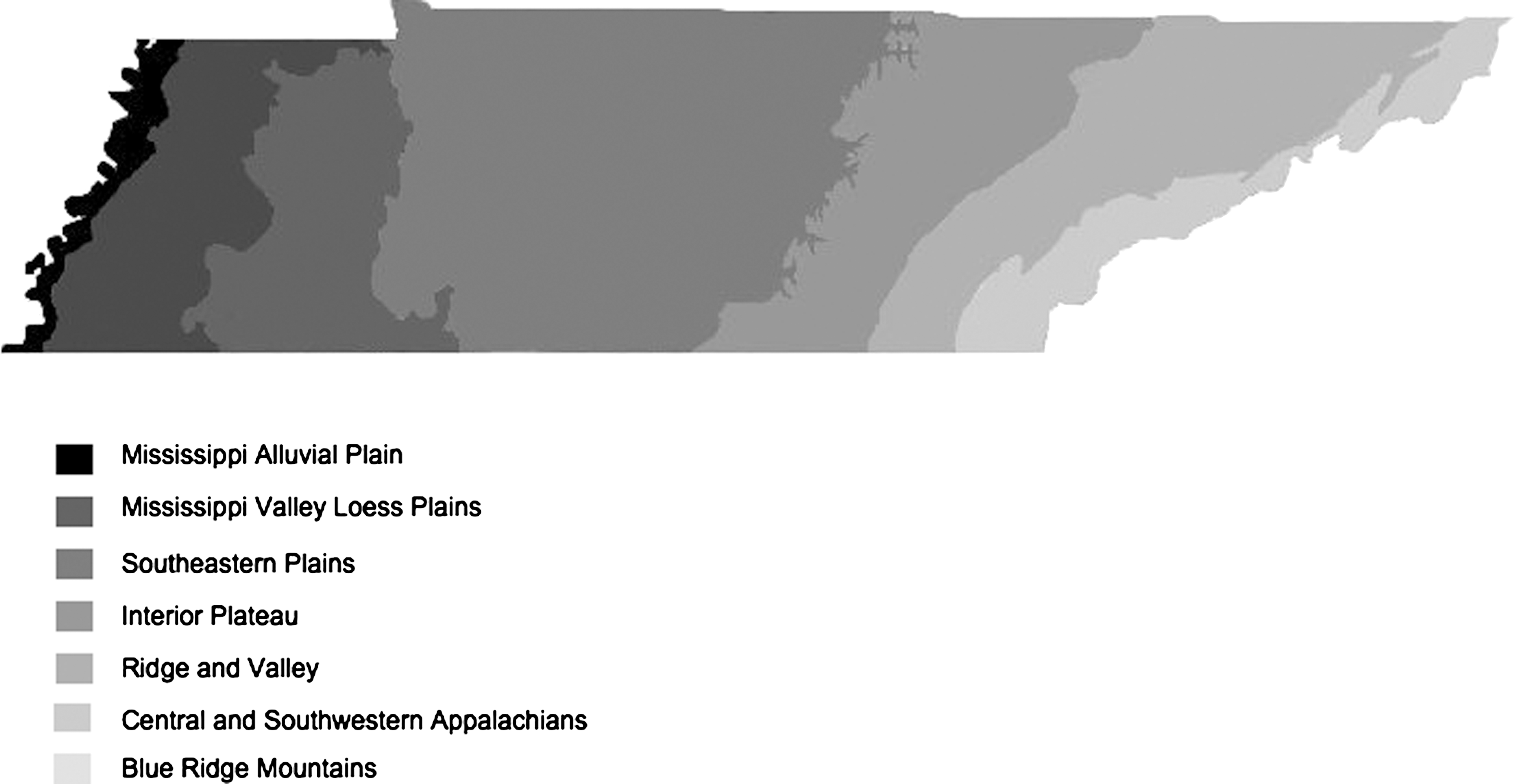
Ecoregions of Tennessee (adapted from Griffith et al. 1997).
Results
Of 309 LST tested, 8 (2.6%) were positive by real-time PCR for E. chaffeensis (Table 1). The prevalence of E. chaffeensis among LST adults (2.7%) and LST nymphs (2.5%) was not statistically different. An additional 307 ticks (277 Dermacentor variabilis, 17 Ixodes texanus, 7 Ixodes cookei, 4 I. scapularis, and 2 Amblyomma maculatum) were negative by PCR. Of the 46 counties sampled for E. chaffeensis, 2 (4.3%) yielded infected LST. E. chaffeensis was identified in 4 of the 23 (17.4%) LST from Davidson County, a metropolitan area in the Interior Plateau ecoregion, and 4 of the 42 (9.5%) LST from Williamson County, a suburban area immediately south of Davidson.
1, Blue Ridge Mountains; 2, Ridge and Valley; 3, Southwestern Appalachians; 4, Interior Plateau; 5, Southeastern Plains; 6, Mississippi Valley Loess Plains.
Includes counties with less than four tested ticks and no positives: Rhea, Johnson, Bledsoe, Sequatchie, Robertson, Chester (one tick); Sullivan, Bradley, Wilson (two ticks); Unicoi, Perry (three ticks).
Of the 238 LST tested, 2 (0.8%), 1 adult female and 1 nymph, were positive by nested conventional PCR for E. ewingii (Table 2). No adult males were positive for E. ewingii. Eighty-six D. variabilis were negative by PCR. Of the 29 counties sampled for E. ewingii, 2 (6.9%) yielded infected LST. E. ewingii was detected in one of the two LST tested from McNairy County, a rural area in the Southeastern Plains ecoregion, and one (4.3%) LST from Davidson County.
1, Blue Ridge Mountains; 2, Ridge and Valley; 3, Southwestern Appalachians; 4, Interior Plateau; 5, Southeastern Plains; 6, Mississippi Valley Loess Plains.
Includes counties with less than four tested ticks and no positives: Robertson, Perry, Hamilton, Van Buren (one tick); Giles, Wilson (two ticks); Hardin (three ticks).
Overall, three (6.5%) counties yielded specimens positive for Ehrlichia spp. DNA (Fig. 2). The highest prevalence was seen in Davidson County with 5 of the 46 (10.9%) LST positive for E. chaffeensis or E. ewingii. The A. americanum samples positive for E. chaffeensis and E. ewingii from Davidson County were collected from two white-tailed deer at distinct GPS coordinates. In Williamson County, all E. chaffeensis–positive ticks were collected from a single drag site. The LST positive for E. ewingii in McNairy County was collected from a human.
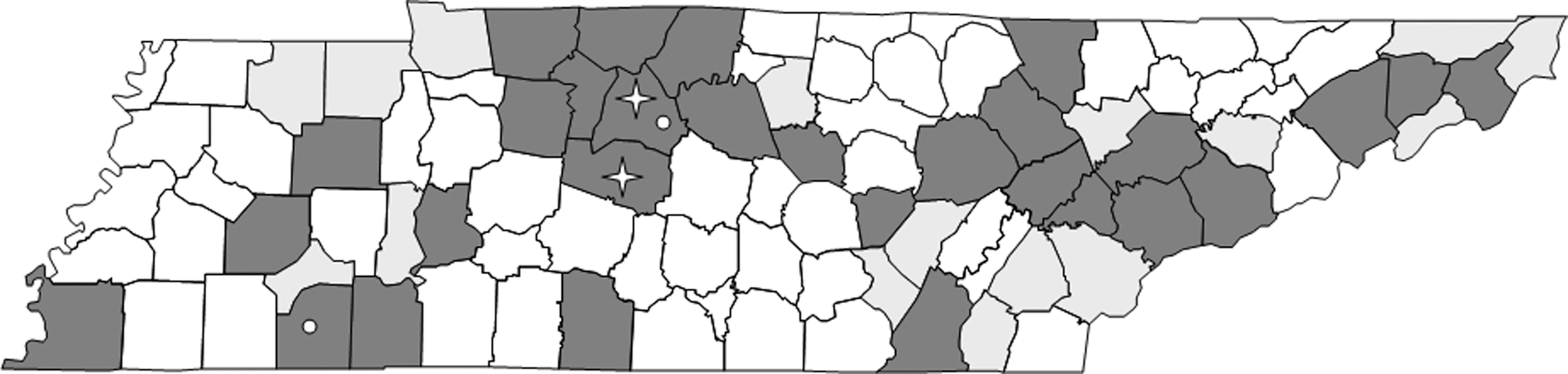
Map depiction of counties from which ticks were collected in Tennessee. Light-shading counties indicate origins of ticks tested only for Ehrlichia chaffeensis. Dark-shading counties indicate origins of ticks tested for E. chaffeensis and Ehrlichia ewingii. Stars depict the locations of E. chaffeensis detections in Amblyomma americanum. Circles depict the locations of E. ewingii detections in A. americanum.
Discussion
Pathogens transmitted by the LST, an aggressive tick, are an increasing public health concern (Paddock and Yabsley 2007). The overall prevalence of E. chaffeensis in LST in Tennessee (2.6%) is very similar to previously reported values of 1.7% and 2.0% in Georgia (Varela et al. 2004, Mixson et al. 2006). However, the prevalence of E. chaffeensis in LST was as high as 17.4% in Davidson County, underscoring the highly focal nature of tick-borne disease transmission. Our overall prevalence for E. ewingii in LST of 0.8% was lower than earlier findings in Georgia (3.4%) (Mixson et al. 2006), yet similar to findings in North Carolina (0.6%) (Wolf et al. 2000).
We tested LST ticks from 31 of the 46 counties sampled from east to west Tennessee. Of the 10 LST positive for Ehrlichia spp. DNA, 9 originated from the Interior Plateau ecoregion, which encompasses Davidson and Williamson Counties in middle Tennessee. In 2008, 19 of the 70 (27.1%) HME cases reported to the TDH were from Davidson County. An additional 29 (41.4%) cases were from other counties within the Interior Plateau ecoregion and 10 (14.2%) were from the western region of Tennessee that includes McNairy County. Only 12 cases (17.1%) were reported from regions that did not produce an Ehrlichia spp.–positive tick in our survey. No cases of E. ewingii ehrlichiosis were reported in Tennessee in 2008. This may be because it only recently became a notifiable disease and requires PCR for diagnosis. Six cases of human ehrlichiosis were reported to the TDH in 2008 for which the etiologic agent was undetermined. It is possible that some of these cases were due to E. ewingii.
Despite an overall low prevalence, areas in which Ehrlichia spp. DNA was detected tended to correspond to areas with higher human disease incidence. This suggests that Ehrlichia spp. may be localized to particular areas in Tennessee. A surveillance system using white-tailed deer as a sentinel for E. chaffeensis predicted a higher probability of E. chaffeensis endemnicity in middle and western Tennessee due to varying elevation, percent total forest cover, soil moisture, minimum temperature, and summer humidity levels (Yabsley et al. 2005). Although our study does not predict human disease, the locations of E. chaffeensis detection in ticks in Tennessee are consistent with the results of this surveillance system.
White-tailed deer density is an important factor for identifying E. chaffeensis exposure risks. Establishment of E. chaffeensis infection depends on the white-tailed deer reservoir since the pathogen is not transovarially transmitted (Long et al. 2003) and simulations of LST population dynamics show that the tick requires white-tailed deer for survival and proliferation (Mount et al. 1993). The Interior Plateau ecoregion in Tennessee averages 30–45 white-tailed deer per square mile compared with 15–30 in the eastern region of the state (The Quality Deer Management Association 1999). The identification of areas with higher densities of white-tailed deer along with detection of E. chaffeensis in LST may indicate the need for targeted vector control interventions. The LST is an aggressive biter and, although a preferred feeder of white-tailed deer, is known to feed on humans throughout its range (Merten and Durden 2000). Sustained use of acaricides on white-tailed deer in areas with high populations may limit the exposure risk of A. americanum–transmitted zoonoses (Gaff and Gross 2007).
Although both E. chaffeensis and E. ewingii are known to circulate in human populations in Tennessee (Paddock et al. 2001, Thomas et al. 2007), this is the first study to identify Ehrlichia spp. DNA in ticks from Tennessee and serves to expand the known range of E. ewingii in the LST. Limitations of this study include the absence of white-tailed deer serum samples for E. chaffeensis antibody testing. Detection of Ehrlichia spp. in ticks is useful in determining distribution of pathogens and potential of exposure, but because some of the ticks in this study were collected from hosts and contained various amounts of host blood, we were unable to determine if positive ticks were infected during a previous life stage or were positive because they contained infected host blood. As white-tailed deer are the reservoir of E. chaffeensis (Dawson et al. 1994, Lockhart et al. 1997), molecular testing of white-tailed deer serum would provide a more accurate depiction of the prevalence of E. chaffeensis, particularly in areas that appear to have higher endemnicity. Another limitation is the low collection yield of I. scapularis, thus preventing A. phagocytophilum detection assays. This is likely explained by the timing of collections as I. scapularis is most abundant during the fall and spring in Tennessee rather than the summer. Future studies involving active surveillance of white-tailed deer in Tennessee and continued tick collections during the fall and spring seasons will be useful for further understanding of ehrlichiae and Anaplasma prevalence.
Footnotes
Disclosure Statement
No competing financial interests exist.