




Abstract
Control of vector(s) or mosquitoes, in general, through biolarvicide as an alternate biocontrol agent is a greatest desire. We evaluated a water-dispersible granular formulation biolarvicide Bacillus thuringiensis var. israelensis (Bti, H-14 serotype; VectoBac® WDG) in the laboratory and also in the field against two principal malaria vectors, Anopheles culicifacies and Anopheles stephensi. Laboratory evaluations against laboratory-reared immature of the two species were carried out at a temperature of 28°C ± 2°C and 70%–80% relative humidity. Field trials were conducted in a rural area and in Bangalore city, Karnataka, South India. First trial against the rural vector An. culicifacies was carried out in stone quarry pits at dosages of 0.05, 0.2, and 1 g/m2. The second trial against urban vector An. stephensi was carried out in ring wells at 0.05, 0.1, 0.2, 0.5, and 1 g/m2 dosages. Laboratory tests revealed increased efficacy against An. stephensi. The fifty percent lethal concentration (LC50) and LC90 values against An. culicifacies and An. stephensi were 0.348 and 1.008 mg/L (χ 2 = 8.49; p > 0.05) and 0.245 and 0.533 mg/L (χ 2 = 4.67; p < 0.05), respectively. Based on the findings of no pupal production in the field, the formulation was effective up to 14 days at 0.2 g/m2 or more appropriately at 0.25 g/m2 dose for both the species under field conditions. We discuss how this new formulation was evaluated against An. culicifacies and An. stephensi under laboratory and field conditions. No adverse effects were observed on the nontarget species such as frogs, their tadpoles, small local fish, Notonectid bugs, and water scatters. We conclude that VectoBac WDG is effective at 0.25 g/m2 and be recommended for its use in the vector-borne disease control program under integrated vector management concept.
Introduction
VectoBac® is a biological larvicide based on Bti (H-14 serotype). Its water-dispersible granular formulation (VectoBac WDG) evaluated by World Health Organization Pesticide Evaluation Scheme (WHOPES) has been found effective for 2–7 days for mosquito larvae control in open water bodies at 125–500 g/ha and for container breeding mosquitoes (Aedes aegypti and Aedes albopictus) for 5–9 weeks at 1–5 mg/L, with safety to human, wildlife, and other nontarget organisms. Its safety needs to be evaluated more in the field in specified breeding habitats of different mosquito species. In this study, we evaluated VectoBac WDG against the principal rural malaria vector Anopheles culicifacies in stone quarry pits and the urban malaria vector Anopheles stephensi in ring wells. Prior to the field trials, the formulation was evaluated in the laboratory against both these vector species.
Materials and Methods
VectoBac WDG (Bti, H-14 serotype) was supplied by Sumitomo Chemical (India) Pvt. Ltd., Mumbai, India.
Laboratory evaluation
The granular formulation of Bti (VectoBac WDG) was first evaluated under controlled laboratory conditions at a temperature of 28°C ± 2°C and relative humidity of 70%–80% using laboratory-reared immature of An. culicifacies and An. stephensi. Initially 1% stock solution was prepared and thereafter serial dilutions were made with distilled water. Tests were carried out in 500-mL glass beakers containing 250 mL treated water. Twenty-five late III and early IV instar larvae of each species were introduced into each beaker for each concentration. Four replicates of each concentration were run along with the control using distilled water. Larval food consisting of dog biscuits and yeast powder (60:40) was added in both treated and untreated water. Mortality of larvae was recorded in both treated and control beakers after 24 h. Corrected percent mortality was calculated from the mortality in concurrent control using Abbott's formula (given below). Fifty percent lethal concentration (LC50) and LC90 values were calculated by log-probit analysis (Finney 1971).
Field evaluation
Against
An. culicifacies in stone quarry pits. In November 2003, field evaluation was carried out in a malaria-affected Primary Health Centre Harohalli, Bangalore Rural district, 50 km south of Bangalore City. The area is hilly and excavation of rocky hills for commercial purpose created stone quarry pits in recent years. These pits are preferred breeding habitats for An. culicifacies (Tiwari et al. 2001). Twelve stone quarry pits ranging from 6 to 130 m2 were randomly selected. VectoBac WDG was applied in nine stone quarry pits (experimental), three each at 0.05, 0.2, and 1 g/m2 dosage; three quarry pits, one each for three different dosages for three replicates, were kept as control.
Against
An. stephensi in ring wells. Recent survey in Bangalore City showed that ring wells supported maximum breeding of An. stephensi (Ghosh et al. 2005). In August 2004, the trial was carried out in Byrasandra Taverkere Madivala layout under north zone of Bangalore city. Eighteen positive wells ranging from 0.385 to 2.8 m2 were randomly selected. VectoBac WDG was applied in 15 wells, three replicates each at 0.05, 0.1, 0.2, 0.5, and 1 g/m2 dosage. Three ring wells were kept as control.
Suspensions of VectoBac WDG of respective doses were prepared and applied in the respective test sites with the help of a Knapsack sprayer using flat fan nozzle. Detailed information on dilutions and treatments to achieve different dosages is given in Table 1. Simultaneously, water temperature and pH of each breeding habitat were measured by a thermometer and a digital pen-type field pH meter, respectively. General information on the breeding habitats of the vector mosquitoes is given in Table 2. Presence of vegetation was also recorded. Any effect on nontarget species such as frogs, their tadpoles, small fish, Notonectid bugs, and water scatters was also recorded. In a few ring wells, only water scatters were noticed. Anopheline immature were collected using standard white enamel larval ladles (125 mm diameter, 250 mL capacity). Larval prevalence was expressed as density per dip and their densities were monitored on day 0, 1, 2, 3, 7, 10, 14, and 17 of VectoBac application in both the experimental and control breeding habitats. Larvae collected from the field were transferred to net-covered plastic containers and fed on larval food until adults emerged. Adult mosquitoes were anesthetized with ether and identified using a binocular stereoscopic microscope following the taxonomic key of Das et al. (1990).
CI, confidence interval.
Percent reduction taking the densities of III and IV instar larvae compared with untreated control was calculated using the formula of Mulla (1971).
where C1 and C2 are the counts of III and IV instars in control habitats, before and after the treatment, and T1 and T2 are counts of III and IV instars in treated habitats, before and after the treatment.
To find out the more appropriate dose, a linear graph was drawn between different dosages and days of protection.
Statistical analysis
Statistical analysis was done using VassarStat software (
Results
Laboratory trial
Results of laboratory evaluation of Bti H-14 (VectoBac WDG) against immature of An. culicifacies and An. stephensi are given in Table 3. This formulation was more effective against An. stephensi (LC50 = 0.245 mg/L and LC90 = 0.533 mg/L; χ 2 = 8.49; p > 0.05) than An. culicifacies (LC50 = 0.348 mg/L and LC90 = 1.008 mg/L; χ 2 = 4.67; p < 0.05).
df, degree of freedom.
Field trial
Against
An. culicifacies in stone quarry pits. The impact on the larvae of An. culicifacies in stone quarry pits is shown in Figure 1a–c. Densities of III and IV instar larvae in the control pits were greater than the treated ones. An overall 100% reduction up to day 3 for all the dosages was recorded. However, significant increase was observed in the densities of III and IV instar larvae at the dose level of 0.05 g/m2 on day 7 (p < 0.05). The increase in the larval densities at 0.05 mg/m2 on day 10 and at 1.0 g/m2 on days 7 and 10 was nonsignificant (p > 0.05). Around 90% reduction was observed up to day 14 posttreatment at 0.2 g/m2 dose. The densities reappeared along with pupae on day 17 when no impact was recorded. The mean water temperature in stone quarry pits was 29.5°C (confidence interval [CI]: 28.01–31.0) and the mean pH was 7.8 (CI: 7.02–8.65). No side effects were observed on Notonectid bugs, small local fish, water scatters, and frogs, especially on their tadpoles, throughout the study period. Floating algal vegetation was recorded in one each of the experimental and control pits (Table 2).
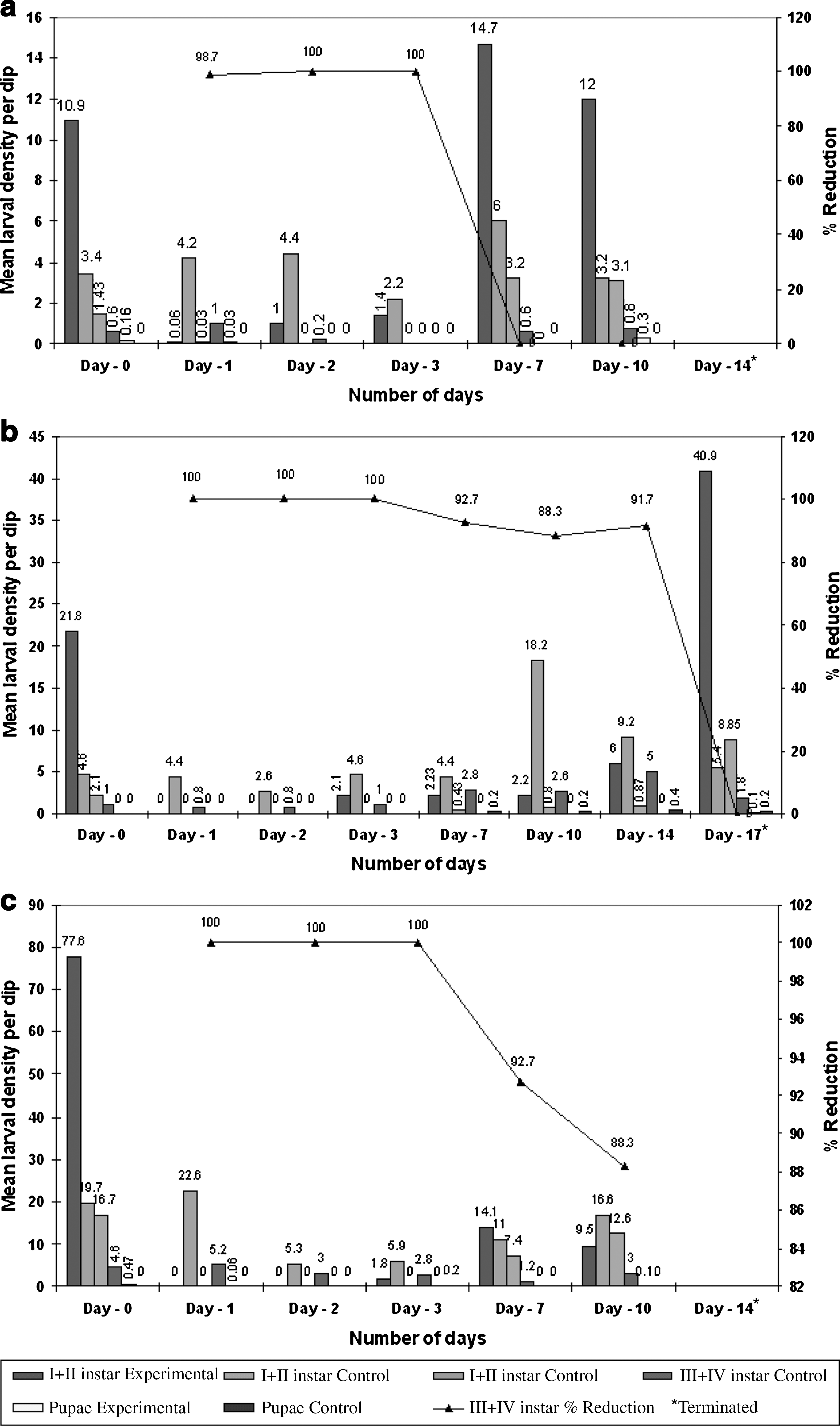
Impact of different dosages of Vectobac® WDG on larvae of Anopheles culicifacies in stone quarry pits, Primary Health Centre Harohalli, Bangalore Rural District, Karnataka, November 2003. Dose: (
Against
An. stephensi in ring wells. In ring wells, the densities of III and IV instar larvae of An. stephensi were significantly lesser in the treated wells than in the control ones (p < 0.05; Fig. 2a–e). Reduction on larvae at different dosages was 100% up to day 7 and was maintained up to day 10 except at 0.05 and 0.5 g/m2 dosages. Larvae including pupae reappeared on day 14 except at 0.2 g/m2 dose. During the experiment, the mean temperature and pH of water were 21.8°C (CI: 21.7–22.5) and 7.74 (CI: 7.63–7.85), respectively. No vegetation was observed in the ring wells selected for the study. Water scatters were recorded in a few wells (Table 2).

Impact of different dosages of Vectobac WDG on Anopheles stephensi larvae in ring wells, Bangalore City, August 2004. Dose: (

The graph between different dosages and days of protection interprets that intrapolation is highly appreciated with r 2 = 99.45% (coefficient of variation/determination). Accordingly, 0.25 g/m2 would be the more appropriate dose (Fig. 3).
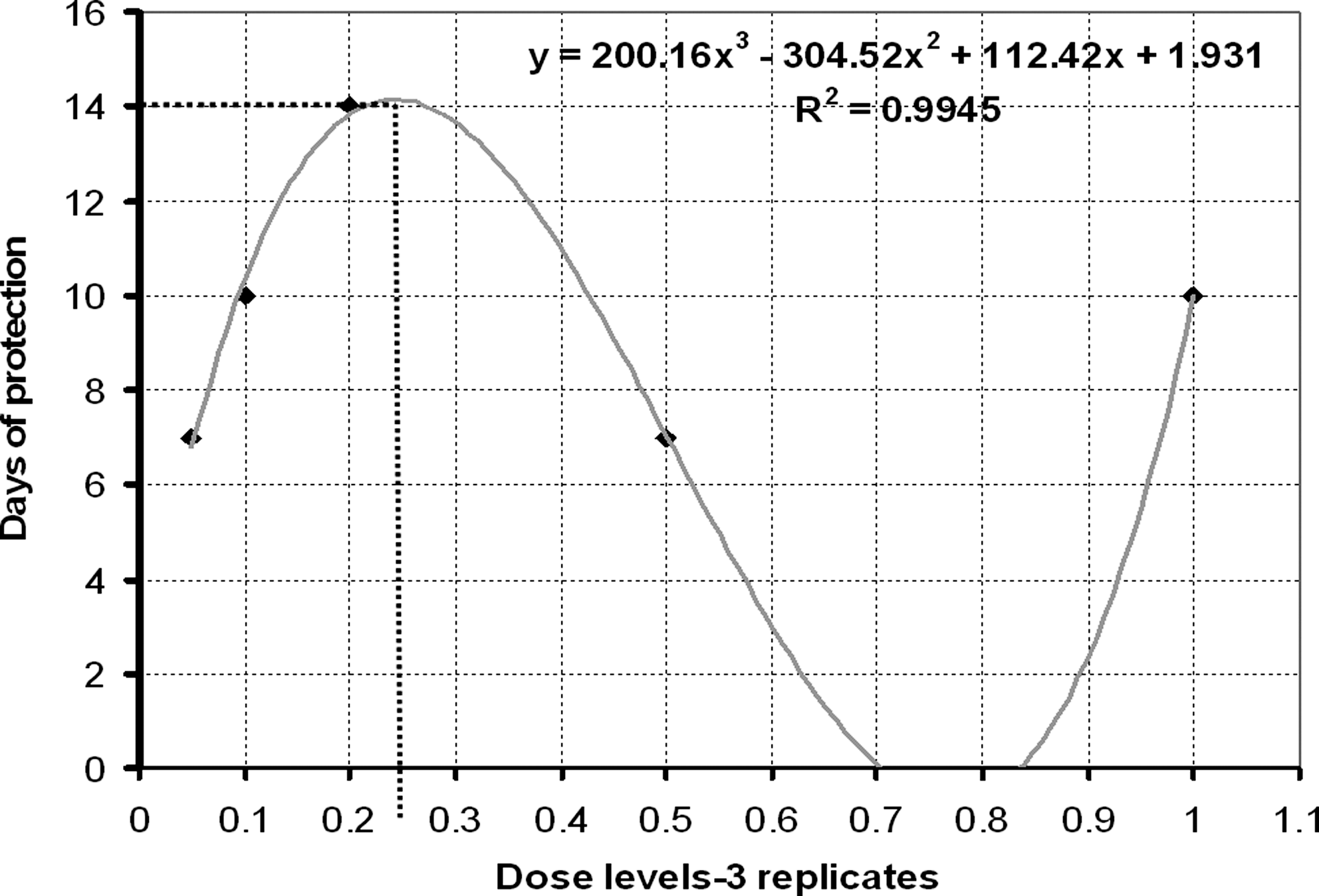
Comparison of effectiveness of Vectobac WDG on larvae of An. stephensi and An. Culicifacies in Karnataka, 2003–2004. This graph shows that extrapolation is not possible. Intrapolation is highly appreciated with r 2 = 99.45% (coefficient of variation/determination).
Discussion
In the last 3 decades, integration of eco-friendly biological control methods in vector control program has been emphasized. One of the potent strains of bacterium Bti (H-14) has been found effective against all mosquito genera (Haq et al. 2004). Sharma et al. (2003) reported the spray impact of Bti (WP) against An. culicifacies in river bed pools for 5 weeks, with a recurrence of larval density within a week after treatment at 0.5 g/m2. Its aqueous formulation showed 10–12 days efficacy at 0.5 mL/m2 in unpolluted water bodies in urban area of Rourkela city of Orissa state (Sharma et al. 2008). In another study, aqueous formulation of Bti has been reported effective for 2–8 days at 1.2 L/ha and for 3–9 days at 2.4 L/ha and granular formulation for 2–9 days at 7 kg/ha in stream pools (Amalraj et al. 2000). In this study, VectoBac WDG, a granular formulation of Bti H-14, was found effective up to 14 days at 0.2 g/m2 dose. In case of An. stephensi, results of this study are in accordance with the earlier reports that recorded 98%–100% reduction on III and IV instar density in cemented tanks/chambers at construction sites during the first week of application of VectoBac 12 AS (liquid formulation) at 0.1–0.2 mL/m2 (Haq et al. 2004). Kumar et al. (1995) tested the bioefficacy of suspension formulation of B. thuringiensis var. israelensis strain 164 and serotype H-14 (trade name Bactoculicide) against An. stephensi in masonry tanks, curing water in construction sites, and discarded overhead tanks (OHTs). The formulation was found effective for 18 days in masonry tanks, 21 days in curing water, and only 3 days in OHTs when applied at 1 g/m2.
The enhanced efficacy in masonry tanks and curing waters was due to prolonged availability of endotoxin particles in the feeding zone of the larvae. Repeated agitation in such waters was created by repeated addition of water and sinking of bricks or cement blocks and their removal for curing purpose. The shorter efficacy in the stone quarry pits and ring wells might be due to lack of such agitation activities. In this study, VectoBac WDG showed relatively better efficacy when applied at a middle dose of 0.2 g/m2. This indicates that at lower dosages the spores might not be sufficient to achieve the desired efficacy and at higher dosages some of the spore granules might have settled down at the bottom, which make them nonavailable to the larvae in their feeding zone (Kumar et al. 1995).
Bti H-14 (Bactoculicide) has been reported to be temperature dependent, as the activity increases significantly with the rise in temperature in larval habitats (Mittal et al. 1993). Kumar et al. (1995) observed the residual efficacy of Bactoculicide against An. stephensi between 3 and 21 days in discarded OHTs, masonry tanks, and curing water when the temperature varied from 24°C to 27°C. In this study, the effectiveness of VectoBac WDG persisted for 3–17 days against larvae of An. culicifacies in stone quarry pits and 7–14 days against larvae of An. stephensi in ring wells when the mean temperature was 29.5°C (CI: 28.01–31.0) in stone quarry pits and 21.8°C (CI: 21.7–22.5) in ring wells.
It has been reported that the presence of microflora reduces the efficacy of B. sphaericus against mosquito larvae (Goldberg et al. 1977, Mittal et al. 1993). The residual efficacy (100%) of VectoBac WDG for 3 days in stone quarry pits with vegetation (pH 7.8; CI: 7.02–8.65) and 2 weeks in ring wells without vegetation (pH 7.74; CI: 7.63–7.85) is in accordance with the earlier findings (Kumar et al. 1995).
Mosquito larvae are usually found in association with other aquatic organisms such as Notonectid bugs, fish, frogs, chironomid midges, and Anisops. In this study, no side effects were observed on the available nontarget species. This is in conformity with earlier reports (Mulla 1985, Sharma et al. 2003). Laboratory studies also confirmed that microbial insecticides are safe to the mosquito fish Gambusia affinis (Mittal et al. 1991).
Thus it is concluded that the new granular formulation of Bti H-14 (VectoBac WDG) is effective for control of An. culicifacies and An. stephensi mosquito larvae for 2 weeks in stone quarry pits and ring wells when applied at 0.2 g/m2 and more appropriately at 0.25 g/m2. As the formulation had no side effects on nontarget organisms it can be used as an additional tool in integrated vector management.
Footnotes
Acknowledgments
The authors thank Sumitomo Chemical (India) Pvt. Ltd., Mumbai, India, for supply of VectoBac for evaluation and for providing financial support. They also thank the staff of National Institute of Malaria Research, Field Station, Bangalore, for technical assistance, and Mr. K.P. Suresh, Scientist (Biostatistics), National Institute of Animal Nutrition and Physiology, Bangalore, for analysis of the data.
Disclosure Statement
On behalf of authors, Susanta K. Ghosh certifies that all authors contributed actively to the study and approved the final version of the article. The authors have no conflict of interest in relation with this study. This study received approval from the Scientific Advisory Committee of the National Institute of Malaria Research. Sumitomo Chemical (India) Pvt. Ltd., Mumbai, India, did not interfere with the scientific management of the study and the redaction of this article.