




Abstract
Rift Valley fever virus (RVFV), a member of the family Bunyaviridae, regularly accounts for large and severe outbreaks among humans and livestock in Africa and Arabia. Therefore, safe and efficient vaccines are highly needed. Here, we report the production of recombinant virus-like particles (VLPs) that, in addition to their similarity to RVFV particles, are able to express the viral nucleocapsid (N) gene. A single inoculation of 1 × 10⁶ of these N-VLPs was sufficient to protect 100% of mice from infection with a lethal dose of 1 × 10⁵ PFU of RVFV. Our study demonstrates that N-VLPs can be considered as a safe and efficient vaccine against the emerging pathogen RVFV, and that VLPs that actively produce a viral antigen may be considered a strategy to improve the immunogenicity of VLPs in general.
RVFV particles are enveloped with viral glycoproteins in their membrane and nucleocapsids inside. RVFV nucleocapsids are the units of transcription and replication. They consist of genomic RNA, which is encapsidated by the nucleocapsid protein (N) and associated with the polymerase (L). Conserved untranslated regions at the 5′ and 3′ ends of the genomic RNA act as promoter for the viral polymerase. The genome of RVFV is divided into the three segments L (large), M (medium), and S (small), which have negative-sense or ambisense polarity. The L segment encodes the L polymerase, the M segment encodes the glycoproteins Gn, Gc, the 78-kDa protein, and the nonstructural protein NSm, and the S segment encodes the N protein and the nonstructural protein NSs. Although the role of the NSm protein in viral pathogenesis is not fully clarified, the NSs protein is known to act as an inhibitor of the antiviral type I interferon system (reviewed in Elliott and Weber 2009).
To reduce the economical and medical impact of RVFV, safe and efficient vaccines are urgently needed. However, the classical vaccines that are currently in use either have significant residual pathogenicity (e.g., live attenuated strain Smithburn), or require multiple inoculations (formalin-inactivated virus) (reviewed in Bouloy and Flick 2009, Ikegami and Makino 2009). Modern approaches to improve the situation involve usage of reverse genetics systems to attenuate the virus in a targeted manner (Bird et al. 2008), DNA vaccines (Spik et al. 2006, Lagerqvist et al. 2009), heterologous viruses expressing RVFV antigens (Wallace et al. 2006, Gorchakov et al. 2007, Heise et al. 2009), or viruses reassorted in the laboratory to combine attenuation markers of different isolates (Bouloy and Flick 2009, Ikegami and Makino 2009). However, even if proved to be safe and immunogenic, all approaches based on live viruses require expensive safety precautions for production. DNA vaccines, by contrast, require three to four inoculations to provoke sufficient immune responses.
Recently, we have developed a system to produce virus-like particles (VLPs) of RVFV containing nucleocapsids that are able to express a reporter gene (Habjan et al. 2009). These VLPs were produced by transfecting cells with cDNA plasmids for the viral L, M, and N genes along with a minigenome RNA construct encoding a reporter gene. In the transfected cells, plasmid-expressed L and N proteins encapsidate the minigenome. These recombinant nucleocapsids are packaged by the M-encoded glycoproteins and form VLPs, which are secreted to the cells' supernatant. The VLPs are able to infect naive cells and express the reporter gene. Moreover, mice inoculated three times with the reporter VLPs were efficiently protected from a lethal RVFV challenge (Naslund et al. 2009).
We have modified our VLP minigenome to express the viral N protein instead of a reporter gene. N proteins of phleboviruses (and other RNA viruses) contain epitopes that can be recognized by cytotoxic T-lymphocytes (Gori Savellini et al. 2008), and we hypothesized that endowing RVFV VLPs with a RVFV N gene may thus result in enhanced immunogenicity.
To clone the minigenome, we amplified by polymerase chain reaction the RVFV N ORF from a cDNA plasmid using primers (sequences available upon request) containing SapI restriction sites at both ends. The amplified DNA fragment was inserted into the minireplicon provector pHH21_RVFV_vMPro (Habjan et al. 2008) via SapI cleavage of both insert and vector. The resulting construct, pHH21_RVFV_vM-N, contains the N ORF of RVFV in negative orientation flanked by the untranslated regions of the M segment. This minigenome plasmid, which is transcribed by human RNA polymerase I, was transfected into 293T cells cultivated in 10-cm dishes along with expression constructs for the RVFV ORFs L, M, and N. At 48 h after transfection, cell supernatants (10 ml) were harvested and VLPs were purified and concentrated as described (Habjan et al. 2009). Then, BHK cells transiently expressing RVFV L were inoculated with different dilutions of the N-VLP preparations, and VLP titers in the range of 107 particles per mL were calculated from the number of N-expressing cells per dilution (detected by immunofluorescence analysis). Moreover, two preparations of concentrated N-VLPs were compared with conventional Renilla luciferase (Ren)-VLPs and to RVFV Clone 13 stocks by Western blot analysis. As estimated from the Gn content (Fig. 1A), N-VLP preparations contain ∼ 30% of RVFV Clone 13 particles. As 1 × 10⁸ Clone 13 particles per mL had been used for Western blot analysis, concentrated N-VLP preparations contain ∼ 3 × 10⁷ particles per mL, confirming the VLP titration results. Thus, N-VLP production was efficient and reproducible. To test their suitability as vaccine, six mice were inoculated with N-VLPs dissolved in phosphate-buffered saline (PBS). As control, six mice were inoculated with PBS only. None of the mice displayed obvious side effects (data not shown). After 10 days, mice were challenged with a lethal dose of RVFV. As shown in Figure 1B, all PBS control mice except one were killed by RVFV. Notably, all mice that had received N-VLPs survived and did not display any sign of disease. These data clearly demonstrate that a single inoculation with N-expressing VLPs is sufficient to protect mice from a lethal dose of RVFV.
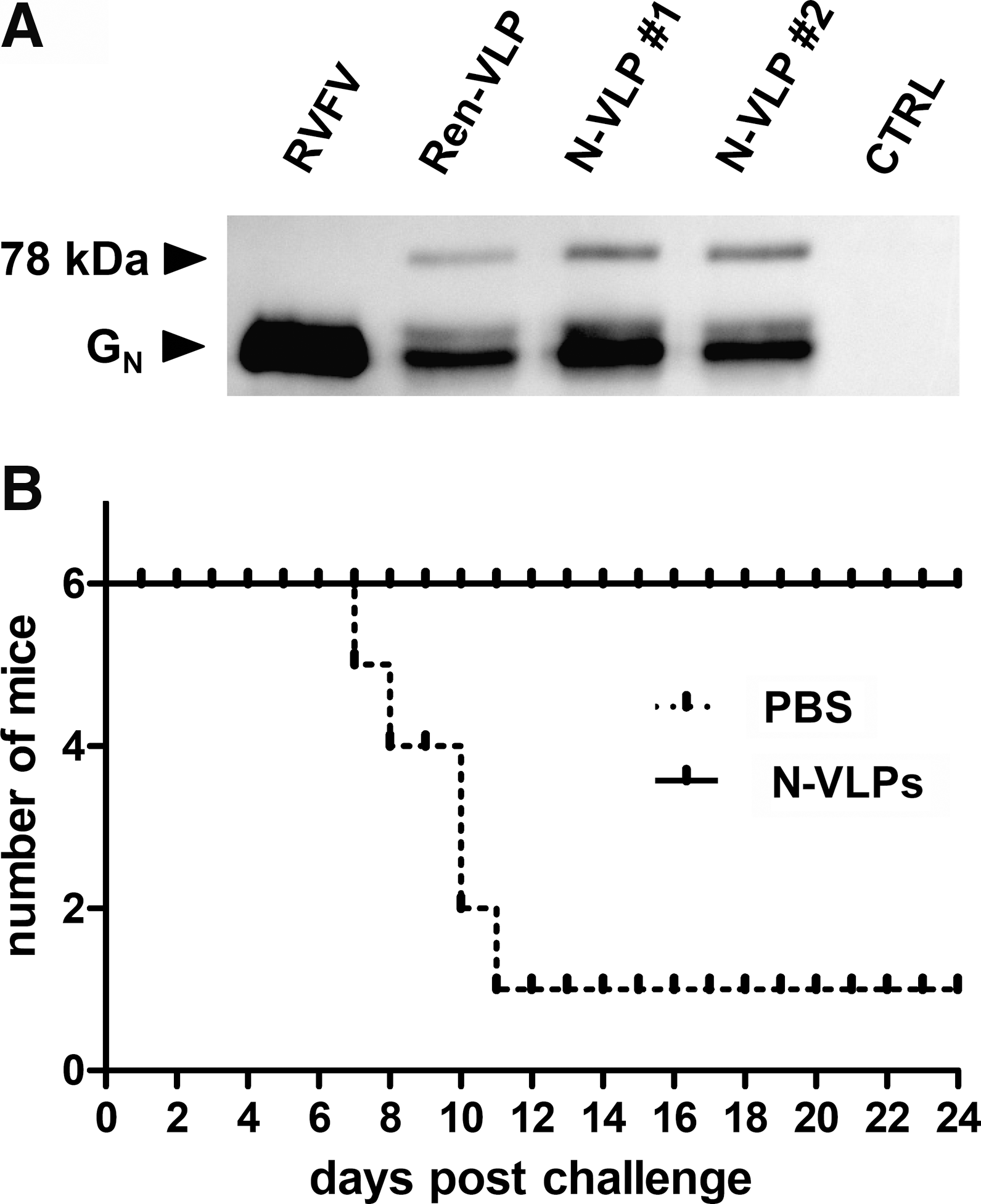
Vaccination with N-VLPs. (
VLPs are promising and modern tools for immunization and have proven efficient against a wide variety of viral diseases (Roy and Noad 2008). In most cases, however, VLPs have structural, but not biological, semblance of authentic viral particles. Although this seems to be sufficient for a certain immune activation, the possibility of gene expression by VLPs may improve their immunogenicity. Our original setup involved the expression of a reporter gene by the RVFV-VLPs, which was useful for optimizing the production procedure and monitoring VLP activity. Upon exchanging the reporter gene by the potential cytotoxic T-lymphocyte antigen N, VLP inoculations of mice could be reduced from three to just one. Although we have not directly compared the immunogenicity of reporter VLPs and N-VLPs, our results suggest an advantage of N expression by VLPs. This is in agreement with studies showing that recombinant N protein provokes protective immune responses against RVFV and the related Toscana phlebovirus (Wallace et al. 2006, Gori Savellini et al. 2008) and implicates that N-VLPs should be considered as a safe and efficient vaccine against the emerging pathogen RVFV. Given the infrastructural constraints present in most countries affected by RVFV, the abolishment of booster steps could greatly facilitate RVFV vaccine campaigns. Moreover, the strategy to engineer VLPs to produce a viral antigen may help to improve the immunogenicity of other VLPs as well.
Footnotes
Acknowledgments
The authors thank Otto Haller for providing support and helpful comments. Work in the authors' laboratory was supported by the grant WE 2616/5-2 from the Deutsche Forschungsgemeinschaft and the technical contract 15273 from the International Atomic Energy Agency. A.P. is the recipient of an EMBO long-term fellowship.
Disclosure Statement
All authors contributed actively to the study and approved the final version of the article. M.H. and F.W. have filed a patent concerning the production of transcriptionally active VLPs for RVFV.