




Abstract

Currently plague can be found circulating in rodent populations on five continents (excepting Australia and Antarctica) where ground-dwelling rodents live in semi-arid climates (Fig. 1). Genetic analyses suggest an Asian origin for the emergence of plague as a flea-borne pathogen of burrowing rodents, and that the evolution of Y. pestis from a pathogen of enteric lymphatic tissues transmitted by the oral–fecal route was relatively recent (Wren 2003, Achtman et al. 2004). In the century since it was first described, Y. pestis and the two other Yersinia species that infect humans have become model organisms for study of gram-negative bacteria, including detailed understanding of basic physiology (e.g., iron uptake, temperature sensitivity), virulence factors and mechanisms of pathogenesis, biofilm formation in fleas, and genomics (at least five complete Y. pestis genomes have been sequenced). Because of this wealth of knowledge, the plague bacterium provides a model for translational research, in which underlying mechanisms of the infection process can be related to large-scale patterns of pathogen transmission and epidemiology (Perry and Fetherston 1997, 2007, Wren 2003, Achtman et al. 2004, Gage and Kosoy 2005, Sebbane et al. 2006, Antolin 2008).
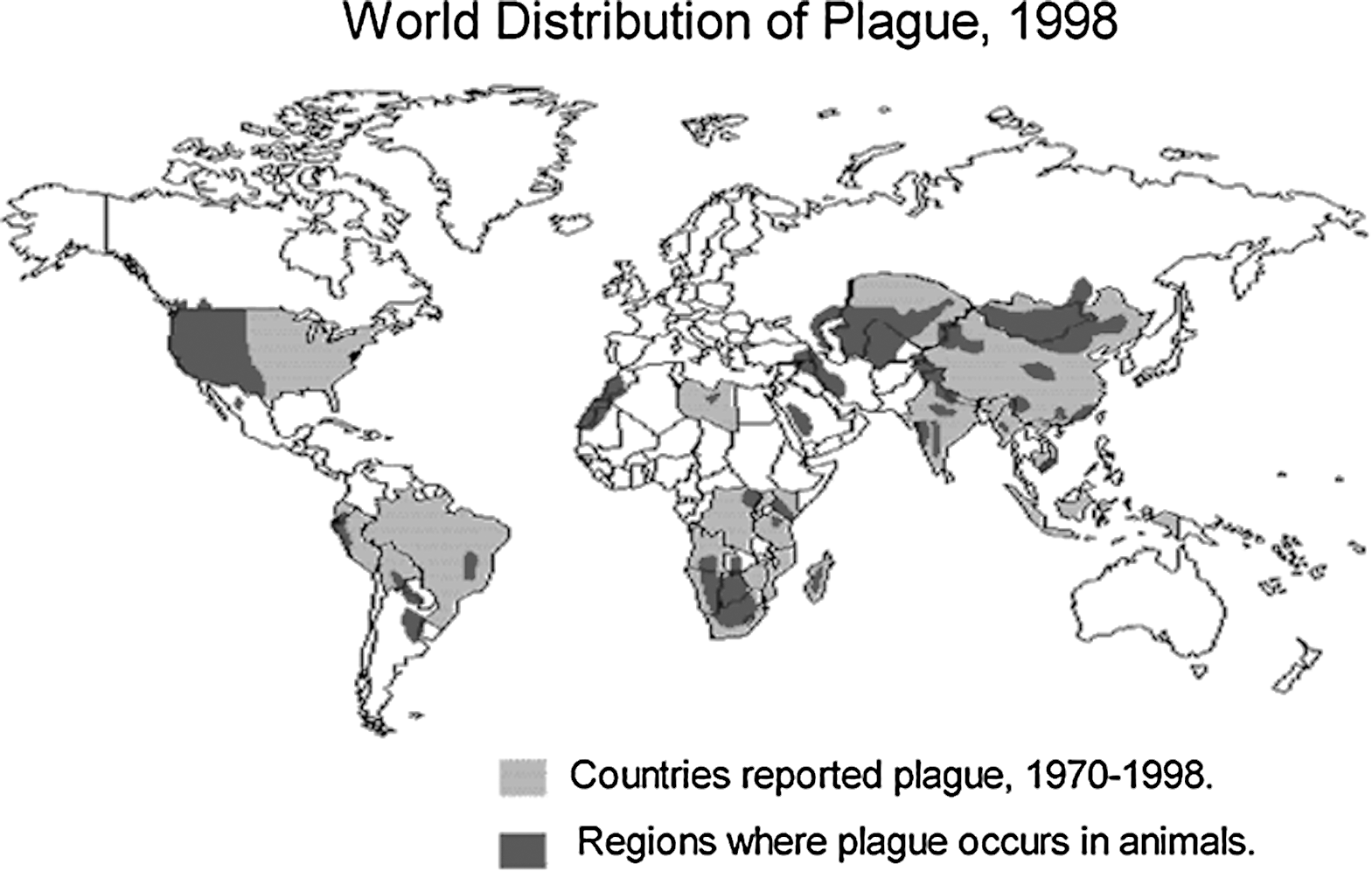
The approximate worldwide distribution of plague as of 1998, from the U.S. Centers for Disease Control web page (
It is paradoxical that despite detailed knowledge of how the plague bacterium kills its hosts we know relatively little about how plague, as an exotic invader with a potentially large host range, has influenced wildlife in its native or introduced range. Further, we still do not know how this highly virulent pathogen persists at low levels within natural populations, only to sporadically re-emerge and cause large-scale epizootics in animals like gerbils (Rhombomys) in Asia or prairie dogs (Cynomys) and ground squirrels (Spermophilus) in western North America (Davis et al. 2007, Stapp et al. 2009). Generally, Y. pestis is maintained in populations of wild rodents and their fleas as an obligate parasite, but it has been recovered from over 200 mammalian species worldwide and many hundreds of flea species (Barnes 1993, Gasper and Watson 2001, Gage and Kosoy 2005). Most infections in other mammals are thought to occur by spill-over from rodent reservoirs and do not continue as sustained chains of transmission.
Despite the potential for large-scale effects on populations and communities of mammals, details of plague's influence on conserving biodiversity are largely missing (Kotliar et al. 1999, Biggins and Kosoy 2001, Antolin et al. 2002). The exception is the critically endangered black-footed ferret (Mustela nigripes) and its their prairie dog prey in western North America. As an obligate predator of prairie dogs, black-footed ferrets have been driven to the brink of extinction by the loss of prairie dogs during plague epizootics and because black-footed ferrets are themselves susceptible to this pathogen (Godbey et al. 2006).
Filling this void while spurring translational research on plague and wildlife was the purpose of an International Symposium on the Ecology of Plague and its Effects on Wildlife convened in Fort Collins, Colorado, during 4–6 November 2008. The few wildlife species that have been examined closely raise cause for alarm and point to the importance of examining plague's influence on conservation. The conservation concerns are arguably greatest where Y. pestis is an exotic organism, but similar concerns within the native range of plague also arise because human activities may influence natural systems in ways that directly or indirectly favor expansion by Y. pestis. The following articles and abstracts represent the work of the 133 participants and span the range from molecular analyses of bacterial pathogenesis, genomics of Y. pestis, mechanisms of transmission by fleas, changes in population dynamics of rodents and related species, and consequences for conservation of endangered species. Although these articles and abstracts cannot capture the sometimes lively discussions surrounding each presentation, they reflect the spirit of searching for answers to broad challenges by filling meeting halls with diverse opinions.
Footnotes
Acknowledgments
We express sincere appreciation to the conference organizers (L. Ellison, S. Godbey, and P. Stevens), other members of the technical steering committee (C. Brand, J. Cully, K. Gage, P. Gober, and T. Rocke), the Colorado State University Infectious Diseases Supercluster, and the Colorado State University Office of Conference Services for planning and implementing this meeting. We thank the volunteer assistants (H. Branvold, A. Carlson, D. Eads, S. Godbey, A. Goldberg, D. Jachowski, R. Jones, S. Larson, P. Marinari, K. McClure, R. Van Nimwegen) for their help before and during the meeting. We are indebted to Senator Wayne Allard, who provided a motivating opening address at the meeting, and to Rita Colwell, who placed the symposium into the broader context of “Climate, Ecology, and Infectious Disease” in her keynote address. Participation by the 133 attendees from nine countries on five continents added to the success of the meeting and provided the global atmosphere that will remain essential for addressing the problems and challenges created by this widespread re-emerging disease. Finally, we appreciate the efforts of editor Stephen Higgs for shepherding this collection of papers through the peer review and publication process.