




Abstract
A survey of ticks from domestic ruminants, together with a serosurvey in humans was conducted in Thrace (northwestern Turkey) to evaluate the prevalence of Crimean-Congo hemorrhagic fever virus (CCHFV) in ticks and humans. More prevalent ticks were Hyalomma marginatum, Hyalomma aegyptium, Rhipicephalus bursa, and Rhipicephalus (Boophilus) annulatus, with low numbers of Dermacentor marginatus, Rhipicephalus sanguineus group, and Ixodes ricinus. No differences in the tick faunal composition were found among surveyed provinces. CCHFV was detected using specific primers for strains belonging to both Europe 1 and Europe 2 clades in a total of 15 pools of ticks collected in nine localities. The maximum likelihood estimate of infection rate was calculated as 0.72/100 ticks (95% CI = 0.42–1.16). Viral RNA was observed only in H. marginatum, R.(B.) annulatus, and R. bursa with overall maximum likelihood estimate infection rates being 0.93 (95% CI = 0.35–2.05), 0.74 (95% CI = 0.24–1.78), and 1.67 (95% CI = 0.69–3.46), respectively. The surveyed region is the only place where both viral strains are circulating together in nature in Turkey. Results from serosurvey on 193 samples from three localities in the region showed that immunoglobulin M and immunoglobulin G rates are compatible with an epidemiological situation in which the virus has been present for a long time and is not the result of a recent invasive event from the main epidemic center in Anatolia (north-central Turkey). Seropositivity rates cannot be compared against the tick faunal composition, because of the homogeneity in the results about tick surveys. The high rate of seropositivity, and the prevalence of CCHFV in both Europe 1 and 2 clades among the ticks, but few clinical cases suggest that the circulation of both viral strains may confer protection against the CCHFV infection.
Introduction
Although the virus has been isolated from at least 31 species of ticks across different countries, the occurrence of the disease is strictly associated with the distribution area of Hyalomma species (Hoogstraal 1979, Turell 2007). Hyalomma marginatum is the main, if not the only, vector in the regions where CCHF infection is prevalent in Turkey. Some studies (Tonbak et al. 2006, Whitehouse et al. 2006) have addressed the question of the distribution of ticks involved in the viral transmission in different regions of Turkey and pointed out the importance of sylvatic cycles of virus amplification under natural conditions. Recently, clusters of CCHF cases were also reported from the neighboring countries of Russia, Bulgaria, and Albania (Onishchenko and Efremenko 2004, Ergonul and Whitehouse 2007). Another viral strain (AP92, clade Europe 2) recorded in Greece is different from other viral isolates (clade Europe 1) in the region (Avsic-Zupanc 2007). This virus was isolated from Rhipicephalus bursa ticks, which were collected from goats in and near Thessaloniki in 1975 (Papadopoulos and Koptopoulos 1980). Interestingly, this strain is the most divergent of all the CCHF viral strains, including those isolated in the neighboring Balkan countries of Albania, Kosovo, and Bulgaria (Avsic-Zupanc 2007).
The Thrace region in northwestern Turkey is geographically neighboring Bulgaria and Greece. The first clinical case of CCHF in the Thrace region of Turkey was reported in 2007 (Midilli et al. 2007). Research on the epidemiology of the CCHF infection in Turkey has focused on the region of Anatolia due to the number of cases. Nothing is known about the tick species composition, virus prevalence on tick carriers, or serological evidence of CCHF virus (CCHFV) in humans in the region of Thrace, an area where cases continued to increase since 2007. There is a need to know whether CCHF reports in the Turkish part of Thrace are compatible with a spread of the disease or whether the infection was already established there before the recording of the first clinical cases. We report herein the results of a geographically extensive survey of ticks, together with viral identification in ticks and seroprevalence rates in humans, in the region of Thrace. The specific aims of this study were (1) to perform a preliminary assessment of the tick fauna in the region, (2) to establish which tick species harbor the virus together with a measure of prevalence of infected ticks, (3) to determine the genetic lineage of the virus, and (4) to determine the types of antibodies to estimate whether there is an immunoprotection in the region as a result of an established infection and not a recent spread of infected ticks into the area.
Materials and Methods
Tick studies
Ticks were collected from 450 cattle in 54 villages of Thrace region, northwestern Turkey, regardless the occurrence of clinical CCHF cases, between 2006 and 2008 (see Fig. 1 for an overview of the surveyed area). Sampling was concentrated on spring and summer to have a greater abundance of ticks. The whole body of each sampled animal was inspected for the presence of ticks. Ticks collected from each animal were kept alive in separate vials and labeled, then taken to the laboratory for identification and further processing. A total of 2149 ticks were collected and determined according to the keys by Estrada-Peña et al. (2004). Some immature specimens of the genus Rhipicephalus were impossible to determine to species level, as they lack important diagnostic features due to engorgement and are, therefore, determined only to genus. All the ticks were pooled into 228 groups, each one including the same species, consisting of 5–20 ticks. Sample vials were labeled according to the species and collection sites. Samples were kept in liquid nitrogen until RNA extraction.
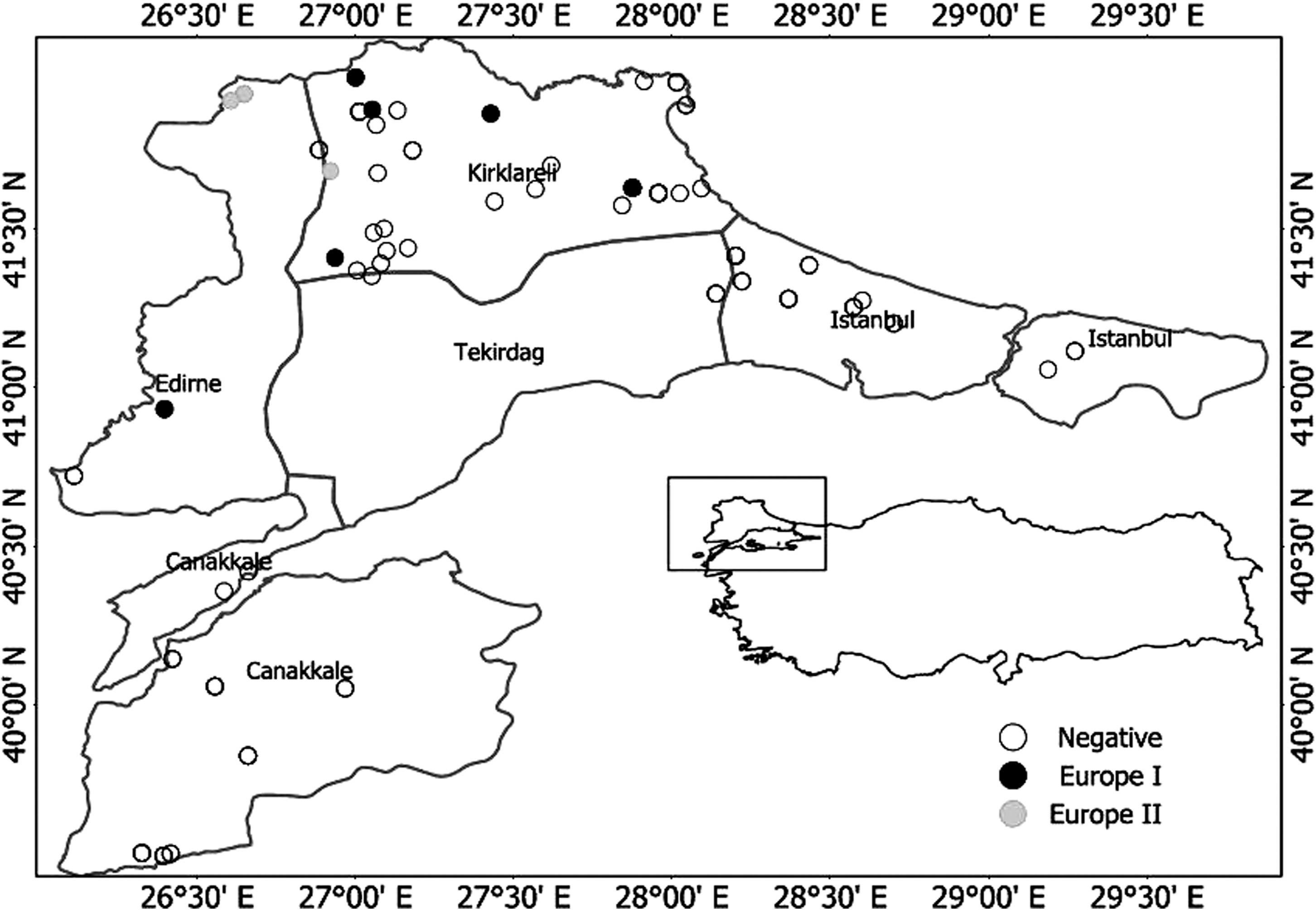
Map of Turkey with a square over the territory where ticks were collected. The big map shows the points for the surveyed localities, together with the administrative boundaries and the names of the provinces. The pattern of the dots shows the results for CCHFV isolation on tick pools, together with the strains of the virus isolated and sequenced.
Tick pools were separately crushed in liquid nitrogen. RNA was extracted from pools using a commercial RNA extraction kit (High Pure Viral Nucleic Acid Kit; Roche Diagnostics®) and cDNA synthesized with Omniscript reverse transcription kit (Qiagen®) in accordance with the manufacturer's instructions. Viral RNA was amplified by polymerase chain reaction using the specific primer sets for Europe 1 and Europe 2 clades, and obtained products were cleaned and sequenced (Midilli et al. 2009). The obtained sequence was edited and aligned using Lasergene (DNA Star®) and Bioedit packages (Hall 1999). Phylogenetic analyses were carried out by distance method using neighbor joining algorithm with Treecon, version 1.3b (Van de Peer and De Wachter 1997). Distances were calculated using Kimura 2 parameter model. Transition/transversion ratio was estimated from the data. Neither insertions nor deletions were taken into account. Topologic accuracy of the tree was evaluated by bootstrap method (1000 replicates), and only bootstrap values ≥65% were considered significant.
Infection rate in pooled ticks was calculated using the Bias-corrected maximum likelihood estimate (MLE) method with 95% confidence interval (CI) as described by Biggerstaff (2006). The results were expressed as MLE of infection rate per 100 ticks.
Serosurvey
Serosurvey in humans was conducted in three villages of Kirklareli province. Sera were collected from 193 individuals (81 in Tasagil, 12 in Cayirli, and 100 from Komurkoy, see Fig. 1). The sample size was calculated as 10% of the permanent inhabitants of the villages. Informed consents were obtained from the individuals. All the samples were tested for anti CCHFV immunoglobulin M (IgM) and IgG, as IgM positivity implies a recent infection; whereas the presence of specific IgG indicates a past infection. A commercial variant of capture ELISA kit (Vectorbest®) was used for detection of IgM antibodies against CCHFV. IgG antibodies were tested by ELISA kit of the same commercial company. The individuals with IgM and/or IgG positivity were prospectively surveyed 6 months after the first collection, to confirm the serologic results. The second set of sera from the same individuals was obtained for anti CCHFV IgM and IgG testing. The first set of sera was simultaneously re-tested with the second group. In statistical analysis of the serological results, chi square was used for categorical variables, and t-test was used for continuous variables. The level of significance was set to p < 0.05. A multivariate analysis to determine the risk factors for IgG positivity was constructed, and logistic regression with stepwise backward selection was performed. The history of tick bite, location, sex, and the age of >50 were included to the model.
Results
Tick data
Both H. marginatum and R. bursa were the only species collected in all of the four provinces, and, together with Hyalomma anatolicum, they were the most common species. Hyalomma scupense and Dermacentor marginatus were marginal species, collected only in one province and in low numbers. Some few Ixodes ricinus was collected in both Kirklareli and Istanbul provinces. Other species represented in the survey were Rhipicephalus (B.) annulatus and Rhipicephalus sanguineus (Fig. 2). Tick numbers varied according to the provinces surveyed, but they cannot be taken as a direct estimation of actual tick incidence. These figures might be produced due to several factors including variable collecting effort and management differences in surveyed animals.

The abundance (expressed as total numbers) and tick species composition according to the surveyed provinces. Included are Hyalomma anatolicum (H.an), Hyalomma scupense (H.scu), Hyalomma marginatum (H.ma), Hyalomma aegyptium (H.ae), Rhipicephalus bursa (R.bu), Rhipicephalus sanguineus group (R.sa), Rhipicephalus spp. (R.sp), Rhipicephalus (B.) annulatus (B.an), Ixodes ricinus (I.ri), and Dermacentor marginatus (D.ma).
A total of 228 pools comprised of 2149 ticks was tested by rt polymerase chain reaction. CCHFV was detected in 15 (6.58%) pools collected in nine localities in Edirne and Kirklareli provinces. The MLE of overall infection rate was calculated as 0.72/100 ticks (95% CI = 0.42–1.16). Among 10 species of ticks collected, only H. marginatum, R. (B.) annulatus, and R. bursa were positive for viral RNA with overall MLE infection rates of 0.93 (95% CI = 0.35–2.05), 0.74 (95% CI = 0.24–1.78), and 1.67 (95% CI = 0.69–3.46), respectively. The MLE of infection rate was 1.5 (95% CI = 0.62–3.11) in Edirne and 1.1 (95% CI = 0.54–2.2) in Kırklareli. The viral strains belonging to Europe 1 clade were detected from the ticks collected in five localities in Kirklareli and from one locality in Edirne provinces (Fig. 1). Isolates of this clade were obtained and sequenced from ticks of the species R. (B.) annulatus, R. bursa, and H. marginatum. Europe 2 clade was detected from R. bursa and H. marginatum collected in two localities at Edirne and one locality at Kirklareli. A total of 5 (33.3%) out of 15 positive pools consisting of H. marginatum, R. bursa, and R. (B.) annulatus were from the two villages where human serosurvey was conducted. The overall MLE of infection rate of tick collected from those villages was 2.05 (95% CI = 0.77–4.52). Sequences of isolates from Europe 2 clade were deposited in GenBank under the accession numbers: FJ392601 (strain Tr-T-06), FJ392602 (strain Tr-T-11), and FJ392603 (strain Tr-T-03) (Fig. 3). There is no spatial correlation between a given pattern of tick faunal composition and areas of tick positivity to CCHFV. Both R. bursa and H. marginatum were captured in every province surveyed, but both tick species were also present in the villages where the virus was not detected.
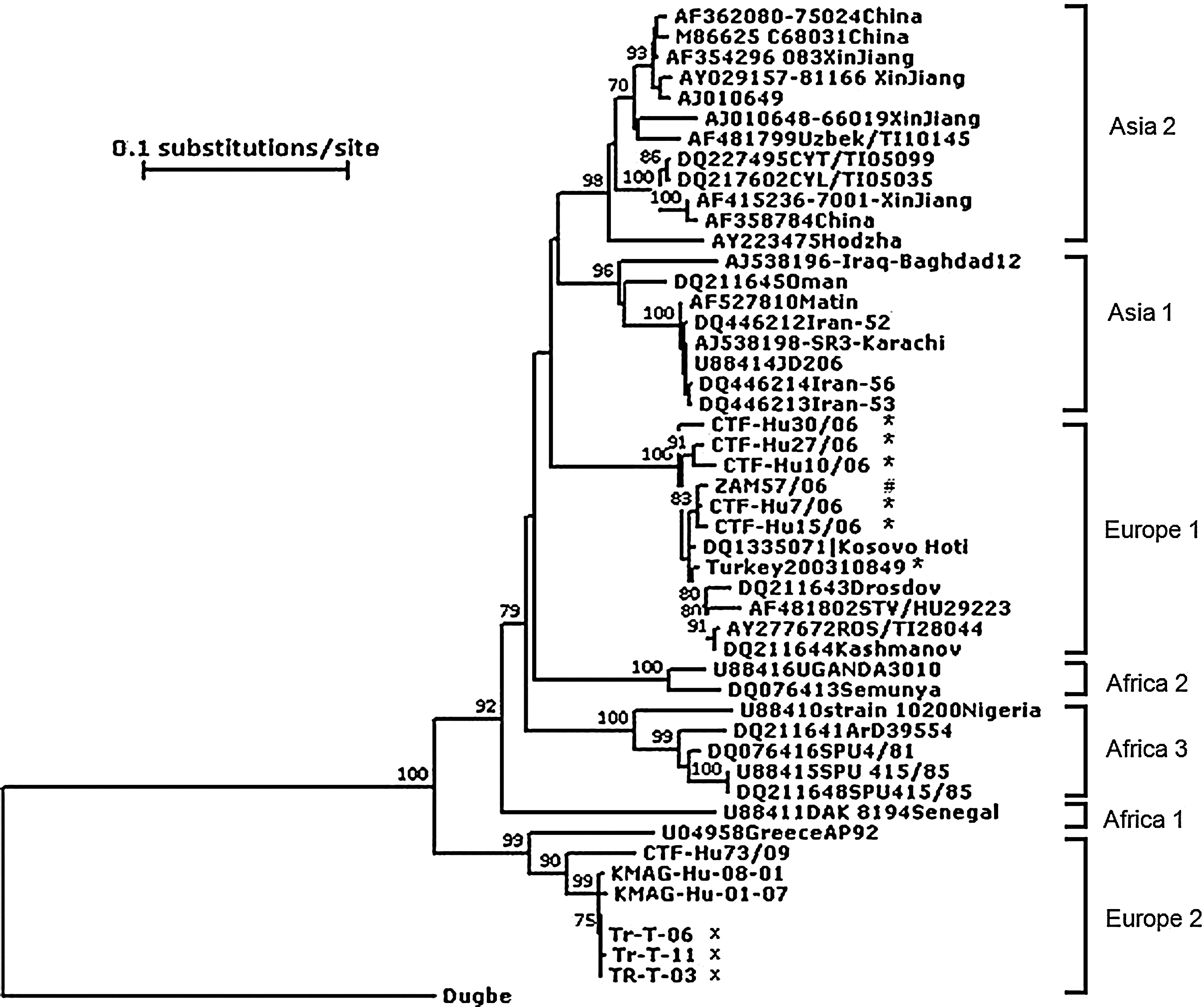
The phylogenetic relationships of the CCHFV strains. Strains marked with * have been previously recorded from humans, those with # have been recorded from ticks in Turkey. Strains marked with × are recorded for the first time in this study.
Results of the serosurvey
Among 193 individuals, 10.9% were found to be IgG positive, and 1.5% were found to be IgM positive in September 2008. Both the mean age and the proportion of men were found to be higher among the IgG-positive group than among the IgG-negative group (Table 1). The proportion of IgG-positive individuals was significantly higher in Cayirli (25%) than in the other villages (Table 1). However, all three IgM-positive individuals were observed in Komurkoy, being the proportion of IgG-positive individuals in Komurkoy of 15%. As mentioned, seropositive individuals were targeted to obtain sera 6 months later in March 2009, and 16 out of 21 (76%) were reached. All of these 16 individuals were found to be IgG positive. One out of three IgM-positive individuals was reached for the second test and found to be IgG positive. Multivariate analysis of serological data with selected variables revealed that the men (odds ratio 2.9, CI 1.04–8.04) and the age >50 (odds ratio 13.4, CI 1.74–103.11) were significant risk factors for IgG positivity.
IgG, immunoglobulin G.
Discussion
Previous studies on the epidemiology of the CCHF (Estrada-Peña et al. 2007, Vatansever et al. 2007) have pointed out the importance of H. marginatum ticks in the maintenance of active foci of the disease in Turkey. These studies also pointed out that foci of CCHF exist within the geographical range of the distribution of its main tick vector, in areas where landscape is composed by agricultural fields and bushland in a highly fragmented and connected pattern. Under such a condition, wild hosts for ticks and virus reservoirs are abundant, driving to an amplification cycle of both virus and vectors. Although nosocomial infections may exist, tick bite is behind the wide majority of clinical cases reported in Turkey.
We report the existence of CCHF viral strains belonging to both Europe 1 and 2 clades in ticks collected at nine localities, far from the main epidemic area of CCHF infection in Turkey. In this study, the proportion of CCHFV-positive pools was 6.57% and overall MLE of infection rate was 0.72 per 100 ticks (95% CL = 0.42–1.16), with variability according to the species. This is the first report that CCHFV was detected from R. (B.) annulatus ticks, which have no direct effect on human health to our knowledge. It is important to mention that, although we demonstrated the viral RNA in three tick species, this can only be suggestive for viral circulation among host animals and cannot be interpreted as a proof for a vector competence.
Tonbak et al. (2006) reported the presence of CCHFV in both H. marginatum and R. bursa with an overall prevalence of 6.25% in Central Anatolia. However, Europe 2 clade, previously reported only from Greece, was not recorded on those ticks in the same study (Tonbak et al. 2006). By this report, we present the first detection of CCHFV Europe 2 clade strains in H. marginatum. This is also the first report of detection of CCHF Europe 2 clade strains among the ticks in Turkey.
Our results showed no differences in tick faunal composition between zones regarding the CCHFV positivity, therefore preventing any conclusion about the specific significance of a tick species on the overall serosurvey results. We must draw a note of prudence about extrapolation of differences in tick abundance among different localities, as many factors other than the collecting effort may confound the relative abundance of each species. Our serological survey was restricted to only three villages and, therefore, correlations with tick faunal composition must be interpreted with caution, as both H. marginatum and R. bursa were collected in localities where virus is either present or absent. Although we cannot make any statistically significant conclusion, it is worth to mention that of the proportion 33.3% of positive pools were from two villages where human serosurvey was conducted and MLE of infection rate in those villages (2.05 [95% CL = 0.77–4.52]) was quite high comparing the overall MLE (0.72 [95% CL = 0.42–1.16]).
In a previous study in the same region, 5.26% of the surveyed people was found to be IgM positive, and 4.72% was found to be IgG positive in September 2007 (Midilli et al. 2009). However, in the current study performed in September 2008, the proportion of IgG seropositive individuals were found to be 10.9%. IgM is detectable in the first 4 months of onset of CCHFV infection and is used for detection and/or confirmation of ongoing or recent infection (Zeller 2007). The detection of CCHFV IgM positivity and elevated proportion of IgG seropositivity indicate that both genetic variants of CCHFV are very active in the region and might have become active few years ago.
In multivariate analysis, serological results point out that IgG positivity is greatly influenced by the sex (men are at great risk, probably due to farming and agricultural activities) and an age >50 years (probably as an indicator of the chance to be bitten by ticks). Seroprevalence rates in other countries of Middle East are obviously variable, according to the actual risk of infection and method used for antibody detection. It was reported to be around 2.35% in Sistan-Beluchestan, Iran (Izadi et al. 2006). IgG seropositivity was reported as 3.09% from Ciflik, Kosovo, and about 6.1% in Greece in an area where CCHF strains of Europe 2 clade were circulating (Avsic-Zupanc 2007). The high IgG rates detected in Thrace, a nonendemic area, are striking, in comparison with the results from the endemic area of Turkey, where seropositivity rates were 12.8% in high risk groups (Gunes et al. 2009). In endemic regions, about 3000 clinical cases in 2008 and 2009 were recorded at the Ministry of Health of Turkey, and the major circulating viral clade was Europe 1. In contrast, in Thrace, a region near Greece, high seropositivity rate (10.9%) was detected, but a few cases were reported. These results further support previous findings (Midilli et al. 2009) suggesting that cocirculation of both viral strains may have a kind of protective effect on humans, resulting in the lack of clinical cases.
As a conclusion, our results from surveys in Thrace show that infection in ticks by strains of both Europe 1 and Europe 2 clades is unique in the region, and that is spatially correlated with a high IgG seroprevalence in humans, meaning for an active immune protection.
Footnotes
Acknowledgment
Tick studies were supported by the Turkish Research Council as project: SBAG-2882. The authors would also like to thank the regional staff of Ministry of Agriculture, especially the animal health departments of Edirne, Kirklareli, and Canakkale branches; staff of infectious diseases department of Ministry of Health, Kirklareli branch; and inhabitants of the sampled villages.
Disclosure Statement
No competing financial interests exist.