




Abstract
Rift Valley fever (RVF) is a major vector-borne zoonosis first identified on the African continent in the early 1900s. In 2000, RVF was reported for the first time in Yemen. In this study, we provide a descriptive analysis of the period 1999–2007 in Yemen, taking into account the environmental and socioeconomic factors likely to have been involved in the emergence of RVF in the country. We characterize each year in the study period by the environmental conditions (linked to vegetation indexes), the festival calendar, and economic data. We then use a principal component analysis to synthesize the different variables, assess whether the year 2000 was atypical compared with other years in the study period, and, if that was the case, in what respect. Our results show that 2000 presented above-normal vegetation index values, which reflect important precipitation, for both the two rainy seasons (the first between March and May; the second between July and October). These environmental conditions, ones favorable to mosquito vector populations, coincided that year with a late (March) starting date of the Eid al-Kabeer festival, which corresponds to a period with high host (cattle, sheep, goats) densities. According to these criteria, 2000 was an atypical year. These conclusions suggest that it is important to consider social variables in addition to environmental ones when assessing the risk of RVF emergence.
Introduction
The virus also may be transmitted, to both ruminants and humans, by direct contact with viremic body fluids such as blood (during slaughtering and butchering), fetal membranes, and amniotic liquid of viremic ruminants. Most human cases are relatively mild and of short duration (WHO 2007). However, complications such as retinitis, encephalitis, and hemorrhagic disease occur in a small proportion of patients, with significant fatality rates. When there is an outbreak in livestock, mortality and abortions have a direct economic impact. However, the indirect impact of outbreaks are even greater as, in accordance with international sanitary policies, very strict restrictions of livestock movement and embargoes on the exportation of live animals and animal products are imposed when cases of infection are declared (Davies 2006).
Prior to 2000, RVF had been only reported in the African continent. Yemen officially declared the first outbreak of RVF on September 19, 2000 (CDC 2000a), a few days after RVF cases were declared in Saudi Arabia (CDC 2000b). This outbreak started on the Tihama Coast (Az-Zuhrah district, Al-Hodeidah governorate) and led to a total of 1328 human cases (166 deaths) (WHO 2000), more than 21,000 animal abortion cases, and 6000 animal deaths between September 2000 and February 2001 (Ahmad 2000, Al Qadasi 2002). This Tihama region was the most affected area during this outbreak (Abdo-Salem et al. 2006). Then, since 2001, no significant RVFV activity has been reported in Yemen (Al Qadasi 2009).
A conjunction of favorable socioeconomic and environmental factors could have contributed to the emergence of RVF in Yemen. First, a large part of the live animals imported into the Arabian Peninsula are originating from RVF endemic areas in the Horn of Africa, where a severe outbreak occurred in 1997–1998 (Woods et al. 2002). The RVFV thus may have been introduced into Yemen through livestock trade with this region (Davies 2000). This hypothesis is supported by genetic analyses of the virus isolated in Saudi Arabia and Yemen showing similarity with the strain that circulated in Kenya (1997) (Shoemaker et al. 2002). Second, unusual rainfall and subsequent flooding of mosquito habitat have been associated with RVF outbreak in the Horn of Africa (Linthicum et al. 1999). It has been shown that satellite-derived measurements of photosynthetic activity (vegetation index), combined with other climatic variables, can efficiently monitor the outbreaks in the East of Africa (Anyamba et al. 2006b, 2007, 2009). However, in 2006, the occurrence of bioclimatic conditions potentially at risk for RVF (Anyamba et al. 2006a) was not followed by any sign of RVFV circulation in Yemen, suggesting that several drivers modulate the emergence of such a complex disease.
To assess the contribution of both socioeconomic and environmental factors in the recent emergence of RVF in Yemen, we explored in detail the period 1999–2007 and described each year in terms of bioclimatic conditions and related activity of the vegetation, trade statistics, and main calendar events driving livestock trade, more specifically religious festival (Eid al-Kabeer celebrations).
Two different potential scenarios were considered (Davies 2000, Swanepoel and Coetzer 2004
): (1) The RVFV was present in Yemen prior to 2000 (possibly introduced from the Horn of Africa during the 1997–1998 outbreak) and the environmental conditions in 2000 favored the amplification of the RVF cycle by mosquito vector populations, leading to an important outbreak in September 2000 (scenario 1); (2) The RVFV was not present in Yemen prior to 2000, and the association of environmental and socioeconomic conditions in 2000 supported both the introduction and amplification of the virus (scenario 2).
Materials and Methods
Study area
The study area was conducted in the coastal plain of Tihama, in the western part of Yemen (Fig. 1). This area lies parallel to the Red Sea and is bordered by the Kingdom of Saudi Arabia in the north, the Red Sea and the strait of Bab el-Mandeb in the west, and the mountains of Tihama in the east (Tihama Development Authority 1987). The area includes nine governorates: Sa'dah, Hajjah, Amran, Al-Hodeidah, Al-Mahweet, Sana'a, Dhamar, Ibb, and Taiz. Of these, three (Sa'dah, Hajjah, and Al-Hodeidah) were affected during the 2000–2001 outbreak (Abdo-Salem et al. 2006).
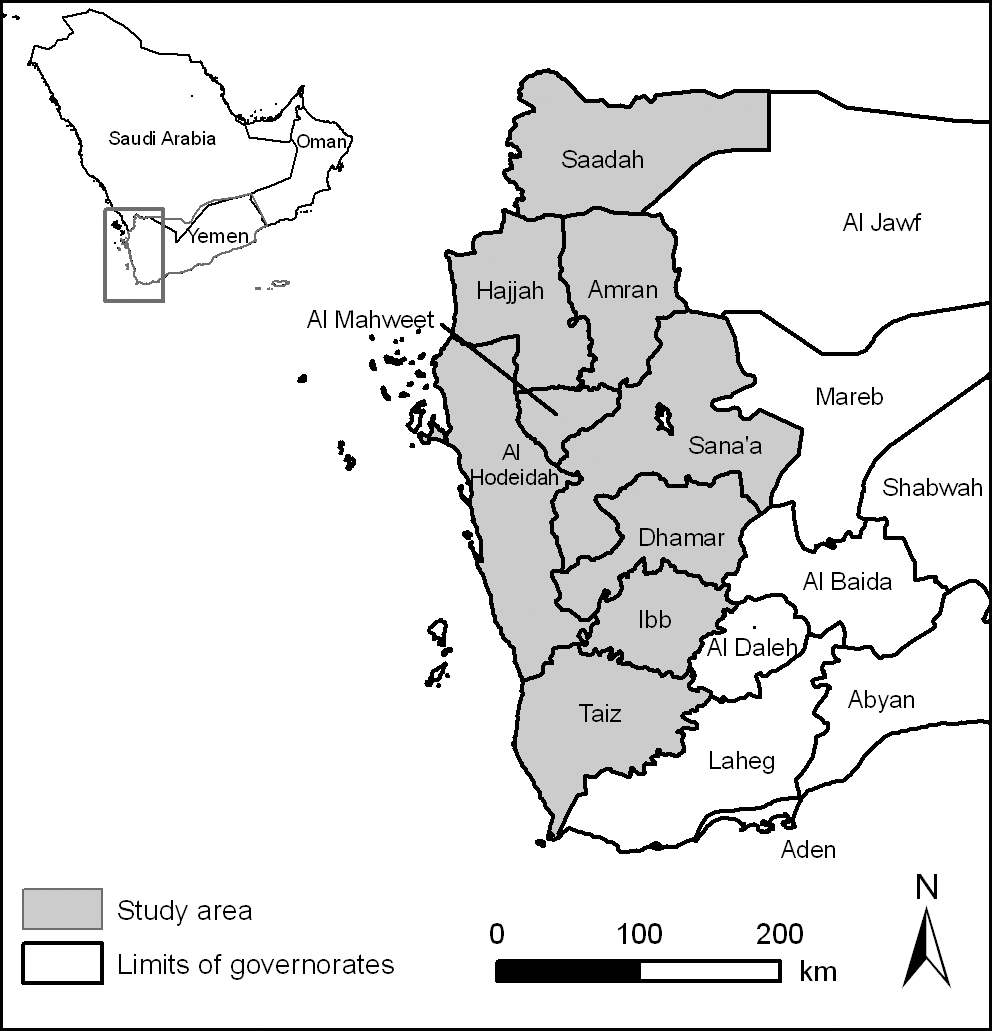
Location of the study area, Tihama coast, Yemen.
In this semiarid region, the climate is dry and hot with temperatures ranging from 30°C–35°C in summer to 25°C–28°C in winter. The relative humidity ranges from 55% to 70%. The mean annual rainfall varies from 50 to 350 mm/year for the whole Tihama region, with two rainy seasons: the first between March and May (accounting for 25% of the total annual rainfall) and the second from July to mid-October. The area is characterized by drainage courses known as “Wadis,” a spate irrigation management system widely used in semiarid environments (Noman 2005). Every rainy season, flood waters from mountain catchments are diverted from river beds and spread over large areas for irrigated agriculture (Chevalier et al. 2008). This irrigation system favors the hatching of Aedes populations, which are possible vectors of RVFV. Additionally, artificial water ponds maintained year round for agriculture allow other mosquito species, including Culex populations, to persist throughout the year.
Environmental data
We choose satellite-derived measurements of normalized difference vegetation index (NDVI), related to vegetation activity, to characterize the environmental conditions of each year in the 1999–2007 study period. This variable is assumed to be linked with rainfall events and thus to indicate favorable conditions for the proliferation of mosquitoes in flooded areas. Rainfall data were not used because, in the Tihama Coast, hydrological dynamics is essentially due to runoff from the mountainous areas. Previous studies highlighted the link between high NDVI anomalies and RVF in the Horn of Africa (Linthicum et al.1999, Anyamba et al. 2007, 2009). Here, we characterized for each year of the 1999–2007 period the shape of the temporal dynamics of NDVI.
The NDVI is a vegetation index (values ranging from −1 to 1) linked to photosynthetic activity (for example, see Fig. 2a). In arid areas, the NDVI has been shown to be a good proxy for rainfall because in such areas vegetation grows very quick after shower (Davenport and Nicholson 1993, Nicholson and Farrar 1994, Haas et al. 2009, Soti et al. 2009).
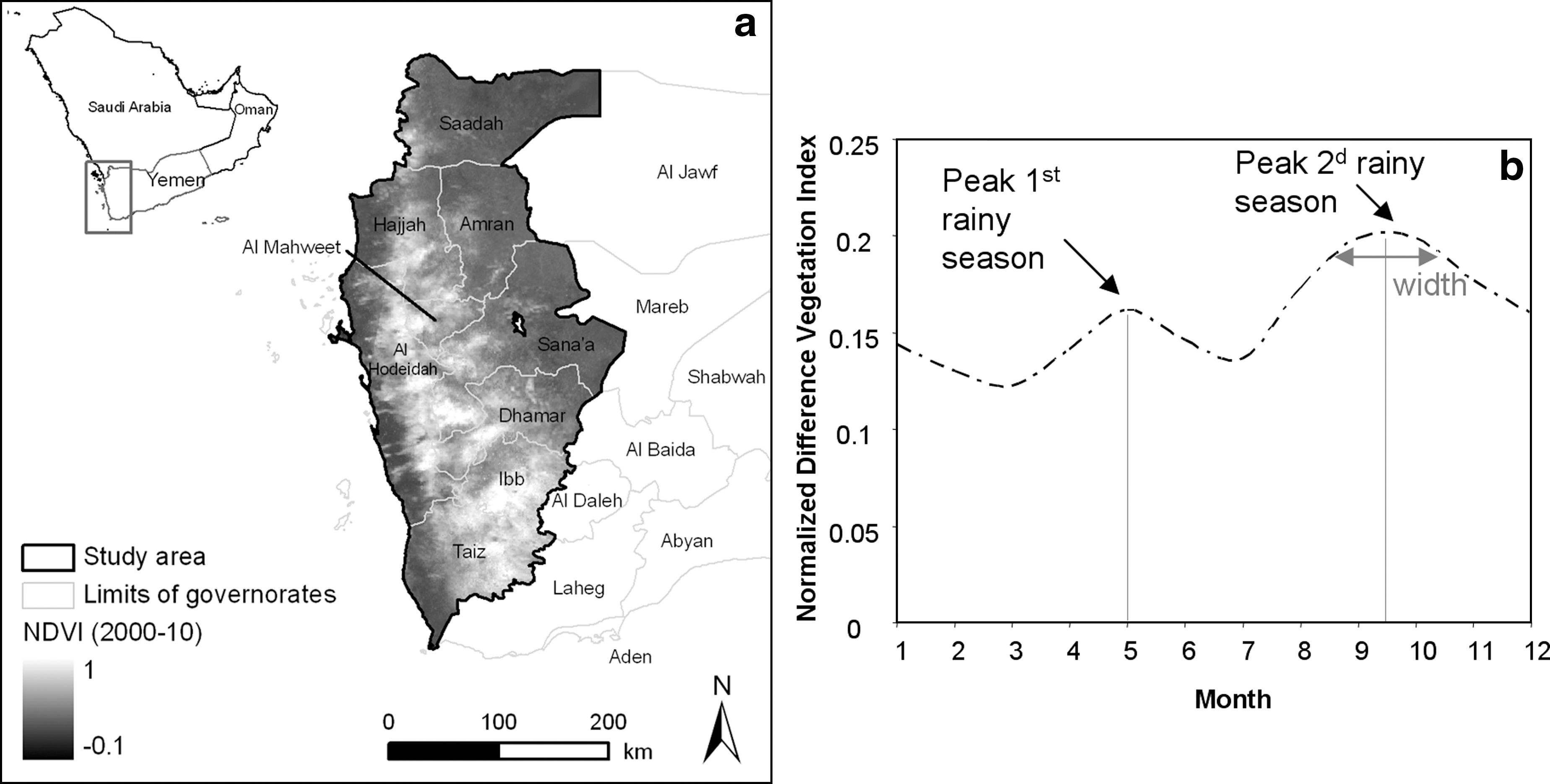
Normalized difference vegetation index (NDVI) image, Tihama coast, Yemen, October 2000
Satellite Pour l'Observation de la Terre (SPOT)-Vegetation images (see • The maximum value of NDVI observed per rainy season (NDVI.Peak1,2). • The width of the main rainy season peak, defined as the duration (in months) of the period with NDVI above at 90% of the maximal value (NDVI.width). • The dates of the maximum of NDVI value during each rainy season (NDVI.Date1,2).
The first two variables were likely to be associated with high mosquito population densities (amount of precipitation, duration of the rainy season), and the third variable (dates of peak occurrences) was used to assess the possible overlapping of the periods with high mosquito densities with the dates of festival celebrations, which correspond to periods of high host population densities in the considered area.
Socioeconomic data
As the RVFV might have been introduced into Yemen by the importation of viremic animals from the Horn of Africa, the total number of animals (sheep, goats, and cattle) imported per year in Yemen was used as an indicator of the risk of virus introduction into this region (data collected from Yemen Quarantine Authority, Sana'a). The three main Yemeni quarantine facilities are in Al-Mukah, Al-Mukhalla, and Aden. Most of the imported livestock originates from eastern Kenya and Ethiopia and transits via local Somalia markets (Alary 2006, Fleming et al. 2008). The numbers of cattle and small ruminants imported vary substantially over and between the year, peaking just before the religious festivals of Ramadan and Eid al-Kabeer (Fleming et al. 2008), when millions of animals (sheep, goats, and bulls) are sacrificed. If this event takes place during periods of high vector densities, it consequently may be of importance for both the introduction of the RVFV and its amplification (Davis 2006). The starting date of Eid al-Kabeer was then considered for each year, as it varies depending on the Islamic lunar calendar, with a drift backward every year by 10–12 days in relation to the solar-based Gregorian calendar. The dates of Ramadan were not separately considered as they are directly derived from Eid al-Kabeer (Eid al-Kabeer takes place 3 months and 10 days after the first day of Ramadan).
Statistical analysis
Two runs of principal component analysis (PCA) were carried out to generate integrative descriptions of the different years under study (1999–2007). A PCA transforms a number of variables with possible redundancy into a smaller number of uncorrelated variables named principal components (PCs) or axes. The first analysis used only environmental factors likely to impact abundant vectors populations (NDVI.Peak1,2, NDVI.width) and thus cycle amplification by vector populations (scenario 1). The second analysis simultaneously included the environmental, economic (statistics on livestock imports), and social (festival calendar) factors likely to favor virus introduction and amplification due to the conjunction of high livestock densities during the religious festivals and abundant vector populations (scenario 2).
Results
At first glance, the year 2000, when the RVF outbreak was declared in Yemen for the first time, does not differ from other years in the study period (1999–2007) (Table 1). Dates of NDVI peaks were relatively late (May and October) in 2000, as in 2003 and 2004. The maximum values of NDVI were high in both rainy seasons in 1999, 2000, and 2001. The second rainy season lasted not very long in 2000, compared with 1999, 2003, or 2005. The number of imported animals varied between 1999 and 2007: it dropped down in the 2000–2001 period because of the embargo (September 2000–mid 2002) following the RVF outbreak in Yemen; then it rapidly increased again. Starting dates of the Eid al-Kabeer celebrations ranged from the 1st of January to the end of March, for the period under study.
NDVI, normalized difference vegetation index.
Three PCs were obtained from the first PCA, which included only environmental factors linked to vector abundance (Table 2). The first two PCs contribute to 88% of the variance observed (Table 2). The first PC is mainly linked to the NDVI peaks: it takes positive values for years with high first and second NDVI peaks, whereas negative values are associated with low values of both NDVI peaks. The second PC is mainly linked to the width of the second NDVI peak: it takes positive values for years with a narrow second NDVI peak, and negative values for years with a wide second NDVI peak.
When the years 1999–2007 are plotted in the space formed by these first two PCs (Fig. 3a), and the vegetation index NDVI is used as a proxy for rainfall and thus favorable conditions for mosquito development, the years 1999, 2000, 2001, 2002, 2006, and 2007 all emerge as years at risk for RVF amplification, with either high maximum values of NDVI peaks or a long second rainy season (values are presented in Table 1). Thus, it can be preliminarily concluded from the first PCA that when bioclimatic variables only are taken into account, the year 2000 should not be considered as contrasted compared with other years under study.
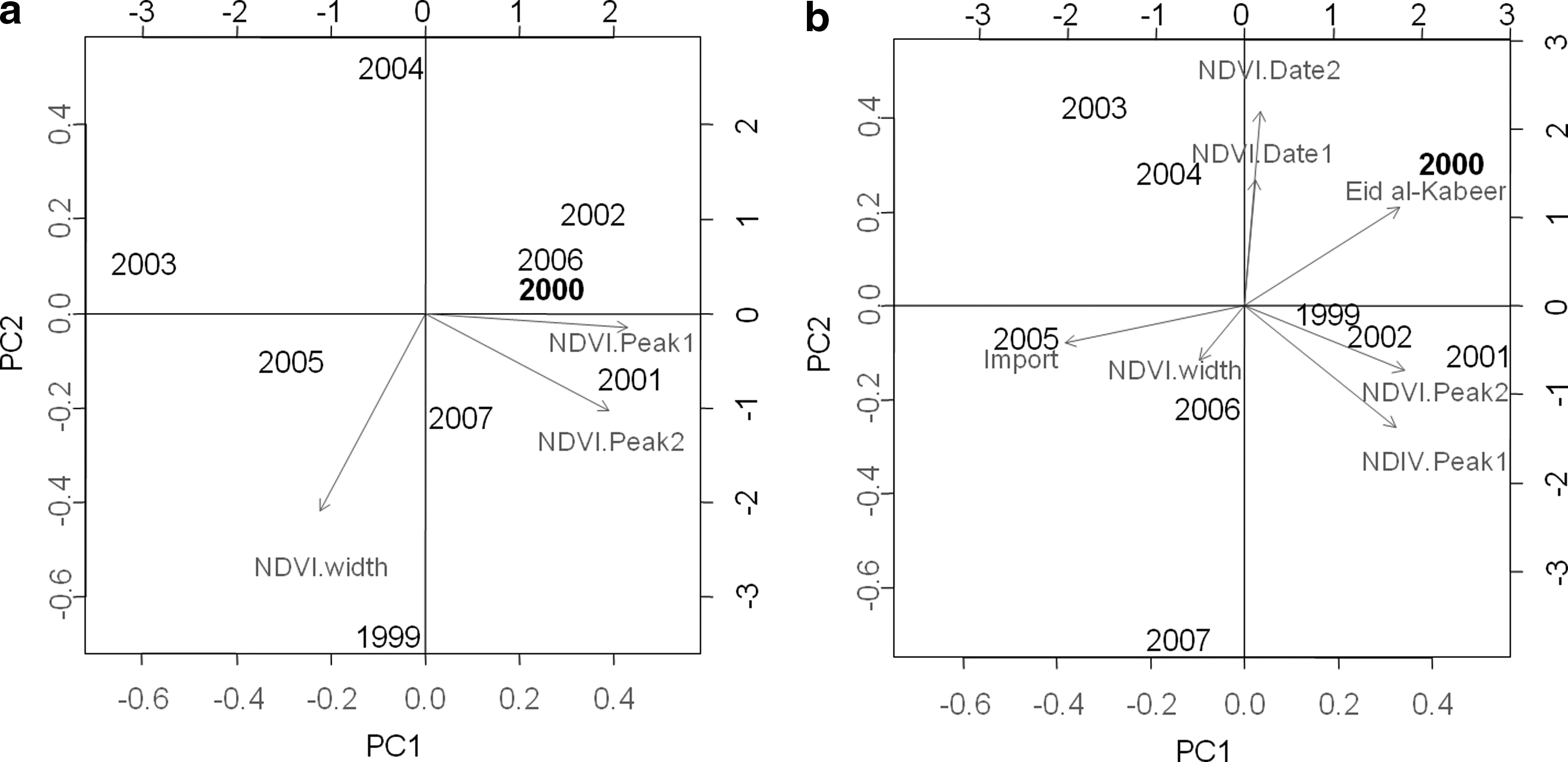
Composition of the PC1 and PC2 and projection of the different years (1999–2007) (in black) and the factors (in gray) on the first PC analysis plan. PC, principal component.
The second PCA, which included environmental, economic, and sociocultural factors, highlighted a more differentiated pattern (Fig. 3b). Six axes were needed to capture all the variance, the first two representing 61% of the variance (Table 3). The first PC is built as a combination of environmental and socioeconomic factors: it takes positive values for years with high values of the NDVI peaks, low imports, and a relatively “late” Eid al-Kabeer, for example, one coinciding with the start of the spring rainy season in March, whereas negative values are associated with low values of NDVI peaks, high imports, and an “early” (January) Eid al-Kabeer (Fig. 3b). The second PC is mainly linked to the dates of the NDVI peaks: it takes positive values for years with late first and second NDVI peaks, and negative values for years with early first and second NDVI peaks.
The main characteristics of the year 2000 with positive coordinates for the two first PCs were the conjunction of late NDVI peaks, high NDVI peaks, a “late” Eid al-Kabeer, and a relatively low number of imported animals. In the PCA first plan, formed by PC1 and PC2, 2000 individualizes from the other years with projection in positive values for the two first axes (Fig. 3b).
Discussion
The drivers of an emerging disease that occurs for the first time in a former disease-free area are difficult to identify. When, in addition, the disease emerge and then apparently disappear for another 10 years, limited epidemiological data are available, as was the case for the unique RVF outbreak in Yemen in 2000–2001. However, given the huge and dramatic social and economic impact of RVF (Ahmad 2000, CDC 2000a, 2000b, Al Qadasi 2002), data from this unique outbreak, in addition to the results of studies conducted in RVF endemic regions, should be exploited in an attempt to identify pertinent risk indicators to target surveillance measures.
Although none of the usually known indicators for RVF emergence in East of Africa was clearly related to this event in Yemen, the present study aimed to further explore the association of different possible drivers in the year 2000, compared with other recent years (1999–2007). For RVF to be transmitted, three components must be present: the pathogen (RVFV), the vectors (mosquitoes), and the hosts (cattle and/or small ruminants). The variables that we used to characterize each year were thus chosen for the following reasons: • The number of animals imported was used as a proxy for the risk of introduction of the virus from countries in the Horn of Africa as it was demonstrated that the virus kept on circulating even during the interepizootic period (1999–2006) (Rostal et al. 2010). • Environmental variables (NDVI characteristics) were chosen because they are known to drive the increase of vector abundance on the Horn of Africa. • The Eid al-Kabeer celebration calendar was included as an indicator of the date of high concentrations of hosts, favoring both RVFV introduction and amplification when vector densities are sufficiently high.
When bioclimatic factors alone are taken into account, this descriptive approach reveals that the year 2000 was not significantly different from other years in the studied period (1999–2007).
However, when other socioeconomic factors are included, 2000 appears atypical regarding (i) the characteristics of NDVI peaks (maximum values for both rainy seasons), (ii) the starting date of the Eid al-Kabeer festival (coinciding with the start of the March rains), and (iii) the number of imported animals (relatively low).
These results are consistent with the hypothesis that the virus was already present in Yemen in 2000, as has been suggested by Madani et al. (2003) and Davies (2000), and that the social and environmental conditions were probably favorable for the amplification of the RVF cycle. The concentration of livestock for the Eid al-Kabeer celebrations, which began that year relatively late (March), coincided with the beginning of the first rainy season, which saw important precipitation. This suggests the following possible scenario: in 2000, the coincidence of a social event driving high concentration of livestock and bioclimatic conditions favoring high vector population densities allowed the amplification of the transmission cycle during the first rainy season, followed by a second amplification in summer from virus persisting at low levels in residual Culex populations between the two rain seasons. The Yemeni and Saudi Arabian outbreaks occurred in similar ecological and climatic contexts, suggesting that the same vectors were involved, namely Aedes vexans and Culex tritaeniorhynchus (Jupp et al. 2002, Miller et al. 2002), and that the emergence processes were similar. As the second rainy season also featured high levels of rainfall and thus high Aedes and Culex mosquito vector densities, the RVF transmission cycle may have been reinitiated with the onset of the autumn rains at high levels of transmission, leading to the declared outbreaks in September. This scenario remains hypothetic as there is no virological or serological data available to support it. Yet, our hypothesis could explain the results of serological surveillance since 2001. The surveillance in Yemen, where animals are not vaccinated, was greatly improved after the RVF outbreak in 2001, as well as the screening of imported animals and the follow-up of RVFV activity at a regional level. The results of the surveillance performed by the Yemeni veterinary services suggest that the virus did not persist or circulated only at a very low level after 2001 (Al Qadasi 2009, Abdo-Salem et al. 2010). These results are in concordance with the hypothesis of a necessary conjunction of environmental and socioeconomic conditions for RVFV amplification. Indeed, such hypothesis could explain that there was no other outbreak in Yemen after 2001, even in the 2006–2007 period, when a severe outbreak occurred in East Africa during the Eid al-Kabeer festival (Jost et al. 2010). In Yemen, bioclimatic conditions seem favorable to vector populations (high NDVI peaks in September 2006 and April 2007; see Table 1 and Fig. 3a) (Anyamba et al. 2006a). Nevertheless, despite of these “at-risk” conditions, there was no serological evidence of RVFV circulation in Yemen during this period (Al Qadasi 2009), possibly because the Eid al-Kabeer festival occurred in January and not in the periods favorable to mosquito development.
Whether the RVFV was present in Yemen prior to 2000 or was introduced that year remains unconfirmed. The main rainy season in Somalia, which occurs between March and May, may be considered to be the risk period for virus transmission in this country. The importation of animals during this period in 2000 consequently may have facilitated the introduction of infected animals into Yemen. Even if fewer animals were imported into Yemen in 2000 compared with other years, this number remains sufficiently high (>200,000) to consider the risk of virus introduction as having been high in 2000. Moreover, the number of imported animals may be underestimated, as smuggling livestock along the borders is common. To conclude, if the virus was introduced into Yemen in 2000, then our results suggest that the dates of importation appear to be more important than the quantity of animals imported.
According to the results of this descriptive approach (Table 1), 1999 resembled 2000 in terms of its climatic profile and relatively late Eid al-Kabeer celebrations. These conditions thus should have resulted in an introduction and amplification of the RVFV in 1999 as well. It, therefore, seems possible that the disease detected in 2000 resulted from two consecutive years favorable to the amplification of the virus.
Our results should be interpreted cautiously because of the limited number of years considered and the lack of information about the mosquito populations present in the study area. Further studies are required to precise the successive links between rainfall, vegetation indices, and mosquito dynamics.
However, the conjunction of two rainy seasons presenting above-normal precipitations and a starting date for the Eid al-Kabeer festival coinciding with the start of the spring rainy season seem to have contributed to the emergence of RVF in Yemen in 2000. These factors should be taken into account for the implementation of early-warning systems in the country. At present, it is unknown whether RVFV survived in Yemen after the 2000 outbreak. Because of subsequent very dry and hot conditions, it is likely that it did not. However, RVF is endemic in the Horn of Africa and the risk of reintroduction into the Arabian Peninsula remains.
In conclusion, our results show that environmental conditions were not the only determinants of the emergence of RVF in Yemen, thereby highlighting the importance of including social variables along with environmental ones in the assessment of RVF risk.
Footnotes
Acknowledgments
The authors thank Dr. Ghaleb El-Eryani for data collection and support and V. Soti, CIRAD, for technical support. The authors also thank the two anonymous reviewers for their comments and suggestions on the earlier version of the manuscript. They significantly contributed to its amelioration.
Disclosure Statement
No competing financial interests exist.