




Abstract
Hungary is regarded as free of leishmaniasis because only a few imported cases have been reported. However, southern Hungary has a sub-Mediterranean climate, and so it was included in the EU FP6 EDEN project, which aimed to map the northern limits of canine leishmaniasis (CanL) in Europe. The numbers of traveling and imported dogs have increased in the last decade, raising concerns about the introduction of CanL caused by Leishmania infantum. Serum samples were collected from 725 dogs (22 localities, 6 counties) that had never traveled to endemic countries, as well as from other potential reservoir hosts (185 red foxes and 13 golden jackals). All sera were tested by the indirect fluorescent antibody test, but they were sero-negative using the OIE cut-off of 1:80 serum dilution except for those of two dogs resident since birth in southern Hungary. These had not received a blood transfusion, but the mode of transmission is unclear because no sandfly vectors were caught locally. From 2006 to 2009, phlebotomine sandflies were sampled in the summer months at 47 localities of 8 counties. They were trapped with castor-oil-impregnated sticky-paper, light, and CO2-baited traps. Small numbers of two vectors of Leishmania infantum were found. Phlebotomus neglectus occurred in three villages near to Croatia and one in north Hungary at latitude 47°N, and Phlebotomus perfiliewi perfiliewi was trapped at two sites in a southeastern county close to the sites where it was first found in 1931–1932. Our report provides baseline data for future investigations into the northward spread of CanL into Hungary, which we conclude has yet to occur.
Introduction
The domestic dog is the main reservoir host of L. infantum, which causes zoonotic visceral leishmaniasis (ZVL) in humans, although wild canids and domestic cats have also been found naturally infected (Ready 2010). Malnutrition is a risk factor for mortality or morbidity in both dogs and humans (Desjeux 2001, Gradoni and Gramiccia 2004) but in Europe in the last 50 years the parasite has become more a veterinary problem rather than a medical one, except among syringe-using drug addicts and people who are immunosuppressed (WHO 2010). It is still often fatal for dogs, because they respond less well than humans to the widely available chemotherapeutics (Gradoni and Gramiccia 2004). However, CanL poses a long-term risk for humans in Europe (Ready 2010), because parasite exposure remains high in endemic areas and so inapparent infections can always give rise to disease following the arrival of new immunosuppressive conditions, as demonstrated by people co-infected with HIV in Spain and elsewhere (WHO 2010).
Moreno and Alvar (2002) estimated that at least 2.5 million dogs have CanL in Mediterranean Europe, where it is one of the main causes of mortality and where all rural dogs probably become infected sometime during their life time, as indicated by sero-prevalences of 25% or higher and horizontal studies using the polymerase chain reaction to screen for parasites (Dujardin et al. 2008). Most transmission is believed to be by the bite of the blood-feeding females of sandflies of the subgenus Larroussius (L.) (Diptera, Phlebotominae) (Ready 2010), and asymptomatic dogs can be as infective as symptomatic dogs to these vectors (Molina et al. 1994).
Hungary is usually regarded as free of leishmaniasis (Ready 2010), because reports of autochthonous cases and phlebotomine vectors are rare. Except for a single infection in a small girl without a travel history (Makara 1942), only imported human cases have been recorded. Várnai et al. (1985) reported 31 cases of cutaneous leishmaniasis or VL among Hungarians returning from endemic areas, and Fried et al. (2003) and Péterfi et al. (2010) diagnosed VL in Hungarians who had spent their holidays in Dalmatia, Croatia. As regards CanL, only a single imported case has been reported, in a dog returning from an endemic region of Greece (Magdus 2004). Knowledge of the phlebotomine sandfly fauna of Hungary is also limited because, as for the disease, there have been no surveys carried out before ours. Lőrincz and Szentkirályi (1933) reported collecting 110 sandflies in human dwellings in Hódmezővásárhely, a city situated in southeastern Hungary, in July–August 1931–1932. All were identified as P. macedonicus (Adler and Theodor 1931), a species currently synonymized (Seccombe et al. 1993) with P. perfiliewi perfiliewi (Adler 1946), a known vector of CanL and ZVL (Ready 2010). Later Szabó (1976) mentioned that sandflies had been seen in a cave in Budapest and in another northern town of Hungary, but no more information was given. Hungary has a temperate continental climate. The weather is quite easily predictable and there are big differences between the weather in the four seasons. Spring starts in early April and is accompanied by lots of showers. The summers are dry and warm. Autumns are cool, foggy, and rainy. Winters are relatively short and moderately cold. Usually, January is the coldest, whereas the hottest months are July and August, when temperatures may rise above 30°C; the mean temperature is slightly over 20°C in these two months. The annual average temperature is about 12°C, the maximum is 38°C and the minimum is around −10°C (Mersich et al. 2003).
The current investigation was undertaken within the EDEN project (Emerging Diseases in a changing European environment;
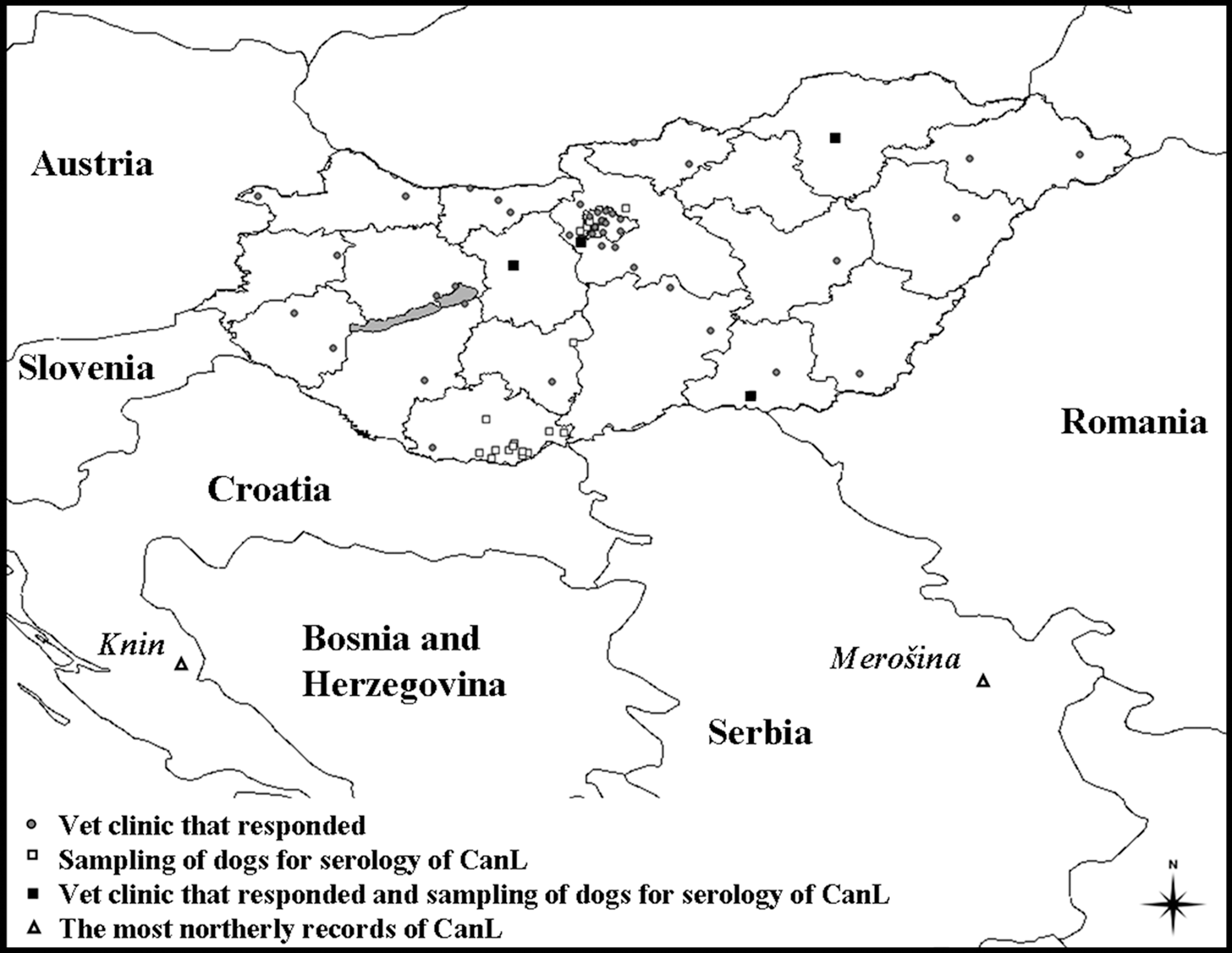
Geo-referenced positions of our serological surveys of dogs and each vet clinic that responded to a questionnaire survey in Hungary, together with the most northerly records of CanL in nearby countries. CanL, canine leishmaniasis.
Materials and Methods
CanL survey by questionnaire to veterinary clinics
A standard questionnaire was posted to all veterinary clinics in all 19 Hungarian counties in May 2008, which was followed up by a telephone call to nonresponders in June 2008. It contained only some of the questions on the EDEN questionnaire used in Mediterranean countries endemic for CanL, because the Hungarian practices and their clients were not expected to have detailed knowledge of the disease and methods of prophylaxis. The questions sought to establish the type of practice (pets and/or farm animals); experience of leishmaniasis (Faculty lectures, or specified other); clinical signs for CanL diagnosis; laboratory tests that were/would be used to confirm diagnosis; number of CanL cases recorded 1999–2008; if any cases were known to be autochthonous; and how cases were treated.
Serological survey of CanL
Blood was taken from the cephalic-antebrachial vein of living dogs and of foxes and golden jackals that had been shot to check the efficacy of oral vaccination against rabies. Blood samples were collected from dogs by the first author and veterinarians. For each dog, a record was made of its breed, age, sex, life style, and medical history, including details of any disease clinically suspected.
All blood samples were stored in the laboratory at −20°C before the serum from each was prepared and tested for the presence of Leishmania antibodies by the indirect fluorescent antibody test (IFAT) following the methods of Gradoni and Gramiccia (2004). The cut-off value selected was a 1:80 dilution of the sample serum (in a series of 1:1 dilutions with PBS, from 1:20 to 1:160), following the OIE recommendation (Gradoni and Gramiccia 2004). Antigen was prepared from L. infantum stock MHOM/FR/78/LEM 75 and MHOM/TN/80/IPT1 in the authors' laboratories in Montpellier (Dereure et al. 2009) and Rome (Gradoni and Gramiccia 2000), respectively. Some serum samples were screened in Budapest using a commercialized IFAT kit (MegaScreen® FluoLeish, Diagnostic MegaCor GmbH).
Sandfly surveys
Most trapping of adult sandflies was carried out in mild temperate or sub-Mediterranean climates (Mersich et al. 2003) potentially permissive for sandflies, either in the southern counties of Baranya and Csongrád bordering Balkan countries endemic for CanL or in the western county of Veszprém. Previously, sandflies had been recorded only from Csongrád. The weather was dry and warm (mean daily temperature was between 20°C and 25°C) during the period of sandfly surveys.
Sticky-paper traps were made by soaking white sheets of A4 photocopy paper in castor oil. From 5 to 60 papers were left for 2–5 days in each locality along a road transect (Rioux and Golvan 1969), in the drainage holes of roadside stone/brick walls of churches, houses, gardens, and embankments, or fixed to the walls of animal stables, or in the rock crevices of a disused limestone quarry.
CDC miniature light traps (John W. Hock Co.) and/or dry ice-baited Mosquito Magnet® X (MMX) traps (American Biophysics Corp.) were operated overnight (19:00–08:00) in peri-domestic sites and the quarry.
The collected adult sandflies were washed in absolute ethanol (to remove castor oil) and stored in 70% analytical-grade ethanol at 4°C. Most specimens were identified to species in the Istituto Superiore di Sanità or the Natural History Museum, after slide-mounting in a Chloral-Lacto-Phenol solution or Berlese fluid, respectively, based on the morphology of the external genitalia of males and the cibarium and internal genitalia of females (Lewis 1982).
Results
CanL survey by questionnaire to veterinary clinics
The questionnaire was completed by 67/216 clinics contacted (Table 1; Fig. 1). All of the responding practices dealt with pets or mainly with pets. All had knowledge of CanL based on Faculty lectures that provided an adequate list of clinical signs for diagnosis. Only eight cases of CanL were recorded from 1999 to 2008, and seven had been diagnosed and treated abroad (dogs traveled to Croatia, France, Italy, Malta, and Portugal). One case of a dog that traveled to Spain was diagnosed in Hungary (Siófok, Somogy county), based on clinical signs (skin ulcers, anaemia, onychogryphosis, and eye disorder) and the MegaScreen® FluoLeish IFAT performed by the HEMO-VET Private Veterinary Lab, Budapest.
Budapest with district number.
Dogs traveled to Greece and Croatia; diagnosed abroad.
Dogs traveled to Portugal, Italy, and Croatia; diagnosed abroad.
Dogs traveled to Malta and France; diagnosed abroad.
Dog traveled to Spain; diagnosed in Hungary.
Serological survey of CanL
Blood samples were collected from 705 dogs living in 21 localities of six Hungarian counties from November 2006 to September 2008 (Table 2; Fig. 1). No dog had ever traveled abroad to an area endemic for CanL. The dogs having owners lived outside the home and were mainly pets or guard dogs. Most dogs were of mixed race.
Strays, stray-dog shelters; clinic, vet clinics; houses, owners' houses.
Positive = 1:80 or higher.
IFAT, indirect fluorescent antibody test; ND, not done.
Bold numbers stress the positive results.
No dog had clinical signs diagnostic for CanL. However, serum samples from two healthy dogs were borderline IFAT positive for Leishmania (1:80 sample serum dilution) when tested in Montpellier. Each sample was collected in one of two nearby villages in Baranya county. The two dogs were born in their villages and had never left them. They were inspected and sampled again about a year later, when both were healthy and were again IFAT negative for Leishmania in Budapest. All six of the other locality samples tested both in Montpellier and Budapest were IFAT negative for Leishmania, and all four locality samples tested both in Rome and Budapest were also IFAT negative. Four other samples were tested only in Montpellier, and 11 others were tested only in Budapest, and all were IFAT negative for Leishmania.
The serum samples of 185 red foxes (Vulpes vulpes) shot countrywide and 13 golden jackals (Canis aureus) shot in Baranya county were IFAT negative for Leishmania.
Sandfly surveys using sticky-paper traps
Forty-two spatio-temporal collections were made from July to September with sticky papers placed in six counties during the period 2006–2009 (Table 3; Fig. 2). Sandflies were found only once in the northern half of Hungary—four male and three female P. mascittii were collected in just one place in Veszprém county—and in and around just one settlement in the southern half of the country, where four male and three female P. neglectus were collected in a roadside churchyard wall and in a nearby limestone quarry in Baranya county, both in 2006 and in 2007, but not in 2008.
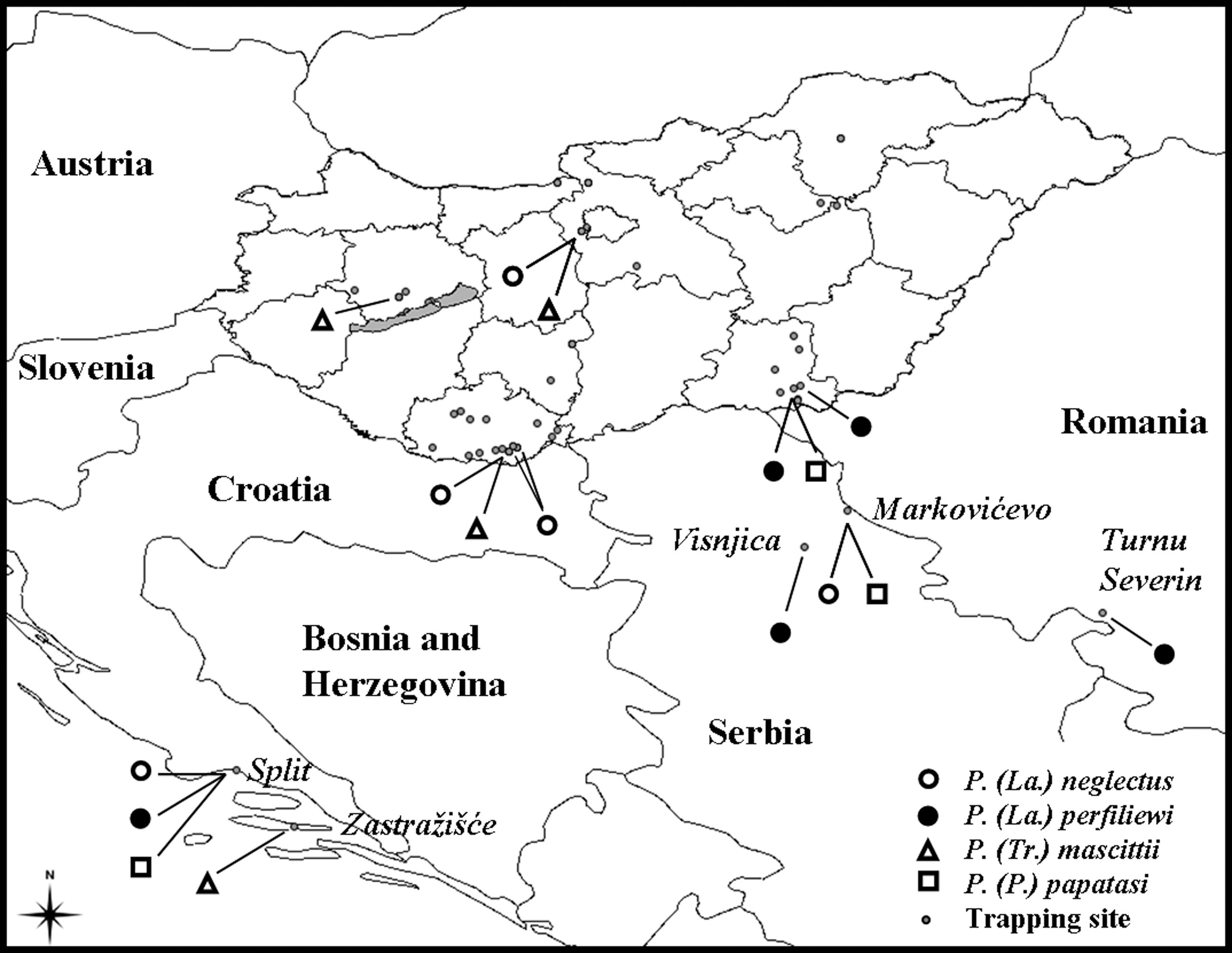
Distribution of sandflies found in Hungary (2006–2009), and the most northerly records in adjacent countries.
SP, sticky-paper traps; DAS, domestic animal shelter; RSW, road-side wall; Q, quarry; W, woods; ND, not done.
Within, at edge of, or between settlements.
No. papers per 2–5-day trapping period per locality.
No. papers/no. localities.
Bold numbers stress the positive results.
Sandfly surveys using light and CO2 baited traps
Forty-four spatio-temporal collections were made from June to September with 320 traps-nights placed in 41 localities of eight counties during the period 2006–2009 (Table 4; Fig. 2). More sandflies were captured than with sticky papers. Sandflies were found only once in the northern half of Hungary. Two males of P. neglectus and one female of P. mascittii were collected by CDC miniature light trap in Pest county not far from Budapest, but only in June 2007. They were not found positive during other seven occasions in the same garden or nearby locations in 2008–2009. Most sandflies were caught in light traps set near the southern border of Hungary. In Baranya county near Croatia, four males and six females of P. neglectus and one female P. mascittii were collected close to chickens in two houseyards in the village of Villánykövesd in 2006 and 2008, but not in three similar villages. Higher numbers of P. neglectus—64 males and 66 females—were found in the nearby limestone quarry in Nagyharsány in 2007–2008. In Csongrád county near Serbia, 126 males and 228 females of P. perfiliewi perfiliewi were caught in just two localities (Földeák and Maroslele) out of the eight visited once in 2009, being associated with poultry yards (Maroslele) or free-range pheasants (Földeák). The former collection contained one female P. papatasi, and this was the only other species collected in the county.
CDC, CDC miniature light trap; MMX, MMX light trap; DAS, domestic animal shelter; DS, dog shelter; G, garden; PBF, pheasant breeding facility; Q, quarry; W, woods; ND, not done.
Within, at edge of, or between settlements.
No. trap-nights per locality.
No. traps-nights/no. localities
Bold numbers stress the positive results.
Discussion
Based on the result of our surveys, we conclude that Hungary lies north of the current endemic range of CanL (Fig. 1). The survey of veterinary clinics discovered only eight imported cases (Table 1). The serological survey focused on Baranya county, which has a sub-Mediterranean climate (Mersich et al. 2003) and the vector P. neglectus, as well as the more northerly and temperate counties of Borsod-Abaúj-Zemplén and Pest (Table 2; Fig. 2). However, only two dogs were borderline positive when their sera were first tested by IFAT, but they were not positive in the follow-up IFAT, and they did not show a combination of clinical signs unambiguously diagnostic for CanL. Additionally, none of the wild canids were IFAT positive, even though both of the species tested (red foxes and golden jackals) can be natural reservoirs of L. infantum (Gramiccia and Gradoni 2005). It is possible that some infections of L. infantum were missed in dogs and wild canids, for the following reasons. Most imported CanL cases (7/8) were reported from Budapest and diagnosed abroad and so, nationwide, veterinarians in Hungary might not be detecting some imported or autochthonous cases. Diagnosis is not always easy, even for experienced veterinarians in long-established CanL foci, because of the variable combinations of diagnostic symptoms that may develop three months to seven years after infection (Dujardin et al. 2008). Other caveats arise from the difficulty of standardizing the IFAT test among laboratories, because of variation among antigen batches (Gradoni and Gramiccia 2004), observer experience, and antibody stability in sera prepared from dead wild canids.
Our vector surveys (Tables 3 and 4; Fig. 2) also did not provide conclusive evidence for including Hungary in the range of CanL. Two of the three known vectors in southeastern Europe (Ready 2010) were collected, namely, P. perfiliewi perfiliewi, for the first time since 1932; P. neglectus, a new record for Hungary and the northernmost record in Europe, in Törökbálint at the 47.435°N; but not Phlebotomus tobbi. However, both the frequency of capture and the density of each species was lower than in CanL foci in southeast Europe (Miščević et al. 1998, Bosnić et al. 2006). We captured only 513 specimens in four summers, 2006–2009. Of 39 settlements examined in eight counties, only seven (17.9%) were positive in the counties of Baranya (3/15), Veszprém (1/7), Pest (1/5), and Csongrád (2/8). Most sandflies were trapped with light traps (CDC: 429/513; MMX: 70/513) because very few localities had walls suitable for sticky-paper trapping. The capture ratios may not reflect any differences between the efficiency of the two light traps, because we had 11 CDC but only two MMX traps, which were used only during the summers of 2007 and 2008. The limited number of light traps might also have influenced the diversity of sandflies caught.
Most sandflies (503/513; 98.06%) came from near the southern border of Hungary (Fig. 2), where just one region produced consistent catches of P. neglectus (Nagyharsány and nearby Villánykövesd, in Baranya county near Croatia) and P. perfiliewi perfiliewi (two nearby localities in Csongrád county, not far from the collections of 1932 and Serbia). This matches some ecological associations of the two vectors: P. neglectus can be more common peri-domestically in areas with a mild and sub-humid climate (Ivović et al. 2007), but we captured 124 in an abandoned limestone quarry where rodents were common; P. perfiliewi perfiliewi is zoophilic, feeding on a wide range of domestic animals and birds (Bongiorno et al. 2003), and we captured it only in poultry yards and in an open-air pheasant raising facility. It is associated with humid and sub-humid bioclimates (Ivović et al. 2007) in Croatia, Serbia, and Romania (Miščević et al. 1998, Bosnić et al. 2006, Dancesco 2008). P. neglectus as P. perfiliewi perfiliewi is one of the most important vector species of L. infantum in the east part of Mediterranean region because it is often associated with human and CanL from Italy to Turkey (Bosnić et al. 2006, Maroli et al. 2008, Ready 2010).
Another new record for Hungary was the finding of P. mascittii in three out of eight surveyed counties (Tables 3 and 4). This sandfly can be anthropophilic (Ready and Ready 1981), but it is unlikely to be an important vector because of autogeny, low biting rates, and an unproven ability to support the development of infective stages of L. infantum (Ready 2008, 2010). It has been recorded sporadically in Europe (Naucke and Pesson 2000), can tolerate cool climates—mean annual temperature <20°C (Lindgren et al. 2004)—and has been caught up to 50° N in Germany (Naucke et al. 2008). A single specimen of P. papatasi was captured in Csongrád county, close to Serbia where it has been recorded (Miščević et al. 1998, Bosnić et al. 2006, Dancesco 2008). It has vectorial competence for L. major/L. infantum hybrids (Dujardin et al. 2008).
Our report provides baseline data for future investigations into the northward spread of CanL in Hungary. The evidence for a natural spread in Europe comes only from Italy (Gramiccia and Gradoni 2005, Maroli et al. 2008), but dog travel from the Mediterranean Basin provides a threat of establishing dog-to-dog transmission in regions not currently endemic for CanL (Ready 2010). We recorded eight Hungarian dogs that had become infected in Portugal, Spain, France, Italy, Malta, and Croatia (Table 1). Also, single dogs from two Hungarian kennels for strays were found to be IFAT positive after arrival in Germany in 2008 (VetmedLab, Germany, personal communication).
Footnotes
Acknowledgments
We wish to thank the staff of all the veterinary practices involved in this study for their kind collaboration and all pet owners who consented to their pets' involvement; Dr. Jerome A. Hogsette (USDA–ARS–CMAVE, Gainesville, FL) for kindly providing MMX traps and advice on their field use; Dr. Luigi Gradoni, and Aldo Scalone and his co-workers in the MIPI Department, Istituto Superiore di Sanità, Rome, Italy, for their valuable contribution to the serological tests; and to the workers of the Duna-Dráva National Park, who provided us with useful information about surveyed territories.
This work was funded by EU grant GOCE-2003-010284 EDEN (Emerging Diseases in a changing European eNvironment) and is cataloged by the EDEN Steering Committee as EDEN0237 (
Disclosure Statement
The contents of this publication are the sole responsibility of the authors and do not necessarily reflect the views of the European Commission. No competing financial interests exist.