




Abstract
Contamination of recreational water by bird feces is a main concern of water managers. It is important to understand the sources of Escherichia coli contamination since the organism is frequently used as a water hygiene parameter. Here, we address presence and levels of E. coli in fecal shedding from several waterfowl (25 geese, 20 coots, and 40 gulls) and demonstrate that there is a bird species variation. Results indicate that gull feces contain a greater average concentration of E. coli per gram than do geese or coot feces. However, contamination risks also depends on bird abundance. These are important aspects for effective water bird management.
Introduction
Materials and Methods
Fecal samples of 85 water birds (25 graylag geese Anser anser, 20 Eurasian coots Fulica atra, and 40 gulls—mostly Lesser black-backed gull Larus fuscus, Herring gull Larus argentatus, and black-headed gull Larus ridibundus) were collected near the shores of the water body and sent to the laboratory for immediate analysis. In the field, fecal droppings from these three species groups can easily be distinguished from one another.
Enumeration of E. coli was performed by serial decimal dilution. From each sample 1 g was suspended in 9 mL of buffered peptone water (dilution−1). From this suspension additional dilutions were prepared. From seven dilutions (−1 to−7), 0.1 mL was spreaded on McConkey agar plates (BioTrading Benelux BV) and incubated overnight at 37°C under aerobic conditions. Plates were examined for the presence of E. coli based on typical colony morphology (appearance of red/pink colonies). Confirmation by biochemical testing was not performed. Although some other coliform bacteria (for instance Enterobacter or Klebsiella) may display the same features, and as a result numbers of E. coli may have been slightly overrated, this was believed not to critically hamper the results. The number of colony-forming units (CFUs) per gram of feces for the different bird species groups was calculated.
A one-way analysis of variance of the log-transformed CFU's was performed to test for significant differences between the three bird species (groups) and a Hochberg multiple comparison-test was used to test for differences between species groups.
To calculate the potential fecal contamination of different bird species, bird numbers were counted during four visits to the water body (I: 7/15/2010; II: 7/30/2010; III: 8/13/2010; IV: 8/27/2010). Bird numbers were then multiplied with the average fecal production for that species group that could be retrieved from previous studies.
Results
The analysis of variance revealed significant differences between the three bird species (F=14.61, Sig.=0.0001; Table 1). The Hochberg multiple comparison-test showed that there were statistical differences between gulls and geese (Sig.=0.000), and between gulls and Eurasian coots (Sig.=0.023), with gulls showing higher values of CFUs than either geese or Eurasian coots. There was no significant difference between geese and coots (Sig.=0.128). In Figure 1, a box plot of the logarithm of the number of E. coli CFU per gram feces of the different bird species groups is presented, which not only demonstrates the differences between the different bird species but also indicates the degree of dispersion (spread) and skewness in the data, and identifies outliers.
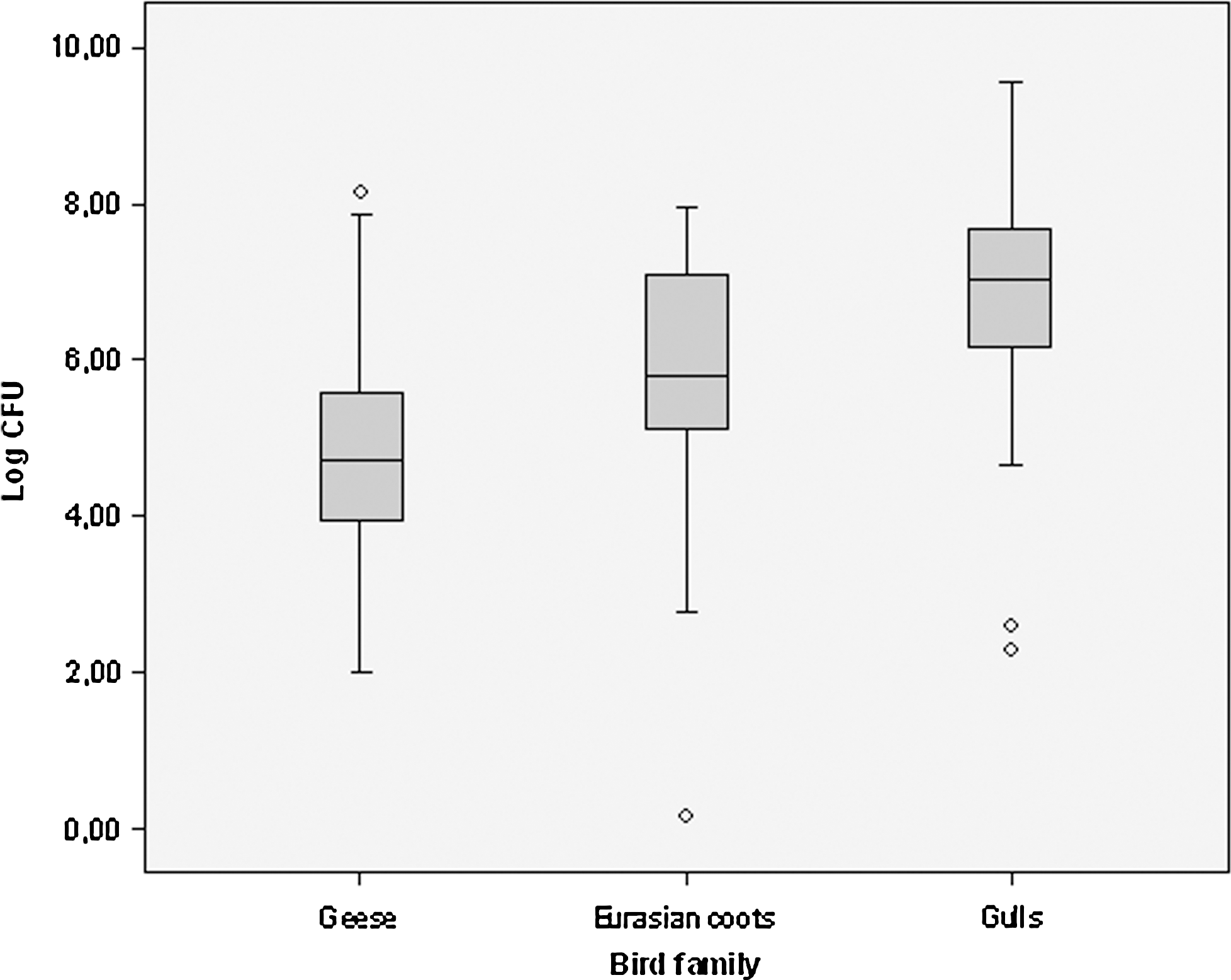
Box plot of the logarithm of the number of Escherichia coli colony-forming unit (CFU) per gram feces of different bird species groups. Box bottom and top represent the lower and upper quartiles, center is the median.
This information was retrieved from scientific literature.
Potential E. coli contamination is calculated by multiplying the average CFU g−1of each bird species×average number of this species present×its estimated fecal production.
CFU, colony-forming unit.
Discussion
The higher number of CFUs of E. coli in gull feces compared to that of geese and coots may be the result of their opportunistic omnivorous behavior (Trapp 1979). In contrast to gulls, geese are herbivorous birds (Amat 1995), whereas coots are omnivorous but less opportunistic (Irwin and O'Halloran 1997). The level of CFUs that were found for gulls in this study are similar to the findings of earlier research, where the number of E. coli CFU ranged from 105 to 109 CFU per gram. Gull species that are frequently present on landfills or that consume waste water (e.g., Larus marinus) displayed higher levels of E. coli CFU than species with other main habitats (e.g., L. argentatus) (Nelson et al. 2008) and previous studies have attributed high numbers of E. coli in surface water to presence of gulls (Benton et al. 1983, Levesque et al. 1993, Fogarty et al. 2003).
However, the risk for contamination of surface water depends not only on the level of CFU of E. coli per gram feces, but also, among others, on the amount of feces that is voided by a specific bird species per 24 h (Gould and Fletcher 1978) and the numbers of birds present on the water surface. From the literature the fecal production was retrieved (g wet weight/24 h) for geese (Manny et al. 1975) and gulls (Gould and Fletcher 1978). For Eurasian coots, such data are unavailable. As this was also the case for birds of similar size and diet (such as Pochards, Aythya ferina, and Gadwalls, Anas strepera), the fecal production of the 50% larger mallard ducks (Marion et al. 1994), Anas platyrhynchos, was used instead.
Based on fecal E. coli concentrations and the average number of observed birds, gulls have the highest potential for E. coli contamination of the water body (see Table 1). However, microbial contamination is seriously influenced by fluctuating bird numbers. For example, if the number of birds observed during just the fourth visit is used, the potential E. coli contamination of surface waters by Eurasian coots (1.9×10¹¹) exceeds that of gulls (1.1×10¹¹).
It should be noted that the real contamination level depends on more factors than were included in this study, such as various environmental conditions (water current, soil type, vegetation, and weather) and bird ecology (e.g., the number of hours present at the water or bird species-specific excretion rates). Moreover, for our calculation of potential E. coli contamination, we assumed that all species have similar defecation rates on water, which is unrealistic considering the different ecological niches they occupy. Despite these limitations, this study is a first step toward a more quantitative assessment of the role of waterfowl in the contamination of recreational waters. Results show that the contribution of different bird species to the deterioration of water quality varies. Such information is important to estimate public health risks and may help in the development of control measures.
Footnotes
Acknowledgments
This study was supported by grants from the water board “Hollands Noorderkwartier” and the Province of North-Holland. The constructive comments of two anonymous referees improved the article.
Disclosure Statement
No competing financial interests exist.