




Abstract
A total of 3696 Ixodid ticks, collected from Hebei Province, China, were examined by a nested polymerase chain reaction for the presence of Anaplasma phagocytophilum. Forty-three (15.4%) of 280 pools tested, including 39 (14.6%) of 267 Haemaphysalis longicornis and four (30.8%) of 13 Dermacentor nuttalli, were positive, but no significant difference was found between D. nuttalli and H. longicornis (p>0.05). Sequence and phylogenetic analyses of 16S rRNA gene indicated that A. phagocytophilum in China is genetically diverse. To our knowledge, this is the first evidence of A. phagocytophilum in ticks from Hebei Province, China, and the first documentation of Anaplasma infection in D. nuttalli.
Introduction
A. phagocytophilum is naturally maintained in a tick–rodent cycle, and human being and domestic animals act only as incidental “dead-end” hosts (Bakken and Dumler 2008). The agent is usually associated with ticks of the genus Ixodes, including Ixodes scapularis and Ixodes pacificus in America (Teglas and Foley 2006), Ixodes ricinus in Europe (Strle 2004), and Ixodes persulcatus in Asia (Ohashi et al. 2005). Wild rodents have been implicated as natural reservoirs (Carlyon et al. 2003).
At least 557 people had been found infected with A. phagocytophilum in China, and 18 of them died in the past 5 years, which were distributed in Hubei, Henan, Anhui, Shandong, Helongjiang, Inner Mongolia, Xingjiang, and Tianjin in China (Chahan et al. 2005, Zhang et al. 2008, 2009). Ixodid ticks include seven genera: Boophilus, Hyalomma, Rhipicephalus, Amblyomma, Ixodes, Dermacentor, and Haemaphysalis. However, A. phagocytophilum was detected only in I. persulcatus ticks in northeastern China, where Lyme disease is endemic, and anti-A. phagocytophilum antibodies were detected in 20% of individuals at high risk for exposure to ticks and animals in central and southeastern China (Cao et al. 2003, 2006, Zhang et al. 2009). The objective of this study was to investigate the presence of A. phagocytophilum in Ixodid ticks in Hebei Province of China.
Materials and Methods
Study site and collection of ticks
Hebei Province is located in the northern part of the North China, which is composed of Hebei Plain in the east and south and the mountain range along the northern and western frontiers. The study was performed in rural areas of Zhangjiakou City (40°46′N, 114°56′E) located in northern Hebei Province, Qinghuangdao City (39°56′N, 119°36′E) and Tangshan City (39°37′N, 118°11′E) located in eastern Hebei Province, and Baoding City (38°10′N, 113°40′E) located in central Hebei Province, from April 2008 to May 2010, where the annual average temperature is 0°C–14°C and the average precipitation is 300–800 mm.
Ticks were collected by dragging vegetation or directly removed from sheep or hedgehog using forceps to maintain the integrity of ticks. All the specimens were stored in 95% ethanol and later identified to the species level using standard guides (Chen et al. 2010).
DNA extraction
Some ticks were pooled before DNA extraction. The pools consisted of 2 to 10 ticks of one species collected from the same site. DNA extraction was performed as previously described (Fyumagwa et al. 2009). Briefly, the ticks were disinfected in 70% ethanol for 10 min, rinsed with sterilized distilled water, put in a microtube, and mechanically disrupted with sterile scissors in 50 μL DNA extract buffer (10 mM Tris [pH 8.0], 2 mM EDTA, 0.1% sodium dodecyl sulfate, and 500 μg of proteinase K per mL). The sample was incubated at 56°C for 4 h and then boiled at 100°C for 10 min to inactivate proteinase K. After centrifugation, the supernatant was transferred to a fresh microtube and DNA was purified by extracting twice with an equal volume of phenol–chloroform, which was stored at −20°C until use.
Polymerase chain reaction
A nested polymerase chain reaction was performed using primers designed to amplify the partial 16S rRNA gene of A. phagocytophilum. A pair of universal primers of the ehrlichial 16S rRNA gene (GenBank accession No. AF414399), Eh-out1 (5′-TTGAGAGTTTGATCCTGGCTCAGAACG-3′, located at positions 1 to 27) and Eh-out2 (5′-CACCTCTACACTAGGAATTCCGCTATC-3′, at positions 653 to 627), was used for the primary amplification of a 653-bp fragment using Taq DNA polymerase (TaKaRa) under the conditions of 94°C for 5 min and then 40 cycles of 95°C for 5 min, 55°C for 50 s, 72°C for 1 min, and 72°C for 10 min.
Primers HGA1 (5′-GTC GAA CGG ATT ATT CTT TAT AGC TTG-3′, at positions 167 to 187) and HGA2 (5′-TAT AGG TAC CGT CAT TAT CTT CCC TAC-3′, at positions 448 to 428), which were designed based on the conserved positions in the sequence of 16S rRNA genes of A. phagocytophilum, were used in the nested amplification of a 389-bp fragment using Taq DNA polymerase under the conditions of 94°C for 5 min and then 40 cycles of 95°C for 5 min, 55°C for 40 s, 72°C for 1 min, and 72°C for 10 min (Wen et al. 2002, Jiang et al. 2010). Distilled water instead of tick DNA template was used as a negative control, and DNA from Haemaphysalis longicornis ticks infected with A. phagocytophilum was used as a positive control.
PCR products were purified and sequenced. The sequences obtained were compared with previously published sequences deposited in GenBank using BLAST and phylogenetically analyzed. Phylogenetic tree was constructed using the neighbor-joining algorithm of Phylip program with Kimura two-parameter model.
Statistical analysis
Chi-square test or Fisher's exact test was used to compare the difference of A. phagocytophilum prevalence of ticks from different regions and different tick species. The difference was considered statistically significant when p-value was<0.05.
Results
Ticks identification
In the 3696 ticks collected, two species H. longicornis (1435 adults and 2210 nymphs) and Dermacentor nuttalli (51 adults) were identified based on the morphological characters. H. longicornis predominated in Hebei Province, China, accounting for 98.6% of the ticks collected. The number of H. longicornis ticks collected from vegetation and sheep was 3203 and 442, respectively. All D. nuttalli adults were collected from hedgehogs. Species and regional distribution of ticks are shown in Table 1.
Nested PCR was used to detect the presence of A. phagocytophilum DNA in tick pools.
Significant difference was found among H. longicornis from the four regions by chi-square test (p<0.05); no significant difference was found between D. nuttalli from the two regions by Fisher's exact test (p>0.05).
PCR, polymerase chain reaction.
Polymerase chain reaction
The DNA from 280 tick pools, representing 3696 ticks collected from Zhangjiakou, Tangshan, Qinhuangdao, and Baoding cities of Hebei Province, China, were analyzed by a nested PCR for the presence of A. phagocytophilum. There was no positive sample found in H. longicornis from Zhangjiakou and Qinhuangdao, and the prevalence in Tangshan and Baoding was 15.6% (14/90) and 73.5% (25/34), respectively. There was significant difference among these regions (p<0.05). In D. nuttalli, the prevalence in Qinhuangdao was 33.3% (4/12); no positive sample was found in Zhangjiakou. No significant difference was found between the two regions (p>0.05) (Table 1). Therefore, 43 (15.4%) of 280 pools tested, including 39 (14.6%) of 267 H. longicornis and 4 (30.8%) of 13 D. nuttalli, were positive. There was no significant difference in the prevalence of A. phagocytophilum between D. nuttalli and H. longicornis (p>0.05) (Table 2).
Nested PCR was used to detect the presence of A. phagocytophilum DNA in tick pools.
No significant difference was found between the tick species, which was compared by Fisher's exact test.
As to the developmental stages, the prevalence of H. longicorni adults and nymphs was 15.2% (16/105) and 14.2% (23/162), respectively. No significant difference was found between the two developmental stages in H. longicorni (p>0.05).
Phylogenetic analysis
Sequence analysis of the partial 16S rRNA gene of A. phagocytophilum from H. longicornis and D. nuttalli ticks showed various (GenBank accession numbers: HQ651825, HQ651826, HQ651827, HQ651828, HQ651829, HQ651830, and HQ651831) but closely related to A. phagocytophilum deposited in GenBank. Phylogenetic analysis indicated that the detected A. phagocytophilum belonged to a novel haplotype, which was distinct from the other haplotypes from Zhejiang Province (GQ500077) and Hubei Province (HM641751 and HQ171975) in China (Fig. 1). These results indicated that A. phagocytophilum in China is genetically diverse.
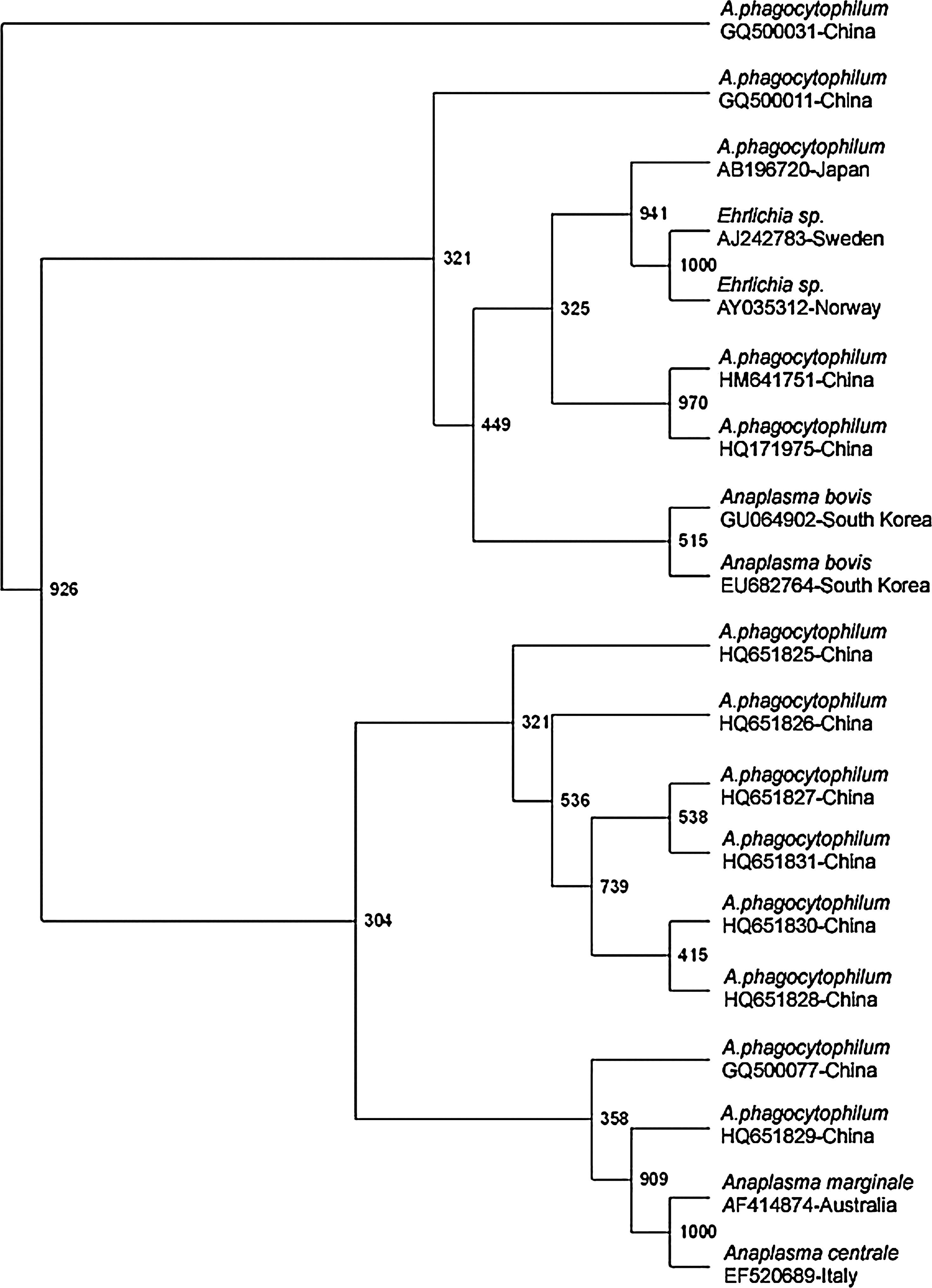
Phylogenetic tree for the partial 16S rRNA gene of Anaplasma phagocytophilum. It was constructed by the neighbor-joining method using Phylip software. Neighbor-joining consensus tree used 1000 bootstrap replicates. The number represents bootstrap values. The species, GenBank accession number, and the country or region are indicated.
Discussion
A. phagocytophilum is believed to be naturally maintained in a tick–rodent cycle in which Ixodes ticks are the vectors. In Asia, I. persulcatus is considered the vector of A. phagocytophilum. The prevalence of A. phagocytophilum in I. persulcatus has been found to be 4.6% in China and 9.6% in Japan (Cao et al. 2003, 2006, Ohashi et al. 2005). However, A. phagocytophilum has been also demonstrated to naturally infect Ixodes ovatus and Haemaphysalis megaspinosa ticks in Japan (Wuritu et al. 2009, Yoshimoto et al. 2010) and infect H. longicornis (35/364) in Korea (Lee et al. 2010). In this study, DNA from 280 tick pools, representing 3696 ticks, including H. longicornis and D. nuttalli collected from Hebei Province, China, was examined for infection with A. phagocytophilum by a species-specific nested PCR. Forty-three (15.4%) of 280 pools examined, including 39 (14.6%) of 267 H. longicornis and 4 (30.8%) of 13 D. nuttalli, were positive for A. phagocytophilum DNA.
A. phagocytophilum was found to infect H. longicornis only in regions of Tangshan and Baoding and to infect D. nuttalli only in Qinhuangdao area. The phenomenon may be attributed to the different vectors of A. phagocytophilum in different ecological environments. Similar prevalence was found between H. longicornis adults and nymphs, showing that A. phagocytophilum is transovarially transmitted in H. longicornis, although it is usually transstadially transmitted in ticks (Baldridge et al. 2009).
To our knowledge, this is the first report of A. phagocytophilum in H. longicornis and D. nuttalli in China. These results show that H. longicornis and D. nuttalli may be the vector tick species of A. phagocytophilum in Hebei Province, China, but their vectorial capacity should be further experimentally validated.
The 16S rRNA gene fragment sequences of the A. phagocytophilum-positive samples were closely related to A. phagocytophilum deposited in GenBank, indicating that there are many genetic variants in Hebei Province and even simultaneously in the same region. Phylogenetic analysis indicated that A. phagocytophilum detected in ticks from Hebei Province, China, belonged to a novel haplotype, different from other isolates in China. Therefore, A. phagocytophilum in China is genetically diverse. This conclusion needs to be further confirmed in additional experiments by targeting other genes of Anaplasma. It is also necessary to demonstrate in further studies whether the strains detected in these ticks are pathogenic to humans and/or domestic animals.
Footnotes
Acknowledgments
This work was supported by Hebei Province Science and Technology Department in China (No. 07276916) and by “Gold Idea” Foundation of Institute of Military Veterinary, Academy of Military Medical Sciences (No. YCX0901).
Disclosure Statement
No competing financial interests exist.