




Abstract
Introduction:
The Shahid Babaie Airbase is one of the most endemic areas of cutaneous leishmaniasis (CL) in Isfahan. Community training on CL prevention could have a critical role in controlling CL in endemic areas. Because of the high incidence of disease among youth, this survey was designed to assess the knowledge, attitude, and prevention practices (KAP) of students regarding CL in this endemic area.
Materials and Methods:
This study consisted of a questionnaire that was filled out while interviewing students attending middle and high school on the Shahid Babaie Airbase of Isfahan. The questionnaire contained questions about KAP of students regarding CL. The total scores in each field were categorized as weak, intermediate, or strong.
Results:
Four hundred fifty students participated in this study, which included 245 high-school students and 205 middle-school students. The total knowledge score of the students was 17.47 (range, 0–30), which indicates an intermediate level of CL knowledge in this population. The students' attitude toward CL was intermediate, with a score of 37 and a range of 13–52. Additionally, practice of prevention was weak (score of 1.8; range, 0–6). There was a significant correlation between gender and both the attitude and knowledge of the students; both scores were higher in female students. Specific knowledge about CL symptoms, carriers, and reservoirs was higher than knowledge about preventative methods. The study revealed that 47.2% of students believed in fortune as a factor involved in acquisition of CL infection. Although 97.9% of students were aware that sandflies carry CL, only 28.6% were able to identify a sandfly.
Conclusions:
The results of this study further emphasize the importance and necessity of educating this at-risk population by planning direct, in-person training, which is an essential step in improving attitudes and preventative practices toward CL and in controlling CL in endemic areas.
Introduction
The Shahid Babaie Airbase District is located in close proximity to CL hyperendemic areas such as Borkhar (a county in Isfahan province). As expected, development activities and the settlement of military personnel and their immigrant families have turned this area into a new endemic focus in the Isfahan province (Desjeux 2001).
Regional reports indicate that the majority of cases occur in young adults with age ranging from 15 to 24 years (Mazloomi et al. 2000). Health education is essential to prevent new CL cases and the evaluation of knowledge, attitude, and prevention practices (KAP) of the target population is the first step in planning related educational programs. Because this disease is prevalent in adolescents and because CL could severely impact this population, we conducted a KAP study on middle- and high-school students of this area. The results of this study will be used in planning educational programs and developing community awareness to control and prevent CL in this endemic area.
Materials and Methods
A descriptive, cross-sectional study was performed. A questionnaire was used to collect the data for this study, and its validity and reliability were assessed previously (Ewles and Simnett 2003). Middle- and high-school students on the Shahid Babaie Air Force Station in Isfahan were the target population. Census sampling was used, and all students participated in this study. The questionnaire was filled out during an interview. The regional health center and teachers were informed of the objectives and methods of the study. The interviews were conducted by trained staff. The questionnaire consisted of 493 questions. There were 31 questions to assess knowledge, which included questions about the signs and symptoms of CL, the disease reservoir, and methods of prevention. Each section was categorized into three levels: weak (0–20), average (11–21), or excellent (22–31).
To assess attitudes toward CL, 13 questions were asked that covered the probability of CL infection; concerns about infection of family members or themselves; beliefs on the effects of fortune, the evil eye, and prayer on CL infection; views on disease prevention; and the role of mothers in this regard. A score of 13–26 was considered weak, 27–39 was considered average, and 42–50 was considered good.
Six questions were asked about performance, and the score was categorized as weak (0–2), average (2.1–4), or good (4.1–6).
Data were analyzed using SPSS 16.
Results
A total of 450 students participated in this study, 205 middle-school students (124 girls and 81 boys) and 245 high-school students (119 girls and 126 boys).
There was a significant correlation between the sex of the interviewee and the level of schooling and their knowledge regarding CL (p<0.001). Girls were more knowledgeable and had better attitudes about CL (p<0.001). There were no differences between the levels of middle- and high-school students.
When students were questioned about their basic knowledge of CL, 95.8% of the students were aware of the signs and symptoms of CL. The percentages of students who knew about the distribution of the CL vector, where the sand flies habitat was located and where sand flies spawn, were 97.9%, 76.3%, and 53%, respectively. Moreover, 82% of the students knew that CL was not contagious and 42.3% were aware of the differences between urban and rural types of CL. When asked about reservoir hosts, 83.3% of the students knew that rodents carry CL, 70% knew that lizards carry CL, 65% knew that humans carry CL, 57.9% knew that dead corpses carry CL, 50% knew that cats carry CL, and 40% knew that dogs carry CL. Only 15% of students were aware of the times of day sand flies bite, which was the lowest percentage for any of the questions.
The students' awareness of the signs and symptoms of CL, the vectors, the location the sand flies habit and spawning sites, the time of day when biting is most common, the transmission of CL, the differences between urban and rural types of CL, and the reservoirs of disease is shown in Figure 1.
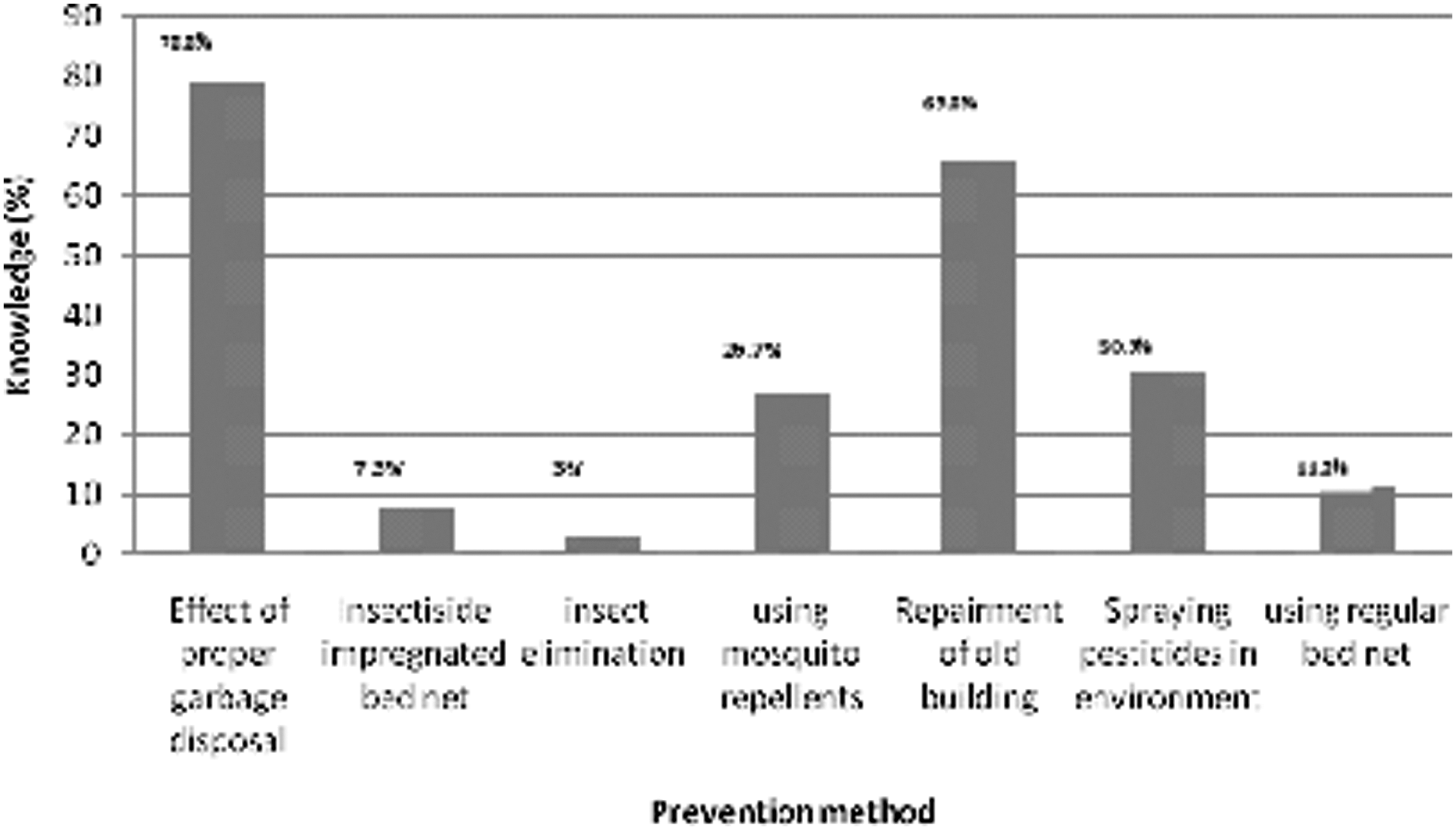
Frequency distribution of knowledge and preventive method of cutaneous leishmaniasis in middle- and high-school students of Shahid Babaeei Airbase District.
The answers to the questions about prevention are shown in Figure 2.
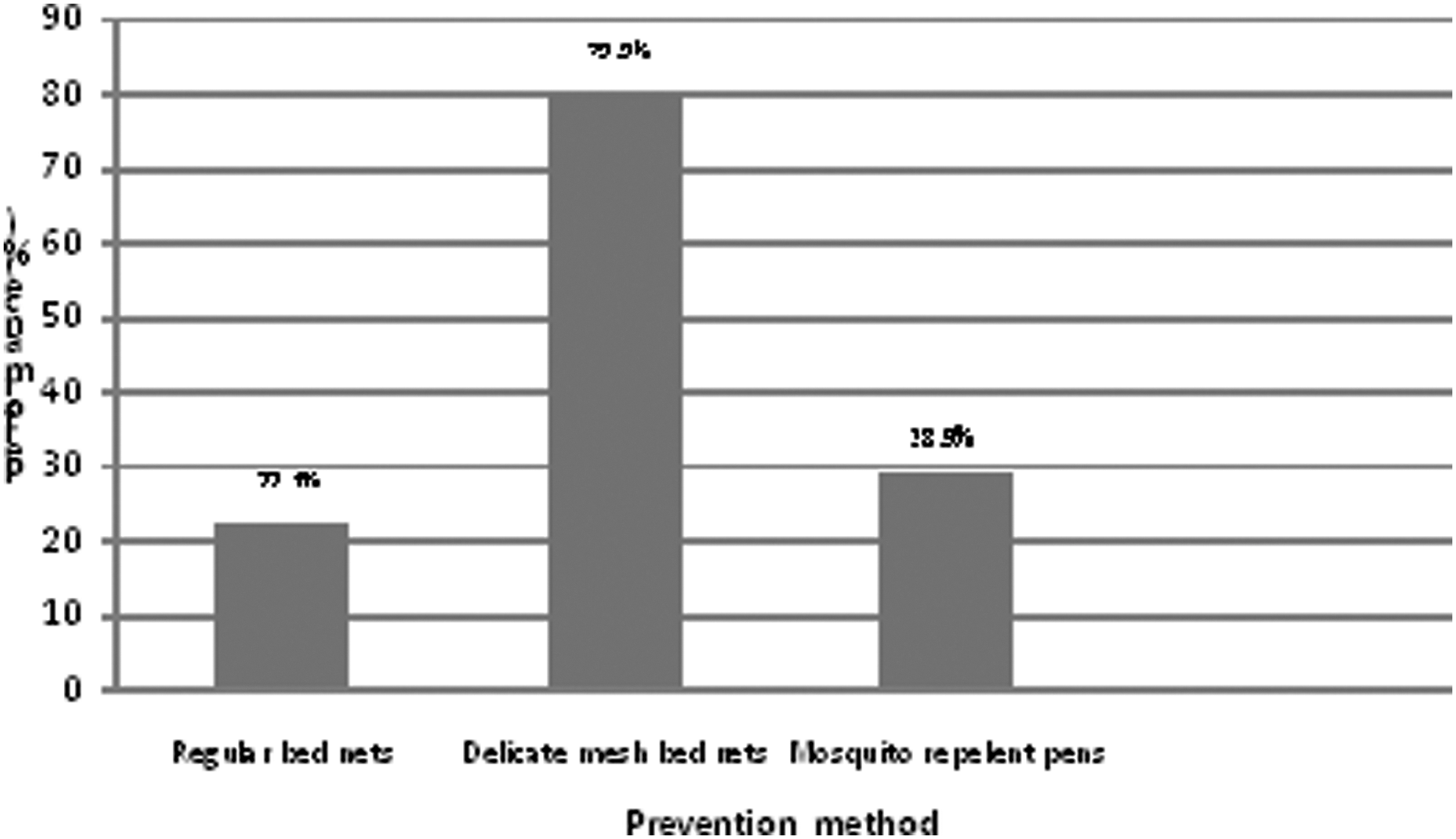
Performance score of the students for using preventive measures for cutaneous leishmaniasis.
Only 2.11% of the students believed that using mosquito nets could completely prevent mosquito bites. Further, 3.22% of the students believed that a CL scar on the face had negative cosmetic effects, whereas 35.8% of the students did not mention the cosmetic issue but did mention the permanent residual scar. Moreover, 1.6% of the participants did not believe in treatment of cutaneous lesions, 3.7% believed that CL treatment was expensive, and 5% considered it a difficult disease to treat. Additionally, 10% of students believed that CL was a dangerous disease that could cause death. The results of the attitude assessment are summarized in Table 1. Notably, 43.5% of the students believed that everyone is at risk for developing CL, 15.2% considered children to be an at-risk population, and 11.4% identified youth as the most at-risk population.
CL, cutaneous leishmaniasis.
Few students believed that there were different prevalences of CL in the sinful, in the rich and the poor, or in men and women. When asked why people do not use bed nets, 17% did not think bed nets were beneficial, 12.3% said that using a bed net is too difficult, 16.7% said it was too hot, and 5.8% said that they could not afford a bed net.
The KAP score (mean±standard deviation, range score) of the students' responses are shown in Table 2.
SD, standard deviation.
In summary, 15.6% of the students had low knowledge of CL prevention, 59.6% had moderate knowledge, 13% had high knowledge, and 8.1% had very high knowledge. Further, 84.4% of the participants were interested in learning more about prevention of CL.
Discussion
The results of this study revealed that 97.8% of the students were aware of the signs and symptoms of CL. Although 97.8% knew that the sand fly is a CL vector, only 28.6% were able to identify a sandfly in a bottle containing an alcohol-preserved sandfly or a sandfly in a picture. In the survey conducted by Mazloomi et al. (2000), only 21.2% of the participants were able to identify a sandfly, which emphasizes the need for additional educational programs that include direct observation of the sand fly. Only 42% of the participants were aware of the differences between the rural and urban types of CL. Because both types of CL are endemic in Isfahan province (Nadim and Seyedi–Rashti 1971, Nilforoushzadeh and Sadeghian 2002, Tashakori et al. 2003), any educational program should provide information about both types of the disease. The results of this study show that most of the students were aware that sand flies start to bite at sunset, but only 9.3% knew that they also bite at sunrise. Consequently, this affects the use of personal protective methods.
In a KAP study of visceral leishmaniasis in the rural areas of India, 46.8% of the study subjects knew that sandflies bite at dusk, 39.7% said midnight, and 12.5% thought that they would bite anytime (Singh et al. 2006). In their study, 92.8% of the respondents were aware of the protective role of bed nets, but only 16.6% and 17.3% were aware that insecticides and repellents are also protective, respectively. In our study, 22.1% of the respondents used bed nets and 28.9% of the respondents used mosquito repellent.
The lack of awareness about sand fly biting times in endemic areas may result in reduced use of personal protection, such as mosquito nets, insecticides, and mosquito repellent, during those times. Bern et al. (2000) demonstrated the effectiveness of using bed nets for prevention in Kala-azar through a case–control study in Nepal. In our study, girls were more knowledgeable about, and had better attitudes toward, CL when compared with boys. This may be because girls are more sensitive about their appearance and beauty.
Although drugs to treat CL are distributed free of charge in the government healthcare centers in endemic areas, about 4% of the students thought that treatment was expensive. It is correct that treatment of the residual scar left by CL is expensive. Further, it is not covered by the government, and it usually requires resurfacing with a laser and cosmetic surgery for the best results. About 40% of the participants believed that they were at low risk for developing CL and 30% believed that chance was the biggest factor in acquiring infection. The Mazloomi et al. (2000) study found that 60% of the participants believed chance was the determining factor in whether a person develops CL, which could potentially cause the participants to be passive and not take preventative measures. In our study, the students' knowledge about CL was mostly provided by healthcare personnel, and the role of teachers and schools in training was weak. In another survey in Kashan, 69.8% of the teachers in the endemic area were not knowledgeable about CL etiology (Doroudgar and Tashakkori 2003). Therefore, providing educational programs for teachers in the endemic areas is needed, and we strongly suggest that it should be incorporated into educational workshops and courses for the students in the endemic areas.
The results of this study further emphasize the necessity of an educational program in this area to improve CL prevention. As the most at-risk population is the youth, ranging from 15 to 24 years old, we strongly recommend that personal protection programs be included.
Conclusions
Because teachers and mothers potentially have the largest impact on the behavior of the students, we suggest that a KAP study is performed on these two populations and that an educational program be developed based on the results of these studies.
Footnotes
Acknowledgments
The authors thank the director and all health staff of the regional Shahid Babaie Airbase Hospital and Skin Disease and Leishmaniasis Research Center head and staff for their kind help and support.
Disclosure Statement
No competing financial interests exist.