




Abstract

Dr. Anthony R. Fooks leads the Rabies and Wildlife Zoonoses Group at the Veterinary Laboratories Agency. Prior to joining the VLA, Dr. Fooks worked at the Centre for Applied Microbiology and Research, a world-renowned UK research center where his focus remained exotic viral diseases. Dr. Fooks has published over 150 peer-reviewed articles in international journals and is a member of the editorial boards of Journal of General Virology, Journal of Virological Methods, and BMC Veterinary Research. He is an associate editor for Epidemiology and Infection and PloSOne. He is a scientific consultant to the UK Department for Environment, Food, and Rural Affairs (Defra) on all issues relating to emerging viral diseases. In 2002, he was appointed director of a World Health Organisation Communicable Disease Surveillance and Response Collaborating Centre for the characterization of rabies and rabies-related viruses. In 2006, he was appointed a Designated OIE Reference Expert for Rabies. He holds an Honorary Visiting Chair in Virology in the Department of Veterinary Pathology at the University of Liverpool, UK. His principal interests remain focused on RNA viruses, viral diseases of the CNS, and emerging/exotic viral zoonoses.

Dr. Fooks, what is Arbo-Zoonet? When was it established, by whom, and what were its initial goals and activities?
The funding from MedVetNet also enabled scientists to work with our funding agency in the EU to provide an evidence base on emerging arboviruses that might threaten the EU. Within the FP7 framework, a call for such a network was tendered. A colleague at the VLA, Dr. Kumar Sivam, and I established a network in response to this tender. A separate, competing consortium was in development, led by, Dr. Michèle Bouloy, at Institut Pasteur in Paris. Michèle and I knew each other from working in similar fields of virology and it was logical to bring together these two consortia to create one larger consortium.
One issue was that the call specified work on three specific agents: West Nile virus (WNV), Rift Valley fever virus (RVFV), and Crimean Congo hemorrhagic fever virus (CCHFV), reflecting examples of mosquito-borne and tick-borne viruses threatening the EU. So we now had a consortium focusing on these three diseases, and we set up a network referred to as Arbo-Zoonet (Arbovirus Zoonosis Network), which operates under the International Network for Capacity Building for the Control of Emerging Viral Vector-Borne Zoonotic Diseases. With her vast experience of working with arboviruses, especially RVFV, Michèle agreed to be coordinator of our consortium. The management forum of Arbo-Zoonet includes Drs. Jabbar Ahmed (Germany), Janusz Paweska (South Africa), Onder Ergonel (Turkey), Franco Ruggio (Italy), Michèle Bouloy, and myself. The chief editor for the Arbo-Zoonet newsletter is Dr. Ulrika Seitzer (Germany). Representative members of Arbo-Zoonet are from throughout Europe, Turkey, China, and Iran. We published information describing the network in the journal Eurosurveillance. 2
In addition, it should be noted, the rationale behind Arbo-Zoonet developed after discussions with colleagues in the U.S. and in learning about the arbovirus surveillance network in the U.S., called ArboNet. I had been fortunate to have the opportunity to visit the University of Texas Medical Branch, Galveston, and to work with Drs. Steve Higgs and Alan Barrett, and also Dr. Kristy Murray at University of Texas-Houston, and Dr. James Steele at the University of Texas Health Science Center School of Public Health. They informed me about ArboNet, which is based in Fort Collins, Colorado, and I have seen how the U.S. deals with surveillance of emerging zoonotic diseases. On one occasion, I had visited the mosquito control center in Houston to witness first hand how mosquito control is undertaken in areas where there is a high incidence of West Nile virus infection. I learned a lot from these opportunities and have tried to put much of that into practice in Europe. I witnessed how the U.S. network was able to gather information on emerging vector-borne diseases and deliver this information quickly to policy makers. I considered the advantages of having such a system in Europe to warn of an incursion of an emerging or re-emerging vector-borne disease.
The funding for Arbo-Zoonet was confirmed towards the end of 2007, but it did not take effect until mid-2008. The first step was to create the surveillance network, mainly for the three diseases I mentioned, but for other arboviruses as well, and to share expertise, reagents, and methods, to educate each other, and to achieve some harmonization of the tools we use in each European country so we can better rely on the data generated.
During the past 2 years, one of our principal objectives was to hold workshops on these three pathogens in order to share expertise and knowledge. Examples have included the following: a workshop on Rift Valley fever virus, which was held in Johannesburg in 2009, with a focus on epidemiology, clinical and pathological features of Rift Valley fever virus, and diagnosis (organized by Dr. Janusz Paweska); in Algeria in 2009, again with a focus on Rift Valley fever virus and an emphasis on innovative approaches to viral epidemiology and entomology (organized by Dr. Jabbar Ahmed); in Istanbul, Turkey, in November 2009, assessing vaccines, antiviral strategies, and anti-vector therapies against the three diseases (organized by Drs. Rob Moorman and Onder Ergonoul); in Montpellier, France, in November 2009, looking at risk assessment, and involving another EU-funded project, EDEN (organized by Dr. Veronique Chevalier), which is focused on ecology and environmental aspects of vectors and their spread; in Berlin, Germany, in December 2009, on various aspects of epidemiology (organized by Drs. Ulrika Seitzer and Jabbar Ahmed); in Italy in April 2010, on West Nile virus diagnostic techniques, with an emphasis on harmonization of existing techniques (which I organized together with members of my team and with Drs. Paulo Calistri and Giovanni Savini and other members of IZS-Teramo); and in Turkey, in July 2010, a technical workshop on tick taxonomy (organized by Drs. Ulrika Seitzer and Jabbar Ahmed).
How has the mission and activities of Arbo-Zoonet evolved? What has it achieved?
What are the plans for the future and how would you like to see the network grow?
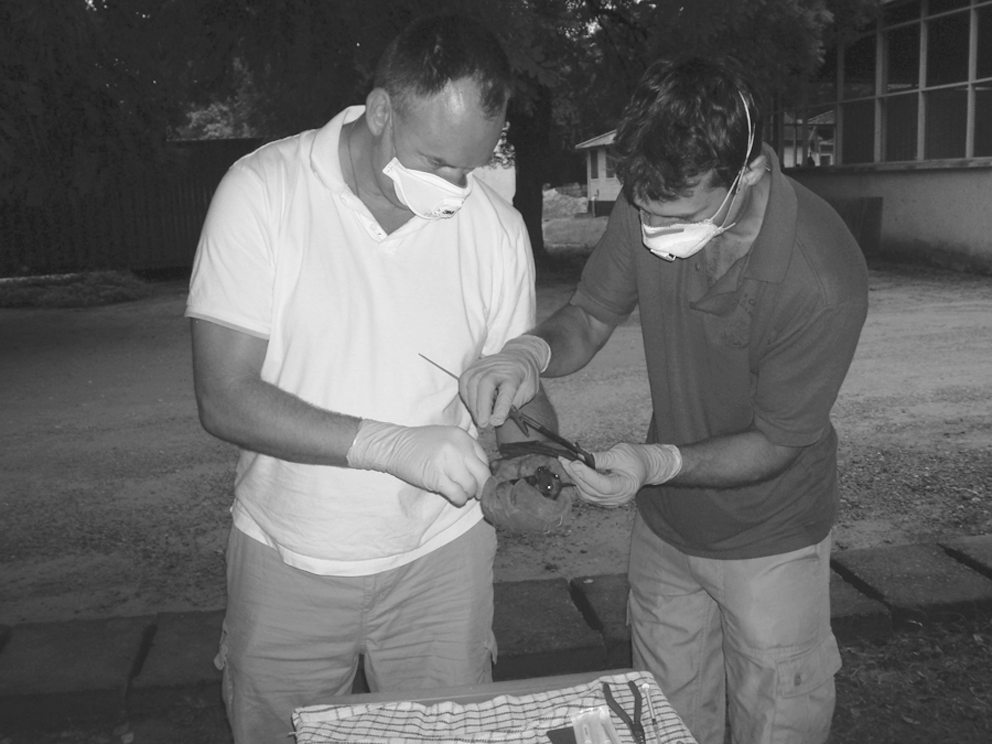
Dr. Fooks (left) and Dr. David Hayman (right) sampling fruit bats (Eidolon helvum) in Accra, Ghana in July 2009.
Much of your own research has focused on rabies and rabies-related viruses. What are the main challenges at present regarding control and prevention of rabies?
One of these initiatives is The Partners for Rabies Prevention. PRP was created in 2008 and consists of an informal network of stakeholders working in the field of rabies prevention and control. The goal of this informal network is to provide a platform by which to share information and expertise and to exchange and discuss current information in the field of rabies prevention including global epidemiology; outbreak information; new tools and diagnostic techniques; laboratory surveillance; and educational awareness and advocacy. During the past 10 years, this partnership has grown in strength and acts as a bridge between academia, private companies, and global organizations.
One PRP project was based on a showcase principle for rabies elimination in dogs in specific rabies-endemic regions. The showcase is a paradigm shift for rabies control that would focus our efforts on vaccination in dogs. The overarching concept is that removing the circulation of rabies virus in dogs would eventually eliminate human exposure and human death. The showcase focused on three countries: Tanzania, Kwa-Zulu Natal in South Africa, and the Philippines, and there are now dog vaccination programs being undertaken in those regions. If we can prove that the vaccination programs can reduce the burden of dog rabies, with a concomitant reduction in human rabies, we would consider them a success. The project is for 4 years and we are about half way through. Other countries have already eliminated dog rabies through vaccination, proving that it can be achieved.
In a second study—a project managed by WHO-Geneva in collaboration with other WHO collaborating centers—our objective was to develop a cheaper and safe alternative to human rabies immunoglobulin. People who live in rabies-endemic areas and are bitten by a suspected rabies-infected animal would typically first clean the wound and then go to their physician. In a functioning healthcare environment they would receive immunoglobulin and then post-exposure vaccination. The immunoglobulin is intended to neutralize any virus within a short window of 1-3 days before the vaccine-induced immunity is elicited. That is the standard-of-care in most countries, but, unfortunately in developing countries, the immunoglobulin is often not available. Furthermore, the vaccine is prepared from purified blood and is very expensive. We are looking into alternative approaches. One is a cocktail of two murine monoclonal antibodies. We have demonstrated both in vitro and in vivo activity of these antibodies and have recently published these findings in PLoS Tropical Neglected Diseases. 3 The hybridomas that produce those antibodies have been licensed to a large biopharmaceutical company, which is undertaking the preclinical assessment. Hopefully, the end-product can be used to save human lives after exposure to rabies, and will be much more cost effective than a human purified drug product.
In 2006, another initiative that PRP began is World Rabies Day (WRD), observed on September 28th—the anniversary of the death of Louis Pasteur, the “‘father” of rabies. The PRP created WRD to raise awareness of this neglected disease. We believed that it was crucial to establish a day for rabies, as it truly remains a neglected disease that attracts very little support or attention. The WRD campaign was overwhelmingly supported throughout the world as a means to join together and therefore become a force in the fight to prevent rabies. Members of my laboratory undertake many educational awareness activities on that day; for example, last year, we walked up Mt. Snowden, which is one of the highest mountains in the U.K. This year we will be sailing around the Isle of Wight in the English Channel.
What types of projects is your group pursuing at the Veterinary Laboratories Agency?
We are also looking at cell signaling pathways with academic collaborators in the U.K. I also have some applied projects looking at diagnostic techniques, and in particular, a technique developed recently with Dr. Robin Weiss's group, by Dr. Ed Wright, at University College, London, which utilizes lentivirus pseudotypes. We are trying to develop techniques that are more available to developing countries and do not have the need for expensive reagents or high containment laboratories, and which, on the whole, can be taught to people without the need for long training periods. We are in the process of developing molecular techniques through the not-for-profit VLA and we will make them available to others.
I also have various studies looking at bat-borne viruses, rodent-borne viruses, and vector-borne arboviruses. I am involved in two other large EU-funded consortia projects: European Virus Archive (EVA); and Epizootics Network of Excellence (EPIZONE). The research on arboviruses in my laboratory focuses mainly on tick- and mosquito-borne flaviviruses, in particular West Nile virus, Japanese encephalitis virus and Rift Valley fever virus, and on tick-borne encephalitis virus and Louping Ill virus.
Looking back over your education and early training, what interests, opportunities, circumstances, and people contributed to your career decisions and led you on the path you pursued?
The opportunity to visit UTMB and work with Drs. Steve Higgs and Alan Barrett and to see how the U.S. works with BSL-3 and 4 laboratories has assisted me in our efforts at the VLA to build improved BSL-3 laboratories, which will come online in September 2010 and will include a Level 3 insectary for working with vector-borne viruses. My interest in RNA viruses continues, especially zoonotic bat-borne, rodent-borne, and vector-borne RNA viruses.
Footnotes
Director, Rabies and Wildlife Zoonoses Group.
Veterinary Laboratories Agency, Executive Agency of The Department for Environment, Food, and Rural Affairs (Defra), London, U.K.
Professor of Virology at The National Centre for Zoonosis Research, University of Liverpool.