




Abstract
During June and July 2007, about 3125 adult ticks were collected from humans, animals, and vegetation in a hyperendemic region (Sivas and Tokat) of Turkey. A total of 2193 ticks were pooled in 225 pools and screened for the Crimean Congo hemorrhagic fever virus (CCHFV) presence by antigen-capture enzyme-linked immunosorbent assay. Infection rates were calculated as the maximum likelihood estimation with 95% confidence intervals (CI). The dominant tick species was found to be Hyalomma marginatum with the following infestation rates in human, cattle and sheep, respectively: 47.43%, 66.07%, and 30.12%. Maximum likelihood estimation values of CCHFV in H. marginatum ticks collected from human, cattle, and sheep were 0.91% (CI 0.05–4.42), 2.10% (CI 1.12–3.64), and 3.11% (CI 1.18–6.87), respectively. CCHFV antigens were also demonstrated in Hyalomma excavatum, Haemaphysalis parva, and Boophilus annulatus ticks collected from cattle and Rhipicephalus bursa ticks from sheep. Our results suggest that the studied area might maintain its endemic properties in the near future unless effective tick control measures are implemented.
Introduction
Ticks are accepted as the reservoirs of the infection. While viremia in animals lasts for up to 2 weeks, ticks can harbor the virus lifelong (1 year) and can also maintain it by transstadial and transovarial passages (Hoogstraal 1979, Logan et al. 1989, Linthicum et al. 1994, Dohm et al. 1996, Faye et al. 1999, Turell 2007). Nonviremic transmission among cofeeding ticks and venereal transmission have also been demonstrated (Gonzalez et al. 1992, Gordon et al. 1993).
Although CCHFV has been isolated from about 30 tick species, the vector competence has been demonstrated only for a limited number of species (Amblyomma variegatum, Hyalomma marginatum, Hyalomma rufipes, H. anatolicum, H. asiaticum, H. truncatum, H. impeltatum, Dermacentor marginatus, Rhipicephalus evertsi, and Rh. rossicus), among which Hyalomma species are strictly associated with the global distribution of the disease (Hoogstraal 1979, Logan et al. 1989, Camicas et al. 1994, Dohm et al. 1996). CCHFV was isolated from H. marginatum, H. detritum, D. marginatus, Rhipicephalus bursa, and Rhipicephalus (Boophilus) annulatus collected from animals (Tonbak et al. 2006, Ozdarendeli et al. 2008, Vatansever et al. 2008), but the tick species associated with the current CCHF epidemic in Turkey is H. marginatum (Vatansever et al. 2007, 2008).
The most important route of infection is tick bites, but humans may also acquire the infection by the crushing of infected ticks and contact with viremic animals' blood/tissues or infected patients (Hoogstraal 1979, Whitehouse 2004, Ergonul 2006). While CCHFV causes severe disease in humans, it generally leads to asymptomatic infections in other mammals (Whitehouse 2004, Ergonul 2006). It has been confirmed that numerous domestic and wild vertebrate animals show detectable viremia up to 7–15 days without any apparent clinical sign (Hoogstraal 1979, Linthicum et al. 1994, Whitehouse 2004, Ergonul 2006).
Direct and indirect approaches are combined for the diagnosis of CCHFV infection. Direct diagnosis of CCHFV from suspected biological specimens like ticks is made either through the isolation and cultivation of the virus or by the demonstration of viral particles using molecular and antigen detection methods. The detection of the CCHFV antigen is a useful and rapid technique. The viral antigens can be detected by antigen-capture enzyme-linked immunosorbent assay (AC-ELISA) (Larichev et al. 2007, Zeller 2007).
Tokat and Sivas provinces are situated in a hyperendemic area of Turkey with more than 1100 confirmed CCHF cases between 2002 and 2009 (data obtained from the Ministry of Health, Turkey). Almost half of the tick species from which CCHFV has been previously isolated are present at several climatic zones of Turkey, including Tokat and Sivas (Gunes 2006, Vatansever et al. 2007). The aim of this study was to evaluate the distribution of tick species and to reveal the prevalence of CCHFV in ticks collected from areas of the CCHFV epicenter.
Materials and Methods
Study area
The Sivas province has 17 administrative districts and is located between 35° 50′–38° 14′ E and 38° 32′–40° 16′ N, in the Central Anatolian Region. The neighboring Tokat province has 12 administrative districts and is located between 35° 27′–37° 39′ E and 39° 52′–40° 55′ N in the central Black Sea section of Black Sea Region (Fig. 1). Both provinces are influenced by the continental steppe climate and have hilly land surface covered by patchy bushes and forests suitable for wildlife (Karaer et al. 1999).
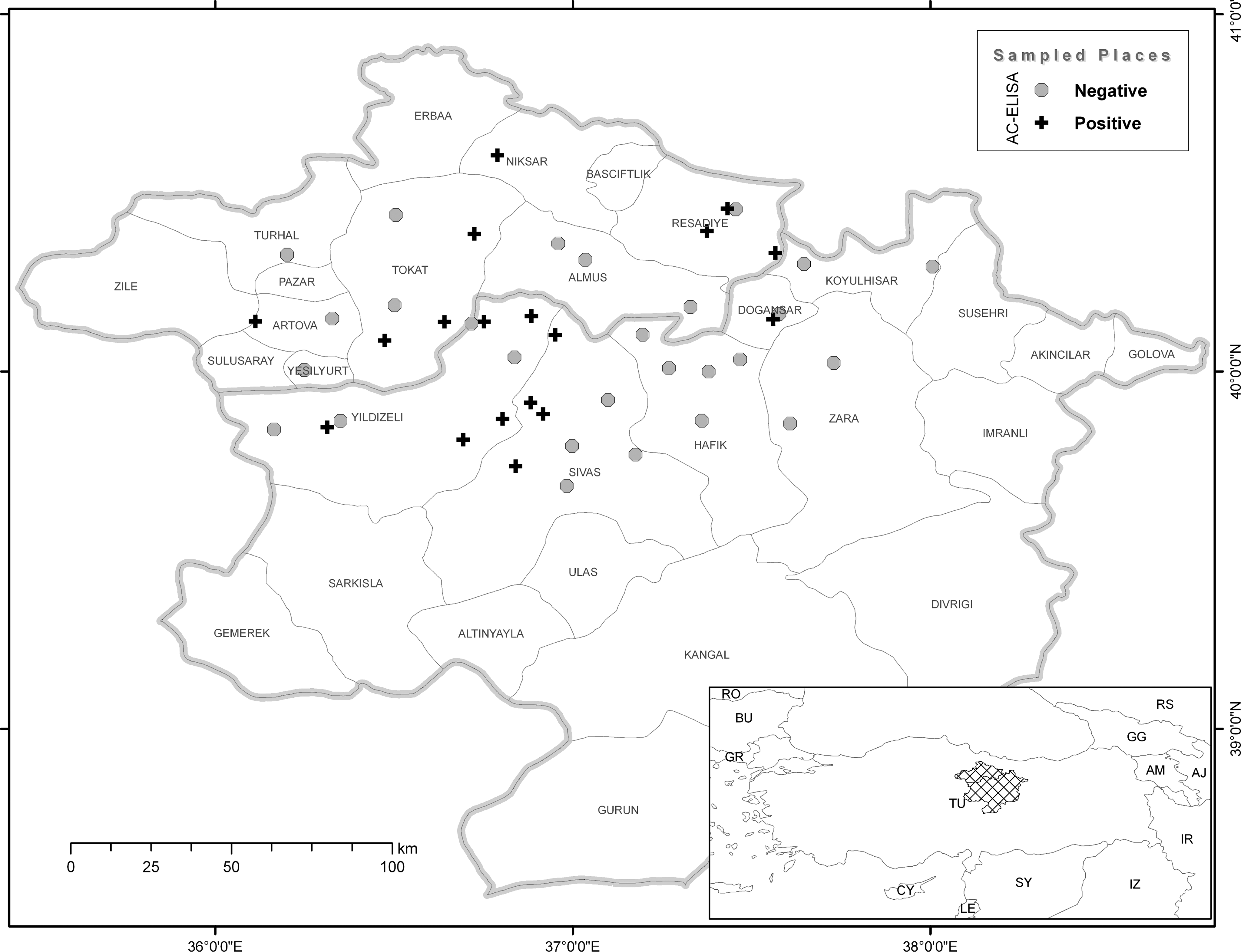
Districts of Tokat and Sivas provinces and sampling sites from which ticks were collected from animals.
Collection of ticks
Between June and July 2007, ticks were collected from livestock (cattle and sheep) in 45 villages belonging to 13 out of 29 districts of Tokat and Sivas provinces (Fig. 1). Sampling was made on randomly selected grazing livestock in each village. Animals were thoroughly examined and attached ticks were collected by not exceeding number of 10 specimens per animal.
During the same period, ticks were taken from people who admitted for tick removal in various health institutions in the same provinces. Further, attempts were made to collect questing ticks from vegetation in picnic areas in Sivas city by dragging a 1.2 m2 (1.5 m×80 cm) blanket over low-lying vegetation.
Ticks were collected in 15 ml polyethylene tubes with appropriate labels and transferred to the laboratory alive.
Adult ticks were examined under the stereomicroscope and identified at species level using the current reference key (Estrada-Pena et al. 2004). Fully engorged female ticks were kept for further biological studies and not included in study. Remaining live ticks (fully motile) were shortly rinsed with 70% ethanol, and then individually placed into Eppendorf tubes (1.5 mL) containing 0.2 mL of phosphate-buffered saline (PBS), and were homogenized manually for at least 2 min using plastic microtube pestles. About 0.1 mL was taken from each stock homogenate and used in establishing test pools (2–10 ticks/pool) grouped according to place of collection, tick species, and host (cattle, sheep, or human). Grouped pools were again homogenized by using a tissue homogenizer (Bio-Gen PRO200) for 5 min. The pools were clarified by low-speed centrifugation at 2000 rpm for 5 min (Hermle z233m-2) and were stored at −80°C until further processing.
Antigen-capture ELISA
The presence of the CCHFV antigen in the pools was determined by using AC-ELISA kit (Vector-Best; Kolsovo). The test was performed according to the manufacturer's instructions and optical densities (OD) of samples were measured at 450 nm using an EL 312 Microplate Bio-kinetics Reader (Bio-Tek Instruments, Inc.). The critical value of OD (ODcrit) was calculated using the formula (ODcrit=the mean OD value of negative control sample +0.2). Optical densities of tested tick pools ≤0.9 ODcrit were considered negative. OD ≥1.1 ODcrit were considered as positive. An OD between 0.9 ODcrit and 1.1 ODcrit was considered suspicious. New tick pools (2 ticks in each pool) were prepared from previously obtained homogenates of suspicious samples and were retested by AC-ELISA.
Statistics
Infection rates in ticks were calculated by using the maximum likelihood estimation (MLE) methods with 95% confidence intervals (CI) (Biggerstaff 2009) and expressed as MLE of infection rate per 100 ticks. Statistical analysis was performed using VassarStats, a Web-based statistical computation program (
Results
Distribution of tick species
Off 501 cattle and 216 sheep examined, 316 (63.07%) cattle and 123 (56.94%) sheep were infested with one or more ticks. Overall infestation rate of livestock was 61.22%. A total of 1968 ticks were collected from infested livestock. All of the collected ticks were adults, except some immature stages of B. annulatus. The dominant species infesting both cattle and sheep was H. marginatum (66.07% and 30.12%, respectively) (Table 1).
No. of tick collected from Tokat, bno. of tick collected from Sivas, ccattle and sheep, donly in Sivas.
A total of 253 adult ticks were collected from humans who applied to the healthcare centers for tick removal. The dominant tick species that was infesting humans was also H. marginatum (47.43%) (Table 1).
Regional distribution rates of H. marginatum collected from animals were 70.76% in Tokat and 46.27% in Sivas. Hyalomma marginatum collected from humans represented 73.39% of the ticks collected in Tokat and 22.48% collected in Sivas. In both humans and animals, H. marginatum infestation was more prevalent in Tokat than in Sivas (p<0.05).
A total of 904 questing adult ticks were collected by flagging from vegetation in picnic areas in Sivas city. Haemaphysalis parva and D. marginatus were two dominating tick species, 50.88% and 43.92%, respectively (Table 1).
The prevalence of CCHFV antigen in ticks
A total of 2193 out of 3125 collected ticks were selected and pooled in 225 pools (2–10 ticks/pool) for the detection of CCHFV antigens. Infection rates are summarized in Tables 2 and 3.
Only in Sivas.
Among the ticks collected from humans, only H. marginatum pools were found positive for CCHFV antigens and MLE of the infection rate was calculated as 0.91% (CI 0.05–4.42) per 100 ticks. CCHFV antigen was found in ticks collected from animals in 18 out of 45 (40%) villages. In tick species collected from cattle, MLE of infection rate was 2.10% (CI 1.12–3.64) in H. marginatum; 1.11% (CI 0.07–5.41) in Hyalomma excavatum; 4.60% (CI 0.33–28.99) in H. parva; and 2.34% (95% CI 0.43–7.73) in Boophilus annulatus. In ticks collected from sheep, MLE of the infection rate was 3.11% (CI 1.18–6.87) in H. marginatum and 0.83% (CI 0.05–4.04) in R. bursa. The overall infection prevalence in ticks collected from animals was 2.03% (CI 0.96–3.85) in Tokat and 1.49% (CI 0.84–2.48) in Sivas.
CCHFV could not be found in 30 pools of both D. marginatus and H. parva samples collected from the picnic areas.
Discussion
Tokat and Sivas provinces are the two high risk areas with hyperendemic presence of CCHFV infection (Yilmaz et al. 2008). There are more than 1100 confirmed cases reported between 2002 and 2009 in these provinces (Ministry of Health-Turkey data). Antibody prevalence among healthy rural inhabitants in the region has been found as 12.8% (Gunes et al. 2009). This high infection rate could be attributed to the fact that H. marginatum is the most common tick species in these regions.
In a study conducted in 2001 in Sivas, only 5% of 10,303 ticks collected on animals were Hyalomma spp (Gunes et al. 2005). In the present study, 47.07% of the 1366 ticks collected from animals in Sivas were Hyalomma spp. This significant increase in Hyalomma spp. in the latter could be one of the underlying reasons of CCHF outbreaks in these regions. The reasons for the increase in the Hyalomma spp. may be caused by changes in regional climate, wild animal populations, land use, or animal husbandry practices.
The prevalence of H. marginatum collected from animals and humans was found to be higher in Tokat than in Sivas (p<0.05). In addition, MLE rates of CCHFV in the ticks were also higher in Tokat than in Sivas. In parallel with these findings, the number of CCHF cases in Tokat was also higher than in Sivas (Yilmaz et al. 2008). The difference in the number of CCHF cases between the two locations could have been caused by the different prevalences of H. marginatum.
The CCHFV can remain for long periods in ticks that have high vector competency such as Hyalomma spp. (Hoogstraal 1979, Logan et al. 1989, Linthicum et al. 1994, Turell 2007). In that case, the CCHFV is expected to be seen in unfed host-seeking tick species in the territory of endemic region, if ever these ticks have a role as the primary vectors. In the current study, although CCHFV antigens were found in H. parva and R. bursa ticks collected from animals, it could not be demonstrated in the same tick species that were collected in the picnic areas and on humans as accidental host. These findings supported that the ticks other than Hyalomma spp. may not serve as primary vectors. Still, the role of ticks other than Hyalomma spp. in the enzootic cycle of the virus needs to be studied.
The majority of prevalence studies on CCHFV have been performed using tick pools consisting of ticks collected from animals. According to the studies conducted in different countries, CCHFV was found between 1% and 15% in Hyalomma spp. pools (Yashina et al. 2003, Papa et al. 2009, Sun et al. 2009). According to the studies performed using PCR methodologies, in endemic areas in Turkey, CCHFV RNA was found between 3.22% and 10% in pools that consisted of H. marginatum ticks collected from livestock (Tonbak et al. 2006, Vatansever et al. 2008) and 16.43% in individually tested host-seeking flat ticks collected from the ground (Vatansever et al. 2010). In the present study, CCHFV antigens were found in 21.33% of H. marginatum pools collected from animals in Tokat and Sivas (MLE=2.36%, CI 1.41–3.73). According to the studies conducted in endemic areas of Turkey, it seems that there is an increase in the prevalence of CCHFV in ticks during the last few years. In a recent study conducted in northwestern Turkey, where CCHF cases have been known to be very rare, MLE of infection rate was 0.93 (CI 0.35–2.05) in H. marginatum collected from animals (Gargili et al. 2011). This result, which should be considered high for a nonendemic region, indicates that there may have been an increase in the prevalence of CCHFV in ticks from nonendemic region too. It could be suggested that the increase in CCHF cases is caused not only by the increase in H. marginatum abundance, but also by the increase in CCHFV prevalence in these ticks, together with other factors like poor personal protective and tick control measures. Also, the infection rates in ticks could be used as an indicator of endemic status of a given region.
The prevalence of the tick-borne infections in humans living in certain geographical areas is determined by several factors, including density of the vector ticks, the prevalence of infectious agents in ticks, geographical structure and climate, and the human activities leading to high tick–human contact (Hoogstraal 1979, Estrada-Pena et al. 2007, Turell 2007). High prevalence of CCHF cases in Tokat and Sivas could be a result of the combinatorial effect of these factors. Our findings suggest that these regions might maintain their endemic properties in the near future for both animals and humans unless effective tick control measures are implemented.
Footnotes
Acknowledgments
This study was funded by the Presidency of Scientific Research Projects Commission (CUBAP) of Cumhuriyet University, Sivas, Turkey (SHMYO-005). The authors thank Brad Biggerstaff, who provided PooledInfRate (Version 4.0), Semra Ozcelik, Ali Fazil Yenidunya, Nergiz Hacer Turgut, Ahmet Alim, and Zubeyde Gunes for suggestions while reviewing the article and for technical support.
Disclosure Statement
No competing financial interests exist.
Conflicts of Interest
There is no conflict of interest concerning the current submission.