




Abstract
This study presents the first record of coronavirus in British bats. Alphacoronavirus strains were detected in two of seven bat species, namely Myotis nattereri and M. daubentonii. Virus prevalence was particularly high in the previously unrecognized host M. nattereri, which can live in close proximity to humans.
Introduction
Coronaviruses cause gastrointestinal, respiratory, and nervous system diseases in a wide variety of species and are capable of cross-species transmission (Graham and Baric 2010). CoVs known to infect humans include members of the alpha- and beta- but not gammacoronavirus genera.
Close contact between bats and humans or domestic animals is a principal cause of disease emergence (Breed et al. 2006; Wong et al. 2007). Increased contact is driven by multiple factors, including hunting, human encroachment on bats' natural habitat, and agricultural intensification (Dasak et al. 2001; Epstein et al. 2006; Leroy et al. 2009). In the U.K., where much natural bat habitat has been lost, bats commonly roost in buildings occupied by humans and domestic animals (Joint Nature Conservation Committee 2007). To determine whether CoVs are present in U.K. bats we tested fecal samples from 7 indigenous insectivorous bat species: Barbastella barbastellus, Myotis daubentonii, M. nattereri, Plecotus auritus, Rhinolophus ferrumequinum, and R. hipposideros.
Materials and Methods
Samples were collected at sites in southwest England between 2006 and 2009. A single fecal pellet was collected from each bat, and either preserved in 250 μL RNAlater™ (Applied Biosystems, Warrington, Cheshire, U.K.) or snap-frozen on dry ice. Samples were stored at −80°C until analysis. Cotton bags in which the bats were held were sterilized between use by autoclaving followed by soaking in 6% sodium hypochlorite (domestic bleach) and washing to prevent cross-contamination. Procedures were approved by the Biosciences Ethics Committee, University of Exeter, and carried out under the appropriate Natural England license.
Fecal pellets stored in RNAlater were homogenized in situ, whereas samples frozen on dry ice were homogenized in 300 μL phosphate-buffered saline (PBS; pH 7.2). Selected fecal homogenates were spiked with 0.2 PFU of human coronavirus NL63 stock (grown and titrated in LLC-MK2 cells) to act as positive controls. PBS or RNAlater served as negative controls. RNA was extracted from 100 μL of fecal homogenate using a viral RNA Mini Kit (Qiagen, Crawley, West Sussex, U.K.). The eluted RNA (8 μL of 60 μL) was random primed reverse transcribed (SuperScript II™; Invitrogen, Paisley, U.K.). Semi-nested PCR using ImmoMix™ (Bioline, London, U.K.) was used to amplify a ∼440 bp CoV-specific region of the RNA-dependent RNA polymerase (RdRP). The PCR was performed as previously described (de Souza Luna 2007), except that first round primers were used at 1 μmol/L, and the number of thermocycles was increased to 35 for the second round of amplification. Representative PCR-positive samples were gel purified (QIAquick kit; Qiagen), cloned (pGEM-T vector; Promega, Madison, WI), and sequenced using vector-specific T7 and SP6 primers (BigDye® Terminator vs3.1 Cycle Sequencing Kit and ABI 3730 DNA analyzer; Applied Biosystems, Carlsbad, CA). All consensus sequences were submitted to GenBank (accession numbers JF440349–JF440366). The novel sequences were aligned with sequences from GenBank using ClustalW in BioEdit 7 (
Results and Discussion
Fecal samples from 112 bats were processed and coronavirus RdRP RNA was detected in 2 of the 7 bat species examined (Table 1). Five of 30 M. daubentonii and 21 of 32 M. nattereri samples were positive. All positive and negative controls yielded the expected results.
Wytham Woods (51°77’27”N, −1°33’41”E).
Savernake Forest (51°39’96”N, −1°67’75”E).
CI, confidence interval.
The viral RdRP sequences from the feces of both the British bat species fall into a phylogenetic subclade that originates within the main Alphacoronavirus clade (Fig. 1). The sequences from European vespertilionid bats form a subclade with 99% bootstrap support. Maximum likelihood (not shown) and neighbor-joining algorithms produced equivalent trees. Some inter-sample sequence variation existed, though clones from a single sample differed by no more than 4 bp. The sequences from British M. daubentonii are closely related to sequences obtained from M. daubentonii sampled in Germany (Fig. 1). The sequences from M. nattereri represent the first record of a coronavirus from this bat species and form a novel, well-supported clade (100% bootstrap value). The M. nattereri clade further divides into two groups which correspond to the two sites (47 km apart) at which the species was sampled. Further sampling and analyses of additional alphacoronavirus loci will be needed to interpret this observation.
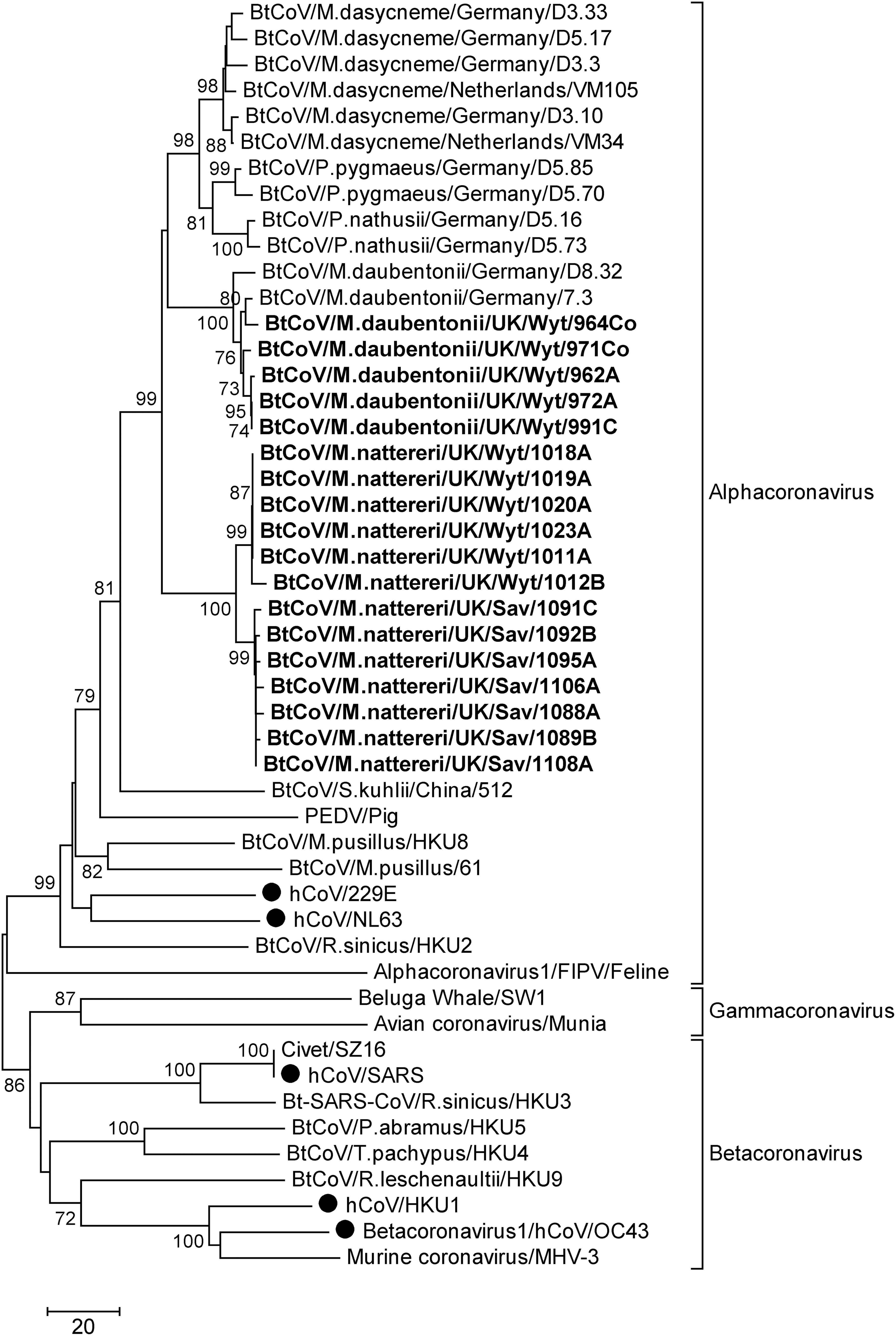
Neighbor joining phylogeny of representative coronavirus (CoV) RNA-dependent RNA polymerase (RdRP) sequences (366 bp), including the new strains (in bold type) found in U.K. bats. Bootstrap values (1000 replicates) are indicated as percentages where the value was greater than 70%. CoVs known to infect humans are indicated by a closed circle (•). The common name of hosts is given for CoV not derived from bats. Scale bar indicates base differences per sequence.
The high prevalence of alphacoronavirus in M. nattereri may be a characteristic of the virus strain. However, unlike M. daubentonii, all M. nattereri samples were collected from maternity roosts, supporting findings from previous studies that have also found high virus prevalence in such roosts (Gloza-Rausch et al. 2008; Drexler et al. 2011). Within these roosts juveniles are immunologically naïve and contact rates are high, which may contribute to the high virus prevalence. The prevalence observed in M. daubentonii is similar to observations from the Netherlands (Reusken et al. 2010). A logistic regression model, including sex, age, location, and species, showed that M. nattereri had a significantly higher prevalence than M. daubentonii (p=0.0002), and across both species suggested a trend toward higher prevalence in juveniles (57% in 21 juveniles, 33% in 43 adults, p=0.09).
The British bat alphacoronavirus strains we identified are distantly related to the zoonotic pathogen SARS-CoV. However, some CoVs are able to switch hosts (Graham and Baric 2010), and evidence suggests that alphacoronaviruses from bats have spilled over to humans in the past (Pfefferle et al. 2009). Therefore, further screening of British bats to better understand CoV epidemiology and to determine whether they harbor other previously unrecognized viruses with zoonotic potential is justified.
Footnotes
Acknowledgments
We thank Christian Drosten and Petra Herzog for generously donating human coronavirus NL63 and cell line LLC-MK2. We also thank Danielle Linton, Heidi Cooper-Berry, Steven Laurence, and many others who helped collect field samples. Thanks also to William Tyne for assistance with sequencing, and Stefanie Schafer for reviewing the manuscript. Funding was provided by the Natural Environment Research Council (NERC).
Author Disclosure Statement
No competing financial interests exist.