




Abstract
The purpose of this study was to evaluate the efficacy of oral treatment of rodents with diets containing the systemic insecticides ivermectin, abamectin, imidacloprid, or spinosad, to control bloodfeeding sand flies. We found that diets containing concentrations higher than 10 mg/kg abamectin were not palatable to rodents, and that a diet containing 10 mg/kg abamectin (a palatable concentration) did not cause 100% mortality of bloodfeeding sand flies. Treatment of rodents with imidacloprid was effective for less than 3 days post-treatment. Treatment of rodents with diets containing 20 mg/kg ivermectin or 5000 mg/kg spinosad caused 100% mortality of bloodfeeding sand flies for at least 1 week. The efficacy of ivermectin and spinosad also were not reduced when combined with the fluorescent tracer dye rhodamine B in a single diet. We also did not observe significant benefits by increasing the feeding period of the rodents from 3 to 6 or 9 days. We conclude that ivermectin and spinosad are effective as rodent systemic insecticides against bloodfeeding sand flies, and suggest that weekly treatment of wild rodent reservoirs of Leishmania major with bait containing one of these systemic insecticides could be a useful tool as part of a sand fly control program.
Introduction
Leishmania major, the causative agent of zoonotic cutaneous leishmaniasis (ZCL) in the Middle East, Southwest Asia, and Africa, is transmitted among populations of burrowing rodents by sand flies. Many different species of rodents have been implicated as reservoirs of L. major, and in ZCL foci, the sand fly vectors of L. major are very closely associated with these rodents. Adult sand flies have been recovered as they enter and exit the burrows of rodent reservoirs, and the burrows of many of these rodents also are believed to be a habitat for the immature stages of sand flies (Yuval and Schlein 1986).
Because of the close association between sand fly vectors and rodent reservoirs of L. major, certain rodent-targeted control measures for sand flies have been explored. Direct treatment of rodent burrows with insecticide has not been successful (Seyedi-Rashti and Nadim 1974). However, recent laboratory studies have shown proof of concept for rodent feed-through insecticides for control of sand fly larvae (Mascari et al. 2007a,2007b,2008,2011; Mascari and Foil 2010a). Ivermectin has also been shown to be effective as a rodent systemic insecticide against bloodfeeding sand flies in the laboratory (Mascari and Foil 2010b).
The objective of this study was to determine the efficacy of the oral treatment of hamsters with imidacloprid, spinosad, abamectin, or ivermectin against bloodfeeding sand flies. Three experiments were conducted in this study. In the first experiment we determined the concentrations of the insecticides that were both effective against bloodfeeding sand flies and palatable to hamsters. In the second experiment we evaluated potential interactions of the insecticides with rhodamine B, a fluorescent tracer dye that could be incorporated in combination with the insecticides into rodent baits. In the third experiment we evaluated whether the number of days the hamsters were fed insecticide-treated food influenced the post-treatment duration of the toxic effects against bloodfeeding sand flies.
Materials and Methods
Sand flies
The sand flies used in these experiments were from a laboratory colony of a Turkish strain of Phlebotomus papatasi that was established at Louisiana State University in 2005. In the colony, sand fly larvae were fed a 1:1 mixture of rabbit feces and rabbit chow. Adult sand flies were provided 20% sucrose solution ad libitum, and were bloodfed using Syrian hamsters (Mesocricetus auratus). The colony was maintained in darkness in environmental chambers at 28°C, 90% relative humidity.
Hamsters
Hamsters were housed individually in micro-isolator cages. The maintenance of the hamsters and the experimental procedures of this research followed Animal Care & Use Protocol No. 08-056, which was approved by the Institutional Animal Care and Use Committee at Louisiana State University, Baton Rouge, Louisiana. Research involving the hamsters was conducted in compliance with the Animal Welfare Act and other federal statutes and regulations relating to animals and experiments involving animals, and adheres to the principles stated in the Guide for the Care and Use of Laboratory Animals, NRC Publication, 1996 edition.
Experiment 1: Effective diet concentrations
Imidacloprid (Makhteshim Agan of North America, Inc., Norwalk, CT), spinosad (Eli Lilly and Company, Greenfield, IN), or abamectin (Makhteshim Agan of North America, Inc.) was added to powdered laboratory rodent diet (5001 Rodent Diet LabDiet; PMI Nutrition International, Brentwood, MO). Ivermectin was not evaluated in this experiment because these data have been obtained in a previous study (Mascari et al. 2008). Three concentrations were prepared for each insecticide (imidacloprid: 250, 500, and 1000 mg/kg; spinosad: 50, 500, and 5000 mg/kg; abamectin: 10, 20, and 60 mg/kg). Soybean oil also was added at a rate of 100 g/kg to the rodent diet as a sticking and palatability agent. Rodent diet containing soybean oil alone was considered control.
Each insecticide was evaluated separately. For each insecticide, three hamsters were assigned randomly to each of four diet groups (one diet group for the three insecticide concentrations and one control diet group). Each day, the hamsters were provided with 15 g of food. The amount of food consumed by the hamsters on each day was recorded, and the daily dose of insecticide for each hamster was calculated. Hamsters were maintained on their respective diets for 3 days. The daily food intake of hamsters in each diet group was compared using repeated-measures analysis of variance (ANOVA) performed with the GLM procedure; the Tukey multiple comparison procedure was used to separate significantly different means (SAS Institute 2001). If the mean daily food intake of hamsters in a diet group was significantly different from that of control hamsters, the three hamsters in that group were removed from further experimentation.
After feeding on insecticide-treated or control diet for 3 days, each hamster was chemically immobilized with an intraperitoneal injection of ketamine HCl (100 mg/kg body weight), plus xylazine HCl (10 mg/kg body weight). Immobilized hamsters were placed individually in a 3.8-L clear plastic cage with 25 female sand flies aged 3–5 days. The sand flies were allowed to feed on the hamster for at least 30 min before the hamster was removed and recovered. Once recovered, the hamster was provided with untreated pellet food (5001 Rodent Diet LabDiet; PMI Nutrition International), and sand flies were provided with 20% sucrose solution ad libitum. Subsequently, another cohort of 3- to 5-day-old sand flies was bloodfed on the hamsters 3, 7, and 14 days after the hamsters were removed from their insecticide-treated diets.
In each bioassay, the mortality of sand flies was assessed after 48 h, and the number of bloodfed sand flies that were alive and dead was recorded. The percent mortality of sand flies that had taken bloodmeals from hamsters in each diet group was compared using ANOVA performed with the GLM procedure, and significantly different means were separated using the Tukey multiple comparison procedure (SAS Institute 2001).
Experiment 2: Insecticides in combination with rhodamine B
Six diets were prepared for this experiment, containing 5000 mg/kg spinosad, 5000 mg/kg spinosad plus 5000 mg/kg rhodamine B, 20 mg/kg ivermectin (Merck & Co., Inc., Whitehouse Station, NJ), 20 mg/kg ivermectin plus 5000 mg/kg rhodamine B, 5000 mg/kg rhodamine B, or an untreated diet.
Spinosad and ivermectin were evaluated separately. For each insecticide, three hamsters were assigned randomly to each of four diet groups (insecticide, insecticide plus rhodamine B, rhodamine B alone, and untreated diet), and maintained on their respective diets for 3 days. After 3 days, all hamsters were withdrawn from treated diets and were fed an untreated diet.
The hamsters were chemically immobilized and placed in cages with 25 female sand flies 0 and 7 days after being withdrawn from treated diets. The percent mortality of bloodfed sand flies in each group was calculated after 48 h, and was compared using ANOVA performed with the GLM procedure; significantly different means were separated using the Tukey multiple comparison procedure (SAS Institute 2001).
Experiment 3: Hamster feeding period
Powdered rodent diets containing 5000 mg/kg spinosad, 20 mg/kg ivermectin, or no treatment were prepared. Spinosad and ivermectin were evaluated separately. For both insecticides, three hamsters were assigned randomly to each of four diet groups: three of the groups of hamsters were fed insecticide-treated food for 3, 6, or 9 days; the fourth group was fed an untreated diet for 9 days. The starting points for feeding different groups of hamsters were staggered so that all hamsters concluded feeding on treated diets on the same day, at which point all of the hamsters were switched to an untreated diet. Sand flies were bloodfed on each hamster 0, 3, 7, 10, and 14 days after the hamsters were removed from their insecticide-treated diets (hamsters fed spinosad also were anesthetized and exposed to sand flies on day 17 post-treatment). The hamsters were chemically immobilized and placed in cages with 25 female sand flies. The percent mortality of bloodfed sand flies in each group was calculated after 48 h and was compared using ANOVA performed with the GLM procedure; the Tukey multiple comparison procedure was used to separate significantly different means (SAS Institute 2001).
Results
Experiment 1: Effective diet concentrations
Hamsters fed a diet containing 20 or 60 mg/kg abamectin ate significantly less than hamsters fed a diet containing 10 mg/kg abamectin or an untreated diet (F=42.38, df=3, p<0.0001); the hamsters in these two diet groups were not exposed to bloodfeeding sand flies. The mean daily dose of hamsters fed a diet containing 10 mg/kg abamectin was 0.8±0.2 mg/kg body weight. Mortality of sand flies that took a bloodmeal from hamsters that had just been withdrawn from a diet containing 10 mg/kg abamectin (0 days after treatment) was less than 100%, but was significantly different from mortality of sand flies fed on control hamsters (F=188.96, df=1, p=0.0002; Table 1). Because sand fly mortality was less than 100% on day 0 post-treatment, we did not bloodfeed sand flies on hamsters fed a diet containing 10 mg/kg abamectin at 3, 7, or 14 days post-treatment.
Values in a column followed by the same letter were not significantly different from each other (p>0.05); separate statistical analyses were conducted for each insecticide.
DAT, days after treatment; the day the hamsters were withdrawn from an untreated or insecticide-treated diet.
Not done.
There were no significant differences in the amount of food consumed by hamsters fed a diet containing 250, 500, or 1000 mg/kg imidacloprid or an untreated diet (F=1.01, df=3, p=0.4032). The mean daily doses of imidacloprid for hamsters fed diets containing 250, 500, and 1000 mg/kg imidacloprid were 16.6±3.8, 28.9±3.4, and 61.2±13.9 mg/kg body weight, respectively. We observed 100% mortality of sand flies that took a bloodmeal from hamsters that had been fed a diet containing any of the three concentrations of imidacloprid immediately after the hamsters were withdrawn from their imidacloprid-treated diet (0 days after treatment; Table 1). However, 3 days after hamsters had been switched from a diet containing imidacloprid to an untreated diet, we observed 0% mortality of sand flies that took a bloodmeal from the imidacloprid-treated hamsters. Sand flies were not bloodfed on imidacloprid-treated hamsters on 7 or 14 days post-treatment.
The mean amount of spinosad-treated food consumed by hamsters was not significantly different from the amount of food consumed by hamsters fed an untreated diet (F=0.73, df=3, p=0.5426). The mean daily doses of spinosad for hamsters fed diets containing 50, 500, and 5000 mg/kg spinosad were 2.8±0.4, 26.4±3.4, and 242.5±56.6 mg/kg body weight, respectively. None of the sand flies that took a bloodmeal from hamsters fed a diet containing 50 or 500 mg/kg spinosad at 0 days post-treatment died within 48 h. We observed 100% mortality of sand flies that took bloodmeals from hamsters fed a diet containing 5000 mg/kg spinosad up to 7 days after the hamsters were withdrawn from spinosad-treated diets (Table 1). At 14 days after hamsters had been withdrawn from a diet containing 5000 mg/kg spinosad, mortality of sand flies was less than 100%, but was significantly different from the mortality of sand flies that fed on untreated hamsters (F=14.18, df=1, p=0.0197).
Experiment 2: Insecticides in combination with rhodamine B
Throughout this experiment we observed 0% mortality of sand flies that took a bloodmeal from hamsters fed an untreated diet or a diet containing rhodamine B. We observed 100% mortality of sand flies that took a bloodmeal from hamsters 0 and 7 days after they were withdrawn from a diet containing spinosad, spinosad plus rhodamine B, ivermectin, or ivermectin plus rhodamine B.
Experiment 3: Hamster feeding period
The 48-h mortality of sand flies that took bloodmeals from spinosad-treated hamsters was 100% on 0, 3, and 7 days after they had been withdrawn from an ivermectin-treated diet (Fig. 1). On day 10 post-treatment, the 48-h mortality of sand flies that took a bloodmeal from a hamster fed a spinosad-treated diet for either 3, 6, or 9 days was less than 100%, but was significantly different from the mortality observed for sand flies that took a bloodmeal from an untreated hamster (F=11.15, df=3, p=0.0215; Fig. 1). At 14 and 17 days after hamsters had been withdrawn from their spinosad-treated diets, mortality was not significantly different between sand flies that took bloodmeals from hamsters in any of the diet groups (hamsters fed spinosad-treated diets for 3, 6, or 9 days, or hamsters fed an untreated diet; F=0.56, df=3, p=0.6542; Fig. 1).
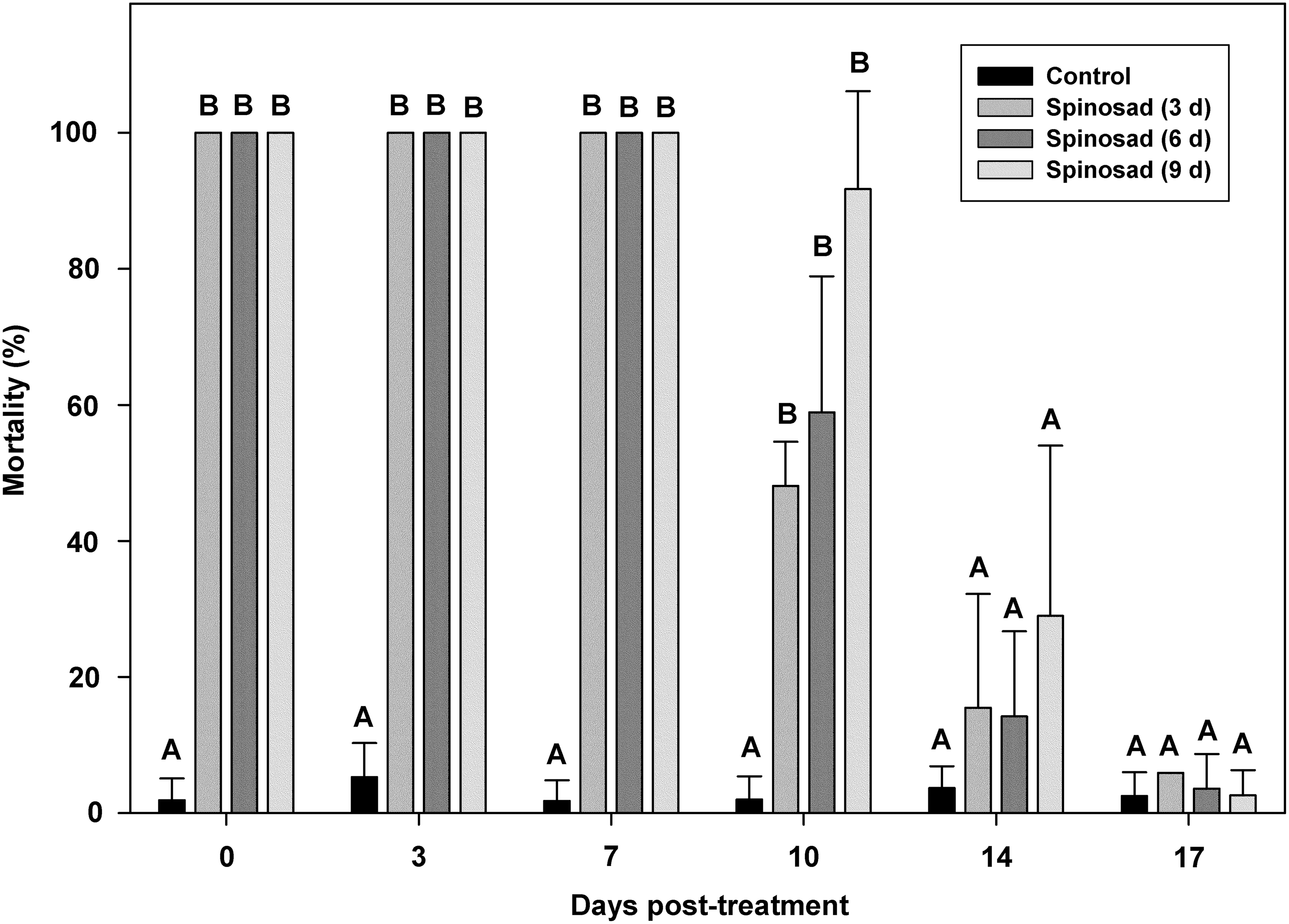
Experiment 3: Mean percent mortality (48 h post-bloodmeal) of sand flies that took bloodmeals from hamsters fed a diet containing 5000 mg/kg spinosad for 3, 6, or 9 days, and then fed an untreated diet. Values with the same letter are not significantly different from each other (p>0.05).
The 48-h mortality of sand flies that took a bloodmeal from an ivermectin-treated hamster 0, 3, and 7 days after it had been withdrawn from an ivermectin-treated diet was 100% (Fig. 2). At 10 and 14 days post-treatment, mortality was not significantly different between sand flies that took bloodmeals from hamsters in any of the diet groups (hamsters fed ivermectin-treated diets for 3, 6, or 9 days, or hamsters fed an untreated diet; F=0.56, df=3, p=0.6542; Fig. 2).
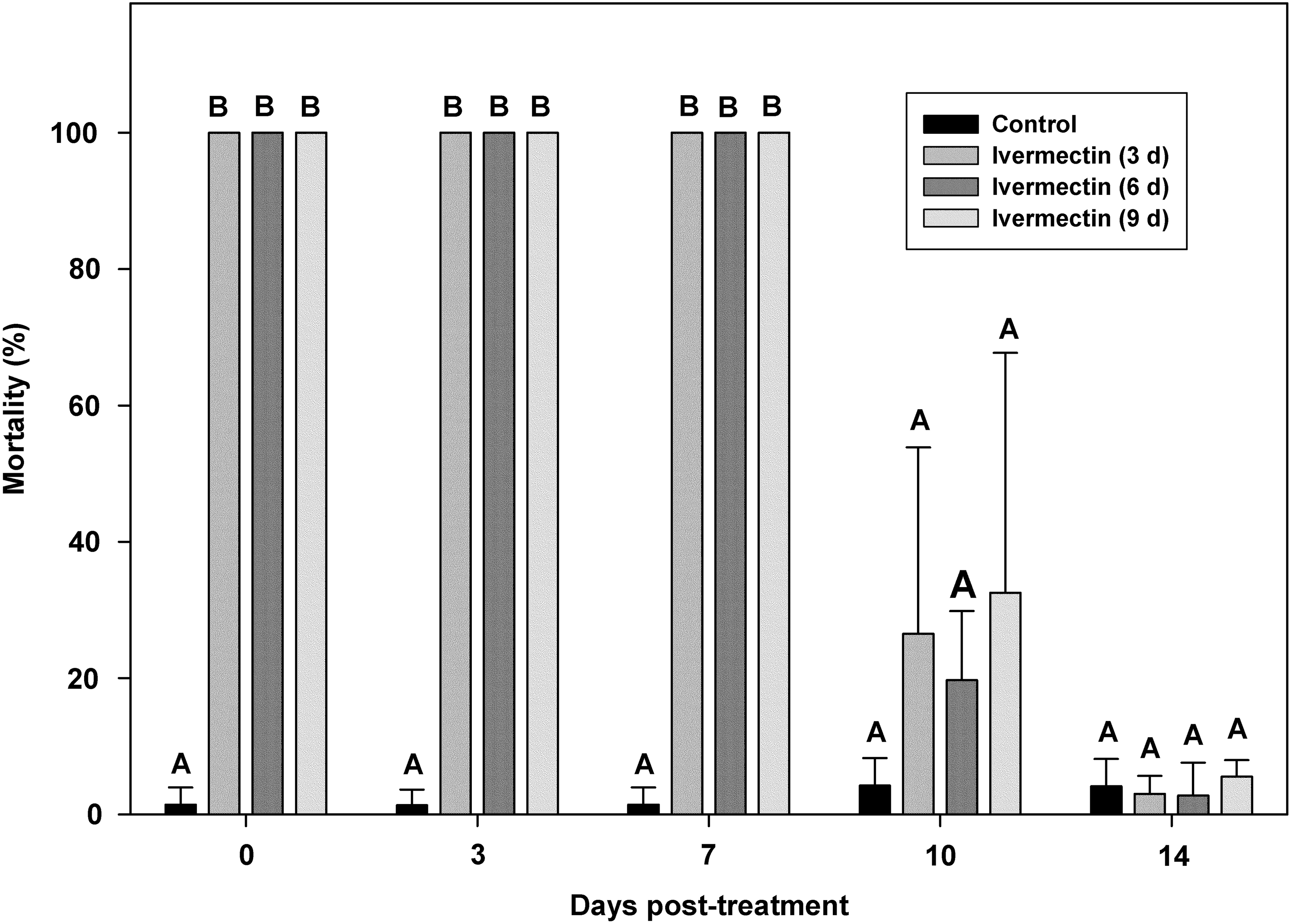
Experiment 3: Mean percent mortality (48 h post-bloodmeal) of sand flies that took bloodmeals from hamsters fed a diet containing 20 mg/kg ivermectin for 3, 6, or 9 days, and then fed an untreated diet. Values with the same letter are not significantly different from each other (p>0.05).
Discussion
The activity of abamectin as a rodent systemic insecticide was evaluated in this study because our previous work with ivermectin, another macrocyclic lactone, showed a toxic effect against bloodfeeding sand flies (Mascari and Foil 2010b). In experiment 1, hamsters were refractory to eating a diet containing 20 or 60 mg/kg abamectin, and we could not achieve 100% mortality of sand flies through treatment of hamsters with the highest palatable diet concentration of abamectin (10 mg/kg). These observations are similar to what we found previously with ivermectin; diets with concentrations greater than 20 mg/kg were unpalatable to hamsters (Mascari et al. 2008). However, unlike with abamectin, the highest diet concentration of ivermectin that was palatable to hamsters also was fully effective against bloodfeeding sand flies, causing 100% mortality for at least 7 days (Mascari and Foil 2010b).
In experiment 1 of this study, we also found that imidacloprid was highly effective against bloodfeeding sand flies immediately after hamsters were treated, but that the toxic effect against sand flies was transient, with no significant sand fly mortality observed 3 days post-treatment. Our results in this study are consistent with what is known about the pharmacokinetics and metabolism of imidacloprid in orally-dosed rodents. Imidacloprid has been shown to be rapidly eliminated by rats (primarily in their urine), with more than 90% eliminated within 24 h after administration, and 96% eliminated within 48 h (Joint WHO/FAO Meeting on Pesticide Residues 2011). Imidacloprid also has been shown to be metabolized rapidly by orally-dosed rats, with only 10–16% of the administered dose of imidacloprid being eliminated unchanged (Joint WHO/FAO Meeting on Pesticide Residues 2011).
Also in experiment 1, we observed that all diet concentrations of spinosad were palatable to hamsters, though only the highest concentration was effective against bloodfeeding sand flies (5000 mg/kg). Very high daily dosages of spinosad were required to demonstrate a toxic effect against bloodfeeding sand flies. However, spinosad has a very low mammalian toxicity, and even the highest observed daily dosage for a spinosad-treated hamster was below the LC50 for rats (>5000 mg/kg rat oral; Joint WHO/FAO Meeting on Pesticide Residues 2011).
In experiment 2, the addition of rhodamine B to diets did not reduce the efficacy of ivermectin or spinosad. Rhodamine B has been shown to mark sand flies that have taken bloodmeals from orally dosed rodents as well as the targeted rodents, and thus is a potentially useful bait additive for monitoring sand fly control studies using insecticide-treated baits (Mascari and Foil 2009). The findings of this experiment suggest that the incorporation of rhodamine B into rodent baits containing ivermectin or spinosad would not reduce the effectiveness of the insecticides against sand flies.
In experiment 3, we did not observe any significant difference in the performance of spinosad or ivermectin as a systemic insecticide when fed to rodents for 3, 6, or 9 days. Since both insecticides are effective against bloodfeeding sand flies for at least 7 days after treatment, treating sites weekly with enough bait for 3 days of feeding by target rodents should be adequate to control sand flies that take bloodmeals from baited rodents.
In this study we determined that two rodent systemic insecticides, spinosad and ivermectin, are effective against bloodfeeding sand flies. We also determined that either of these insecticides could be combined with the fluorescent biomarker rhodamine B into a single rodent bait, and would be compatible with the use of rhodamine B as a control efficacy diagnostic tool in initial field trials, and ultimately on an operational basis. Incorporation of rhodamine B into insecticide-treated baits would mark targeted rodents and their feces, providing a measure of bait palatability, and whether any sand flies that have taken a bloodmeal from a baited rodent have survived. This information would be particularly important when using ivermectin-treated baits, since there is a small range of concentrations that are both palatable to rodents and effective against bloodfeeding sand flies. The results of this study suggest that that targeting rodents in ZCL foci with baits containing ivermectin or spinosad could be an important component of an integrated approach to sand fly control. Specifically, the use of rodent baits containing systemic insecticides in ZCL foci would target the most epidemiologically important subset of the sand fly population: sand flies that take bloodmeals from rodent reservoirs of L. major.
Footnotes
Acknowledgments
This work was supported by a grant from the Deployed War-Fighter Protection (DWFP) Research Program, funded by the U.S. Department of Defense through the Armed Forces Pest Management Board (AFPMB). This article was published with the approval of the Director of Louisiana Agricultural Experiment Station.
Author Disclosure Statement
No competing financial interests exist.