




Abstract
Tick-borne diseases are of great concern worldwide. Despite this, in Romania there is only limited information regarding the prevalence of vector-borne pathogens in dogs. In all, 1146 serum samples were tested by SNAP® 4Dx® (IDEXX Laboratories, Inc., Westbrook, ME) for Anaplasma phagocytophilum, Borrelia burgdorferi, and Ehrlichia canis antibodies, and for Dirofilaria immitis antigen. The correlation between positive cases and their geographic distribution, as well as potential risk factors (age, sex, breed, type of dog, habitat, and prophylactic treatments) were evaluated. Overall, 129 dogs (11.3%) were serologically-positive to one or more of the tested pathogens. The seroprevalence for the four infectious agents were: A. phagocytophilum 5.5% (63/1146), D. immitis 3.3% (38/1146), E. canis 2.1% (24/1146), and B. burgdorferi 0.5% (6/1146). Co-infection with E. canis and A. phagocytophilum was registered in 2 dogs (0.2%). The geographical distribution of the seropositive cases suggests clustered foci in southern regions and in the western part of the country for D. immitis, and in the southeastern region (Constanţa County) for E. canis. A. phagocytophilum and B. burgdorferi showed a homogenous distribution, with a tendency for Lyme-positive samples to concentrate in central Romania. For D. immitis, A. phagocytophilum, and E. canis, administering prophylactic treatments was a risk factor associated with infection. Another associated risk factor was the type of dog (stray dogs were at risk being positive for D. immitis, shelter dogs for E. canis, and hunting dogs for B. burgdorferi). The prevalence of D. immitis was significantly higher in males and in dogs older than 2 years. This survey represents the first data detailing A. phagocytophilum and E. canis seroprevalence in Romanian dogs, and the most comprehensive epidemiological study on vector-borne infections in dogs from this country.
Introduction
Heartworm disease is a cosmopolitan parasitic infection of domestic and wild carnivores, caused by the filarial nematode D. immitis. The intermediate hosts and vectors are mosquitoes of the family Culicidae, with nearly 70 species susceptible to infection and therefore considered to be potential vectors (Vezzani and Carbajo 2006).
In Europe, the highest prevalence has been reported in canine populations of the Mediterranean countries. Genchi and associates (2005) provided the first risk assessment maps for Europe, and suggest that if the climatic trend continues, filarial infections should spread into previously infection-free areas.
In Romania, the distribution of canine dirofilariosis is poorly known. Epidemiological studies were carried out in only a few counties (Popescu 1933; Ciocan et al. 2009; Tudor et al. 2009). The first report of the parasite in Romania was in 1903, when Motaş found microfilariae of D. immitis in the blood of a dog. Subsequently, microfilariaemia in dogs from Romania was reported by several authors (Popovici 1916; Popescu 1935; Paşca et al. 2008). Recent studies in dogs with clinical manifestations from the Bucharest area reported a prevalence of infection between 23.7% and 35% (Coman et al. 2007; Tudor et al. 2009). In another study from Timiş County the prevalence was 4% (Ciocan et al. 2009).
Borrelia burgdorferi, the agent of Lyme disease, is transmitted to humans and animals by Ixodes ticks during the blood meal. The most important vector in Europe is Ixodes ricinus (Parola et al. 2005; Zygner et al. 2008). Actively-infected dogs have to be distinguished from seropositive dogs due to past exposures or vaccination by means of a suitable serologic assay (Levy et al. 2008). As many dogs do not develop clinical signs, active infection does not automatically imply illness (Littman et al. 2006). So far, only the species B. burgdorferi sensu stricto has been found to be pathogenic in dogs after experimental infections (Krupka and Straubinger 2010). There is ample epidemiological data on the distribution of B. burgdorferi throughout Europe. However, data on the epidemiology of Lyme disease spirochetes in Romania are scarce, even though the tick vector Ixodes ricinus is widespread (Coipan and Vladimirescu 2011). The presence of B. burgdorferi sensu lato has been recognized in Romania for more than 20 years (Crăcea et al. 1988). In 2011, Coipan and Vladimirescu, detected three B. burgdorferi s.l. genospecies in Ixodes ricinus ticks: B. afzelii, B. garinii, and B. valaisiana. Studies conducted a decade ago have estimated Borrelia seroprevalence in healthy blood donors and forestry workers (Hristea et al. 2001), and recently in dogs and horses (Kiss et al. 2011). Data regarding the pathogen's circulation in enzootic areas is scarce, with limited studies conducted on lizards and their ticks (Majláthovlá et al. 2008), as well as on unfed ticks collected from vegetation (Coipan 2010; Coipan and Vladimirescu 2011).
Anaplasma phagocytophilum (formerly known as Ehrlichia phagocytophila, E. equi, or “HGE” agent; Dumler et al. 2001) is the causative agent of granulocytic ehrlichiosis (anaplasmosis) in humans, horses, sheep, cattle, dogs, and cats. In dogs, infection with A. phagocytophilum results in a mild to severe acute illness, often accompanied by anorexia, lethargy, fever, lameness, thrombocytopenia, hypoalbuminemia, lymphopenia, and increased liver enzyme levels (Lester et al. 2005; Pantchev 2010). This pathogen has been reported in some countries from Central and Eastern Europe (Alekseev et al. 2001; Cizman et al. 2001; Sréter et al. 2004). In Europe, the vector is the castor bean tick, Ixodes ricinus (Sréter et al. 2004; Parola et al. 2005; Mantelli et al. 2006; Severinsson et al. 2010). Co-infection of ticks with both A. phagocytophilum and other agents transmitted by the same tick species, such as B. burgdorferi, are also regularly reported (Fingerle et al. 1999; Milutinović et al. 2008). This explains recent data from Germany, where 3.1% of the dogs (179 out of 5504 samples tested by SNAP® 4Dx®) showed antibodies to A. phagocytophilum and B. burgdorferi (Krupka et al. 2007).
Canine monocytic ehrlichiosis (CME) caused by Ehrlichia canis is a widespread tick-borne infection, transmitted by Rhipicephalus sanguineus, which feeds primarily on dogs and occasionally humans (Dantas-Torres 2008). The pathogenesis of CME involves an incubation period of 8–20 days, followed by acute, subclinical, and sometimes chronic phases. The primary signs of acute ehrlichiosis are nonspecific, and include fever, anorexia, weight loss, lethargy, and depression. The most consistent abnormalities seen with ehrlichiosis on hemograms are thrombocytopenia and non-regenerative anemia (Harrus and Waner 2011), although some dogs have normal platelet counts. Lymphadenopathy and hyperglobulinemia are often noted. Pancytopenia may be seen in the severe chronic phase (Neer et al. 2002). Although E. canis does not show a zoonotic potential, dogs may serve as reservoirs for other life-threatening species of the Anaplasmataceae family, such as Ehrlichia chaffeensis (Walker 2005), a species so far prevalent only in the United States (Neer and Harrus, 2006).
The objectives of the present study were to establish the seroprevalence and geographic distribution of D. immitis, A. phagocytophilum, E. canis, and B. burgdorferi in dogs, and to determine the risk factors (age, sex, breed, type of dog, habitat, and prophylactic treatments) associated with the presence of antigen or antibodies.
Materials and Methods
Study area
Romania is located in southeast Central Europe north of the Balkan Peninsula on the Lower Danube, within and outside the Carpathian arch, bordering the Black Sea. It lies between 43°37′07″ and 48°15′06″ north latitude and 20°15′44″ and 29°41′24″ east longitude. With a surface area of 238,391 square kilometers, Romania is the largest country in southeastern Europe and the 12th largest in Europe. The country is divided into 41 primary administrative divisions called counties, plus the municipality of Bucharest.
Romania has a temperate-continental climate of a transitional type, specific to Central Europe, with four clearly defined seasons. Local differences are caused by altitude and by slight oceanic (to the west), Mediterranean (to the southwest), and continental (to the east) influences.
The Carpathians serve as a barrier to Atlantic air masses, limiting their oceanic influence to the west and center of the country, which have milder winters and heavier rainfalls as a result. The mountains also block the continental influences of the vast plain to the north, which results in frosty winters and less rain to the south and southeast. In the extreme southeast, Black Sea influences offer a milder, maritime climate (Trusca and Alecu 2005).
Animals and sample collection
In Romania the dog population is estimated to be around 2.5 million (unofficial data, National Veterinary and Food Safety Agency). During May 2008 and March 2011, 1146 blood samples from randomly selected dogs (guard, pet, shelter, stray, and hunting dogs) from 25 counties were collected. Demographic information and data regarding the administration of prophylactic treatment with acaricide/insecticide drugs were collected for each dog with a questionnaire. No information regarding the clinical condition and medical history of the dogs were available. All dogs were aged between 6 months and 17 years (median=3 years). Most of the dogs were of mixed breed (949/1146; 82.8%). Among the pure-bred dogs (197/1146; 17.2%), German Shepherds represented almost half of the dogs (82/197; 41.6%), while the rest belonged to 32 other breeds (each with 1–17 individuals). A 5-mL blood sample was drawn from the cephalic vein of each dog using tubes without anticoagulant. Serum was collected following centrifugation of clotted blood and was stored at −20°C until further processing.
Serologic assay
All collected blood samples included in the study were tested using an in-clinic enzyme-linked immunosorbent assay (ELISA) SNAP 4Dx (IDEXX Laboratories, Inc., Westbrook, ME) that detects A. phagocytophilum, B. burgdorferi, and E. canis antibodies, and D. immitis antigens, according to the manufacturer's directions.
The membrane matrix of the test is impregnated with synthetic peptide from the major surface protein p44/MSP2 of A. phagocytophilum, C6 peptide derived from the IR6 region within the Borrelia membrane protein VlsE, peptides p30 and p30-1 from the outer membrane of E. canis, and antibodies against specific antigens of D. immitis (Duncan et al. 2004). The sensitivity (Se) and specificity (Sp) are as follows: 84% Se and 97% Sp for D. immitis (Atkins 2003); 94.4% Se and 99.5% Sp for B. burgdorferi sensu lato (O'Connor et al. 2004; Duncan et al. 2004); 95.7% Se and 100% Sp for E. canis (O'Connor et al. 2002, 2004, 2006), and 99.1% Se and 100% Sp for A. phagocytophilum (Chandrashekar et al. 2010).
Statistical analysis
Statistical analysis of the data was performed using EpiInfo 2000 software. First, we established values for frequency and prevalence, and then the difference among variables was tested using chi-square testing. We choose as variables: age (≤2 years or >2 years), gender (male or female), breed (crossbred or purebred), type of dog (guard, pet, shelter, stray, or hunting), life style (indoor or outdoor), acaricide/insecticide prophylactic treatments (Yes or No), and region (western, northwest, southwest, central, northeast, southeast, or south). The differences were considered significant if p<0.05.
Results
The seroprevalence of D. immitis, A. phagocytophilum, E. canis, and B. burgdorferi in dogs from Romania is shown in Table 1. The number of dogs serologically positive for any of the four pathogens surveyed in this study was 129 (11.3%). The overall seroprevalence of the pathogens was as follows: A. phagocytophilum 5.5%, D. immitis 3.3%, E. canis 2.1%, and B. burgdorferi 0.5%. Co-infection with E. canis and A. phagocytophilum was registered in 2 dogs (0.2%). There were no statistically significant differences among regions for A. phagocytophilum and B. burgdorferi, but D. immitis and E. canis were significantly more prevalent in the southeastern region (p<0.001).
p<0.05; ** p<0.01; *** p<0.001.
D. immitis antigen; b A. phagocytophilum antibody; c E. canis antibody; d B. burgdorferi sensu lato antibody; e A. phagocytophilum, E. canis co-infection; fnumber of positive dogs by any of the four test results by SNAP 4Dx test.
The seroprevalence of D. immitis antigen-positive samples was significantly higher in males, dogs older than 2 years, stray dogs, and in dogs without acaricide/insecticide prophylactic treatment (Table 2). The breed and life style did not influence the prevalence. Regarding the geographical distribution of seropositive cases, we noted clusters of foci, especially in southern regions and in the west (Fig. 1). The prevalence ranged between 3.6% and 14%, with the highest values seen in Tulcea County (31%; Fig. 1).
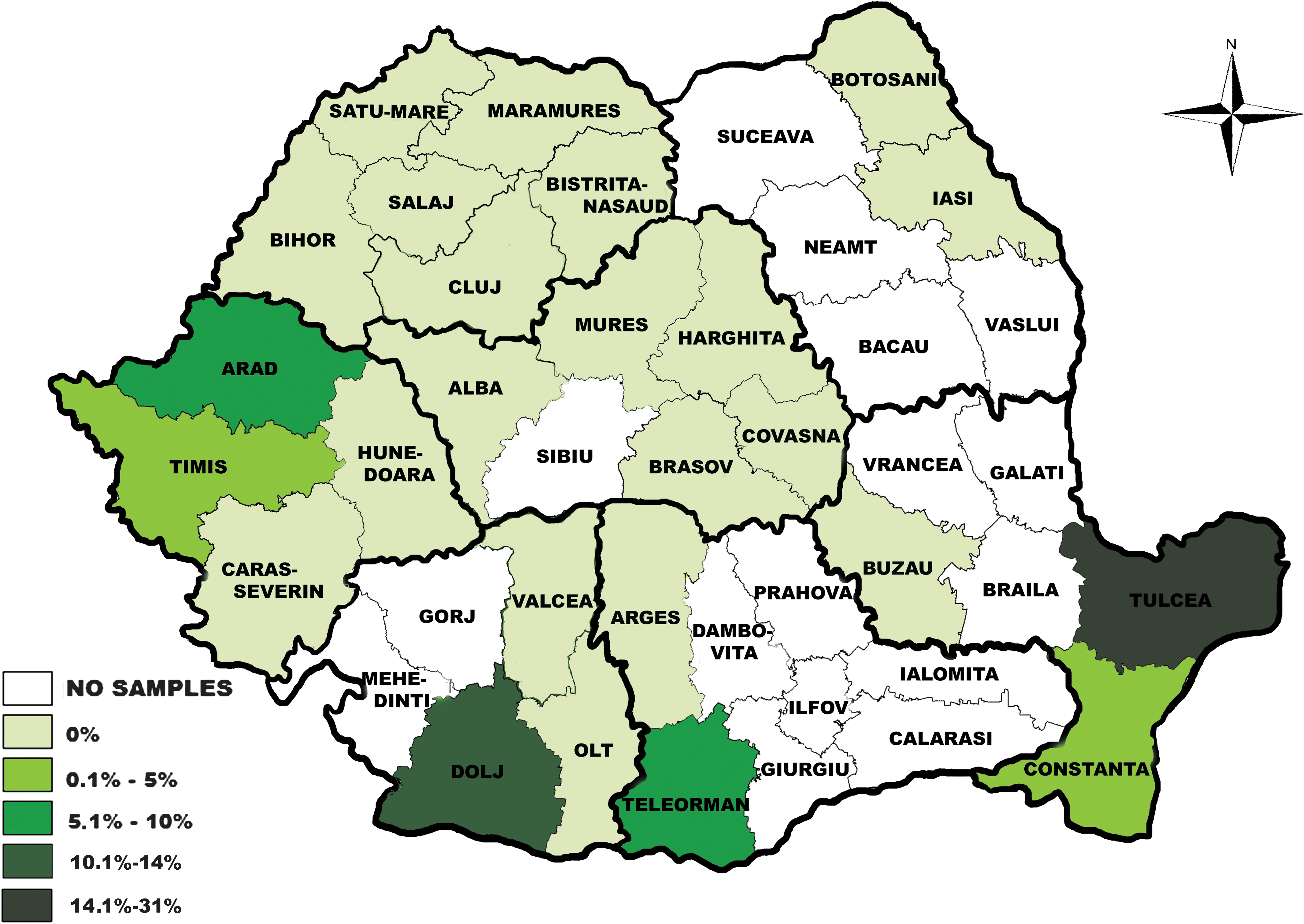
Geographic distribution of Dirofilaria immitis by regions and counties, grouped according to percentage of positive results in dogs. Color images available online at
D. immitis antigen; b A. phagocytophilum antibody; c E. canis antibody; d B. burgdorferi sensu lato antibody; e A. phagocytophilum; E. canis co-infection.
p<0.05; ** p<0.01; *** p<0.001.
A. phagocytophilum was the most prevalent vector-borne pathogen, with a homogenous distribution throughout the country, ranging between 4.7% in Bihor County and 11.7% in Cluj County (northwest region; Fig. 2). The prevalence was significantly associated with the absence of acaricide/insecticide prophylactic treatments (p=0.01; Table 2).

Geographic distribution of Anaplasma phagocytophilum by regions and counties, grouped according to percentage of positive results in dogs. Color images available online at
Specific antibodies against E. canis were detected in 24 (17.1%) out of 140 dogs from Constanţa County (Fig. 3). The prevalence was significantly higher in shelter dogs (p=0.0006), and in dogs without acaricide/insecticide prophylactic treatment (p=0.01; Table 2).
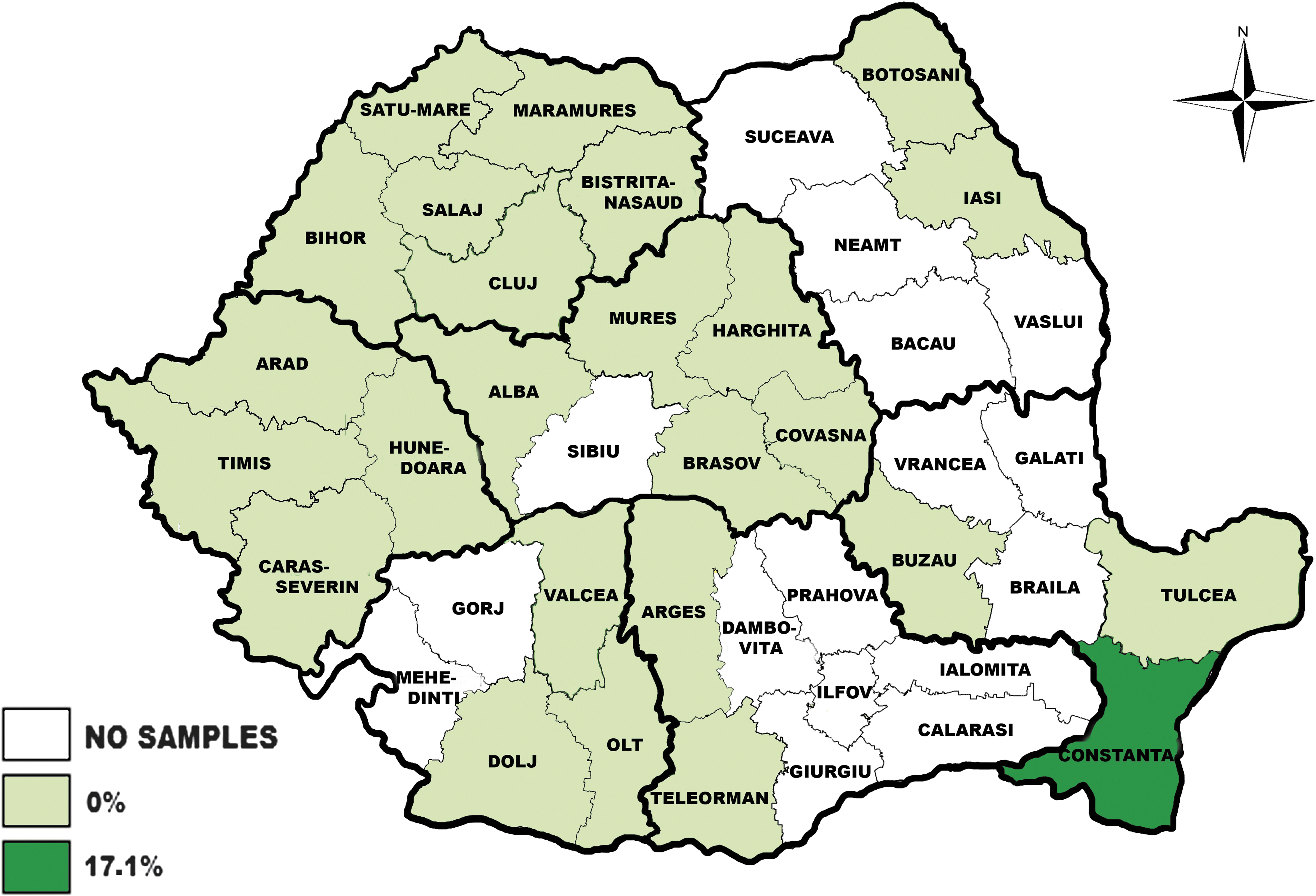
Geographic distribution of Ehrlichia canis by regions and counties, grouped according to percentage of positive results in dogs. Color images available online at
The lowest seroprevalence in dogs was observed for infections with B. burgdorferi sensu lato (0.5%), ranging between 1.6% (Cluj County) and 6.3% (Harghita County). The highest seroprevalence was registered in hunting dogs (6.3%; p=0.03). No statistical associations were found between positive results and age, sex, or prophylactic treatment. Lyme-positive samples had a tendency to concentrate towards the center of Romania (Fig. 4).
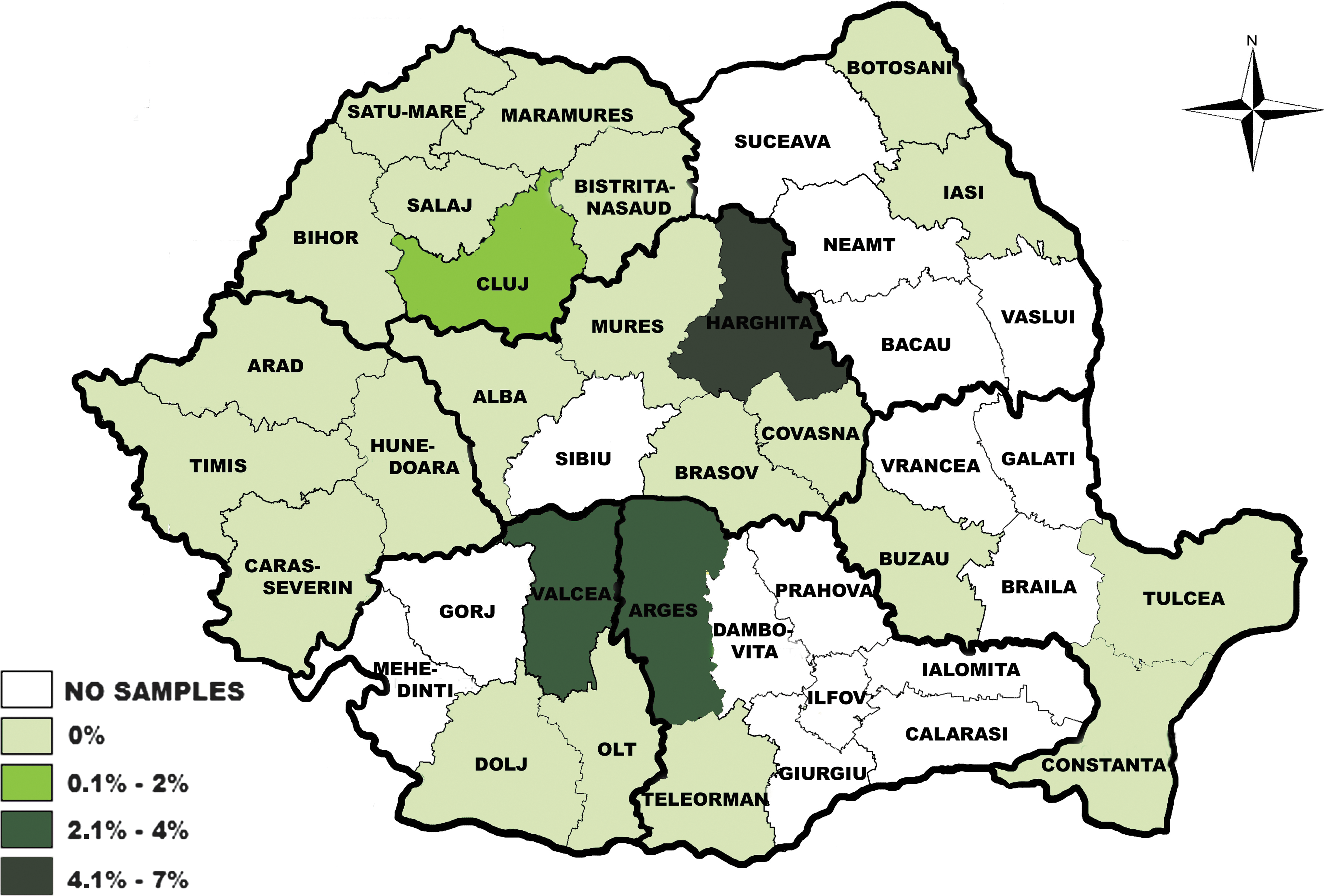
Geographic distribution of Borrelia burgdorferi by regions and counties, grouped according to percentage of positive results in dogs. Color images available online at
Discussion
This study strongly indicates that dogs from Romania are potentially at risk of major canine vector-borne diseases because of the relatively high prevalence rates of both mosquito- and tick-borne pathogens in dogs.
The seroprevalence of D. immitis was 3.3%, with focal regions in the south, southwest, and southeast parts of the country. The distribution of positive cases in these areas can be explained by the particular climatic conditions, in correlation with the high number of mosquitoes, especially vector-competent species for D. immitis. In 2003, Nicolescu and associates published distribution maps for the species of the genera Anopheles, Aedes, and Culex recorded in Romania. Five of them are recognized as vectors for Dirofilaria immitis: Anopheles atroparvus, A. maculipennis, Culex modestus, C. pipiens, and C. torrentium (Cancrini and Gabrielli 2007). The highest prevalence in Tulcea County (31%) can be attributed to the fact that all samples were collected from stray dogs living in proximity to the Danube Delta, where mosquito populations are abundant (Nicolescu et al. 2003). Some previous studies from Romania showed a high seroprevalence for D. immitis (23.7–35%) in different areas from the southeastern part of the country (Coman et al. 2007; Tudor et al. 2009), but only 4% in the west (Ciocan et al. 2009). By comparing the geographical distribution of the positive samples from our study with the results published 80 years ago (Popescu 1933), we note an extension of the areas positive for D. immitis to the southern limit of the Carpathian Arch. In Europe, the prevalence for D. immitis ranges between 0–60% (Trotz-Williams and Trees 2003). Such results are influenced by several factors, such as climatic conditions, the mosquito population, and the number of the dogs tested, as well as the specificity and sensitivity of the method. The rapid assay test deployed showed an average sensitivity of 67% (95% CI: 58,75%), with 35% (95% CI: 16,60%) at zero adult female worms, 65% (95% CI: 53,75%) at 1–2 adult female worms, and 94% (95% CI: 76–98%) at more than two adult female worms, and showed a specificity of 98% (95% CI: 92,100%; Courtney and Zeng 2001). Evaluation of canine heartworm prevalence by sex has yielded contradictory results. In some studies, no significant differences between males and females were reported (Song et al. 2003; Montoya et al. 2006; Rapti and Rehbein 2010). On the other hand, other studies (Montoya et al. 1998; Yildirim et al. 2007) reported significantly higher prevalence rates in males. In our study, D. immitis prevalence was found to be significantly higher in males than in females. The higher prevalence rates in males can be attributed to the fact that more male dogs are kept outdoors, because they are considered to be more suitable for defending property (Song et al. 2003). The outdoor environment facilitates contact between dogs and intermediate hosts (Glickman et al. 1984). Montoya and colleagues (1998) also indicated that the generally higher infection rate in male dogs could be due to their stronger attractiveness to mosquitoes. Generally, older dogs show an increased risk for infection with D. immitis, as shown in several studies in which dogs younger than 6 months were included (Song et al. 2003; Montoya et al. 2006; Yildirim et al. 2007; Tudor et al. 2009; Lim et al. 2010). In our study, D. immitis prevalence was significantly higher in dogs over 2 years of age. The infection risk for dogs likely continues throughout a dog's life, and the likelihood of acquiring infection with D. immitis increases with increased exposure to mosquitoes (Rhee et al. 1998). Thus, older dogs have more time and more opportunities to become infected with heartworms. In the present study, pure-bred and cross-bred animals did not show significantly different levels of seropositivity; however, cross-breeds are probably more likely to be infected with D. immitis, due to the fact that pure-breed owners are more likely to provide anthelmintic treatment for their pets. Management of indoor-outdoor time and prophylaxis for dogs in heartworm-endemic areas do have an effect on the risk of infection (Theis et al. 1999). This influence is presumably due to vector exposure rates, as dogs that spend all their time outdoors have a greater chance of being bitten by mosquitoes, and dogs that are not on heartworm prophylaxis are at higher risk of acquiring infection. In the present study, statistically significant differences were seen in dogs that did not receive prophylactic treatments, and also in stray dogs.
A. phagocytophilum antibodies were detected in 61 samples from 12 counties. The seroprevalence ranges from 4.7–11.7%. Of the four pathogens tested in this study, A. phagocytophilum showed the highest prevalence and the widest geographical distribution, a fact that can be explained by the ubiquitous character of the tick vector, I. ricinus (Teodorescu and Popa 2002). The seroprevalence rates of A. phagocytophilum in dogs in other countries are 2.72% in France (Pantchev et al. 2009a), 21.5–43.2% in hunting dogs in Germany (Krupka et al. 2007; Pantchev et al. 2009b), 11.5% in Spain (Solano-Gallego et al. 2006), 5.5–29% in the U.S. (Bowman et al. 2009; Beall et al. 2008), 25.2% in Tunisia (M'Ghirbi et al. 2009), and 18.8% in Korea (Lim et al. 2010). Although A. phagocytophilum and B. burgdorferi have the same vector, no cases of co-infection were seen in our study. However, we observed two cases of co-infection with E. canis and A. phagocytophilum. A similar situation has been reported in France (Pantchev et al. 2009a).The A. phagocytophilum analyte detects antibody generated against a synthetic peptide from the major surface protein (p44/MSP2). In a subset of samples, SNAP 4Dx® sensitivity and specificity were 99.1% and 100%, respectively (Chandrashekar et al. 2010). However, recent studies indicate that the A. phagocytophilum analyte in the SNAP 4Dx ELISA cross-reacts with samples from Anaplasma platys-infected dogs (Chandrashekar 2010; Gaunt et al. 2010). Rhipicephalus sanguineus is suspected to be the vector for A. platys (Chomel 2011). As this tick species is the dominant dog tick in Constanţa County, where the A. phagocytophilum/E. canis co-infection cases were found, may indicate a cross-reaction of A. phagocytophilum with A. platys. Thus more specific diagnostic methods are necessary due to serological cross-reactions, particularly among members of the same genus (e.g., PCR; Cohn 2003; Chandrashekar et al. 2010; Pantchev 2010). This would also help to differentiate tick-borne pathogens causing similar clinical signs (Aguirre et al. 2006). In areas where the Ixodes tick vector is less prevalent or absent, a positive Anaplasma result could be the result of A. platys exposure.
CME is caused by the rickettsia Ehrlichia canis, and is an important canine disease with a worldwide distribution. The prevalence of E. canis is largely dependent on the distribution of its vector R. sanguineus, which occurs mainly in tropical and subtropical regions. The seroprevalence of E. canis antibodies in dogs has been reported in several countries: Italy 6.4% (Solano-Gallego et al. 2006), France 0.33% (Pantchev et al. 2009a), the U.S. 0.33–0.6% (Bowman et al. 2009), Mexico 44.1% (Rodriguez-Vivas et al. 2005), Iran 14.63% (Akhtardanesh et al. 2010), and Korea 6.1% (Lim et al. 2010). In the present study, we found an overall seroprevalence of 2.1%. The infection with E. canis was recorded only in dogs from Constanţa County. The seroprevalence calculated only for this county was 17.1%. This situation is well correlated with the distribution of the vector tick R. sanguineus in Romania (Feider 1965). In our study, the highest prevalence was seen in shelter dogs (p=0.0006). This aspect was also described by Sàinz and colleagues (1996), and is in accord with studies of the ecology of R. sanguineus
The overall seroprevalence of B. burgdorferi antibodies in dogs was 0.5%. In another study from Romania, Kiss and associates (2011) found a serologic prevalence of 6.52% using a commercial ELISA kit in a significantly smaller number of samples, and from dogs from areas known to be endemic for human Lyme borreliosis. Nevertheless, both studies show that B. burgdorferi infection occurs in focal areas in the center of the country. These data are correlated with high prevalence rates in humans in this area (Hristea et al. 2001), and also in Ixodes ricinus ticks (Coipan and Vladimirescu 2011). The overall seroprevalence in our study is similar to the results from other areas, such as France 0.33% (Pantchev et al. 2009a) and Spain 0.6% (Solano-Gallego et al. 2006). Higher rates were found in studies conducted in Korea 2.2% (Lim et al. 2010), Sweden 3.9% (Egenvall et al. 2000), Germany 4.5–9.7% (Krupka et al. 2007; Pantchev et al. 2009b), the Czech Republic 6.5–10.3% (Pejchalová et al. 2006; Kybicová et al. 2009), and the U.S. 5.1% (Bowman et al. 2009). In accordance with the literature, no relationship has been established between seroreactivity to B. burgdorferi s.l. and gender or age (Delgado and Cármenes 1995; Štefančíková et al. 2008; Couto et al. 2010; Kiss et al. 2011). The lack of correlation may be a consequence of the limited persistence of anti-B. burgdorferi antibodies, which would explain why older individuals do not show higher seroprevalence rates as a result of increased opportunities to be infected throughout their lives (Goossens et al. 2001). However, our study showed a higher prevalence in hunting dogs than in other types, as was also shown in previous studies (Goossens et al. 2001; Guerra et al. 2001; Lim et al. 2010). This correlation is probably the result of more frequent exposure to infected ticks. Because of their lifestyle and contact with large numbers of ticks, dogs are more likely to be exposed to B. burgdorferi, and may therefore serve as a marker for the risk for human exposure (Duncan et al. 2004; Little et al. 2010).
Footnotes
Acknowledgments
This article was supported by the PNII/IDEI/PCCE 7/ 2010 grant of CNCSIS (National Council of Scientific University Research of Romania). We thank IDEXX for kindly providing the SNAP tests used in this study.
Author Disclosure Statement
No competing financial interests exist.