




Abstract
Q fever is an important zoonotic disease caused by Coxiella burnetii. There are few reliable data about C. burnetii infection available. The aim of this study was to assess the importance and potential infectious sources of Q fever in Hungary. A total of 215 milk samples (10 individual samples from each herd and 1 bulk tank milk sample from each cattle herd), and 400 serum samples (20 from each herd) were tested from 15 dairy cattle herds and 5 sheep flocks located in different parts of Hungary. The study found 19.3% (58/300) and 38.0% (57/150) seropositivity in cattle, and 0% (0/100) and 6.0% (3/50) seropositivity in sheep, by complement fixation test (CFT) and enzyme-linked immunosorbent assay (ELISA), respectively. C. burnetii DNA was detected by IS1111 element-based TaqMan real-time polymerase chain reaction (PCR) in 8.7% (13/150) of individual dairy cow milk samples, 4.0% (2/50) of individual sheep milk samples, and 66.7% (10/15) of dairy bulk tank milk samples. Samples taken from nine different commercially-available pasteurized cow milk products from different Hungarian producers were also tested for the presence of C. burnetii DNA, and eight of these samples were found to be positive (88.9%). The real-time PCR examination of 5402 ixodid ticks collected from different parts of the country yielded negative results. Knowledge of the true prevalence of Q fever is crucial for policymakers involved in evidence-based decision making.
Introduction
A recent study highlights that there are few reliable prevalence data about C. burnetii infection available (Guatteo et al. 2011). In Hungary, antibodies to Q fever were first detected in the sera of workers tested at a cattle slaughterhouse in 1950, and the first diagnosis of the disease in a Hungarian cattle herd took place in 1956 (Romváry 1957). The last large-scale survey to assess the seroprevalence of infection in Hungarian ruminants using the complement fixation test (CFT) dates back to the 1970s, and it reported 13.5% positivity among dairy cows and 14.2% among sheep (Romváry et al. 1979). The aim of this study was to evaluate the potential role of Hungarian cattle, sheep, and ticks in the epidemiology of Q fever, by detecting C. burnetii DNA in milk, in ticks, and in commercially-available pasteurized milk samples, using a TaqMan-based real-time polymerase chain reaction (PCR), and by demonstration of seroconversion by CFT and enzyme-linked immunosorbent assay (ELISA).
Materials and Methods
Blood, milk, and bulk milk tank samples were collected from 15 dairy herds and 5 sheep flocks randomly selected from different regions of Hungary, between November 2010 and June 2011 (Fig. 1). In each herd blood samples were collected from 20 randomly-selected animals, while 10-mL milk samples were taken from 10 individuals. Also, 50-mL samples were taken from the bulk milk tanks of dairy herds, and from 9 commercially-available pasteurized milk products from different Hungarian producers in March 2011. A total of 224 milk and 400 serum samples were included in this study. The 400 serum samples were examined by CFT utilizing C. burnetii phase 2 antigen, according to the manufacturer's instructions (Virion/Serion GmbH, Würzburg, Germany), and the Terrestrial Manual (World Organisation for Animal Health 2010). The ELISA test, using inactivated phase 1 and phase 2 antigens, was carried out according to the manufacturer's directions (IDEXX Laboratories Inc., Berne, Switzerland) on 200 serum samples of animals from which milk samples were also examined by PCR. The serum samples for the ELISA tests were diluted at 1:400 according to the manufacturer's instructions. For DNA extraction from milk samples, somatic cells were concentrated using low-speed centrifugation as described previously (Loftis et al. 2010). Cell pellets were re-suspended in 200 μL of phosphate-buffered saline, and were processed with an in-house DNA extraction method, as previously described (Dán et al. 2003). First, 10-mL pasteurized milk samples were mixed with 10, 50, 100, and 500 μL of Q fever vaccine (Coxevac; Ceva-Phylaxia Co., Budapest, Hungary), and served as a positive control, while phosphate-buffered saline was used as a negative control in DNA extraction. The samples were screened using a sensitive and specific real-time PCR assay for the IS1111 element of C. burnetii (Loftis et al. 2006). The detection threshold of the PCR system was ∼0.1 CFU (Ct 36.95), according to a commercially-available positive control (Adiavet Cox; Aes Chemunex Inc., Cranbury, NJ). A total of 5024 questing ticks (nymphs and adults; Ixodes ricinus /3222/, Dermacentor marginatus /369/, D. reticulatus /361/, Haemaphysalis inremis /315/, H. concinna /735/, and H. punctata /22/) were collected from the vegetation by the dragging/flagging method at 39 different locations in Hungary during 2007 and 2009. Another 374 samples of I. acuminatus were collected from rodents, as were 4 Dermacentor nymphs from dogs (Fig. 1; Hornok and Farkas 2009; Gyuranecz et al. 2010, 2011). DNA was extracted in pools containing 10 or fewer ticks, using the MagNA Pure LC total nucleic acid isolation kit (Roche Diagnostics, Rotkreuz, Switzerland) as described previously (Hornok et al. 2010), and tested with the IS1111 element-based real-time PCR assay for the presence of C. burnetii.
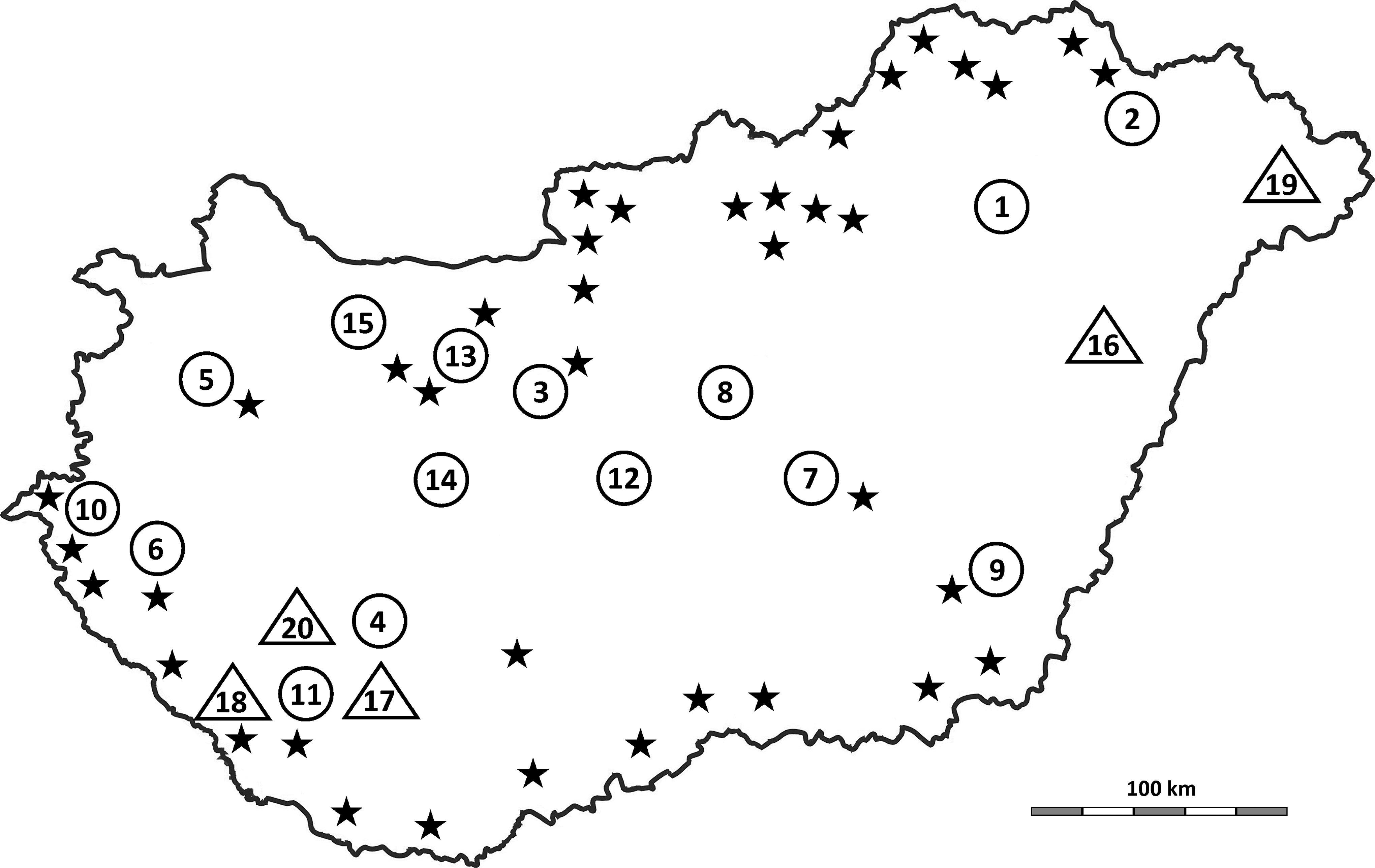
Geographical distribution of the studied dairy herds (circles) and sheep flocks (triangles), and the origin of the analyzed ticks (stars) in Hungary. The numbers in circles and triangles indicate the identification numbers of the herds and flocks as shown in Table 1.
Results
The results of the herd examinations are summarized in Table 1. In dairy herds an average of 19.33% individual seropositivity was detected by CFT, primarily (15.7%) exhibiting low (1:10–1:40), and fewer (3.7%) with high (≤1/80) titers. Infection was not found in sheep flocks by CFT. Among cattle and sheep, respectively, the ELISA testing showed 38.0% and 6.0% individual seropositivity, and 100.0% and 60.0% at the herd level.
20 animals were tested from each herd/flock.
10 animals were tested (half of the 20) from each herd/flock.
Positive results with ELISA as well are shown in parentheses.
NE, not examined.
C. burnetii shedding in milk was observed in 8.7% (Ct 24.2–36.8) of dairy cows, and 4.0% (Ct 34.5–35.1) of sheep. Bulk milk tank examinations showed that 66.7% (Ct 32.6–36.8) of the dairy herds were infected with Q fever. C. burnetii DNA was detected in 8 of the 9 (88.99%, Ct 27.7–34.8) commercially-available pasteurized milk samples. The PCR examination of the 5402 ticks yielded negative results.
Discussion
CFT is still widely used by laboratories in many countries to assess the seroprevalence of C. burnetii infection, and it yields excellent results for routine diagnosis at the flock level. On the other hand, our study supports previous findings (World Organisation for Animal Health 2010) that conclude that CFT is less sensitive than ELISA testing. Nevertheless, the interpretation of CFT titers is an easy way to differentiate the latent and evolving phases of infection (World Organisation for Animal Health 2010). Following international suggestions, we considered the ELISA results to be reliable for screening of seroprevalence (World Organisation for Animal Health 2010; Guatteo et al. 2011). The individual and herd level seroprevalence rates among dairy cows were above the international average (20.0% and 37.7%; Guatteo et al. 2011). This result could be linked to the fact that most of the cattle studies were conducted earlier, when only less-sensitive methods like CFT were available. This hypothesis is confirmed by the bulk milk tank PCR examinations, which showed herd-level prevalence similar to that of other recent studies (Guatteo et al. 2011). The herd-level seroprevalence in sheep was also higher than the international mean (25.0%), but the individual positivity rate was below the average reported from several other countries (15.0%; Guatteo et al. 2011). In agreement with earlier studies (World Organisation for Animal Health 2010), it was found that some animals shed C. burnetii and pose a risk of infection prior to the development of antibodies. Alternatively, this may also mean that some infected animals do not seroconvert.
Contrary to a previous study in which 2.6% (6/235) prevalence was found in ticks in Slovakia and a small area of northern Hungary (Spitalska and Kocianová 2003), C. burnetii-positive ticks were not detected in our large scale screening. Based on our data, ixodid ticks may play a small role in the epidemiology of Q fever in Hungary, similarly to that seen in the Netherlands (Sprong et al. 2012). It is hypothesized that domestic ruminants (e.g., dairy cattle) are the main reservoirs of Q fever in Hungary. The vast majority of dairy cows are housed within farms throughout their lifespan, and they may infect each other through their bodily discharges. Since they do not go out to pasture, they cannot serve as an infectious source for the tick vectors.
As reported recently (Guatteo et al. 2011), few well-designed studies have applied diagnostic methods sensitive enough to provide reliable prevalence data for C. burnetii infection, and the knowledge of the true prevalence rate is crucial for policymakers involved in evidence-based decision making. With this study we aimed to fill this information gap in Hungary, although the infection rates in goats and wild ruminants, and shedding patterns in vaginal mucus, urine, and feces require further study.
Footnotes
Acknowledgments
The laboratory work was in part performed with logistical support from the Center for Clinical Studies at the Vetsuisse Faculty of the University of Zurich. We thank Imréné Öri, Ernöné Ottinger, and Ágnes Juhász for their technical assistance. S.H. and K.E. are Bolyai János Research Fellows of the Hungarian Academy of Sciences.
Author Disclosure Statement
No competing financial interests exist.