




Abstract
Recent floods drastically increased the burden of disease, in particular the incidence of malaria, in the southern districts of the Punjab province in Pakistan. Control of malaria vector mosquitoes in these districts requires the adoption of an appropriate evidence-based policy on the use of pesticides, and having the latest information on the insecticide resistance status of malaria vector mosquitoes is essential for designing effective disease prevention policy. Using World Health Organization (WHO) test kits, the present study utilized papers impregnated with DDT, malathion, deltamethrin, lambda-cyhalothrin, and permethrin, to determine the insecticide susceptibility/resistance status of malaria vector mosquitoes in four flood-affected districts. The test results showed that both Anopheles stephensi and Anopheles culicifacies remained resistant to DDT and malathion. Tests with three commonly used pyrethroids, permethrin, lambda-cyhalothrin, and deltamethrin, detected resistance in the majority of cases, but in a number of localities mortalities with these three pyrethroids ranged from 80–97% and were therefore placed under verification-required status. This status indicates the presence of susceptible individuals in these populations. These results suggest that if appropriate resistance management strategies are applied in these areas, then the development of high levels of resistance can still be prevented or slowed. This study forms an important evidence base for the strategic planning of vector control in the four flood-affected districts.
Introduction
The latest WHO global malaria control strategy consists of three primary interventions for achieving the millennium developmental goals for malaria by 2015: (1) prompt diagnosis and treatment; (2) full coverage of populations at risk with insecticide-treated nets; and (3) indoor residual spraying (IRS) to kill vector mosquitoes and reduce and eliminate malaria transmission (World Health Organization 2006). At present, Pakistan is supported by the global Roll Back Malaria program, and the national malaria control strategy is in line with WHO Roll Back Malaria (RBM). RBM grouped Pakistan along with Iran, Iraq, and Saudi Arabia, as a specific target to reduce illness and deaths from malaria by 50% by 2010.
Malaria control in Pakistan was started as Malaria Control Activity in 1950. In 1961 this program became the Malaria Eradication Program, with the objective to interrupt malaria transmission with residual insecticides, but in 1969 this program suffered technical, administrative, and financial problems. Insecticide resistance in vector mosquitoes and anti-malarial drug resistance posed major technical hurdles. The failure of the Malaria Eradication Program led to the initiation of a 5-year National Malaria Control Program (MCP), for which control of vector mosquitoes was the main control strategy. Of the approximately 500 known anopheline species worldwide, only 60 species are known malaria vectors (Sylvie et al. 2007). In the EMR, 18 out of 70 anopheline species are confirmed malaria vectors (Rathor 1996). Out of 24 reported Anopheles species in Pakistan (Aslam 1971), only two primary malaria vectors, A. stephensi and A. culicifacies, have been reported.
Vector control is an important part of the global malaria control strategy (Malaria vector control in Africa 2001). In the past, the use of pesticides has been the mainstay of mosquito control in Pakistan, but unfortunately little attention was given to the application of alternative control methods and the development of trained manpower in the specialized field of medical entomology and disease vector control. Dichlorodiphenyltrichloroethane (DDT) was used for mosquito control in the province of Punjab from 1961 to 1975 (two cycles/year of 1–2 g/m2), which consequently produced strong DDT resistance in anopheline malaria vector mosquitoes. In 1975 DDT was partially replaced by β-hexachlorocyclohexane (BHC), to which resistance developed rapidly. In 1976 malathion (two cycles/year, 1 g/m2) was introduced for malaria vector control. At the same time, fenitrothion was introduced in some areas (Rathor et al. 1980). After 1996, operational failure of vector control, partly due to insecticide resistance to organophosphate insecticides, and to financial and administrative constraints, as well as changes in the global vector control strategy of selective insecticide application, influenced the MCP to shift its emphasis to selective spraying with pyrethroids and increased use of insecticide-treated bednets.
Baseline work on insecticide resistance monitoring in the country was carried out in 1985, as the first large-scale field survey to map insecticide resistance status in 11 randomly selected districts in the Punjab province (Rathor et al. 1985). A. culicifacies was susceptible to all insecticides except DDT, but for A. stephensi resistance to malathion was widespread.
During the last 25 years, little work has been done to monitor the insecticide resistance status of anopheline mosquitoes in Pakistan. This lack of information on the resistance status of vector mosquitoes can have serious technical and financial consequences, especially when pyrethroids are used extensively for agricultural and household purposes. The development of undetected vector resistance to currently effective pyrethroids can lead to uncontrollable epidemics by vector-borne diseases.
Knowledge of vector/pest susceptibility to pesticides and insight into changing trends of resistance and expected operational implications provide the evidence base to form effective national policy and pesticide use strategies for vector-borne disease and pest control programs. Therefore, insecticide resistance monitoring must be an integral part of disease vector and public health pest control programs.
Recent floods in the south Punjab region increased the malaria problem in Pakistan, as the floods favored breeding conditions, which results in a high density of mosquitoes. Malaria is endemic in 36 of the 77 flood-affected districts. Six districts located in the low-endemic province of Punjab have reported sporadic cases, but the number and percentage of P. vivax cases is disproportionately high in southern Punjab, with high endemicity in Muzaffarghar district. This heightened the need to control malaria vector mosquitoes in these districts, and to develop policy and strategies for the appropriate use of pesticides. Evidence-based policy can only be made if the latest status of susceptibility/resistance in malaria vector mosquitoes is known. The present study was designed to determine the insecticide susceptibility/resistance level in malaria vector mosquitoes in four Punjab districts.
Materials and Methods
Four flood-affected districts of southern Punjab were visited by joint teams from Medical Entomology and Disease Vector Control (MEDVC), Health Services Academy (HSA) Islamabad, and the National Institute of Malaria Research and Training (NIMRT), Lahore Pakistan. The insecticide susceptibility/resistance baseline survey was conducted in the affected districts of south Punjab using mouth aspirators and mechanical sweeper machines. Collections were made from human dwellings and animal sheds from June to September 2011. Female mosquitoes of all stages, including fed, half-gravid, and gravid, were collected from the following areas (Fig. 1) of the Punjab province, Pakistan: Layyah Lohanch Nashaib (LOH N); Jaman Shah (JAM S); Chack Garray Wala (CGW 104); UC Sahuwala (C SAH W); Muzafarghar Kot Adu Road (KAR); Janat wali (JW); Alipur (AP); DG Khan Jhakra Imam (JIS); Taunsa Road (TR); Kot Chutta (K); Dharaman (DH); RajinPur Kot Methan Road (KMR); NoorPur (NP); AkelPur (AKP).
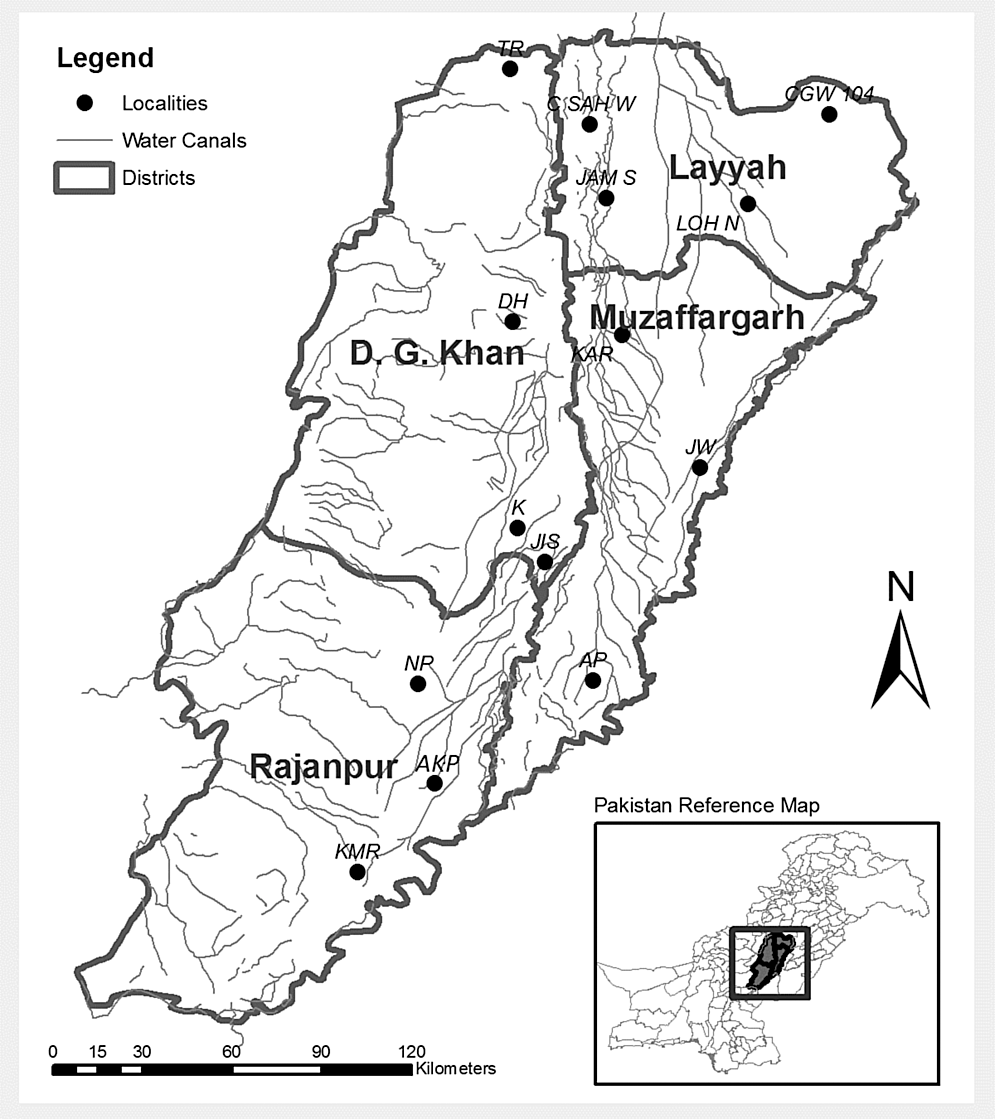
Map showing vector mosquito collection and insecticide susceptibility testing sites in four flood-affected districts of South Punjab Province (LOH N, Layyah Lohanch Nashaib; JAM S, Jaman Shah; CGW 104, Chack Garray Wala; C SAH W, UC Sahuwala; KAR, Muzafarghar Kot Adu Road; JW, Janat wali; AP, Alipur; JIS, DG Khan Jhakra Imam; TR, Taunsa Road; K, Kot Chutta; DH, Dharaman; KMR, RajinPur Kot Methan Road; NP, NoorPur; AKP, AkelPur).
Standard WHO adult test kits (World Health Organization 1998, 2005) were used. Three kinds of susceptibility tests were performed on adult stages: (1) wild-caught fed females were tested under field conditions; (2) progeny of the females that survived the diagnostic doses in the field were tested under laboratory conditions; and (3) testing of the progeny of the wild-caught females not tested in the field. The mosquitoes were exposed to the discriminating doses recommended by WHO. WHO-supplied test papers impregnated with 0.05% deltamethrin, 0.05% lambda-cyhalothrin, 0.75% permethrin, 4% DDT, and 5% malathion were used, with a 1-h exposure period. Water was provided during the 24-h holding period, after which mortalities were calculated. Appropriate controls were run in all cases. Normally there were no mortalities in the controls, but in cases where 5–20 % mortalities were observed in controls, corrected percentage mortalities were calculated using Abbott's formula (World Health Organization 1998).
The percentage of mortalities was calculated and used to establish the susceptible and resistant status of these populations. Interpretations of the susceptibility tests were based upon the following arbitrary criteria (World Health Organization 1998): susceptible (S)=98–100%; verification required (?)=80–97%; resistance (R)=0–79%.
Results
Anopheles stephensi exposed to various diagnostic doses of three pyrethroids (deltamethrin, lambda-cyhalothrin, and permethrin), one organophosphate (malathion), and one chlorinated hydrocarbon (DDT), showed a range of mortalities in various localities of the four districts.
As shown in Table 1, in the Layyah district species were resistant to both DDT, with 48.88–51% mortality, and malathion, with 55–60% mortality. The species were susceptible to deltamethrin and lambda-cyhalothrin with 100% mortality, but for permethrin lower mortalities ranging from 85.66–87.5% were observed, which indicated that verification was required.
Status: susceptibility (S)=98–100%; verification required (?)=80–97%; resistance (R)=0–79%.
Level of significance p<0.05; non-significance p>0.05.
LOH N, Layyah Lohanch Nashaib; JAM S, Jaman Shah; CGW 104, Chack Garray Wala; C SAH W, UC Sahuwala; KAR, Muzafarghar Kot Adu Road; JW, Janat wali; AP, Alipur; JIS, DG Khan Jhakra Imam; TR, Taunsa Road; K, Kot Chutta; KMR, RajinPur Kot Methan Road; NP, NoorPur; AKP, AkelPur.
In the Muzaffarghar district, the species were resistant to four pesticides, where a range of mortalities within the resistance level were observed in the tests with lambda-cyhalothrin (43–46.66%), permethrin (66.66–71.66%), DDT (45–48%), and malathion (46.66–53%). With deltamethrin, mortality ranged from 85–87.71%, which places the results in the verification required category.
In district DG Khan, A. stephensi was resistant to all five insecticides. Mortalities within the resistant level were observed in tests with deltamethrin (55–62.5%), lambda-cyhalothrin (48–52%), permethrin (60–65%), DDT (45–48%), and malathion (46–48%). In district Rajanpur, the species were resistant to deltamethrin with 50–52% mortality, lambda-cyhalothrin with 45–55% mortality, permethrin with 60–65% mortality, DDT with 45–50% mortality, and malathion with mortalities ranging from 49–50%.
As shown in Table 2, A. culicifacies was susceptible to deltamethrin and showed 100% mortality in all four localities. There was lambda-cyhalothrin susceptibility in two localities with 100% mortality, but the other two localities showed lower mortalities (94.86–97.61%), for a verification-required status. In the case of permethrin, one locality showed susceptibility (98% mortality), but the lower mortalities (93.3, 95.5, and 97.6%) in the remaining three localities placed it in the verification-required category. Tests with malathion indicated susceptibility in the majority of localities, with mortalities ranging from 98–100%. But in one locality, verification-required status was observed with 97.5% mortality. With DDT, mortalities ranged from 29–47%, which placed it in the resistant category. In DG Khan, the species were resistant to all pesticides, with mortalities at the resistant level observed in tests with deltamethrin (49–75%), lambda-cyhalothrin (45.83–75%), and permethrin (41.6–75%). The species were resistant to malathion, with mortality ranging from 55–60.5%. In Rajinpur, species were resistant to deltamethrin, permethrin, DDT, and malathion, with mortality ranges of 45–70%, 30–70%, 50–52%, and 30–60%, respectively. For lambda-cyhalothrin, lowered mortalities of 82–87% were observed.
Status: susceptibility (S)=98–100%; verification required (?)=80–97%; resistance (R)=0–79%.
Level of significance p<0.05; non-significance p>0.05.
LOH N, Layyah Lohanch Nashaib; JAM S, Jaman Shah; CGW 104, Chack Garray Wala; C SAH W, UC Sahuwala; AP, Alipur; TR, Taunsa Road; K, Kot Chutta; DH, Dharaman; KMR, RajinPur Kot Methan Road; NP, NoorPur; AKP, AkelPur.
A. subpictus, which is not a malaria vector, was also tested against five insecticides to determine if there was any significant difference in susceptibility status compared to the two vector species. A. subpictus was found to be resistant to all five insecticides. Mortalities within the resistant level were observed in tests with deltamethrin (71–75%), lambda-cyhalothrin (46–72.5%), permethrin (64.10–68%), DDT (41–45%), and malathion (73–79%).
A limited number of progeny tests were made on A. stephensi collected from the Muzaffarghar district. Two types of tests were conducted: (1) tests on progeny of field-collected mosquitoes not tested with insecticides in the field; and (2) tests on the progeny of field-collected females who survived exposure to the diagnostic doses of various insecticides,
For the tests on the progeny of the field-collected mosquitoes (115 gravid females not tested in the field were brought to the laboratory; their F1 progeny was pooled to draw 835 females for the tests), they showed resistance to deltamethrin, with mortality of 59–61.22% (n=245, replicates=16) with 13.04–20% (n=230, replicates=14), to lambda-cyhalothrin, with mortality of 57–59% (n=210, replicates=09) for permethrin, and 58–61% (n=150, replicates=09) for malathion.
However, the progeny of wild-caught females who survived exposure to the diagnostic dose also showed resistance to deltamethrin (74–76.92%; n=65; the F1 progeny of 25 females that survived the field test with deltamethrin were pooled to draw 65 females for this test; replicates=06), lambda-cyhalothrin (45–47.37%; n=76; the F1 progeny of 99 females that survived the field test with lambda-cyhalothrin were pooled to draw 76 females for this test; replicates=05), permethrin (76–78%; n=105; the F1 progeny of 55 females that survived the field test with permethrin were pooled to draw 105 females for this test; replicates=07), DDT (22.86–25%; n=70; the F1 progeny of 96 females that survived the field test with DDT were pooled to draw 70 females for this test; replicates=04), and malathion (34–35%; n=51; the F1 progeny of 90 females that survived the field test with malathion were pooled to draw 51 females for this test; replicates=05).
Chi-square tests were performed to compare populations collected from different locations for hetrogeneity. At least three collections were made at different dates, and three replicates of each were made from nearly all locations.
Discussion
Malaria in Pakistan still persists in the southern part of the Punjab province, and Plasmodium falciparum dominates the northern part of the country with high mortality and morbidity rates. The southern districts of Punjab were recently devastated by unprecedented floods, which created large populations of internally displaced people (IDP). IDP are usually more exposed to malaria vector mosquito bites, and consequently have an increased likelihood of contracting malaria. In the late 1970s, the Punjab province faced malaria control failure due to undetected resistance to DDT and malathion, which were in use at that time. Due to this history, the judicious use of pesticides, supported by appropriate insecticide resistance monitoring in southern Punjab has assumed top priority, particularly for pyrethroids, which are presently not only used for public health, but are also used in large quantities for agricultural purposes. Such a situation calls for intensified monitoring and surveillance of resistance in insect vectors.
The results of the present study were compared with the results of previous studies in which resistance to DDT and malathion was first recorded 32 years ago (Rathor and Toqir 1980; Rathor et al. 1983) in Punjab Province. In the present study we noted that in the four districts, both A. stephensi and A. culicifacies remained resistant to DDT and malathion, and there was no sign of reversal of resistance. This was despite the fact that the use of both pesticides for malaria vector control has been discontinued for nearly two decades. The evidence for the disuse of both DDT and malathion for malaria vector control is provided by the official report of the directorate of malaria control of Pakistan (Ministry of Health 2009). According to the report the use of DDT for malaria vector control in Pakistan started in 1961 and stopped in 1979. Malathion was used from the early 1980s to mid-1990. Due to the development of resistance to malathion, the use of malathion was discontinued in 1996, and it was replaced by deltamethrin, which is still being used.
This shows that the end of the use of DDT and malathion for malaria vector control was stopped 33 and 16 years ago, respectively. Normally it is expected that discontinuation of the use of a pesticide may result in reduction of insecticidal selection pressure on the vector mosquitoes, and may lead to the reversal of resistance. However, this expectation was not realized.
In most districts resistance to some pyrethroids is slowly developing in some districts, for example to permethrin, lambda-cyhalothrin, and deltamethrin (Tiwari et al. 2010; World Health Organization 2011). However, in a number of districts, verification-required status for some of the pyrethroids indicates the presence of susceptible populations, and with appropriate resistance-management strategies, the development of high levels of resistance can be prevented or delayed. The results of this study form an important evidence base for strategic planning for vector control.
Conclusions
We conclude that in view of the present status of the resistance in disease vectors, the development and implementation of comparatively new strategies for vector pest management, in particular integrated vector management (IVM), needs to occur in light of the data detailed here.
In order to manage, prevent, or slow the development of resistance to the presently-used effective insecticides, a strategic approach for the judicious use of pesticides is essential. This approach requires efficient and regular monitoring of the susceptibility status of disease vectors as an important component of IVM. Unfortunately, pesticide resistance monitoring and surveillance is extremely inadequate in Pakistan. An effective resistance management policy is not possible without the strong evidence obtained from monitoring and surveillance.
Footnotes
Acknowledgments
The considerable logistical and technical support given by the staff of both the HSA and the NIMRT, namely by Mr. Muhammad Ali, Mr. Imran Khalid, Mr. Shaheen Akhtar, Mr. Sultan Ahmed, Mr. Ghulam Nabi, and Mr. Muhammad Hussain, is gratefully acknowledged.
Author Disclosure Statement
No competing financial interests exist.