




Abstract
We determined the prevalence of Bartonella spp. and investigated which species of Bartonella naturally infects Korean water deer (KWD, Hydropotes inermis argyropus) in the Republic of Korea (ROK). A total of 70 spleens from KWD carcasses were collected by the Conservation Genome Resource Bank for Korean Wildlife (CGRB) in the ROK between 2008 and 2009. Nested PCRs were performed using the rpoB gene and internal transcribed spacer (ITS) region primers to amplify the DNA fragment of Bartonella. Using ITS-based nested PCR, Bartonella grahamii and Bartonella schoenbuchensis–related species were detected in 11 (15.8%) and 9 (12.9%) of 70 KWD spleens, respectively. The 11 B. grahamii amplicons were classified into 2 genotypes by sequence analysis. Using rpoB-based nested PCR, B. grahamii was detected in 5 (7.1%) of 70 KWD spleen samples. This is the first report of B. grahamii and B. schoenbuchensis in KWD, suggesting that KWD may act as reservoirs for the spreading of Bartonella spp. in the ROK.
Introduction
In the Republic of Korea (ROK), Bartonella spp. have been detected in wild rodents, ticks, and companion animals (Chae et al. 2008, Kim et al. 2009), and B. elizabethae was isolated from wild rodents (Kim et al. 2005). Recently, several human cases of Bartonella infection have been reported (Suh et al. 2010, Yoon et al. 2010).
Water deer (Hydropotes inermis) are indigenous to the lower reaches of rivers in China and the Korean peninsula. They are divided into 2 subspecies—the Korean water deer (KWD; Hydropotes inermis argyropus) and the Chinese water deer (Hydropotes inermis inermis). Wild deer are an important reservoir of Bartonella spp. infection in the United States and Europe (Dehio et al. 2001, Matsumoto et al. 2008). Furthermore, in the ROK, Anaplasma phagocytophilum, A. bovis, and Theileria spp. were detected in wild water deer (Han et al. 2009, Kang et al. 2011). These findings indicate that wild deer could be reservoirs for other vector-borne diseases. However, Bartonella spp. have not been evaluated in water deer and other wild deer in Asia.
The aim of the present study was to investigate the prevalence of Bartonella DNA in KWD and determine which Bartonella species could infect water deer in the ROK. We used nested PCR and phylogenetic analysis based on the internal transcribed spacer (ITS) region and rpoB gene to conduct molecular detection and genetic diversity analysis of Bartonella spp. from naturally infecting wild KWD.
KWD carcasses (N=70) were collected in Chungcheongbuk-do (n=5), Gangwon-do (n=16), Gyeonggi-do (n=11), and Jeollanam-do (n=18) provinces, Seoul City (n=4), and Ulsan City (n=16) in the ROK between March, 2008, and August, 2009, by the Conservation Genome Resource Bank for Korean Wildlife (CGRB).
DNA was extracted from spleens using DNeasy Blood and Tissue Kits (Qiagen Inc., Valencia, CA) according to the manufacturer's instructions. Bartonella-specific DNA fragments were amplified in 2 different nested PCR reactions with different target genes to confirm the results and to differentiate Bartonella species. All samples were screened using 2 sets of species-specific nested PCR primers targeting the ITS region (QHVE OF, 5′-TTCAGATGATGATCCCAAGC-3′; QHVE OR, 5′-AACATGTCTGAATATATCTTC-3′; QHVE IF, 5′-CCGGAGGGCTTGTAGCTCAG-3′; QHVE IR, 5′-CACAATTTCAATAGAAC-3′) and rpoB gene (BrpoB OF, 5′-GTAGACTGATTAGAACGCTG-3′; BrpoB OR, 5′-CGCATTGGCTTACTTCGTATG-3′; BrpoB IF, 5′-GTAGACTGATTAGAACGCTG-3′; BrpoB IR, 5′-TTCCCGTACCAACAAATGG-3′) (Houpikian et al. 2001, Renesto et al. 2001). To avoid nested-PCR contamination, sample preparation, DNA extraction, PCR preparation, and nested-PCR amplification and analysis were performed in separate rooms with entirely separate equipment, supplies, and solutions. Negative controls, consisting of bacteria-free spleen DNA and water control, were included in all the nested PCR runs, and no bands were detectable from the negative controls. B. henselae (American Type Culture Collection [ATCC] 49882) and B. grahamii (ATCC 700132) genomic DNA were used as positive controls for detecting Bartonella species. Amplified products were separated by electrophoresis on 1.5% agarose gels, visualized by ethidium bromide, purified using the QIAquick Gel Extraction Kit (Qiagen Inc., Valencia, CA), and sequenced by dideoxy termination with an automatic sequencer (ABI 3730xl capillary DNA sequencer).
Comparative analyses of the nucleotide sequences were completed using Bartonella ITS regions and rpoB gene sequences in the GenBank database. Phylogenetic analyses of the region and rpoB gene fragments were constructed using the Clustal X (version 1.60) program and the neighbor-joining method with MEGA 4.0 software. The phylogenetic tree based on the rpoB gene and ITS region shows the positions of strains identified in this study (Fig. 1). The sequences obtained in the present study have been deposited in GenBank, and accession numbers are shown in Table 1.
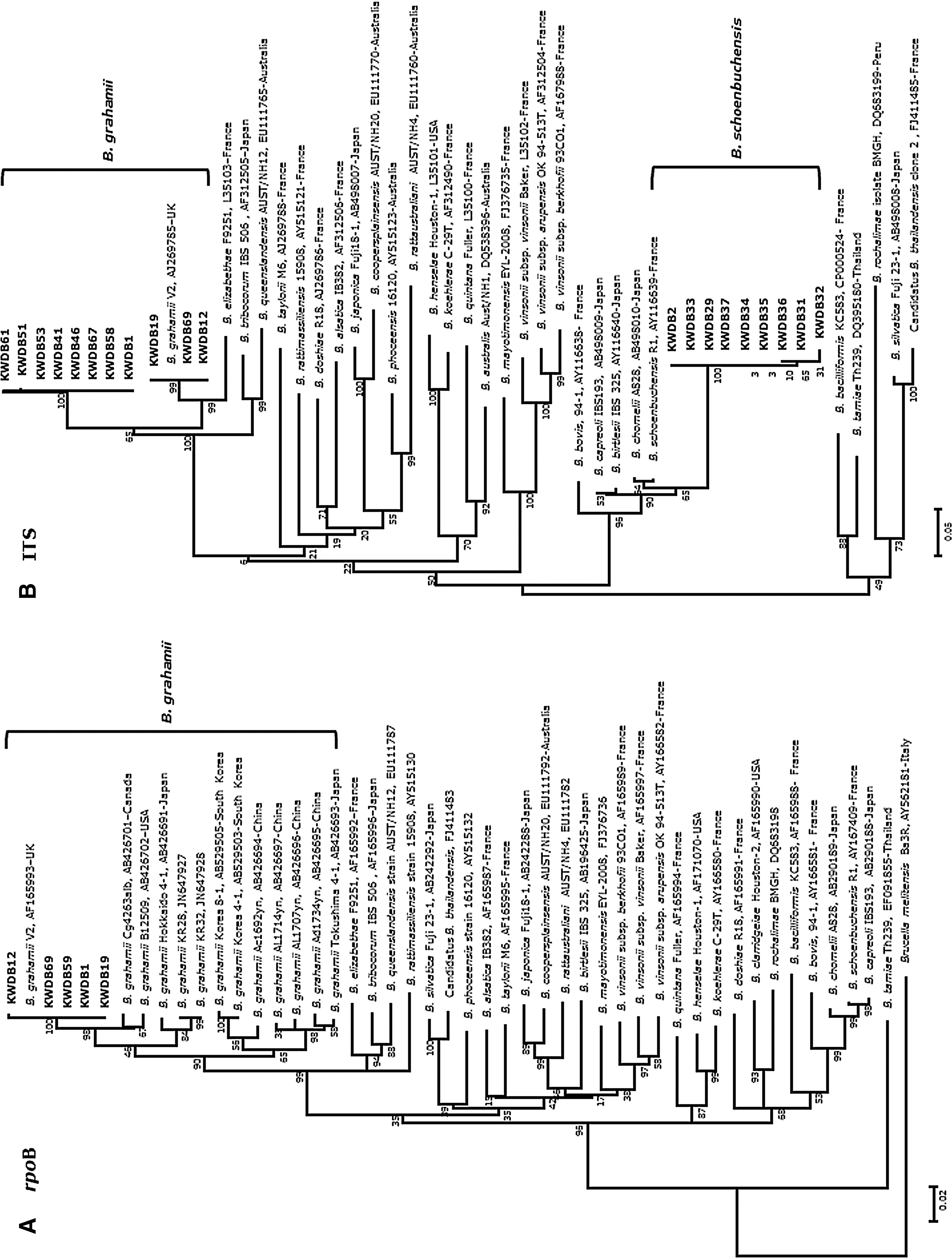
Phylogenetic tree for members of the genus Bartonella inferred from comparison of rpoB (
Sequence similarity with closest relative [B. grahamii strain V2 (AF16599, AJ269785), B. schoenbuchensis strain R1 (AY116639)].
The prevalence of Bartonella DNA in KWD was 7.1% (5/70) and 28.6% (20/70) using rpoB gene- and ITS region-detecting nested PCRs, respectively. The homology of 5 amplified rpoB sequences showed 96.9–97.0% similarity to the representative B. grahamii strain V2 (AF16599). In the ITS region-based PCR, 11 B. grahamii (15.8%) and 9 B. schoenbuchensis–related species (12.9%) were identified.
A total of 11 B. grahamii-related sequences were classified into 2 genotypes that showed 91.2% and 100% sequence similarity to B. grahamii strain V2 (AJ269785). This result corresponds with those of earlier studies that reported the similarity of the B. grahamii ITS sequence as 91.9% and 98.8% (Gil et al. 2010). Nine ITS-positive PCR products (sample ID: KWDB 2, 29, 31, 32, 33, 34, 35, 36, and 37) showed low sequence homology (72.8–74.2%) to the closest relative B. schoenbuchensis strain R1 (AY116639) and 68.8–70.2% sequence identity with B. capreoli strain IBS193 (AB498009) (Fig. 1B). In phylogenetic trees of the ITS region, those sequences showing low sequence similarities (both B. grahamii– and B. schoenbuchensis–related) were grouped independently from the closest relative, suggesting that these strains might be considered a new species; however, further analysis, including isolation and biochemical and molecular characterizations, should be performed to define this genotype as a novel species.
In this study, B. grahamii and B. schoenbuchensis–related species were identified in the spleens of wild KWD by sequence analysis. B. schoenbuchensis was first isolated from the blood of wild roe deer (Dehio et al. 2001). Subsequently, this species has been detected mainly in ectoparasites of deer (Matsumoto et al. 2008). Until now, wild rodents were known as a main reservoir/host of B. grahamii, which is distributed worldwide and detected predominantly in Asian countries, such as China and Japan (Inoue et al. 2009).
This is the first report of the molecular detection of Bartonella in KWD, suggesting that water deer may serve as a mammalian reservoir for transmission of Bartonella spp. Furthermore, this result has enabled us to provide additional information on the epidemiology of B. grahamii, the predominant Bartonella species in the world.
Several new Bartonella spp. have been identified in wild animals, and the number of human bartonellosis cases has been rapidly increasing. Our results suggest that further study will be necessary to determine the relationships and host specificity among public health, domestic and wild animals, and Bartonella spp. Furthermore, the impact of these pathogens on human health, especially in undiagnosed cases of febrile illness, needs to be evaluated.
Footnotes
Acknowledgments
This research was supported by Basic Science Research Program through the National Research Foundation of Korea (NRF) funded by the Ministry of Education, Science and Technology (2012-0005524).
Author Disclosure Statement
No competing financial interests exist.