




Abstract
Escherichia coli O157:H7 is frequently isolated from cases of diarrhea in many industrialized countries; however, it is seldom found in developing countries. The present manuscript reports the presence of E. coli O157:H7 in Ecuadorian livestock, a country where enterohemorrhagic E. coli disease in humans has never been reported. The Ecuadorian isolates were genetically related to some strains linked to clinical cases in the United States as assessed by multiple-locus variable number tandem repeat (VNTR) analysis.
Introduction
Most and more severe EHEC infections have been reported in industrialized countries, though the reasons for this distribution are still under debate (Palmeira et al. 2005). Developing nations such as Ecuador, despite having high rates of animal E. coli contamination, have had no human EHEC infections reported. The lack of the disease caused by this pathogen has led to the assumption that Ecuador has no circulating EHEC strains. The present study is the first report of EHEC O157:H7 from bovine fecal samples obtained from an Ecuadorian abattoir.
Material and Methods
Fecal samples
Rectal swabs were obtained from 600 cattle from the main abattoir in Quito Ecuador during December, 2009. Swabs were placed in semisolid thioglycollate medium for 2 h and then streaked onto sorbitol–MacConkey's agar plates (Wells et al. 1991). Colonies unable to ferment sorbitol were inoculated in Chromocult® (Merck).
DNA extraction and PCR reactions
Nonsorbitol fermenting isolates that were unable to cleave the X-glucuronide substrate were screened by PCR to detect the following genes: stx1 and stx2 following the protocol published by Pollard et al. (1990), genes eaeA, and λ-tir according to the protocol published by Karns et al. (2007), and genes hlyA and rfbEO157 as described by Paton (1998).
Multiple-locus variable number tandem repeat analysis
Positive samples were then genotyped using multiple-locus variable number tandem repeat (VNTR) analysis (MLVA). A previously designed MLVA system for E. coli O157 consisted of 29 VNTR loci that provide a high level of discriminatory power among E. coli O157:H7/HN and E. coli O55:H7 isolates (Keys et al. 2005). We selected a subset of 11 of the most diverse of these loci for inclusion in a simpler MLVA system for use in discriminating among E. coli O157 isolates (see Table S1; Supplementary Data are available at
Results and Discussion
We obtained 600 E. coli isolates, 1 for each collected fecal sample. Thirty-two isolates showed the typical E. coli O157:H7 phenotype (nonsorbitol fermenting and unable to cleave the X-glucuronide substrate) and carried stx genes, but only 6 isolates (1%) carried additional genes eaeA, λ-tir, hlyA, and rfbEO157 (Table 1). High-resolution genetic analysis via MLVA was attempted on the 32 isolates with the typical E. coli O157:H7 phenotype, but only 4 clustered with clinical strains of E. coli O157:H7 the rest of isolates did not amplify some of the VNTRs (Fig. 1).
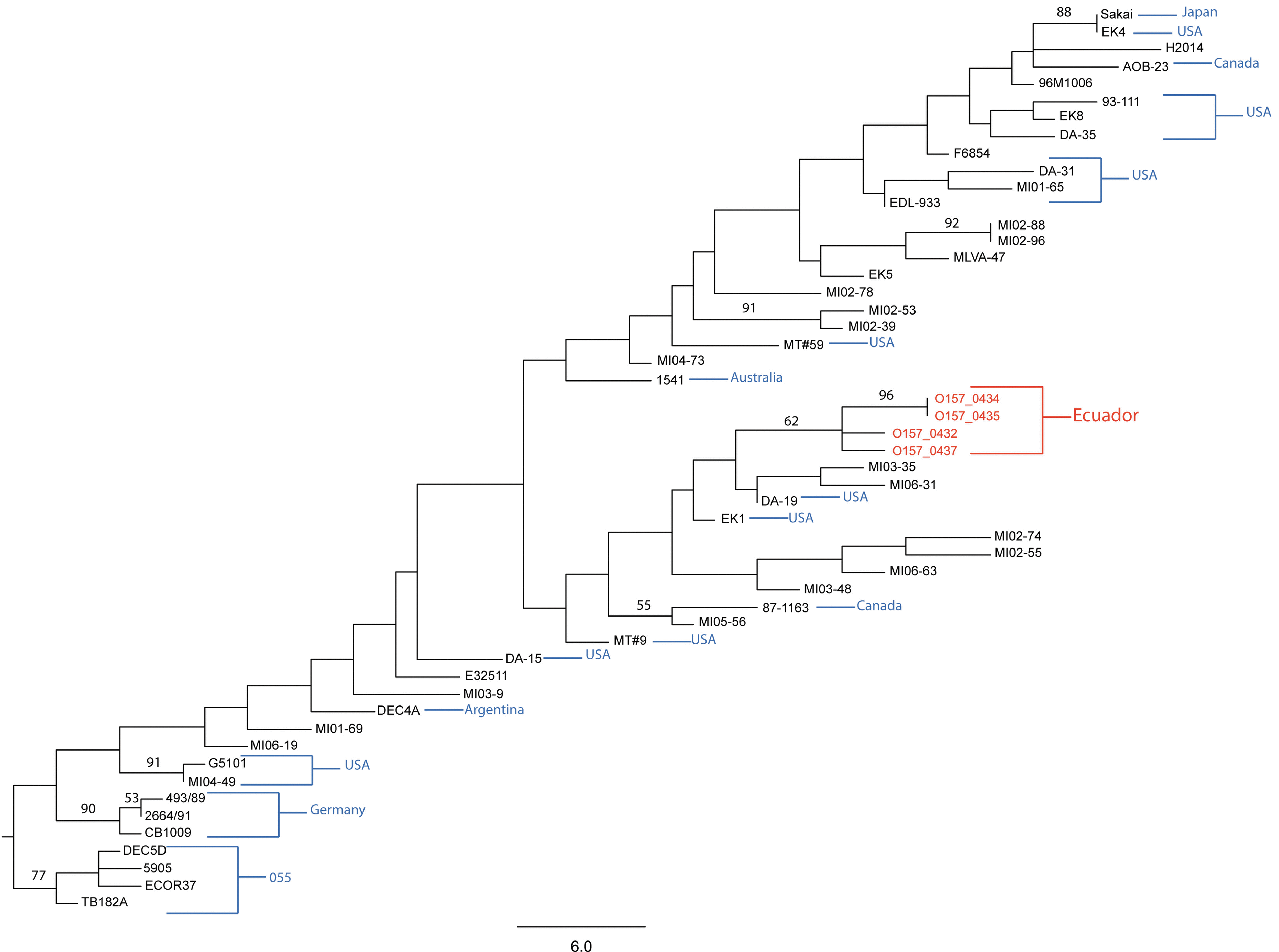
A maximum parsimony tree of MLVA patterns. The numbers on the tree represent the bootstrap values. Samples are from human clinical isolates (Manning et al. 2008) and publicly available whole-genome sequences, except for Ecuadorian isolates, which were obtained from cattle. The tree is rooted on E. coli O55 isolates. (Color image available online at
Multiple-locus variable-number tandem repeat analysis clustered these isolates together and with clinical strains of E. coli O157:H7.
All 6 isolates were PCR positive for genes: eae, λ-tir, hlyA, and rfbEO157.
The present study demonstrates that Ecuadorian livestock are colonized with EHEC O157:H7 strains, which are genetically most closely related to EHEC clinical isolates from the United States. Human exposure to this pathotype in Ecuador is very likely due to the large amounts of E. coli found in Ecuadorian animal products. For instance, we have detected up to 110,000 cfu/gram of E. coli in soft cheese sold in Quito public markets (data not shown).
However, there have been no confirmed O157:H7 isolations reported from diarrheal cases in Ecuadorian hospitals. One of the main microbiology laboratories in Quito has conducted surveillance of diarrheal cases for 7 years using sorbitol–MaConkey agar and found only 1 suspicious isolate obtained from patient who was an American Embassy employee (a sorbitol-negative colony that reacted with anti-O157 and anti-H7 antisera) (Zurita 2011). In Peru, where EHEC O157:H7 has been found in many animal-derived foods (Mora 2007), there has been only 1 isolate reported from a clinical sample since 2001 (Huapaya et al. 2001).
Unexpectedly, Colombia, a neighboring country with higher food hygiene standards, has reported E. coli O157:H7 in children, with many cases of HUS in Bogota (Mattar et al. 1998).
Although deficient surveillance has been attributed to this lack of O157:H7 reports, there may be other factors explaining this phenomenon that deserve further consideration: (1) EPECs share many virulence-associated proteins with E. coli O157:H7 (with high amino acid sequence similarity among them) and constant exposure and subsequent immunity to them may produce cross protection to O157:H7 (Palmeira et al. 2005), (2) larger intakes of red meat in industrialized countries not only may increase exposure and the possibility of getting an infection, but also increases the affinity of the toxin to cell membranes by incorporating bovine sialic acid into host cell membranes (Lofling et al. 2009). The annual meat intake per capita in Ecuador is 46.5 kg and in the United Sates is 126.6 kg (Food and Agriculture Organization 2009); however, Japan (a nation with many reports of E. coli O157:H7 infections) has annual meat intake per capita of 45.4 kg (3) Finally, meat in developing countries often contains large amounts of microbial contaminants, which may outcompete EHEC (Vold et al. 2000). Understanding the factors involved in this apparent absence of developing country human morbidity will lead to a better understanding of the complex ecology, evolution, and pathogenesis of E. coli O157:H7 and potentially limit the impact of the disease in other locations. Finally, the detection scheme used in this study was directed to detect only E. coli O157:H7 in Ecuadorian cattle and the results do not reflect the prevalence of other EHECs.
Footnotes
Acknowledgments
The authors would like to thank, Roxanne Nottingham, Talima Pearson, Erin Price, and Ramiro Gonzales (Camal Municipal de Quito) for their valuable help. Funding for this research was provided by Center for Microbial Genetics and Genomics, Northern Arizona University and Universidad San Francisco de Quito.
Author Disclosure Statement
No competing financial interests exist.
References
Supplementary Material
Please find the following supplemental material available below.
For Open Access articles published under a Creative Commons License, all supplemental material carries the same license as the article it is associated with.
For non-Open Access articles published, all supplemental material carries a non-exclusive license, and permission requests for re-use of supplemental material or any part of supplemental material shall be sent directly to the copyright owner as specified in the copyright notice associated with the article.
