




Abstract
In recent years, the number of West Nile virus (WNV) cases reported in horses and humans has increased dramatically throughout the Mediterranean basin. Furthermore, the emergence of Usutu virus (USUV) in Austria in 2001, and its subsequent expansion to Hungary, Spain, Italy, Switzerland, the United Kingdom, and Germany, has given added cause for concern regarding the impact of the spread of flaviviruses on human and animal health in western Europe. Despite frequent detection of WNV and USUV cases in neighboring countries, no case of WNV has been detected in France since 2006 and USUV has never been reported. However, recent investigations focused on detecting the circulation of flaviviruses in France are lacking. We investigated the circulation of WNV and USUV viruses in wild birds in southern France on the basis of a serological survey conducted on a sentinel species, the magpie (Pica pica), in the Camargue area from November, 2009, to December, 2010. We detected WNV-neutralizing antibodies at a high titer (160) in a second-year bird showing recent exposure to WNV, although no WNV case has been detected in humans or in horses since 2004 in the Camargue. In addition, we observed low titers (10 or 20) of USUV-specific antibodies in six magpies, two of which were also seropositive for WNV. Such low titers do not give grounds for concluding that these birds had been exposed to USUV; cross-reactions at low titers may occur between antigenically closely related flaviviruses. But these results urge for further investigations into the circulation of flaviviruses in southern France. They also emphasize the necessity of undertaking epidemiological studies on a long-term basis, rather than over short periods following public health crises, to gain insight into viral dynamics within natural reservoirs.
Introduction
In southern France, WNV infections were reported in horses, humans, and birds in the 1960s and between 2000 and 2006 (Jourdain et al. 2007, Jourdain et al. 2008, Balança et al. 2009). Since 2006, no WNV case has been detected, although multiple outbreaks have occurred throughout southern Europe (ECDC 2012). Despite frequent detection of WNV and USUV in neighboring countries, the French flavivirus surveillance network has been limited since 2007 to reporting important mortality events in wild birds and clinical cases in horses and humans. Therefore, two major issues remain unresolved: (1) Does WNV regularly circulate in southern France in the absence of human and equine cases? (2) Do other flaviviruses circulate in southern France without being detected? We have investigated these questions on the basis of a serological study conducted on wild birds in the Camargue area.
We chose to focus on the magpie (Pica pica) because this species is a sensitive sentinel to detect WNV enzootic activity (Jourdain et al. 2008) and because USUV has already been isolated from this species (Savini et al. 2011). Furthermore, the sedentarity of the magpie offers some guarantee that positive individuals have been infected within the study area or within a few kilometers of it. We chose the Camargue as a study area because WNV circulation has repeatedly been reported there, the last local WNV case detection dating from 2004 (Jourdain et al 2008, Balança et al. 2009). Moreover, this region, located at the crossroads of several bird migration routes, is a hotspot for the potential introduction of bird pathogens.
Materials and Methods
The study was conducted from November, 2009, to December, 2010, in two sites, i.e., A1, which includes dry and wet habitats, and A2, which is a wetland area (Fig. 1). WNV had been reported at both sites in 2004 (Jourdain et al. 2007) in horses (A1) or wild birds (A2), and seropositive magpies had been detected in 2005 (A1 and A2) (Jourdain et al. 2008). Circular multicatch magpie traps were set every working day during three capture sessions: November–December 2009, May–June 2010, and November–December 2010. On the basis of plumage criteria, magpies were classified as juveniles (i.e., born in the preceding spring), second year (i.e., born in spring of the previous year), or adults (Svensson 1992). They were ringed and sampled for blood analysis before being released. Blood samples were centrifuged and resulting serum samples were stored at −20°C. Neutralizing antibody (NAb) titers for WNV (IS-98-ST1 and France00 strains) and USUV (SAAR-1776 strain) were determined using a 96-well plate neutralization test as described (Figuerola et al. 2007). Serum samples with a neutralizing activity (absence of cytopathic effect) at dilution ≥1:10 were considered positive. When there was sufficient volume remaining, positive samples were further tested for NAbs specific for Japanese encephalitis virus (JEV, Nakayama strain) and tick-borne encephalitis virus (TBEV, Hypr strain), a flavivirus belonging to the tick-borne flavivirus group, which is not closely related to WNV. To assess the specificity of the methods, we tested serum samples collected on magpies in the Camargue area during and after the 2004 WN epizootic in horses (Jourdain et al. 2008), for which we strongly expected seropositivity for WNV. These samples were tested for antibodies against WNV, USUV, and TBEV (Hypr strain). All strains were provided by the National Reference Centre for arboviruses of the Institut Pasteur of Paris.
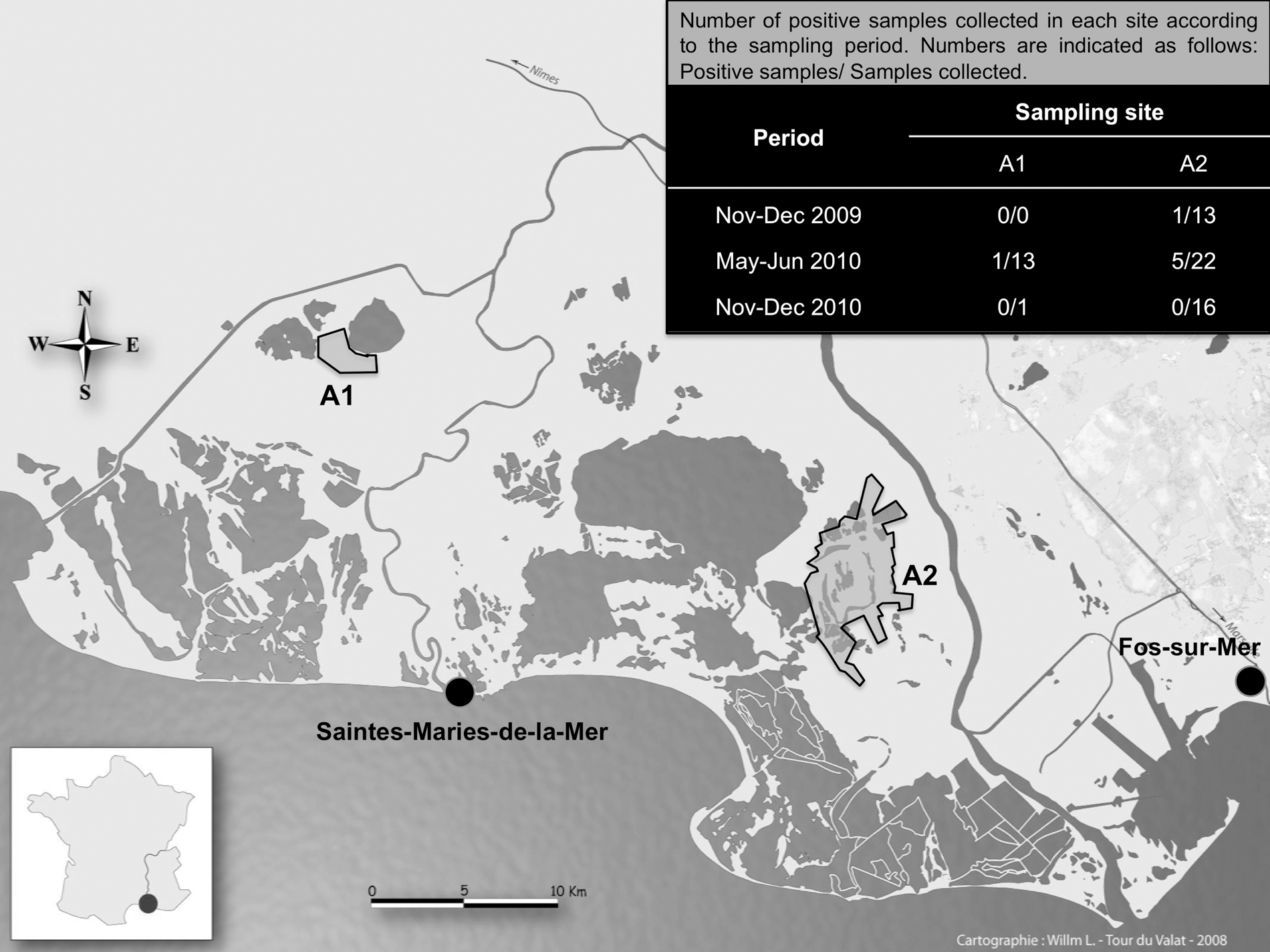
Localization of the sampling sites and proportion of seropositive samples (either to Usutu virus and/or to West Nile virus) detected in each site for each sampling session.
Results
Among the 65 magpies sampled, a second-year bird trapped in spring 2010 at site A1 was seropositive for WNV with NAb at titer 160 (Table 1). In addition, three adult magpies, trapped in June 2010, and a first-year bird trapped in December, 2009, all of them at site A2 were seropositive for USUV with NAb at low titer (10–20; Table 1). Finally, two adult birds caught at site A2 presented NAbs against both WNV and USUV. NAbs specific for TBEV or JEV were not detected in the five and three USUV- and/or WNV-positive samples, respectively, that could be tested (Table 1). It remained, however, unclear whether USUV-seropositive birds had been exposed to USUV, WNV, both, or a closely related virus. Cross-reaction between WNV and USUV antibodies can be visualized at low titers in virus neutralization tests because WNV and USUV are closely antigenically related.
Titers against tick-borne encephalitis virus (TBEV) and Japanese encephalitis virus (JEV) are also included when tests could be performed.
IS-98, IS-98-ST1 WNV strain.
Fr00, France00 WNV strain.
ND, no data.
The aim of the tests implemented on samples collected in 2004–2005 was to investigate this cross-reactivity. Out of 49 sera, 12 were positive for WNV NAbs only and 22 were positive for both WNV and USUV NAbs (see Supplementary Data available at
Discussion and Conclusions
This serosurvey shows that WNV and potentially other closely related flaviviruses have recently circulated in the Camargue area, although no human or equine cases have been reported since 2004. These results indicate the need for further investigations into flavivirus circulation in southern France. However, serology does not allow determining when the sampled individuals were infected. In addition cross-reactivity can occur between antibodies that are specific to closely related viruses. Thus, such future investigations should couple serological and virological detection approaches to isolate the flavivirus strains that are circulating in the region and determine their geographical origin, following the example of the recent study by Valiakos et al., which isolated a WNV lineage 2 strain from the tissues of a magpie in Greece (Valiakos et al. 2011). Furthermore, our findings highlight the fundamental importance of undertaking epidemiological studies on a long-term basis, rather than over short periods following public health crises, to gain insight into viral dynamics within natural reservoirs. They also suggest that the magpie is a suitable sensitive indicator species for the detection of WNV circulation. This point is in accordance with a recent study, which underlined the geographical association between WNV seropositivity in magpies and WNV human cases in Greece (Valiakos et al. 2012). We suggest that a long-term multifocus serosurvey undertaken on magpies throughout the Mediterranean basin would be an efficient tool that could be added to active and passive surveillance focused on humans and horses. The simultaneous use of such complementary tools could greatly help in predicting and dealing with future outbreaks linked to flaviviruses.
Footnotes
Acknowledgments
M. Vittecoq was supported by an AXA PhD research fellowship. We are grateful to trappers and students who helped us to collect samples. We also thank the MAVA Foundation for its financial support and the Centre Scamandre for authorizing bird captures on its land.
Author Disclosure Statement
No competing financial interests exist.
References
Supplementary Material
Please find the following supplemental material available below.
For Open Access articles published under a Creative Commons License, all supplemental material carries the same license as the article it is associated with.
For non-Open Access articles published, all supplemental material carries a non-exclusive license, and permission requests for re-use of supplemental material or any part of supplemental material shall be sent directly to the copyright owner as specified in the copyright notice associated with the article.
