




Abstract
We report the first serological evidence of Usutu virus (USUV) infection in horses in Croatia. During 2011, 1380 horse serum samples from healthy animals were collected from six northern Croatian counties. All samples were first screened for West Nile virus (WNV) immunoglobulin G (IgG) antibodies using an enzyme-linked immunosorbent assay (ELISA). Sixty-nine WNV ELISA-reactive samples were further tested for WNV antibodies by a virus neutralization assay (VN assay) and plaque reduction neutralization test (PRNT), and USUV by a VN assay and tick-borne encephalitis virus (TBEV) antibodies by PRNT. During the same period, 306 human serum samples from patients coming for routine testing with no symptoms of acute febrile disease were tested for USUV IgG using ELISA. Reactive samples were tested for both USUV and WNV using a VN assay. USUV-specific neutralizing antibodies were detected in two of 69 WNV ELISA-reactive horse serum samples. Seropositive animals were found in two different regions of Croatia. One additional sample showed specific WNV-neutralizing antibodies that cross-neutralized USUV. Only one human sample (0.3%) was reactive to USUV antibodies in an ELISA test. In a confirmatory test, WNV-neutralizing antibodies were detected, indicating cross-reactive antibodies with USUV in ELISA. The exposure to USUV was documented in two WNV ELISA-reactive horses at distant locations. These results indicate the presence of USUV in northern Croatia.
Introduction
Until 2001, the virus was given minor importance because it was confined to sub-Saharan Africa and only few infections were reported (Nikolay et al. 2011). The first cases outside of Africa were documented in Austria in 2001. In contrast to the observation in Africa, infection was associated with severe and fatal disease in different bird species (Weissenböck et al. 2002). Thereafter, USUV-associated disease in birds was reported from Hungary (Bakonyi et al. 2007), Italy (Manarolla et al. 2010), Switzerland (Steinmetz et al. 2011), and Germany (Becker et al. 2012). The medical importance of USUV in humans is not yet fully understood. In the past, USUV was not considered as a potential threat for humans because the virus had never been associated with severe diseases in humans (Weissenböck et al. 2002). However, in summer 2009, USUV infection was detected in two immunocompromised patients in Italy (Cavrini et al. 2009, Pecorari et al. 2009). The endemic appearance of USUV infection in many European countries indicates that USUV has become a resident pathogen in Europe and the consequences for public health should be considered (Vazquez et al. 2011).
In the last few years, a vector-borne flaviviruses national surveillance program has been established in Croatia. Although USUV is a primary pathogen of birds, no birds have been found to be positive for USUV infection. We are reporting the first serological evidence of USUV infection in horses in Croatia.
Materials and Methods
During 2011, 1380 horse serum samples were collected from randomly selected healthy animals that showed no signs of clinical disease in the last 6 months. Tested animals were from six northern Croatian counties with the highest risk of flavivirus infection (Barbić et al. 2012). All samples were evaluated for immunoglobulin G (IgG) antibodies to West Nile virus (WNV) by commercial competitive enzyme-linked immunosorbent assay (ELISA) test (West Nile Competition Screening Test, ID.VET, Montpellier, France) in accordance to the manufacturer's instructions. The competition rate (S/N) was calculated and expressed as percentage by dividing the sample optical density (OD) by the negative control OD. The interpretation was determined as follows: S/N>50%, negative;>40 S/N ≤50%, equivocal; S/N ≤40%, positive.
Sixty-nine WNV-reactive samples were sent to the OIE Reference Laboratory (RL) for WNV, Istituto G. Caporale, Teramo, Italy, for result confirmation. At the OIE RL, the sera were tested for WNV antibodies by virus neutralization assay (VN assay) and plaque reduction neutralization test (PRNT), USUV by VN assay, and tick-borne encephalitis virus (TBEV) antibodies by PRNT to rule out possible cross-reactions (Lelli et al. 2008). During the same period, a total of 306 human serum samples from a bank of specimens collected at the Croatian National Institute of Public Health (CNIPH) were tested for the presence of USUV IgG antibodies. Samples were randomly selected from hospitalized patients and nonhospitalized patients aged 30–60 coming for routine testing with no symptoms of acute febrile disease. Anti-USUV antibodies were detected using a commercial indirect ELISA test (Anti-Usutu virus IgG, Euroimmun, Lübeck, Germany) at the National Reference Laboratory for Arboviral Disease at the CNIPH. Results are expressed in relative units (RU)/mL according to the manufacturer's recommendation. The interpretation was determined as follows: <16 RU/mL, negative; ≥16–22 RU/mL, borderline; ≥22 RU/mL, positive. Reactive samples were sent to the OIE RL for result confirmation.
Results
Out of 1380 horse serum samples, 69 were WNV ELISA reactive. Out of 69 WNV-reactive samples, three samples neutralized USUV in a VN assay. In two of them, USUV titers of 5 and 10 were detected, respectively, whereas antibodies to WNV in a VN assay and PRNT resulted a negative result. The third sample that neutralized USUV (titer 20) also presented a high titer of neutralizing WNV antibodies (160) indicating a cross-reaction. No one sample was positive for TBEV in PRNT. The two USUV-positive and WNV-negative sera were sampled in two different Croatian counties (Zagreb and Sisak regions) (Fig. 1). Of the remaining 66 WNV ELISA-reactive samples, 48 were confirmed as WNV seropositive by VN assay and PRNT.
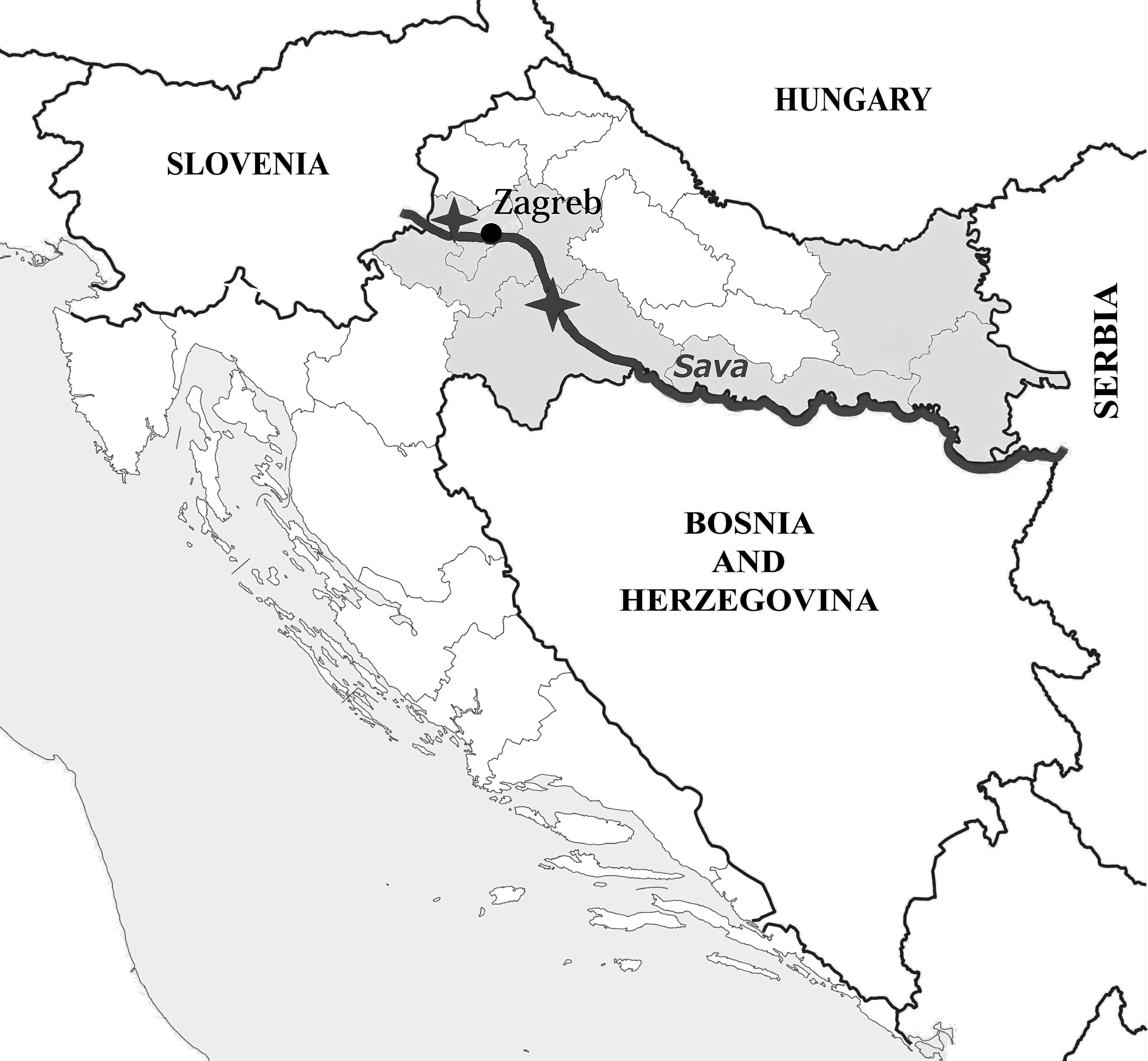
Map of Croatia showing the location of six Croatian counties (shadowed) that were included into the surveillance program. Geographical locations of Usutu virus–seropositive horses are marked with stars.
Only one human sample (0.3%) from a patient residing in the Osijek Region, eastern Croatia, was reactive to both USUV and WNV antibodies in ELISA test (178 RU/mL and 212 RU/mL, respectively). In a confirmatory test, a low titer (5) of neutralizing WNV IgG antibodies was detected.
Discussion
Two USUV-seropositive horses out of 1380 (seroprevalence 0.14%) were found in two distant locations in the northern part of Croatia, located in the Sava River Basin. Because only WNV ELISA-reactive samples were tested for USUV, it is possible that seroprevalence is in fact higher. The first positive horse was found in the area of Lonjsko polje Nature Park, a large protected wetland of the Sava River and an important habitat of many different bird species. This is in accordance with recently published data that demonstrated USUV infection in the wild bird population in wetlands (Savini et al. 2011). The second positive horse was found in the urban region of the Croatian capital of Zagreb. In Europe, most cases of USUV infection in birds were reported from urban areas (Weissenböck et al. 2002, Bakonyi et al. 2007, Manarolla et al. 2010, Steinmetz et al. 2011). Despite low titers of USUV-neutralizing antibodies in seropositive horses, there was no cross-reactivity with other flaviviruses, which contributes to the laboratory diagnosis of USUV infection. The possible explanation for the low titers of USUV antibodies is that the animals were infected with USUV a long time before the sampling. In addition, the multiplication of USUV in horses is poorly supported because horses are not susceptible to USUV and do not develop a strong immune response with high antibody titers (Savini et al. 2011).
There is only one recently published study on the seroprevalence of USUV in humans, conducted in northeastern Italy among 359 blood donors, which reported four IgG-positive samples (Gaibani et al. 2012). Our study showed no positive results for USUV, while one sample was positive for WNV. A recently published Croatian study has shown the presence of WNV antibodies in 3.43% horses and 0.11% cattle sera. The highest seroprevalence was found in eastern Croatia, in the same region where a WNV IgG-positive human sample was detected (Barbić et al. 2012).
In conclusion, the exposure to USUV was documented for the first time in two horses in Croatia. Seropositive horses were found in the Sava River Basin without reported mortality in birds. Distance of positive animal locations indicates the presence of USUV in northern Croatia. Further studies on a larger group of animals and humans are needed to confirm this observation.
Footnotes
Acknowledgments
Funding for this project was provided by the Ministry of Agriculture, Fisheries and Rural Development of the Republic of Croatia. The authors thank all the laboratory personnel in Croatia and Italy for their help during the study.
Author Disclosure Statement
No competing financial interests exist.